 Orvus
OrvusWhen to Automate Data Annotation and When to Keep It Manual
May 7, 2026
The choice between manual and automated annotation is not binary. Most production systems use hybrid approaches that combine machine efficiency with human judgment. Understanding when to automate data annotation and when to keep work manual requires evaluating specific project characteristics: dataset volume, task complexity, accuracy requirements, budget constraints, and available expertise. Making the right choice prevents both premature automation that wastes setup costs and inefficient manual work that burns through budgets.
This framework maps project characteristics to optimal annotation approaches. It provides decision criteria, cost thresholds, and implementation guidance based on current industry practice. The goal is to help operators make informed annotation decisions that balance speed, cost, and quality for their specific circumstances.
What Data Annotation Automation Actually Means in 2026
Automated annotation is not a binary switch. The term describes a spectrum of approaches where machine learning models assist, accelerate, or partially replace human labeling work. At one end sits fully manual annotation, where humans label every data point from scratch. At the other end sits fully automated systems, where models generate labels without human review. In practice, neither extreme dominates production environments.
Most organizations operate somewhere in the middle. Pre-labeling systems use trained models to suggest initial labels, which humans then verify or correct. Active learning loops identify uncertain predictions and route them to human reviewers, letting the model handle confident cases automatically. Model-assisted review workflows present human annotators with draft labels, reducing the cognitive load and time required per sample. These hybrid approaches have become the industry standard because they balance efficiency with quality control.

The myth of pure automation persists because it sounds simpler. In reality, even highly automated systems require human oversight. Models drift as data distributions change. Edge cases emerge that training data never covered. Systematic biases creep into predictions when corner cases accumulate. Quality assurance remains a human responsibility, even when machines handle the bulk of labeling work. Understanding this reality prevents disappointment and helps operators set realistic expectations for what automation can deliver.
When operators talk about choosing to automate data annotation, they are really choosing how much of the labeling workflow to delegate to models versus keeping under direct human control. The decision hinges on specific project characteristics, not abstract preferences. Volume, complexity, accuracy requirements, budget, and available expertise all factor into the calculation. The goal is not to eliminate humans entirely but to allocate their time where judgment and domain knowledge matter most.
The Core Decision Variables That Actually Matter
Five variables determine whether automation makes sense for a given annotation project. Dataset volume and growth trajectory come first. Small datasets under 50,000 samples rarely justify the setup cost of training and integrating automated systems. The per-unit savings do not offset the initial investment in model development, infrastructure, and workflow integration. For one-time projects, manual annotation often costs less and delivers results faster. Ongoing projects with continuous data inflow change the calculation. When new samples arrive weekly or monthly, automation setup costs amortize across a growing dataset, making the investment worthwhile.
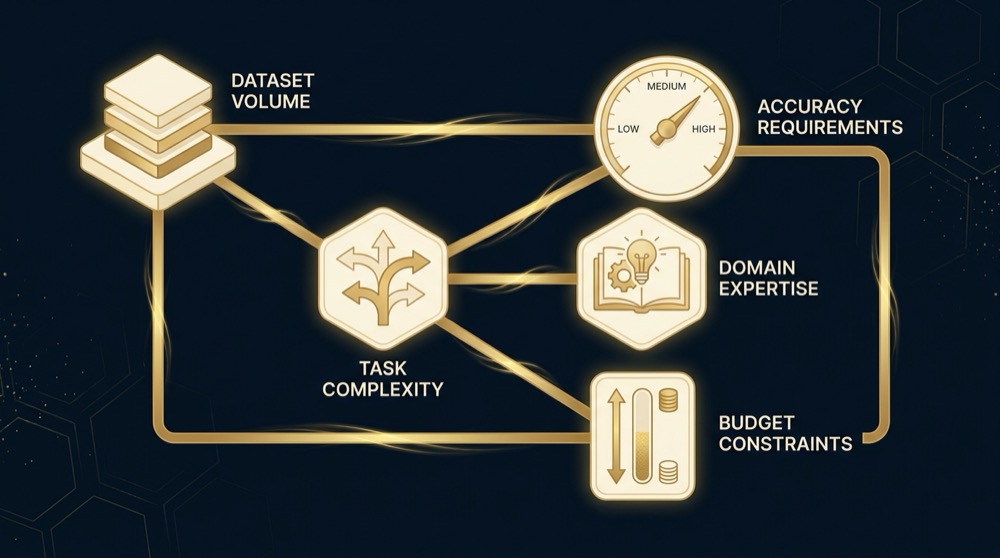
Task complexity and ambiguity level matter just as much. Binary classifications like yes/no decisions or simple bounding box tasks suit automation well. The labeling schema is clear, the decision space is constrained, and models can learn patterns quickly. Multi-label scenarios where a single sample receives several tags introduce ambiguity. Semantic segmentation requiring pixel-level precision demands more sophisticated models and higher quality training data. Subjective assessments like sentiment analysis or content moderation involve contextual judgment that models struggle to replicate consistently. As task complexity rises, the accuracy gap between automated and manual annotation widens.
Accuracy requirements and error cost form the third variable. Some applications tolerate mistakes. A recommendation system that occasionally mislabels user preferences causes minor inconvenience. Medical imaging analysis where a missed tumor leads to delayed treatment carries catastrophic cost. Legal document classification where mislabeling exposes a client to liability risk cannot accept automation errors. High-stakes domains demand near-perfect accuracy, which automation alone cannot guarantee. Even when models achieve 95% accuracy in controlled tests, the remaining 5% error rate may be unacceptable depending on what those errors represent.
Budget constraints and timeline pressure create practical limits. Initial automation setup costs range from $15,000 to $150,000 depending on task complexity, required model sophistication, and integration needs. Small teams without dedicated ML engineers face higher costs because they must contract expertise or purchase managed platforms. Timeline pressure cuts both ways. Automation can accelerate labeling once operational, but the setup phase takes weeks or months. Projects needing labeled data immediately have no choice but manual annotation. Projects with flexible timelines can invest in automation that pays off over subsequent batches.
Available domain expertise rounds out the decision framework. Some annotation tasks require specialized knowledge that models cannot replicate. Radiologists interpreting medical scans, lawyers reviewing contracts, or cultural experts assessing sentiment in multilingual content bring expertise that years of training data cannot replace. When domain knowledge is scarce or expensive, automation becomes attractive for routine cases, reserving expert time for ambiguous samples. When expertise is readily available and affordable, manual annotation may be faster and more reliable than training models to approximate that expertise.
Decide What to Automate
These five variables interact in complex ways. A high-volume project with simple tasks and moderate accuracy requirements might favor automation, but tight budgets or missing expertise could shift the decision toward manual work. A low-volume project with complex tasks normally suggests manual annotation, but ongoing data inflow and available ML resources might justify hybrid approaches. The framework provides structure, but but each project requires individual assessment based on its specific combination of constraints and requirements.
When Automation Delivers Clear ROI
Automation makes economic sense when dataset volume exceeds 100,000 samples and the labeling task follows repetitive patterns. At this scale, the per-unit cost savings from automated labeling outweigh setup and maintenance expenses. Organizations report 70-85% cost reductions compared to fully manual approaches once systems reach steady state operation. The math is straightforward: if manual annotation costs $0.50 per sample and automation reduces that to $0.10, the savings on 100,000 samples total $40,000, easily covering typical setup costs.
Well-defined labeling schemas with low ambiguity create ideal conditions for automation. Object detection in standardized images exemplifies this scenario. Bounding boxes around cars, pedestrians, or traffic signs in street-view imagery follow clear rules. The objects have consistent visual features. The decision criteria are objective. Models trained on thousands of examples learn to replicate human annotations with high accuracy. Named entity recognition in structured text presents similar characteristics. Identifying person names, organizations, dates, and locations in news articles or business documents involves pattern matching that models handle reliably.
Calculate the break-even point by comparing setup costs to per-unit savings. If automation setup costs $30,000 and reduces per-unit annotation cost from $0.50 to $0.10, you save $0.40 per sample. Dividing $30,000 by $0.40 gives a break-even point of 75,000 samples. For one-time projects, this calculation is straightforward. For ongoing projects with continuous data inflow, factor in the total samples you expect to label over six to twelve months. If that total exceeds your break-even point and the task has low to medium complexity, automation likely delivers positive ROI. If volume falls short or the task requires extensive domain expertise, manual or hybrid approaches are more economical.
Tasks where speed matters more than perfection also favor automation. Real-time content moderation systems that filter user-generated content cannot wait for human review of every post. Automated models flag potentially problematic content instantly, with human moderators handling only flagged items or reviewing samples for quality assurance. Search engines labeling billions of web pages for relevance cannot rely on manual annotation. Models trained on user behavior and editorial judgments generate labels at scale, accepting that some percentage will be imperfect but prioritizing coverage over precision.
Scenarios with ongoing annotation needs justify automation investments that one-time projects cannot. A company building a visual search product needs continuous labeling as new product images arrive daily. An autonomous vehicle company annotates sensor data from every test drive, accumulating millions of samples over months. A customer service platform labels support tickets to train routing models, with new tickets generating fresh training data indefinitely. In these cases, automation setup costs amortize across an expanding dataset, and models improve continuously as more labeled data accumulates.
When Manual Annotation Is Still the Right Call
Tasks requiring contextual judgment and domain expertise resist automation. Medical imaging analysis demands that radiologists interpret scans in light of patient history, symptoms, and clinical context. A model might identify a shadow on a lung X-ray, but determining whether it represents cancer, infection, scar tissue, or imaging artifact requires medical training and experience. Legal document analysis involves understanding contractual language, regulatory requirements, and case-specific implications that models trained on general text cannot grasp. Sentiment analysis with cultural nuances depends on recognizing idioms, sarcasm, regional dialects, and social context that vary across communities and evolve over time.
Edge cases and rare events expose automation limitations. Models learn from patterns in training data, which means they perform best on common scenarios and struggle with outliers. A fraud detection system trained on typical transaction patterns may miss novel fraud schemes. An image classifier trained on standard object categories fails when encountering unusual object combinations or viewing angles. Manual annotators handle edge cases by applying reasoning and common sense, recognizing that an unusual sample still fits established categories or requires a new label. Automation either forces edge cases into existing categories incorrectly or flags them as uncertain, requiring human review anyway.
High-stakes domains where errors are costly cannot accept automation accuracy levels. Even models achieving 95% accuracy in controlled tests produce thousands of errors across large datasets. In medical diagnosis, legal compliance, financial auditing, or safety-critical systems, those errors carry consequences that outweigh efficiency gains. A cost-benefit analysis in these domains shows that the expense of manual annotation is lower than the expected cost of automation errors multiplied by their impact. Manual annotation becomes not just preferable but necessary to meet regulatory requirements and professional standards.
Small datasets under 50,000 samples rarely justify automation investment. The setup costs for training models, integrating tools, and establishing quality assurance workflows exceed the savings from reduced per-unit labeling costs. A project with 10,000 samples might cost $5,000 to annotate manually at $0.50 per sample. Automating the same project could require $20,000 in setup costs even if per-unit costs drop to $0.10, resulting in total costs of $21,000. The math only works if the dataset will grow significantly or if the same automation system will be reused across multiple projects. For one-time efforts with limited scope, manual annotation is faster and cheaper.
One-time projects without reuse potential face similar constraints. If a company needs labeled data for a single product launch, research study, or compliance audit, the automation infrastructure built for that project has no future value. Manual annotation delivers results without requiring investment in systems that will sit idle afterward. Ongoing projects that will generate similar annotation needs over months or years can justify automation because the infrastructure will be used repeatedly. The distinction between one-time and ongoing needs is critical to the ROI calculation.
The Hybrid Workflow That Most Operators Should Use
Pre-labeling with automated models forms the foundation of hybrid workflows. A trained model processes unlabeled data and generates draft labels. These predictions are not final but serve as starting points for human reviewers. Instead of labeling from scratch, annotators verify, correct, or approve the model suggestions. This approach reduces the cognitive load and time required per sample. Studies show 60-70% time savings compared to fully manual annotation while maintaining quality thresholds.
Human review and correction layer adds the quality control that pure automation lacks. Annotators examine pre-labeled samples, identify errors, and make corrections. The review process is faster than original labeling because the model handles straightforward cases correctly, leaving humans to focus on ambiguous or incorrect predictions. Quality improves because human judgment catches systematic errors, edge cases, and context-dependent nuances that models miss. Organizations implementing this workflow report maintaining accuracy above 98% while processing data far faster than manual-only approaches.
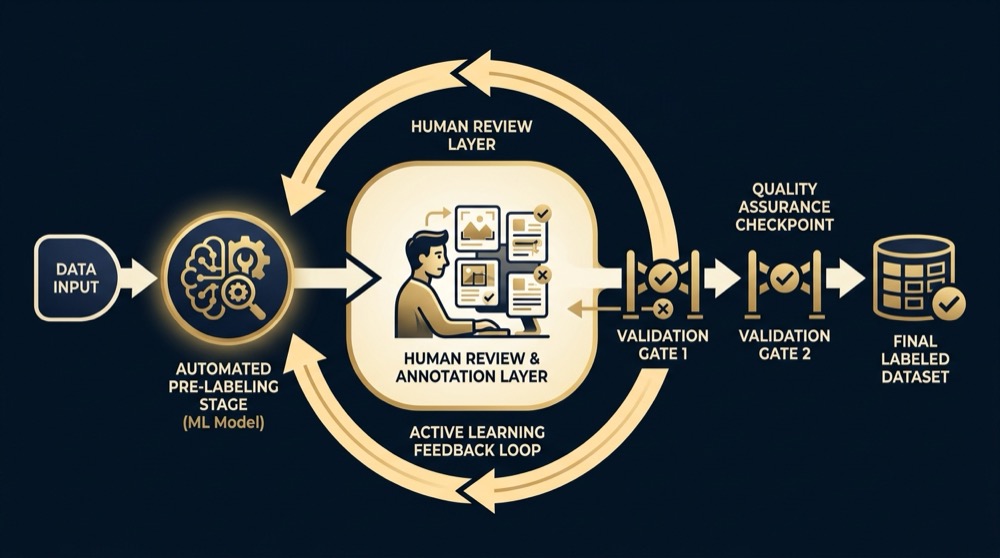
Active learning to improve model performance closes the loop between annotation and model training. As humans correct pre-labeled samples, those corrections become new training data. The model retrains periodically, learning from its mistakes and improving prediction accuracy. Active learning algorithms identify samples where the model is least confident and prioritize those for human review. This targeted approach ensures that human effort focuses on cases where it adds the most value, while the model handles confident predictions automatically. Over time, the model improves and the percentage of samples requiring human review decreases.
Quality assurance sampling protocols ensure that automation errors do not accumulate undetected. Even in hybrid workflows, a percentage of samples must undergo independent human validation to detect model drift and systematic biases. Industry practice suggests validating 10-15% of automated annotations through random sampling or targeted review of high-risk categories. This validation catches problems early, before they propagate through large datasets. Operators building ML products with limited resources benefit from structured approaches to quality assurance that balance thoroughness with efficiency, ensuring that hybrid workflows deliver both speed and reliability.

Implementing a hybrid workflow requires several steps. First, create a small manually labeled dataset to train the initial pre-labeling model. Second, deploy the model to generate draft labels on new data. Third, route pre-labeled samples to human reviewers for verification and correction. Fourth, collect corrections and retrain the model periodically. Fifth, implement quality assurance sampling to monitor accuracy over time. Sixth, adjust the percentage of samples requiring human review based on model confidence and observed error rates. This iterative process balances automation efficiency with human quality control, adapting as the model improves and the dataset evolves.
Common Mistakes That Waste Time and Money
Automating before you have clean training data guarantees poor results. Models learn from the data they are trained on. If initial training data contains errors, inconsistencies, or biases, the model replicates and amplifies those problems. A common mistake is rushing to automate using whatever labeled data exists, even when that data was created hastily or without clear guidelines. The resulting model produces low-quality predictions that require extensive human correction, negating the efficiency gains automation promised. The correct sequence is to manually label a clean, representative sample first, establish clear labeling guidelines, and only then train automation models.
Skipping quality assurance on automated labels allows errors to compound silently. Models make mistakes, and those mistakes are not always obvious. Systematic biases emerge when the model consistently mislabels certain categories or edge cases. Model drift occurs as data distributions change over time, causing accuracy to degrade gradually. Without regular quality checks, these problems go undetected until they have corrupted large portions of the dataset. Organizations that skip QA discover the problem only when downstream model training fails or production systems behave unexpectedly. By then, fixing the corrupted labels costs more than proper quality assurance would have.
Underestimating setup and integration costs leads to budget overruns and abandoned projects. Automation is not as simple as purchasing a tool and pressing start. Models must be trained on domain-specific data. Annotation platforms must integrate with existing data pipelines. Workflows must be redesigned to accommodate human review of automated predictions. Staff must be trained on new tools and processes. These activities take time and require expertise. A realistic budget for automation setup ranges from $15,000 to $150,000 depending on complexity. Teams that budget only for software licenses find themselves unable to complete implementation.
Validate that your annotation workflow includes essential quality assurance steps before scaling automation
Check all items before committing to automated annotation at scale.
Ignoring model drift and systematic errors allows quality to degrade over time. Models trained on data from one time period or context may perform poorly as conditions change. An image classifier trained on summer photos may struggle with winter scenes. A text classifier trained on formal writing may fail on casual social media posts. Systematic errors occur when the model consistently mishandles specific categories, often because those categories were underrepresented in training data. Without monitoring, these problems persist and worsen. Effective automation requires ongoing vigilance, periodic retraining, and mechanisms to detect when model performance degrades.
Choosing tools based on features instead of fit creates mismatches between capabilities and needs. Annotation platforms offer impressive feature lists, but not every feature matters for every project. A small team with straightforward labeling tasks does not need enterprise-scale collaboration tools, complex workflow orchestration, or advanced active learning algorithms. Conversely, a large organization with diverse annotation needs cannot rely on simple tools lacking integration capabilities or quality controls. The right tool fits the specific task complexity, team size, budget, and technical infrastructure. Evaluating tools based on marketing materials rather than actual project requirements leads to expensive purchases that do not solve the real problem.
A Simple Decision Tree for Your Next Project
Start with volume and complexity assessment. Count the samples requiring labels and estimate growth over the next six months. Classify the task complexity as low (binary choices, simple bounding boxes), medium (multi-label, standard semantic segmentation), or high (subjective judgment, domain expertise required). If volume is under 50,000 samples and complexity is medium or high, manual annotation is likely the right choice. If volume exceeds 100,000 samples and complexity is low, automation becomes attractive. For scenarios in between, hybrid workflows offer the best balance.
Factor in budget and timeline constraints. Calculate available budget for both setup and ongoing annotation costs. Determine how quickly labeled data is needed. If budget is limited and timeline is tight, manual annotation provides the fastest path to results. If budget allows for setup investment and timeline permits a few weeks of preparation, automation or hybrid approaches become feasible. Remember that automation setup costs range from $15,000 to $150,000, so budget must accommodate both initial investment and ongoing operational expenses.
Evaluate available expertise and tools. Assess whether your team includes ML engineers capable of training and maintaining annotation models. Determine if domain experts are available for quality assurance and handling edge cases. Research annotation platforms and tools that fit your task type and budget. If expertise is limited and tools are unfamiliar, starting with manual annotation or managed hybrid services reduces risk. If expertise exists and appropriate tools are accessible, automation becomes more practical. The decision depends not just on what is theoretically possible but on what your team can actually implement and maintain.
Choose your approach and plan quality checks. Based on volume, complexity, budget, timeline, and expertise, select manual, automated, or hybrid annotation. Regardless of the choice, design quality assurance into the workflow from the start. For manual annotation, implement inter-annotator agreement checks and periodic audits. For automated annotation, plan human validation of at least 10-15% of samples. For hybrid workflows, establish clear criteria for when samples require human review and how corrections feed back into model training. Quality assurance is not optional; it is the mechanism that ensures annotation decisions deliver the accuracy your project requires.
Revisit the decision as the project evolves. Annotation needs change as datasets grow, task definitions clarify, and team capabilities develop. A project that starts with manual annotation may justify automation once volume crosses 100,000 samples. A project that begins with automation may require more manual intervention if accuracy falls below thresholds or edge cases proliferate. Treat the annotation approach as a strategic choice that can be adjusted based on results, not a permanent commitment. Monitoring costs, accuracy, and throughput provides the data needed to make informed adjustments.
What to Do Right Now
Audit your current annotation process. Document how labels are currently created, who performs the work, how long each sample takes, and what quality checks exist. Calculate total time and cost per labeled sample. Identify bottlenecks where work slows down or errors accumulate. Assess whether current quality meets project requirements or if improvements are needed. This audit establishes a baseline for evaluating whether changes to the annotation approach would deliver meaningful improvements.
Calculate your actual per-label costs. Include direct labor costs for annotators, overhead for management and quality assurance, and any platform or tool expenses. Divide total costs by the number of labeled samples to get per-unit cost. Compare this figure to industry benchmarks and to the cost projections for automated or hybrid approaches. If current costs are reasonable and quality is high, changes may not be necessary. If costs are high or quality is inconsistent, exploring automation or hybrid workflows makes sense.
Test automation on a small batch before committing. Select 1,000 to 5,000 representative samples and run a pilot test. Train a simple pre-labeling model or use a managed annotation platform with automation features. Measure the time savings, accuracy, and error types that result. Calculate the actual cost including setup time and any platform fees. Compare pilot results to manual annotation on the same samples. This test provides real data about whether automation will work for your specific task and dataset, removing guesswork from the decision.
Build quality checks into your workflow from day one. Whether you choose manual, automated, or hybrid annotation, establish quality assurance protocols before labeling begins. Define inter-annotator agreement targets for manual work. Set human validation sampling rates for automated work. Create feedback loops so annotators learn from errors and models retrain on corrections. Schedule periodic audits to catch systematic problems early. Quality assurance is easier to implement at the start than to retrofit after problems emerge. Treating it as foundational rather than optional ensures that annotation decisions deliver the accuracy your project depends on, much like implementing proper analytics tracking from the beginning of any digital project.
Initial automation setup costs range from $15,000 to $150,000 depending on task complexity, required model sophistication, and integration needs. Small teams without dedicated ML engineers face higher costs because they must contract expertise or purchase managed platforms. For datasets under 50,000 samples, these setup costs often exceed the savings from reduced per-unit labeling costs, making manual annotation more economical. Automation becomes cost-effective when dataset volume exceeds 100,000 samples and the labeling task will be ongoing rather than one-time, allowing setup costs to amortize across growing data volumes.
Yes, transitioning to automation mid-project is feasible if you have accumulated sufficient manually labeled data to train pre-labeling models. Most hybrid workflows require at least 5,000 to 10,000 cleanly labeled samples as initial training data. The transition works best when you implement it gradually: start by using models to pre-label new samples while humans verify and correct predictions, then expand automation as model accuracy improves. Maintain quality by validating 10-15% of automated annotations through human review and monitoring for model drift. The key is treating automation as an enhancement to your existing process rather than a complete replacement, preserving quality assurance protocols throughout the transition.
Industry best practice suggests validating 10-15% of automated annotations through human review to detect model drift and maintain accuracy above 98%. This validation should include both random sampling across all categories and targeted review of high-risk or ambiguous cases where models are less confident. The exact percentage depends on task complexity and error cost: high-stakes domains like medical imaging or legal document analysis may require 20-25% validation, while straightforward tasks like bounding box detection in standardized images may need only 5-10%. Monitor validation results over time and adjust the sampling rate based on observed error rates and model confidence scores.
The framework presented here provides structure for making annotation decisions, but each project requires individual assessment. Volume, complexity, accuracy, budget, and expertise interact in ways specific to your situation. Use the decision variables as a checklist, test approaches on small batches before committing, and build quality assurance into your workflow from the start. These practices ensure that annotation decisions deliver the efficiency and accuracy your ML project depends on.
References
Want this kind of work done for your business?
We build and run AI-powered marketing and automation. 15 minutes, honest assessment.
Book a call