 Orvus
OrvusWhen to Automate Lead Qualification: Manual vs Automated Scoring
June 12, 2026
The decision centers on measurable thresholds rather than aspirational best practices. Lead volume, data maturity, deal complexity, sales cycle length, and team size interact to determine whether automation delivers positive ROI or simply adds technical overhead to a process that worked adequately without it. Below certain thresholds, manual qualification remains faster to implement, cheaper to operate, and more adaptable to changing conditions than building automated infrastructure. Above those thresholds, manual processes consume unsustainable time regardless of optimization efforts.
This framework treats automation as one option among several, including refined manual processes and hybrid models that combine automated screening with human review. The goal is helping you determine which approach fits your current operational reality, not convincing you that automation represents progress.
What Lead Qualification Automation Actually Means
Lead qualification automation refers to software systems that evaluate and score incoming leads based on predefined criteria, replacing or supplementing human judgment in determining which prospects warrant immediate sales attention. The distinction matters because many teams conflate automation with improvement, when the two operate independently.
Manual qualification: the baseline process
Manual lead qualification means a human reviews each incoming lead, evaluates fit against sales criteria, and assigns priority based on judgment and experience. The process typically involves checking company size, budget signals, decision-making authority, timeline indicators, and engagement behavior. A sales representative or operator examines CRM records, website activity, form responses, and any available context to determine whether the lead merits immediate outreach, nurturing, or disqualification. This approach scales linearly with lead volume, consuming roughly 5 to 15 minutes per lead depending on complexity and available data. The primary advantage lies in contextual judgment, particularly for complex sales where relationship nuances, industry-specific factors, or unusual buying patterns require interpretation beyond simple scoring rules.
Automated scoring: what changes operationally
Automated lead scoring systems apply algorithms to incoming leads, assigning numerical scores based on demographic attributes, firmographic data, and behavioral signals tracked in CRM systems. The software evaluates factors like company revenue, employee count, job title, email engagement, website visits, content downloads, and form completions without human intervention. Leads exceeding a predetermined score threshold route directly to sales queues, while lower-scoring leads enter nurture sequences or disqualification workflows. The operational change centers on speed and capacity rather than accuracy. Automation handles hundreds of leads in seconds, but it evaluates only what the model was trained to recognize. Unusual buying patterns, emerging market signals, or relationship context outside the scoring parameters remain invisible to the system.
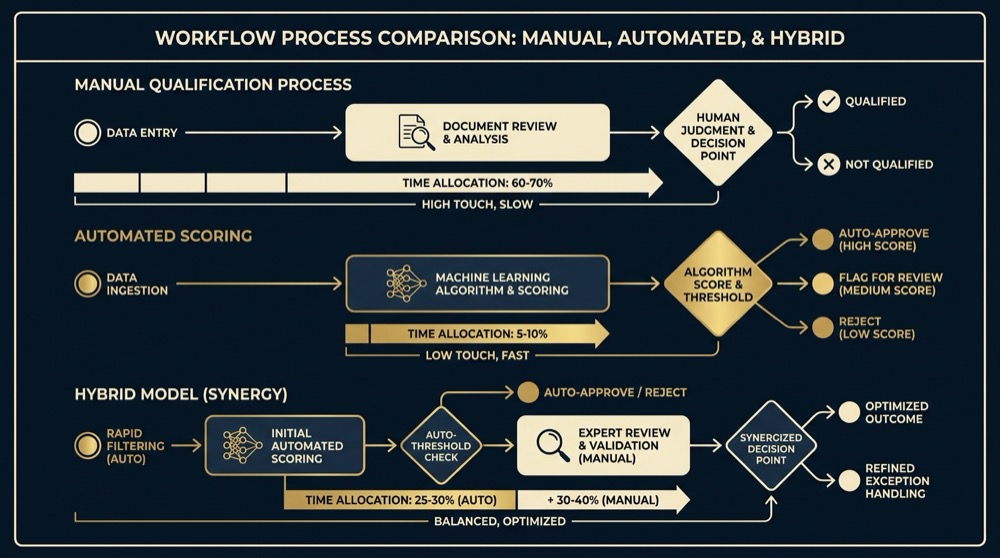
The hybrid middle ground most teams actually use combines automation for initial filtering and manual review for final decisions on high-value opportunities. The system scores all incoming leads automatically, routing obvious poor fits to disqualification and clear strong fits to immediate sales attention. Leads falling in the middle range, typically 40% to 60% of total volume, receive human review before final disposition. This approach preserves judgment capacity for ambiguous cases while eliminating manual work on obvious decisions.
The hybrid middle ground most teams actually use
Hybrid qualification models use automation for initial filtering and manual review for final decisions on high-value opportunities. The system scores all incoming leads automatically, routing obvious poor fits to disqualification and clear strong fits to immediate sales attention. Leads falling in the middle range, typically 40% to 60% of total volume, receive human review before final disposition. This approach preserves judgment capacity for ambiguous cases while eliminating manual work on obvious decisions. Most lead scoring models in practice operate as hybrid systems rather than pure automation, though vendors rarely describe them this way. The hybrid structure acknowledges that automation excels at pattern recognition within known parameters but struggles with edge cases, new market conditions, and relationship-dependent factors that manual qualification handles naturally.
The Volume Threshold: When Lead Count Forces the Decision
Lead volume creates the primary forcing function for automation decisions. Below certain thresholds, manual processes remain faster to implement and cheaper to operate than building automated infrastructure. Above those thresholds, manual qualification consumes unsustainable time regardless of how efficient the process becomes.

The 100-lead monthly benchmark and why it matters
Organizations processing fewer than 100 leads monthly typically achieve better results with manual qualification than with automation investment. The threshold derives from time allocation mathematics rather than arbitrary convention. At 10 minutes per lead, 100 monthly leads require roughly 17 hours of qualification work, approximately 10% of a full-time role. Below this volume, automation setup costs, model training time, and ongoing maintenance typically exceed the efficiency gained. The benchmark shifts based on lead complexity and sales cycle length, but 100 monthly leads represents the point where automation begins delivering measurable time savings for standard B2B qualification processes. Teams handling 50 leads monthly gain little from automation because the 8 to 9 hours spent on manual work remains manageable within existing roles. The decision calculus changes sharply between 100 and 200 monthly leads, where manual qualification begins consuming 20% to 40% of available sales time.
The 20% rule for manual work
When manual qualification consumes more than 20% of total sales capacity, automation or process redesign becomes necessary regardless of absolute lead count. A three-person sales team spending 20% of their time on qualification loses the equivalent of one full-time role to administrative work rather than revenue-generating activity. This threshold applies whether the team handles 100 leads or 500, because the constraint centers on opportunity cost rather than volume alone. Teams below the 20% threshold should focus on improving qualification criteria and data capture before considering automation. Teams above 20% face a capacity problem that process optimization alone cannot solve. The 20% benchmark also accounts for the reality that qualification work expands to fill available time when no forcing function exists. Without clear time allocation limits, sales teams often over-invest in marginal qualification decisions that deliver minimal improvement in conversion rates.
How to calculate your actual qualification time
Track qualification time for two weeks across all team members involved in lead evaluation. Record time spent reviewing lead information, researching companies, evaluating fit, documenting decisions, and updating CRM records. Exclude time spent on actual sales conversations, proposal work, or relationship building. Divide total qualification hours by total leads processed to determine per-lead time investment. Multiply by average monthly lead volume to calculate total monthly qualification burden. Compare this figure to total available sales hours to determine percentage allocation. Most teams underestimate qualification time by 30% to 50% because the work occurs in small increments throughout the day rather than dedicated blocks. Time tracking reveals the actual cost, which often surprises operators who assumed their process was efficient. If your calculation shows qualification consuming less than 10% of sales time, automation likely costs more than it saves. If the figure exceeds 20%, you have reached the threshold where when to automate lead qualification becomes an immediate operational question rather than a future consideration.
Track Your Real Qualification Cost
Tracking qualification time sounds simple but most teams struggle to capture the scattered 5-minute increments spent reviewing leads throughout the day. A basic time-tracking template that prompts logging at natural workflow breaks, such as after each batch of lead reviews or at the end of each day, reveals the actual burden. The data typically shows qualification consuming 40% to 60% more time than initial estimates suggest, which changes the automation decision calculus significantly.
When Manual Qualification Outperforms Automation
Automation optimizes for speed and volume, but certain sales contexts reward judgment and relationship nuance more than processing capacity. These scenarios favor manual qualification regardless of lead count or available technology.
Complex B2B sales: the $50K deal value line
Sales processes with average deal values exceeding $50,000 typically involve multiple stakeholders, custom solutions, relationship-dependent decisions, and qualification criteria that shift based on organizational context. Automated scoring models struggle in these environments because the factors determining fit often lie outside standard demographic and behavioral data. A lead from a 200-person company in manufacturing might represent a poor fit if their buying committee favors incumbent vendors, while a 50-person company in the same industry could be ideal if they are actively replacing legacy systems. Manual qualification captures these distinctions through research and conversation that automated systems cannot replicate. The $50,000 threshold marks the point where the cost of a single misqualified lead, either pursuing poor fits or dismissing strong prospects, exceeds the efficiency gained from automation. High-value B2B sales require understanding organizational dynamics, political considerations, timing factors, and competitive positioning that emerge through human interaction rather than data patterns.
Long sales cycles and relationship-dependent decisions
Sales cycles extending beyond 90 days involve evolving qualification criteria as prospects move through evaluation stages, budget cycles, and internal approval processes. What qualifies a lead as strong in month one often differs from qualification criteria in month four after initial discovery reveals implementation complexity or stakeholder concerns. Automated scoring assigns static values to attributes and behaviors, but long-cycle sales require dynamic reassessment as new information emerges. A lead demonstrating strong early engagement might stall due to budget timing, only to re-engage six months later with different stakeholders and revised requirements. Manual qualification adapts to these shifts naturally, while automated systems either miss the context entirely or require constant model retraining to reflect changing conditions. Relationship-dependent sales, where trust and advisor positioning matter more than product features or pricing, similarly favor manual approaches. The qualification question in these contexts centers on whether the prospect values the relationship dynamic your team provides, which behavioral scoring cannot measure reliably.
Small team dynamics under five representatives
Sales teams with fewer than five representatives typically lack the lead volume, data infrastructure, and specialized roles needed to justify automation investment. A three-person team handling 150 monthly leads can manage manual qualification within existing workflows without dedicated operations support. The setup costs for automated scoring, including CRM configuration, model development, testing, and ongoing maintenance, often exceed $15,000 to $25,000 in the first year when accounting for software, implementation services, and internal time investment. Small teams achieve better returns investing that budget in additional sales capacity, better data capture processes, or improved qualification training. The ROI calculation shifts dramatically at five or more representatives, where coordination overhead, inconsistent qualification standards, and capacity constraints create clear automation value. Below that threshold, manual processes remain faster to adjust, easier to optimize, and less expensive to operate than building automated infrastructure that the team may outgrow or need to replace as the business scales.
Data Requirements: The 12-Month Minimum for Effective Automation
Automated lead scoring models require historical data to identify patterns correlating with successful conversions. Without sufficient training data, the models produce arbitrary scores that reflect assumptions rather than actual performance.
Why automated scoring needs historical CRM data
Lead scoring algorithms identify which attributes and behaviors predict conversion by analyzing past leads that became customers versus those that did not. The system needs hundreds of completed lead cycles, from initial contact through closed-won or closed-lost outcomes, to distinguish signal from noise. A model trained on 50 leads might identify patterns, but those patterns likely reflect coincidence rather than reliable predictors. Organizations with 12 months of clean CRM data typically have 200 to 500 completed lead cycles, enough volume for algorithms to detect meaningful correlations between lead attributes and conversion outcomes. The time requirement matters as much as the volume because seasonal patterns, market shifts, and product evolution affect which factors predict success. Six months of data might miss quarterly budget cycles, annual planning periods, or industry-specific timing factors that influence conversion rates. Twelve months captures full-cycle patterns, reducing the risk of training models on incomplete or seasonally skewed data.
What counts as clean, usable qualification data
Clean CRM data means complete records with consistent field population, accurate outcome tracking, and reliable behavioral logging across the full lead lifecycle. Each record must include demographic information like company size, industry, and job title; engagement data such as email opens, website visits, and content downloads; and definitive outcomes marking whether the lead converted, disqualified, or remains in process. Inconsistent data entry, missing fields, incomplete outcome tracking, or gaps in behavioral logging render historical data unusable for model training regardless of volume. A CRM with 1,000 leads but only 40% field completion rates provides less training value than 300 leads with 95% complete records. Data quality also requires consistent definitions over time. If your team changed lead status definitions, qualification criteria, or data capture processes during the historical period, the data reflects multiple systems rather than a single coherent pattern. Most organizations overestimate their data quality by focusing on record count rather than field completeness and consistency. Audit your CRM by sampling 50 random closed leads and checking whether you can answer basic questions: company size, industry, initial source, engagement level, disqualification reason or win factors, and timeline from first contact to final outcome. If more than 20% of sampled records lack clear answers, your data likely needs cleanup before supporting automation.
New sales operations or businesses launching new products lack the historical data needed to train effective scoring models, creating a cold start problem where automation cannot deliver value until sufficient data accumulates. The standard solution involves running manual qualification while systematically capturing data in structured CRM fields, building the dataset needed for future automation. This approach requires 12 to 18 months of disciplined data collection before automation becomes viable, which frustrates teams seeking immediate efficiency gains.

The cold start problem for new operations
New sales operations or businesses launching new products lack the historical data needed to train effective scoring models, creating a cold start problem where automation cannot deliver value until sufficient data accumulates. The standard solution involves running manual qualification while systematically capturing data in structured CRM fields, building the dataset needed for future automation. This approach requires 12 to 18 months of disciplined data collection before automation becomes viable, which frustrates teams seeking immediate efficiency gains. Attempting to automate without sufficient data produces models based on assumptions rather than evidence, often performing worse than manual qualification because the scores reflect guesses about what should matter rather than what actually predicts conversion. Some organizations try importing data from previous systems or similar products to accelerate the timeline, but this rarely works unless the sales process, target market, and qualification criteria remain nearly identical. The cold start period represents unavoidable infrastructure building, similar to establishing product-market fit or developing sales processes. Rushing automation before data maturity creates technical debt and often requires complete model rebuilds once real patterns emerge from actual performance data.
Focus on data quality remediation while implementing a manual hybrid process to manage current volume. Assign one team member to handle initial screening on obvious poor fits (bottom 30% by simple criteria like company size or industry mismatch) while another reviews ambiguous and strong leads. This reduces per-lead time investment without requiring automated scoring. Simultaneously, implement strict data entry standards for all new leads, capturing complete information in standardized CRM fields. Audit and clean historical records in batches, prioritizing the most recent 6 to 12 months. This approach manages immediate capacity constraints while building toward automation readiness, typically requiring 6 to 9 months before data quality supports reliable model training. The manual hybrid process also tests workflow logic you will eventually automate, making the transition smoother when data maturity allows.
The Hybrid Model: Automated Screening Plus Manual Review
Hybrid qualification combines automated initial scoring with human review for leads meeting specific criteria, preserving judgment capacity while eliminating manual work on obvious decisions.
How hybrid qualification actually works operationally
The system scores all incoming leads automatically based on demographic, firmographic, and behavioral data. Leads scoring below a lower threshold, typically the bottom 30% to 40%, route to automatic disqualification or low-priority nurture sequences without human review. Leads scoring above an upper threshold, usually the top 20% to 30%, route directly to sales queues for immediate outreach. Leads falling between the two thresholds receive manual review before final disposition. The reviewer examines CRM data, researches the company, evaluates fit against current sales priorities, and makes the final qualification decision. This structure reduces manual workload by 50% to 70% compared to reviewing every lead, while preserving human judgment for ambiguous cases where automated scoring lacks confidence. The operational workflow requires clear threshold definitions, documented review criteria for the middle tier, and feedback loops where manual decisions inform ongoing model refinement. Most teams set initial thresholds conservatively, routing only obvious poor fits and exceptionally strong signals to automated disposition, then gradually expand the automated range as model performance improves and team confidence grows.
The 34% conversion rate advantage explained
Research comparing hybrid models to single-method approaches found that organizations using automated screening with manual review for high-value leads achieved 34% higher conversion rates than teams using purely manual or fully automated qualification. The advantage stems from combining automation’s speed and consistency on clear-cut decisions with human judgment on complex cases. Automated scoring eliminates the inconsistency and fatigue that degrades manual qualification performance when reviewing high volumes of similar leads. Human review prevents the edge-case errors and context blindness that limit fully automated systems. The hybrid approach also allows sales teams to focus qualification effort on leads where judgment actually matters, rather than spending equal time on obvious fits, obvious misfits, and genuinely ambiguous prospects. The conversion improvement appears primarily in the middle tier of leads, where manual review identifies strong prospects that automated scoring would have undervalued due to unusual patterns or incomplete data. Fully automated systems often misclassify 15% to 25% of middle-tier leads, either routing strong prospects to nurture sequences or pushing weak fits to sales queues. Hybrid models reduce this error rate to 5% to 10% by applying human review exactly where automated confidence is lowest.
Setting the automation-to-human handoff threshold
The handoff threshold determines which leads receive manual review versus automatic disposition. Set the lower threshold by identifying the score below which historical conversion rates drop to near zero, typically leads converting at less than 2% to 3%. Set the upper threshold by identifying the score above which conversion rates exceed 40% to 50%, indicating strong fit with minimal qualification risk. The range between these points represents ambiguous leads where manual judgment adds value. Most organizations start with conservative thresholds, automating only the bottom 20% and top 10% of leads by score, then expand the automated range as they validate model performance against actual outcomes. Track conversion rates by score band monthly, adjusting thresholds when patterns shift due to market changes, product evolution, or sales process modifications. The goal is maximizing the percentage of leads handled automatically while maintaining conversion performance on manually reviewed leads. A well-tuned hybrid system typically automates 60% to 75% of total lead volume, with the remaining 25% to 40% receiving human review. Teams automating more than 80% of volume often sacrifice too much judgment value, while teams automating less than 50% fail to capture meaningful efficiency gains from the hybrid approach.
ROI Calculation: When Automation Pays for Itself
Automation investment makes financial sense when efficiency gains and conversion improvements exceed implementation and maintenance costs within a reasonable timeline.
Implementation costs vs efficiency gains
Typical lead scoring automation implementation costs range from $10,000 to $40,000 in the first year, including software licensing, CRM integration, model development, testing, and team training. Ongoing costs run $3,000 to $12,000 annually for software maintenance, model updates, and system administration. Efficiency gains come from reduced qualification time, allowing sales teams to handle higher lead volumes without additional headcount or to redirect qualification time toward revenue-generating activities. Calculate efficiency value by multiplying hours saved monthly by the fully loaded cost per hour of the roles performing qualification work. A team saving 30 hours monthly at a $75 fully loaded hourly rate generates $27,000 in annual efficiency value, covering implementation costs in 5 to 7 months if no other benefits materialize. Conversion improvements add incremental revenue value when automation or hybrid models improve close rates on qualified leads. A 10% conversion improvement on 100 monthly leads with $25,000 average deal value generates $300,000 in additional annual revenue, dwarfing implementation costs. Most ROI models focus heavily on efficiency while underweighting conversion impact, but the revenue side often determines whether automation delivers transformative value versus modest time savings.
The 3-5x ROI timeline for mature data organizations
Organizations with mature CRM data, clear qualification criteria, and lead volumes exceeding 200 monthly typically achieve 3 to 5 times ROI within six months of implementing lead scoring automation. The multiple reflects both efficiency gains and conversion improvements when models train on high-quality historical data and teams integrate automation into existing workflows effectively. A $20,000 implementation investment returning $60,000 to $100,000 in combined efficiency value and incremental revenue within six months represents the upper end of realistic performance for well-executed automation projects. These results require data maturity, volume thresholds, and process discipline that many organizations lack. Teams attempting automation without these prerequisites typically see 18 to 24-month payback periods and ROI multiples below 2x, often because they spend the first year fixing data quality issues, refining models, and adjusting processes rather than capturing value. The timeline matters as much as the multiple because extended payback periods increase the risk of market shifts, product changes, or team turnover disrupting the automation investment before it delivers returns.
Break-even analysis for small teams
Small teams face unfavorable ROI dynamics because implementation costs remain relatively fixed while efficiency gains scale with team size and lead volume. A three-person team handling 120 monthly leads might save 15 hours monthly through automation, worth roughly $13,500 annually at typical fully loaded rates. Against $15,000 to $25,000 first-year implementation costs, break-even extends to 14 to 22 months, during which the team must maintain the system and adapt to workflow changes. The calculation worsens if conversion rates remain flat or decline during implementation due to model tuning issues or process disruption. Small teams achieve better returns by investing automation budget in additional sales capacity, improved data infrastructure, or manual process optimization until lead volume crosses 200 monthly or qualification time exceeds 25% of sales capacity. At those thresholds, the efficiency gains and conversion improvements justify implementation costs even for small teams. The break-even analysis should also account for opportunity cost, comparing automation ROI against alternative investments like additional marketing spend, sales training, or CRM improvements that might deliver faster or more certain returns.
Calculate break-even timeline and ROI multiple for lead scoring automation based on team size, lead volume, and cost assumptions
Assumes $25K average deal value and 30% margin for conversion improvement revenue calculation
Decision Framework: Six Factors That Determine Your Path
The decision to automate, remain manual, or adopt a hybrid approach depends on six factors that interact to determine the optimal qualification method for your specific operation.
Lead volume and time allocation assessment
Evaluate monthly lead volume and current time investment in qualification activities. Teams processing fewer than 100 leads monthly or spending less than 15% of sales time on qualification should default to manual processes unless other factors create compelling automation need. Volume between 100 and 200 monthly leads with 15% to 25% time allocation represents the transition zone where hybrid models often deliver the best balance of efficiency and judgment. Above 200 monthly leads or 25% time allocation, automation or hybrid approaches become necessary to prevent qualification work from consuming unsustainable sales capacity. The volume threshold adjusts based on lead complexity, with simpler transactional sales supporting higher manual volumes and complex B2B sales requiring automation at lower thresholds. Time allocation matters more than absolute volume because it directly measures opportunity cost, the sales capacity lost to administrative work rather than revenue generation.
Deal complexity and sales cycle evaluation
Assess average deal value, sales cycle length, and the role of relationship factors in buying decisions. Sales processes with deal values below $25,000, cycles under 60 days, and primarily product-driven decisions favor automation because speed and volume matter more than nuanced judgment. Deal values between $25,000 and $75,000 with 60 to 120-day cycles typically benefit from hybrid models that automate initial screening while preserving manual review for qualified prospects. Above $75,000 deal values or 120-day cycles, particularly in relationship-dependent sales, manual qualification often outperforms automation regardless of lead volume. The complexity assessment should also consider whether your sales qualification criteria remain stable over time or shift based on market conditions, competitive dynamics, or product evolution. Stable criteria support automation, while frequently changing qualification standards favor manual approaches that adapt quickly without model retraining.
Data maturity and technology infrastructure check
Audit CRM data quality, historical record completeness, and existing technology capabilities. Organizations with less than 12 months of clean CRM data should focus on data infrastructure building rather than automation implementation. Even with sufficient history, data quality issues like inconsistent field population, incomplete outcome tracking, or unreliable behavioral logging prevent effective model training. Technology infrastructure assessment includes CRM capabilities, integration options with marketing automation or sales engagement platforms, and team technical capacity to implement and maintain automated systems. Teams lacking technical resources or working with limited CRM platforms may face implementation costs 50% to 100% higher than organizations with mature technology stacks and internal technical support. The infrastructure check also reveals whether your current systems can support hybrid models, which require more sophisticated routing logic and workflow automation than simple manual or fully automated approaches. For teams building foundational systems before automation becomes relevant, understanding how to structure operational systems provides the process discipline needed to capture clean data and establish consistent workflows.

Common Mistakes in the Manual-to-Automated Transition
Most automation failures stem from predictable mistakes in timing, scope, and implementation approach rather than technology limitations or poor execution.
Automating before you have sufficient data
Teams frequently attempt automation with six months or less of CRM history, producing models trained on insufficient data that generate arbitrary scores unrelated to actual conversion patterns. The resulting system appears to work because it produces numerical outputs and routes leads to different queues, but the scores reflect assumptions about what should matter rather than evidence of what actually predicts success. This mistake often goes undetected for months because teams lack the baseline metrics needed to evaluate whether automated scoring outperforms their previous manual process. The fix requires acknowledging the data gap, returning to manual qualification with disciplined data capture, and deferring automation until 12 to 18 months of clean records accumulate. Some organizations try compensating for limited data by importing records from previous systems, borrowing models from similar businesses, or using vendor-provided templates, but these approaches rarely work because lead qualification patterns are specific to your product, market, sales process, and team capabilities. The only reliable path involves building your own dataset through systematic manual qualification that captures the information automated models will eventually need.
Ignoring the hybrid option for mid-complexity sales
Many teams frame the decision as binary, choosing between pure manual qualification or full automation, which leads to poor fits at both extremes. Mid-complexity sales with deal values between $30,000 and $70,000, sales cycles from 60 to 120 days, and moderate lead volumes from 100 to 300 monthly often perform best with hybrid models, but teams skip this option because it seems like an incomplete solution rather than a deliberate strategy. The all-or-nothing thinking stems from vendor positioning that treats hybrid as a temporary transition state rather than a sustainable operating model. In practice, hybrid qualification delivers better results than either extreme for the majority of B2B sales operations, combining automation’s efficiency on clear decisions with human judgment on ambiguous cases. Recognizing hybrid as a permanent solution rather than a compromise allows teams to invest in the workflow design, threshold tuning, and feedback systems needed to optimize the approach rather than viewing it as a placeholder until full automation becomes feasible. Organizations seeking to build scalable marketing and sales systems often discover that hybrid approaches provide the best balance between automation efficiency and human judgment across multiple operational areas.
Underestimating implementation and maintenance costs
Published automation costs typically reflect software licensing only, excluding integration work, model development, testing, training, and ongoing maintenance that often double or triple total investment. A platform advertised at $500 monthly might require $8,000 in implementation services, 40 hours of internal time for setup and testing, 20 hours for team training, and 5 to 10 hours monthly for model updates and system administration. The fully loaded first-year cost reaches $18,000 to $22,000, far exceeding the $6,000 software cost that drove the initial decision. Maintenance costs also persist indefinitely, requiring ongoing attention to model performance, threshold adjustments, integration updates, and data quality monitoring. Teams that budget only for software licensing frequently abandon automation projects mid-implementation when actual costs emerge, or they deploy systems without proper testing and optimization, producing poor results that undermine confidence in the approach. Accurate cost estimation requires including all implementation labor, both vendor services and internal time, plus realistic ongoing maintenance estimates based on your team’s technical capacity and system complexity.
What to Do Right Now Based on Your Current State
Immediate next actions depend on where you fall across the volume, data, and complexity dimensions that determine optimal qualification approach.
If you are under 100 leads monthly
Focus on manual qualification process optimization rather than automation exploration. Document your current qualification criteria in a simple checklist or scorecard that ensures consistency across team members and over time. Implement systematic CRM data capture, recording company size, industry, job title, initial source, engagement indicators, qualification outcome, and disqualification reasons for every lead. This data discipline builds the foundation for future automation while improving current manual process consistency. Track time spent on qualification weekly to establish baseline metrics and identify inefficiencies in your current workflow. Most sub-100 lead operations discover they can reduce qualification time 20% to 40% through better criteria definition, improved data access, and elimination of redundant research steps, achieving efficiency gains without automation investment. Set a calendar reminder to reassess the automation decision when monthly lead volume crosses 100 or qualification time exceeds 15% of sales capacity, whichever occurs first. Until then, invest time and budget in lead generation, sales process refinement, or conversion optimization rather than qualification automation that delivers minimal value at current scale.
If you have volume but lack data history
Implement structured manual qualification immediately with the explicit goal of building the dataset needed for future automation. Create standardized CRM fields for all qualification factors, establish clear outcome definitions, and require complete data entry for every lead regardless of disposition. Assign one team member as data quality owner responsible for auditing records weekly and ensuring consistent field population across the team. This role requires 3 to 5 hours weekly initially, declining to 1 to 2 hours as data discipline becomes habitual. Run this process for 12 to 15 months before revisiting automation, using the interim period to refine qualification criteria, test different scoring approaches manually, and identify which factors actually predict conversion in your specific context. Many teams discover through this process that their initial assumptions about what matters in qualification were incorrect, making the data-building period valuable for improving manual performance even before automation becomes viable. Consider implementing a simple hybrid approach manually during this period, where one person handles initial screening on obvious poor fits while another reviews ambiguous and strong leads, testing the workflow logic you will eventually automate while building data that informs model development. Teams establishing these foundational processes often benefit from understanding how to structure analytics and tracking systems that capture clean, actionable data from the start.
If you meet all automation prerequisites
Begin with a pilot implementation on a subset of lead volume rather than full deployment across all sources and segments. Select 30% to 40% of monthly leads, preferably from a single source or segment with consistent characteristics, and implement automated scoring while maintaining manual qualification on the remainder. Run the pilot for 60 to 90 days, comparing conversion rates, sales cycle length, and qualification time between automated and manual cohorts. This approach reduces implementation risk, allows model tuning with real performance feedback, and provides clear evidence of ROI before full commitment. Start with a conservative hybrid model during the pilot, automating only the bottom 20% of leads by score for automatic disqualification and the top 10% for direct sales routing, with manual review on the middle 70%. Expand the automated range gradually as model performance validates and team confidence grows. Document the implementation process, model decisions, threshold rationale, and performance metrics to inform future optimization and provide institutional knowledge as team members change. Plan for 90 to 120 days from pilot start to full deployment, allowing time for model refinement, workflow adjustment, and team adaptation before scaling across all lead volume. Most successful automation implementations follow this staged approach, while failed projects attempt full deployment immediately and lack the feedback mechanisms needed to identify and correct issues before they become systemic.
Lead scoring automation becomes cost-effective at 100+ leads monthly or when qualification consumes more than 20% of sales team time. Below 100 monthly leads, implementation and maintenance costs typically exceed efficiency gains, making manual qualification more practical. The threshold adjusts based on deal complexity, with simpler transactional sales supporting automation at lower volumes and complex B2B sales requiring higher thresholds. Teams should also consider whether they have 12+ months of clean CRM data, as automation without sufficient historical records produces unreliable scoring models regardless of lead volume.
No, effective lead qualification automation requires a CRM system with at least 12 months of historical data tracking lead attributes, behaviors, and outcomes. Automated scoring models identify which factors predict conversion by analyzing past leads that became customers versus those that did not. Without CRM infrastructure capturing demographic information, engagement data, and definitive outcomes, automation has no basis for scoring decisions. Teams lacking CRM systems should implement manual qualification with structured data capture first, building the foundation needed for future automation rather than attempting to automate prematurely.
Organizations with mature CRM data and lead volumes exceeding 200 monthly typically achieve 3 to 5 times ROI within six months of implementation, combining efficiency gains from reduced qualification time with conversion improvements from better lead prioritization. Small teams handling fewer than 150 monthly leads often face 14 to 22-month break-even periods because implementation costs remain relatively fixed while efficiency gains scale with volume. The timeline depends heavily on data quality, with teams lacking clean historical records spending 6 to 12 additional months fixing data issues before capturing automation value.
Most teams benefit from starting with disciplined manual qualification that builds the data foundation automation eventually requires, then transitioning to hybrid models as volume crosses 100 to 200 monthly leads, and reserving full automation for high-volume, lower-complexity sales processes with mature data infrastructure. The path depends on where you are now, not where you think you should be.
References
- https://www.gartner.com/en/digital-markets/insights/lead-scoring-comparison
- https://www.forrester.com/report/lead-scoring-roi-automation-manual-comparison/
- What is content marketing and SEO? A systems guide for teams
- orvus.net
- How to Build a Marketing System Without a Marketing Team
- What is SEO analytics? A systems guide
Want this kind of work done for your business?
We build and run AI-powered marketing and automation. 15 minutes, honest assessment.
Book a call