 Orvus
OrvusHow to Build a Marketing System Without a Marketing Team
April 29, 2026
A marketing system for solopreneurs is not about doing more marketing. It is about building repeatable processes that generate leads and nurture prospects with minimal daily intervention. The difference between sporadic effort and systematic marketing is the difference between hoping for customers and reliably acquiring them.
This guide presents a practical framework for designing, implementing, and maintaining a marketing system that works without a marketing team. It covers channel selection, content production, email automation, acquisition mechanics, metrics tracking, documentation practices, and a 90-day implementation roadmap. The focus is operational: what to build, how to build it, and how to maintain it as a solo operator with limited time and resources.
What a Marketing System Actually Means for Solo Operators
A marketing system for solopreneurs is not a collection of tactics you execute when you remember. It is repeatable infrastructure that runs with or without your direct attention on any given day. The distinction matters because most solo founders treat marketing as a series of campaigns, bursts of activity followed by silence, then panic when leads dry up.
The difference between a system and sporadic effort is predictability. Systems produce consistent output from consistent input. You publish content on a schedule, not when inspiration strikes. Email sequences run automatically based on subscriber behavior. Lead magnets deliver without manual intervention. Metrics get reviewed weekly, not when something feels wrong.
Every functional marketing system for solopreneurs contains three components: acquisition infrastructure that brings people into your world, nurture mechanisms that build trust and demonstrate value over time, and conversion processes that turn attention into revenue. Miss any one of these and you have a leaky bucket. Build all three and you have a machine that compounds.
Most solo founders fail at marketing not because they lack effort or ideas. They fail because they confuse activity with infrastructure. They post on social media daily but have no email list. They write blog posts but never repurpose the content. They run ads but have no nurture sequence to catch the traffic. The work happens, but it does not accumulate into a system that works when you step away.
Marketing automation and customer acquisition funnels are not enterprise luxuries. They are survival tools for operators who cannot afford to trade time for every lead. The goal is to build once, then maintain and optimize, not to reinvent your approach every quarter. Understanding basic search engine optimization principles helps ensure your content infrastructure compounds over time rather than requiring constant reinvention.
The Channel Selection Framework: Picking Your One or Two
Omnichannel presence kills solopreneur momentum faster than almost any other mistake. You cannot be excellent on six platforms while also running your business. The math does not work. Each channel requires different content formats, posting cadences, engagement patterns, and optimization knowledge. Spreading thin means being mediocre everywhere, which in marketing means being invisible.
The primary-secondary channel model works. Pick one channel where you will build deep systematic presence, then select one secondary channel that complements it. Your primary channel gets 70% of your marketing time and attention. Your secondary gets 25%. The remaining 5% goes to experiments and maintenance.

Evaluating channels requires honest assessment against three constraints: time per week you can actually commit, your existing skills or willingness to develop them, and confirmed presence of your audience. A channel where your customers do not spend time is worthless regardless of how good you could become at it. A channel requiring skills you hate developing will never get consistent effort.
Effective primary-secondary combinations for solo businesses often pair a compounding channel with a distribution channel. SEO-focused content marketing as primary, LinkedIn as secondary. Email marketing as primary, guest posting as secondary. Video content as primary, Twitter for clips and discussion as secondary. The pattern: one channel that builds long-term assets, one that amplifies and distributes.
Get the System-Building Resources
To systematically evaluate your channel options and identify which combinations match your constraints and audience, Orvus provides a channel selection framework that walks through decision criteria, time requirements, and skill assessments. This prevents the common trap of choosing channels based on what sounds exciting rather than what fits your operational reality.
Platform-hopping destroys system building. Jumping from TikTok to Instagram to YouTube to podcasting because you saw someone else succeed wastes the most valuable asset you have: cumulative progress. Every channel switch resets your learning curve, audience building, and content library to zero. Commit to your selected channels for at least 90 days of consistent execution before evaluating performance.
Content marketing and email marketing form the foundation for most solo marketing systems because they compound over time and allow full ownership of the audience relationship. LinkedIn works for B2B operators who sell to other businesses. SEO works for businesses where customers search for solutions before knowing specific providers. Match the channel to how your customers actually discover and evaluate options in your category.
Building Your Core Content Engine
The single-asset repurposing model solves the solopreneur content problem: you need presence across multiple formats and platforms but cannot spend 40 hours per week creating. The solution is to create one substantial piece of content, then systematically derive 10 to 15 smaller assets from it. One long-form article becomes three LinkedIn posts, five tweets, two email newsletter sections, one short video script, and several social media graphics with pull quotes.
This is not about copying and pasting the same content everywhere. It is about extracting different angles, insights, and formats from a single research and thinking session. You invest deep work once, then apply structured repurposing to maximize distribution without reinventing your thinking every day.
The single-asset repurposing model makes this possible by creating one substantial piece of content weekly, then systematically deriving 10 to 15 smaller assets from it. One long-form article becomes three LinkedIn posts, five tweets, two email newsletter sections, one short video script, and several social media graphics with pull quotes. You invest deep work once in research and structured thinking, then apply a documented repurposing workflow to maximize distribution without reinventing your thinking every day. This approach allows solo founders to maintain consistent presence across multiple channels while spending just 3 to 5 hours on core content creation and 90 minutes on derivative production each week.
The workflow: produce one core asset weekly, something substantial that requires research and structured thinking. For most solopreneurs this means a 1,200 to 1,800 word article, a 10 to 15 minute video, or a detailed case study. Time investment: 3 to 5 hours for research, creation, and initial editing. This becomes your content anchor for the week.
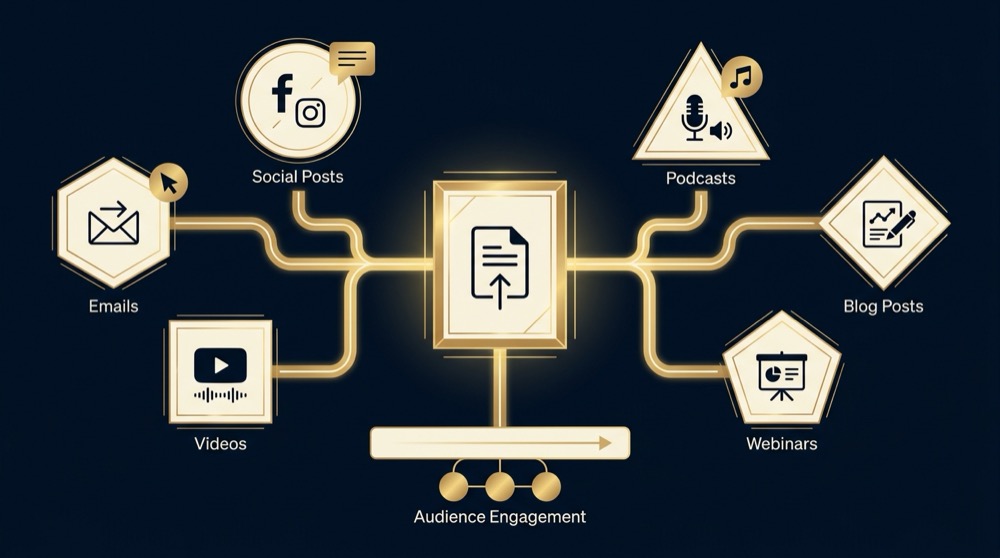
From that anchor, extract derivative assets within 90 minutes. Pull three key points for LinkedIn posts. Identify five quotable sentences for Twitter threads. Grab two sections that work as standalone email content. Script a 90-second video summary. Create three visual quote cards. The derivatives require minimal new thinking because the intellectual work already happened in the core asset.
Content formats that actually convert for solo businesses are educational and specific, not entertaining and broad. Tutorials that solve narrow problems. Frameworks that organize messy topics. Comparison guides that help buyers evaluate options. Case studies showing specific results. Templates and tools that provide immediate value. Avoid hot takes, inspirational content, and anything requiring you to be funnier or more charismatic than you are.
Setting up a sustainable production cadence means deciding what you can maintain for 52 weeks, not what sounds impressive. One substantial piece per week is realistic for most solopreneurs if you batch research and use repurposing discipline. Two per week is possible if content creation is a primary business activity, not a side task. Three or more per week is unsustainable unless content is your product.
Tool recommendations for repurposing automation include Descript for video-to-text transcription and editing, Canva for quick visual derivatives, and a simple spreadsheet to track which core assets have been fully repurposed. Avoid complex content management systems until you have six months of consistent production. The system is the workflow, not the software.
Your content calendar structure should specify core asset topics four weeks ahead, with repurposing tasks scheduled immediately after each core piece publishes. Block creation time on your calendar like client work. Treat it as non-negotiable infrastructure maintenance, not something you do when you feel inspired. Content systems for solo founders succeed through consistency, not creativity bursts.
Email Automation: The Highest-ROI Component
Email remains the highest-ROI channel for solopreneurs because you own the list, the message reaches subscribers directly without algorithm interference, and automation handles nurture without ongoing manual effort. Social platforms can disappear, change rules, or throttle your reach overnight. Your email list is yours. This matters more than any engagement metric.
The three essential automated sequences are welcome, nurture, and re-engagement. Every subscriber should enter a welcome sequence immediately after signup. This sequence introduces who you are, what you do, sets expectations for email frequency and content, and delivers whatever lead magnet prompted the signup. Five to seven emails over 10 to 14 days. The goal is to establish the relationship and demonstrate value before asking for anything.
Your nurture sequence runs after welcome and continues indefinitely until someone buys or unsubscribes. This is where you build trust through education, share frameworks and tools, tell relevant stories, and occasionally make offers. The cadence depends on your business, but weekly emails work for most solo operations. Each email should provide standalone value, not just tease your products or services.
Re-engagement sequences target subscribers who have not opened emails in 60 to 90 days. Three to four emails asking if they still want to hear from you, offering a preference update, or providing a compelling reason to stay subscribed. If they still do not engage, remove them. List quality beats list size. Sending to disengaged subscribers hurts deliverability and wastes your time analyzing metrics from people who do not care.
Building effective email sequence architecture requires understanding subscriber psychology and decision-making patterns. Orvus provides detailed frameworks for structuring welcome, nurture, and conversion sequences specifically for solo founders, including copy templates, timing recommendations, and behavioral trigger setups. These templates eliminate the blank-page problem and give you proven structures to customize for your business.

Platform recommendations with strong automation capabilities include ConvertKit for creators and educators, ActiveCampaign for businesses needing more complex segmentation and CRM features, and Drip for e-commerce-focused solopreneurs. All three offer visual automation builders, behavioral triggers, and reasonable pricing for small lists. Avoid enterprise platforms until you have 10,000+ subscribers and complex needs.
Behavioral triggers allow sequences to respond to subscriber actions without manual intervention. Someone clicks a link about a specific topic, they get tagged and enter a relevant sequence. Someone purchases, they exit nurture and enter a customer onboarding sequence. Someone abandons a cart, they get a recovery sequence. Set these up once and they run forever.
The ROI data supporting email priority is clear: email marketing for solo businesses generates average returns of 36 dollars for every dollar spent, higher than any other digital channel. More importantly for solopreneurs, email automation provides consistent nurture without requiring you to show up daily. Your sequences work while you sleep, travel, or focus on client delivery.
The Acquisition Mechanics: Getting People Into Your System
Lead magnets that actually work for solo businesses solve a specific, immediate problem your ideal customer faces right now. Not eventually, not philosophically, but today. The best formats are templates they can use within an hour, guides that answer a pressing question, tools that automate a tedious task, or checklists that prevent expensive mistakes. Avoid ebooks that require 40 pages of reading before providing value.
Your lead magnet should be directly related to what you sell but not a miniature version of it. If you sell marketing consulting, your lead magnet might be a channel selection worksheet or a content repurposing template. If you sell financial planning, it might be a retirement readiness calculator or a tax optimization checklist. The magnet demonstrates your expertise and gets them thinking about the problem you solve, creating natural demand for your paid offering.
Organic acquisition tactics with compounding returns include SEO-optimized content that ranks for problems your customers search for, guest posting on sites your audience already reads, and strategic partnerships with complementary businesses. These tactics require more time upfront but continue generating leads months and years after the initial work. A well-ranked article can drive signups for three years. A guest post on a popular site builds authority that lasts.
SEO basics for solopreneurs mean targeting specific, lower-competition keywords where you can actually rank, not broad terms dominated by large companies. Focus on long-tail searches that indicate buying intent or specific problems. Optimize your content properly but do not obsess over technical SEO until you have 50+ published pieces. Publishing consistently matters more than perfect optimization in the beginning. Learning what long-tail SEO is and how to leverage it gives solo operators a realistic path to ranking without competing against enterprise budgets.
Guest content and partnership strategies work when you identify sites, newsletters, or communities where your ideal customers already gather, then offer genuinely valuable content in exchange for exposure and a link back to your lead magnet. Pitch specific, useful ideas, not generic thought leadership. Show you understand their audience. Make it easy for them to say yes by delivering ready-to-publish quality.
Paid acquisition makes sense when you have validated that your funnel converts, you know your customer lifetime value, and you can afford to spend at least three months testing and optimizing before expecting positive ROI. Do not run ads if you are still figuring out messaging, offers, or product-market fit. Paid traffic amplifies what already works, it does not fix what is broken.
The decision framework: if your customer lifetime value is above 500 dollars and you have at least 1,000 dollars per month to invest in testing, paid ads can accelerate growth. If your LTV is below 200 dollars or you cannot commit to consistent monthly spend, focus entirely on organic tactics until your economics improve. Customer acquisition for solopreneurs requires honest math about what you can afford to spend per lead.
Realistic timeline expectations for organic growth: three to six months before you see meaningful traffic from SEO, two to four months before guest posting and partnerships generate consistent leads, six to twelve months before content marketing produces enough volume to rely on. This is why starting early and staying consistent matters more than any individual tactic.
Tracking What Actually Matters: Metrics for Solo Founders
Revenue metrics beat vanity metrics every time. Follower counts, page views, and engagement rates feel good but do not pay bills. The numbers that matter are conversion rate from visitor to subscriber, cost per lead, email open and click rates, revenue per subscriber, and channel-specific ROI. These tell you whether your system is working or wasting time.
The five numbers every solopreneur should track weekly: new email subscribers, conversion rate from subscriber to customer, revenue generated, cost per acquisition if running paid traffic, and which channel or content piece drove the most valuable actions. Track these in a simple spreadsheet or basic dashboard. You need visibility, not a data science project.
Conversion rate is the percentage of people who take your desired action at each stage. What percent of website visitors subscribe? What percent of subscribers book a call or buy? What percent of call bookings close? These ratios tell you where your system leaks and where to focus improvement effort. A 1% subscriber-to-customer conversion rate means you need 100 subscribers to make one sale. Improving that to 2% cuts your acquisition work in half.
Customer acquisition cost is total marketing spend divided by new customers acquired. If you spend 500 dollars on ads and get 10 customers, your CAC is 50 dollars. Compare this to customer lifetime value. If LTV is 200 dollars and CAC is 50 dollars, you have a healthy 4:1 ratio. If CAC is 180 dollars, your economics do not work and you need to fix conversion rates or reduce spend.
Lifetime value is the total revenue you expect from a customer over the entire relationship. For one-time purchases, it is average order value. For subscription businesses, it is monthly fee times average retention months. For service businesses, it is average project value times typical number of projects per client. Know this number. It determines how much you can afford to spend acquiring customers.

Building feedback loops into your system means reviewing metrics weekly, identifying what is working and what is not, then making small adjustments. Not daily panic reactions, not quarterly strategic reviews that come too late. Weekly rhythm keeps you connected to performance without obsessing over noise. Set a recurring calendar block for metrics review and treat it like a client meeting.
Warning against over-optimization: do not change your system based on one week of data. Do not split-test 15 variables simultaneously. Do not rebuild your entire funnel because one metric dipped. Give changes at least 30 days and 100+ data points before evaluating results. Most solopreneurs quit working tactics too early or optimize prematurely instead of letting systems mature. Analytics for solo businesses should inform decisions, not create paralysis.
Documentation and SOPs: Making Your System Resilient
Documentation matters even when you are the only operator because your future self will forget the details, you will eventually want to delegate pieces of the system, and written processes reduce decision fatigue. Every time you document a process, you free mental energy for higher-value work. Every time you skip documentation, you guarantee you will waste time relearning or reinventing later.
The benefits are concrete: consistency in execution even when you are tired or distracted, ability to hand off tasks to a contractor or assistant without extensive training, and reduced cognitive load from remembering every step of every process. Standard operating procedures are not bureaucracy for solo founders. They are infrastructure that makes your business less dependent on your perfect recall and constant presence.
Core SOPs to document include your content creation workflow from research to publication, email sequence update process when you add new products or change messaging, lead magnet delivery and follow-up procedures, and weekly metrics review checklist. These four processes run repeatedly in any solopreneur marketing system. Documenting them once saves hours every month.
Simple documentation formats work better than elaborate systems. A checklist in a Google Doc is fine. A Loom video walking through a process is often better than written steps. A Notion template with embedded videos and checklists is ideal if you already use Notion. The goal is usable documentation, not pretty documentation. If you would not actually reference it when doing the task, it is too complex.
Track essential marketing SOPs for solopreneurs to document and maintain
Helps ensure critical processes are documented and kept current without over-engineering
Loom is excellent for processes with visual components like setting up email automations, configuring tools, or demonstrating content formatting. Record your screen while doing the task, narrate what you are doing and why, then store the video link in your documentation hub. Five-minute videos often communicate better than 10 pages of written steps.
Notion templates provide structure for recurring processes. Create a template for content production with sections for research notes, outline, draft, editing checklist, and repurposing tasks. Clone the template each time you start a new piece. The structure ensures you do not skip steps and makes the process faster through repetition.
Maintenance schedule for SOPs: review and update quarterly or whenever you change a significant part of your system. Set a recurring calendar reminder. Outdated documentation is worse than no documentation because it creates confusion and wastes time. Keep it current or delete it. Process documentation for solo founders is a living system, not a one-time project.
Common Mistakes Solo Founders Make Building Marketing Systems
Over-engineering before validation kills momentum. Solo founders read about enterprise marketing funnels with 12-step sequences, complex segmentation, and multi-channel attribution, then try to build that before they have 100 subscribers or proven product-market fit. The result is months spent configuring tools and building infrastructure for a system that does not work because the fundamentals are wrong.
The corrective action: start simple and add complexity only after you prove each component works. Begin with a basic welcome sequence and one nurture email per week. Get 100 subscribers and see if anyone buys. If they do, optimize. If they do not, fix your offer or messaging, not your funnel architecture. Build the minimum system that can produce a result, then expand based on what works.
Tool proliferation and integration hell happen when you subscribe to a CRM, an email platform, a social scheduler, an analytics dashboard, a landing page builder, a webinar tool, and five other services that all need to talk to each other. Each integration is a potential failure point. Each tool requires learning time and ongoing management. The monthly costs add up faster than you expect.
The corrective action: pick one platform that handles multiple functions even if it is not the absolute best at each one. ConvertKit does email and landing pages. Notion handles documentation and project management. Canva covers graphics and simple video. Three tools that work together beat 10 best-in-class tools that require constant integration maintenance. Add specialized tools only when a specific limitation blocks real revenue growth.
Ignoring the time cost of free channels is common. Organic social media is free, so solopreneurs assume it is low-cost. But if you spend 90 minutes per day on Twitter and Instagram and generate two leads per month, your time cost per lead is enormous. That same 45 hours could have written 10 SEO articles that generate leads for years, or set up email sequences that nurture automatically.
The corrective action: calculate time investment per channel and divide by leads generated. Be honest about what your time is worth. If a channel requires 10 hours per week and generates leads you could get from 2 hours of paid ads at acceptable cost, the paid option is cheaper. Free is only free if your time has no value. For solopreneurs, time is the scarcest resource.
Copying enterprise playbooks without adaptation fails because enterprises have teams, budgets, and operational capacity that solo founders do not. A marketing strategy that requires a content team, a designer, a paid ads specialist, and a marketing ops person will not work when you are all four roles plus running the actual business. Trying to execute it anyway leads to burnout and inconsistent execution.
The corrective action: when you see a strategy or tactic from a larger company, ask what would need to be true for you to execute it sustainably. If the answer involves hiring people or spending money you do not have, discard it. Look for solopreneur-specific approaches or ruthlessly simplify enterprise tactics to fit your constraints. Your system must match your reality, not your aspirations.
Your First 90 Days: Implementation Roadmap
Month one focuses on foundation and channel selection. Week one: audit your current marketing activities, list where you spend time, and measure what results you are getting. Week two: use the channel selection framework to pick your primary and secondary channels based on time constraints, skills, and audience presence. Week three: select and set up core tools, email platform first, then any channel-specific tools you need. Week four: create your first lead magnet and set up a basic welcome sequence.
Time commitment for month one: 8 to 12 hours per week. This is setup work, not ongoing maintenance. You are building infrastructure that will reduce future time requirements. The audit and channel selection are thinking work, not execution. Tool setup takes longer than you expect, budget extra time for learning curves and technical issues.
Month two milestones center on content engine and email automation. Week five: produce and publish your first core content asset using the repurposing model. Week six: create derivatives from that asset and distribute across your selected channels. Week seven: write and schedule your first month of nurture emails. Week eight: set up behavioral triggers for your email sequences and test the complete subscriber journey from signup through first purchase opportunity.
Time commitment for month two: 10 to 15 hours per week. Content creation is the biggest time block. Email sequence writing takes longer the first time because you are establishing voice and structure. Testing your complete funnel is essential, do not skip this. Sign up with a test email address and experience what subscribers experience.
Month three focuses on acquisition tactics and optimization. Week nine: publish your second and third core content pieces, refine your repurposing workflow based on what took too long in month two. Week ten: implement your primary organic acquisition tactic, whether that is SEO optimization, guest posting outreach, or partnership development. Week eleven: run your first metrics review using the framework from the tracking section, identify what is working. Week twelve: make your first system iterations based on data, not assumptions.
Time commitment for month three: 12 to 18 hours per week. Acquisition tactics require outreach and relationship building, which takes time upfront. Metrics review should take 60 to 90 minutes weekly once you have the dashboard set up. System iteration means small adjustments, not rebuilds. Change one thing at a time so you know what caused any performance shifts.
Success criteria for each phase: month one succeeds if you have selected channels, set up tools, and have a functioning lead magnet with welcome sequence. Month two succeeds if you have published at least four core content pieces, have derivatives distributed, and have a complete email nurture sequence running. Month three succeeds if you have consistent content production, at least one acquisition channel actively generating leads, and a metrics dashboard you review weekly.
Realistic expectations: you will not have a flood of leads in 90 days. You will have a functioning system that can scale with consistent effort. Most solopreneurs see meaningful lead flow between months four and six after starting this roadmap. The first 90 days build the machine. The next 90 days optimize it. Months seven through twelve are when compounding effects start to show.
When to Evolve Your System (and When to Leave It Alone)
Signals that your system needs adjustment include conversion rate drops that persist for more than two weeks, channel saturation where your audience size stops growing despite consistent effort, or time constraints where system maintenance takes more hours than you can sustainably commit. These are data-driven signals, not feelings or boredom with your current approach.
Conversion rate drops require investigation before action. Check if the drop is real or statistical noise from small sample sizes. Look for external factors like seasonality, market changes, or competitor actions. Review recent changes you made to messaging, offers, or funnel steps. Only adjust if you identify a clear cause and have a hypothesis for improvement. Random changes to fix unexplained drops usually make things worse.
Channel saturation happens when you have reached most of your addressable audience on a platform and growth stalls despite consistent content quality. This is a real ceiling, not a performance problem. The solution is either to expand to a new secondary channel, increase publishing frequency to capture more attention from the existing audience, or shift strategy to deepen engagement rather than grow reach.
Time constraints signal system bloat. If maintaining your marketing system takes more than 15 to 20 hours per week as a solopreneur, you have over-complicated it or chosen too many channels. The solution is to cut, not optimize. Drop your weakest channel, simplify your content formats, or reduce publishing frequency. A system you can maintain beats a perfect system you abandon after three months.
The 90-day rule for system stability: do not make major changes to your channel mix, content strategy, or funnel architecture for at least 90 days after implementing them. Minor optimizations are fine, complete overhauls are not. Most systems need three months of consistent execution before you have enough data to evaluate performance. Changing too quickly means you never learn what actually works.
How to prepare your system for future delegation starts with documentation. Every process you might hand off needs an SOP. Every tool needs login credentials stored securely and instructions for common tasks. Every content template needs examples and guidelines. Build these as you go, not in a panic when you are ready to hire. Delegation-ready systems for solo founders are documented systems.
Planning for eventual team growth means designing your system with handoff points in mind. Content creation might stay with you while editing and repurposing get delegated. Email strategy might stay with you while sequence writing and scheduling get delegated. Metrics analysis might stay with you while data entry and dashboard maintenance get delegated. Think in terms of tasks that require your specific expertise versus tasks that follow a process.
Final emphasis on consistency over perfection: a simple system you run every week for a year beats a sophisticated system you run for six weeks then abandon. Your marketing system does not need to be impressive, it needs to be sustainable. It does not need to use every channel, it needs to own the channels you choose. It does not need to be innovative, it needs to generate leads reliably. Build for endurance, not applause.
A well-designed marketing system for solopreneurs requires 12 to 18 hours per week once fully implemented. This breaks down to 6 to 8 hours for content creation and repurposing, 2 to 3 hours for email sequence management and updates, 2 to 3 hours for channel-specific distribution and engagement, and 1 to 2 hours for weekly metrics review and system maintenance. During the initial 90-day setup period, expect to invest 8 to 15 hours per week building infrastructure, creating foundational content, and configuring automation. The time investment decreases as automation handles more nurture and distribution tasks. If your system requires more than 20 hours weekly after the setup phase, you have likely over-complicated it or chosen too many channels. The goal is a system that runs with minimal daily input, not one that becomes a second full-time job.
The essential tool stack for a solopreneur marketing system includes an email marketing platform with automation capabilities like ConvertKit or ActiveCampaign, a content creation and repurposing tool such as Canva for graphics and Descript for video-to-text, a documentation system like Notion or Google Docs for SOPs and content planning, and basic analytics through Google Analytics or your email platform's built-in metrics. Optional but valuable additions include a social media scheduler if using social channels, an SEO tool like Ahrefs or Semrush for content optimization, and a landing page builder if your email platform does not include one. Avoid tool proliferation by choosing platforms that handle multiple functions rather than best-in-class specialists for each task. Three to five well-integrated tools beat 10 specialized tools that require constant maintenance. Start with email and content tools, then add specialized capabilities only when a specific limitation blocks measurable revenue growth.
A marketing system can work during product-market fit exploration, but it should be minimal and focused on learning rather than scale. Build a basic lead capture mechanism with a simple lead magnet, a short welcome sequence that asks questions about subscriber needs and challenges, and a weekly email that tests different messaging angles and offer positioning. Use the system to gather feedback, validate assumptions, and identify which customer segments respond most strongly to your value proposition. Avoid building complex funnels, multi-step sequences, or investing heavily in paid acquisition until you have clear signal that people will pay for what you offer. The system during this phase is a research tool, not a growth engine. Once you validate product-market fit through actual sales and can articulate who buys, why they buy, and what messaging converts, then expand your system with the full acquisition, nurture, and conversion infrastructure. Premature scaling of marketing systems before product-market fit wastes time building infrastructure for offers that do not work.
The systems that work are simple, documented, and consistent. They prioritize automation over manual effort, focus over breadth, and sustainability over impressive complexity. Start with the fundamentals in this guide, implement them over 90 days, then optimize based on data rather than assumptions. Your marketing system will never be finished, but it can be functional, reliable, and effective without requiring you to become a full-time marketer.
References
- https://journals.sagepub.com/doi/full/10.1177/small-business-marketing-2024
- https://contentmarketinginstitute.com/articles/content-systems-solo-founders
- https://www.marketingprofs.com/articles/2024/email-marketing-roi-solopreneurs
- What is basic search engine optimization? A systems guide
- What is longtail SEO? A systems-first guide
- How do you write hooks?
- https://www.hubspot.com/marketing-automation-information
Want this kind of work done for your business?
We build and run AI-powered marketing and automation. 15 minutes, honest assessment.
Book a call