 Orvus
OrvusWhat is SEO in e-commerce? Guide to Search
December 10, 2025
Why ecommerce SEO still matters for stores that want real sales
ecommerce SEO is the steady engine that brings shoppers who already want to buy to your store. In an advertising ecosystem that changes constantly, organic search remains one of the most dependable sources of high-intent visitors and repeatable revenue. That means investing in ecommerce SEO isn't a nice-to-have; it's a practical, measurable part of running a healthy online business.
Search behavior changes, SERP features evolve, and new shortcuts appear - and yet the fundamentals of discoverability, trust, and usability remain constant. This article unpacks those fundamentals and gives practical steps that work for both small shops and large catalogs.

How this guide will help you
Read this as a playbook: you'll get clear technical checks, content and product page advice, governance for category and faceted pages, link and authority guidance, and a measurement loop that ties work to revenue. Whether you have ten SKUs or a million, the same principles apply.
Ready to turn search into steady sales?
Technical foundations: make search engines comfortable
Everything starts with crawlability and indexability. If search engines cannot reach your pages or understand which version is canonical, you won't rank reliably, no matter how persuasive your copy is. Technical ecommerce SEO is the quiet plumbing: site architecture, consistent URL patterns, canonical tags, and good performance.
Site architecture - think like a shopper
Your site should guide visitors to purchase without friction. Group products into logical categories and keep paths shallow so key pages aren’t buried eight clicks deep. Use descriptive, human-friendly URLs and avoid letting dozens of parameter-driven pages create duplicate content.
Control crawl budget and avoid index bloat
Search engines spend a finite amount of attention on your site. If you let filtering and sorting create millions of near-duplicate pages, crawlers will waste time on noise and your important product pages will be crawled less often.
Simple steps help immediately: robots.txt to block irrelevant bots, noindex rules for parameter-only pages, canonical tags where multiple URLs show the same content, and a clean sitemap.xml that lists canonical URLs you want indexed.
Performance and Core Web Vitals
Performance is both a ranking and conversion signal. A slow product page destroys impulse buys. Focus on the pages that drive revenue: lazy load images beyond the fold, keep key content above the fold, and measure real user experience with field data. Prioritise stable, usable experiences rather than shiny perfect scores.
Product pages: where search meets conversion
A product page is a translator: it must tell search engines what the item is and tell shoppers why they should buy it. For ecommerce SEO, product titles, unique descriptions, availability, pricing, and structured data matter equally.
Titles and meta snippets that convert
Think of the title as a search headline. Use the phrasing customers use - not internal SKUs. Include the most meaningful qualifiers (size, color, model) and avoid stuffing. Meta descriptions influence click-through rates; write short, helpful snippets that communicate benefit and set expectations.
Real, helpful product descriptions
Many stores use manufacturer copy or leave descriptions empty. Those pages compete against dozens of similar listings. Unique descriptions that mention dimensions, fit, use cases, and what the product is not for will help both ranking and conversions. If possible, add short customer stories or use-cases to answer unspoken questions and reduce returns.
Structured data and rich results
Structured product data (product and offers schema) gives search engines clear signals about price, availability, and reviews. Adding structured data increases the chance of appearing in shopping carousels, rich snippets, and other SERP features. For many merchants, implementing schema on key product templates is a high-return, low-maintenance investment.
At scale, use templates for structured fields but reserve manual description work for bestsellers and strategic lines. Automation is powerful - but only when it doesn't create thin, duplicated content.
Category pages and faceted navigation: capture intent at scale
Category pages match buying intent at different moments. Broad categories like “running shoes” capture early-stage comparison shoppers; narrower combinations like “women’s trail running shoes size 7” catch people closer to purchase. A deliberate category strategy aligns content depth and page structure with the user intent you want to own.
Facets: necessary but dangerous
Filtering and faceted navigation are critical for a great shopping experience, but they create many permutations of similar pages. Left unmanaged, these pages bloat your index and dilute internal link equity.
Not every faceted view needs indexing. Keep high-value, commonly searched facet combinations indexable and block or canonicalise the rest. Governance - a shared taxonomy and URL parameter policy across product, dev, and SEO teams - prevents accidental index bloat. For practical advice on faceted navigation best practices, see this guide on faceted navigation in SEO and this implementation-focused resource at Faceted Navigation SEO Guide 2025.
Practical governance at scale
Automated rules for canonical tags and sitemap inclusion often become essential for large stores. If a brand-filtered view converts extremely well, make sure that view has a clear canonical, or include it in the sitemap so search engines treat it as primary rather than noise.
Content strategy: capture demand beyond product names
Search engines bring more than buyers who type product names. They bring problem-solvers, comparers, and people seeking guidance. Content that answers those needs brings future buyers into your store.
Types of content that work
Buying guides, comparison posts, and comprehensive FAQs are the best places to start. These pages should be useful first and promotional second. A practical guide to picking running shoes will attract readers, build trust, and provide natural internal links to product pages.
Long-tail vs catalog content
Product pages chase transactional queries. Content pages chase informational queries. One deep, well-researched guide can outperform dozens of thin articles. Prioritise content that supports your top categories and where your brand has authority to add value.
Links and external authority: quality beats quantity
Backlinks remain a core authority signal. For ecommerce, the most meaningful links often come from niche blogs, buying guides, trade press, and complementary brands rather than broad, general news outlets.
Earned coverage without a huge PR budget
You can earn coverage with genuinely useful things: thoughtful packaging, original product guides, helpful research, or influencer collaborations focused on utility rather than promotion. Aggregator and review sites also pass valuable signals when paired with proper structured markup.
Avoid shady link networks - they risk penalties and bring low-quality traffic. Focus on links that bring relevant visitors and that will stand up to scrutiny.
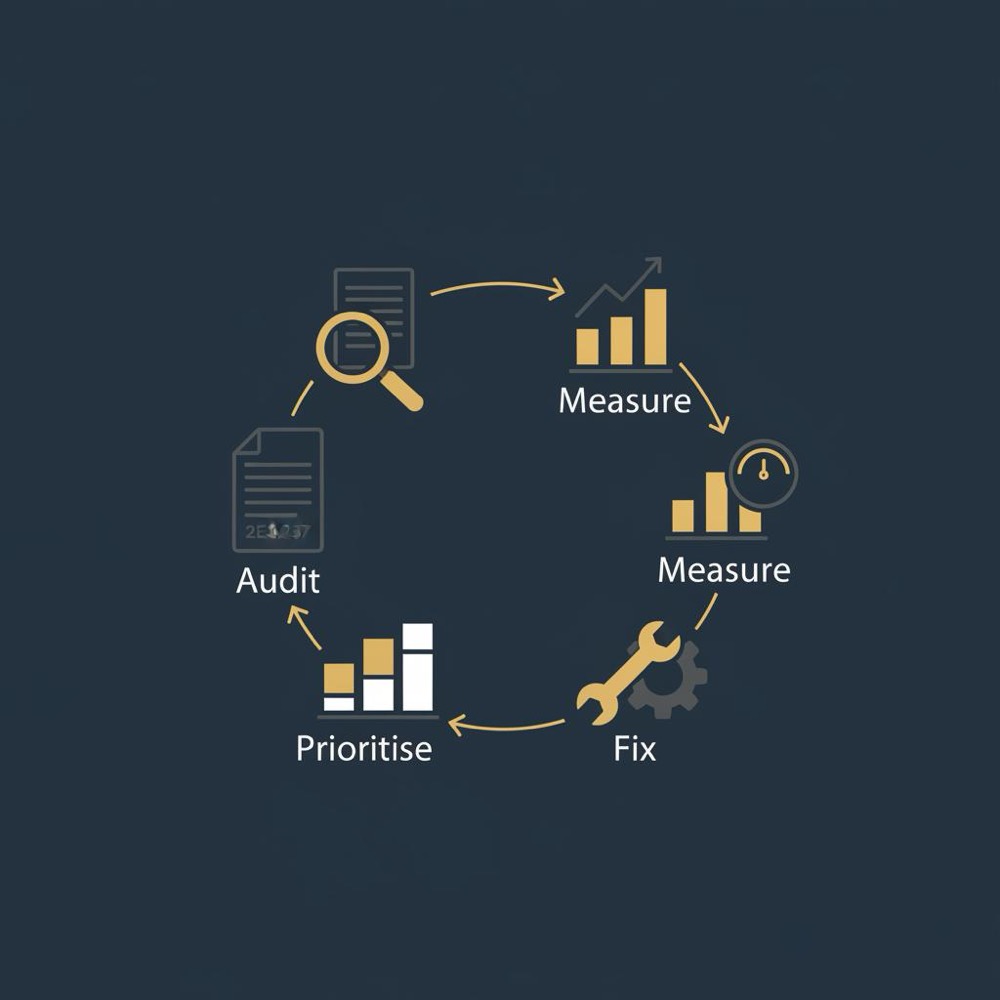
The implementation loop: audit, prioritise, fix, measure
Put your work into a repeatable loop: audit (technical crawl, content inventory, backlink surface), prioritise (tie issues to revenue or risk), fix the blockers, and measure results.
Quick prioritisation frame
Fix what prevents indexing or breaks the user experience first. Next, improve pages that drive the most revenue. Finally, scale improvements across the catalog with templates and governance.
Measurement that ties to business outcomes
Beyond sessions and revenue, monitor impressions and CTR for target queries, index coverage, crawl reports, and Core Web Vitals for your most valuable pages. Conversion rate by channel tells you whether organic visitors actually buy when they arrive.
Segment data by intent to understand where content is driving early-stage discovery and where product pages are closing sales. Keep a change log for template or URL updates so you can correlate deployments with traffic shifts.
High-impact fixes for small and large stores
Small merchants often get big wins from a short list: readable product titles, unique descriptions, product schema, canonicalised duplicates, and a streamlined sitemap. Large retailers need governance: parameter policies, automated canonical rules, templated structured data, and cross-team processes.
Examples of quick wins
Pick one revenue-driving product and one category as experiments. Fix the title, write a helpful product description, add schema, and ensure the category page has a short, useful intro. Measure before and after - small, consistent experiments compound.
Need help running a pragmatic experiment? For a tailored mix of audits, quick fixes, and scalable changes, consider working with Orvus. View our services for strategic growth and technical SEO support at Orvus services.
Measurement and reporting: what to watch and why
Track organic sessions and revenue but dig deeper: impressions and CTR for priority queries, ranking distribution for target keywords, crawl coverage, and Core Web Vitals on top pages. Conversion rate by channel tells you whether organic visitors actually buy when they arrive.
Track impressions and CTR with Search Console, use analytics for on-site behaviour and revenue, and run a crawler to detect technical issues. For broader beginner-friendly guidance on ecommerce SEO principles, see the Ecommerce SEO: Ultimate Beginner's Guide 2025.
Open questions and risks to watch
Two big debates recur: when to automate and when to write by hand, and how SERP changes impact click behavior. Automation at scale brings consistency and efficiency, but it can produce shallow content. Balance templated fields with manual copy for items that matter.
Regional differences matter too - test and measure. And as AI features in search change how users interact with results, tracking impressions and CTR becomes more crucial.
Practical tips you can use this week
If you're short on time, pick one product and one category. Make the product title readable, write a unique product description, add product schema, and give the category page a short, helpful intro. Run the experiment for a few weeks and measure traffic and conversion changes.
Collect reviews
Real user reviews improve conversion and, when marked up, can enhance search snippets. Ask verified purchasers to leave short notes about fit, durability, or comfort - those specifics reduce returns.
Keep a change log
Document site-wide updates to templates, canonical logic, or URL structures. It’s an inexpensive habit that saves hours when diagnosing ranking changes.
Yes. A targeted change-such as fixing canonical tags and adding structured product data for a top product-can restore indexing and recover lost traffic quickly. While durable growth comes from a steady program, well-chosen fixes often produce measurable short-term gains.
Yes - sometimes. A single, well-targeted fix (for example, correcting canonical tags and adding product schema for a high-volume product) can restore indexing for an entire section and quickly recover lost traffic. That said, durable improvements usually come from a steady program of audit, prioritisation, and incremental fixes.
Common pitfalls and how to avoid them
Index bloat, duplicate content, poor templates, and ignoring user intent are common mistakes. Prevent them with parameter policies, canonical rules, and clear content ownership. Make sure developers, merchandisers, and SEO share an agreed process for introducing filters, new collections, or site features.
Beware of over-automation
Automation saves time, but if it outputs thin or duplicated descriptions at scale, it will hurt both search and conversion. Use templates for consistent structured data but keep manual writing for strategic products.
How to prioritise fixes (a quick framework)
Score issues by impact and effort. High-impact/low-effort fixes (titles, adding schema, fixing critical CWV problems) come first. Medium-impact/medium-effort (taxonomy changes, better category content) next. High-effort/high-impact projects (catalog-wide governance, major platform migrations) should be planned with cautious staging and strong rollback plans.
Example prioritised list for a small store
1) Update titles for top 20% SKUs. 2) Add unique descriptions for top sellers. 3) Implement product schema on key templates. 4) Fix slow-loading product images. 5) Collect and display reviews.
Example prioritised list for a large retailer
1) Audit faceted navigation and parameter handling. 2) Create a URL parameter policy and automate canonical tags. 3) Build structured data templating with manual overrides for bestsellers. 4) Establish cross-team governance and a deployment change log.
Real metrics to watch and why they matter
Measure impressions and CTR for target queries to see whether your pages are visible and enticing. Track organic sessions and revenue, but drill into conversion rate by channel. Watch index coverage and crawl reports for duplicates and noindexed pages. Monitor Core Web Vitals for your priority templates.

Use Search Console for queries and impressions, an analytics platform for on-site revenue, and a crawler for technical signals. PageSpeed and field performance tools help monitor Core Web Vitals in production.
How Orvus approaches ecommerce SEO differently
Orvus focuses on rebuilding search architecture so that search reflects how the business actually makes money. We combine technical fixes, measurement, and pragmatic automation with human judgement: templates where they help, manual effort where it matters.
That approach is why teams choose deep collaboration over volume-based packages: the goal is compound improvement rather than one-off spikes.
Putting it all together: a 90-day experiment blueprint
Here’s a pragmatic 90-day plan that works for many small to mid-sized stores. It’s designed to prove value quickly and create a repeatable structure for ongoing work.
Days 0-14: Fast audit and prioritisation
Run a technical crawl, review top product pages, and gather Search Console and analytics data. Identify quick technical blockers (indexation issues, major CWV problems) and a short list of product pages for immediate improvement.
Days 15-45: Fast wins
Implement product schema templates, update titles and descriptions for the selected products, add a short category intro where it matters, and begin collecting reviews. Track before/after for impressions, CTR, and conversions.
Days 46-90: Governance and scale
Create a parameter and indexing policy, automate canonical and sitemap rules where feasible, and build templates for structured data with manual overrides for bestsellers. Prepare a repeatable content calendar for guides that support your main categories.
Case examples and quick stories
A retailer I worked with added a small noindex policy and fixed canonical tags after an infinite filtering feature created millions of near-duplicates. Traffic recovered as crawlers refocused on canonical product and category pages. Another brand saw a measurable uplift after rewriting top product titles and adding structured data to 50 SKUs.
Questions we still ask with every project
Where does this site make money? Which pages deserve manual attention? Which facets match real user demand? Answering these questions prevents waste and focuses engineering on high-leverage work.
Final practical checklist
1) Confirm canonical logic and sitemap accuracy. 2) Fix major CWV problems on top revenue pages. 3) Make product titles customer-first and add schema. 4) Create a parameter policy for facets. 5) Build a content plan for supporting buyer stages. 6) Collect and markup verified reviews.
Further reading and tools
Use Search Console for queries and impressions, an analytics platform for on-site revenue, and a crawler for technical signals. PageSpeed and field performance tools help monitor Core Web Vitals in production. For additional resources and regular insights, check our blog at Orvus useful knowledge.
A last friendly note
ecommerce SEO isn’t an instant magic trick - it’s a system. Fix the plumbing, optimise the listings people see, and build content that answers real questions. Done patiently, these habits compound into steady, trusted organic revenue for your store.
Want help turning this playbook into a tailored 90-day plan? We can sketch one based on your catalog and constraints. See Orvus services for details.
Compare the number of URLs you expect to be indexed with Search Console’s reported numbers. A sudden spike or drop in indexed pages, or crawl reports showing many parameter-driven duplicates, usually signals indexation problems. Run a technical crawl to find thin or duplicate pages and inspect your sitemap.xml and canonical tags.
Not all faceted pages should be indexed. Only keep indexable the facet combinations that match real user demand and convert. Block or canonicalise permutations that exist mainly for sorting or that create near-identical pages. A parameter and taxonomy policy helps cross-functional teams decide which facets are valuable to index.
Yes. Orvus specialises in pragmatic, high-leverage growth work: audits, targeted fixes, and scalable governance. They typically begin with a compact diagnostic tied to your numbers and priorities, then implement a 30-90 day plan focused on measurable improvements in traffic and revenue. See Orvus services for a tailored plan.
References
Want this kind of work done for your business?
We build and run AI-powered marketing and automation. 15 minutes, honest assessment.
Book a call