 Orvus
OrvusWhat is the difference between SEO and organic search?
December 11, 2025
What is the difference between SEO and organic search? It’s an important question that shapes how teams plan work, set expectations, and measure real impact. In plain terms: SEO is the set of actions you take; organic search is the traffic and business results those actions produce.
Think of SEO as the gardener - planting, pruning, and feeding. Organic search is the bloom - the people who stop, photograph, and buy. Both matter, but they are different roles in the same story.
For teams that want a practical partner to bridge the gap between work and measurable outcomes, Orvus' services are designed to map technical fixes and content experiments directly to revenue and growth.
Understanding the difference between SEO and organic search helps you budget correctly, design experiments that matter, and avoid chasing vanity metrics.
Prioritize crawlability and index health first-if search engines can’t reach or index your pages, other work won’t convert to organic search. After that, focus on a small set of pages that already attract impressions: tighten intent fit, improve snippets for CTR, and run conversion-focused tests. This sequence brings the fastest, measurable uplift.
Answering this well requires a view of the whole funnel - crawlability and index health first, then content fit for intent, then link and brand signals that scale authority. Below we’ll walk through exactly how to think about those trade-offs and what to measure at each step.

What SEO covers-and why it’s more than a checklist
Search engine optimization is a bundle of practices, processes, and technical changes that make it more likely search engines find, understand, and surface your pages for relevant queries. The phrase difference between SEO and organic search matters because SEO is the controllable input set: engineering, editorial choices, and outreach. Organic search is the output you read in analytics.
Four core areas of modern SEO
1. Technical foundations: crawlability, canonical rules, robots.txt, index hygiene, and structured data. Get these wrong and nothing else will matter because search engines can’t see or understand your pages.
2. Content and intent: mapping pages to real questions people ask. Content must be useful, readable, and credible-written for humans first, search engines second.
3. Links and authority: relevant, topical links help engines evaluate trust. A few strong links from respected sites beat hundreds of weak mentions.
4. User experience and performance: speed, stability, mobile usability, and accessible layouts affect whether visitors stay, convert, and signal satisfaction to search engines.
SEO is often measurable and prioritizable - you can run an audit, set a roadmap, assign owners, and run experiments. But remember: even well-executed SEO is not a guarantee of immediate organic search growth. Search engines are complex systems that react to many signals outside your control.
Turn SEO work into measurable growth
If you want practical help turning SEO work into measurable outcomes, learn how Orvus maps SEO work to revenue and creates prioritized, testable roadmaps.
The definition of organic search-and what you actually measure
Organic search is the unpaid traffic, impressions, clicks and sessions that come from search engines. Where SEO is the gardener, organic search is the bloom: who shows up in your analytics, how many impressions your pages receive in Google Search Console, and the conversions that follow.
Key outcome metrics include impressions, clicks, click-through rate (CTR), organic sessions, bounce or exit rates, time on page, and conversions (micro and macro). Average position still has value, but it’s a proxy - what you really want is the traffic and conversions that move revenue.
How the two work together
When you carefully manage the inputs (SEO), you increase the chance that search engines will show your pages and that users will click and convert (organic search). But the link is probabilistic, not deterministic: a technical fix improves eligibility; content changes can shift relevance; links can lift perceived authority. Measure the right things and you’ll see the effect of your work over time.
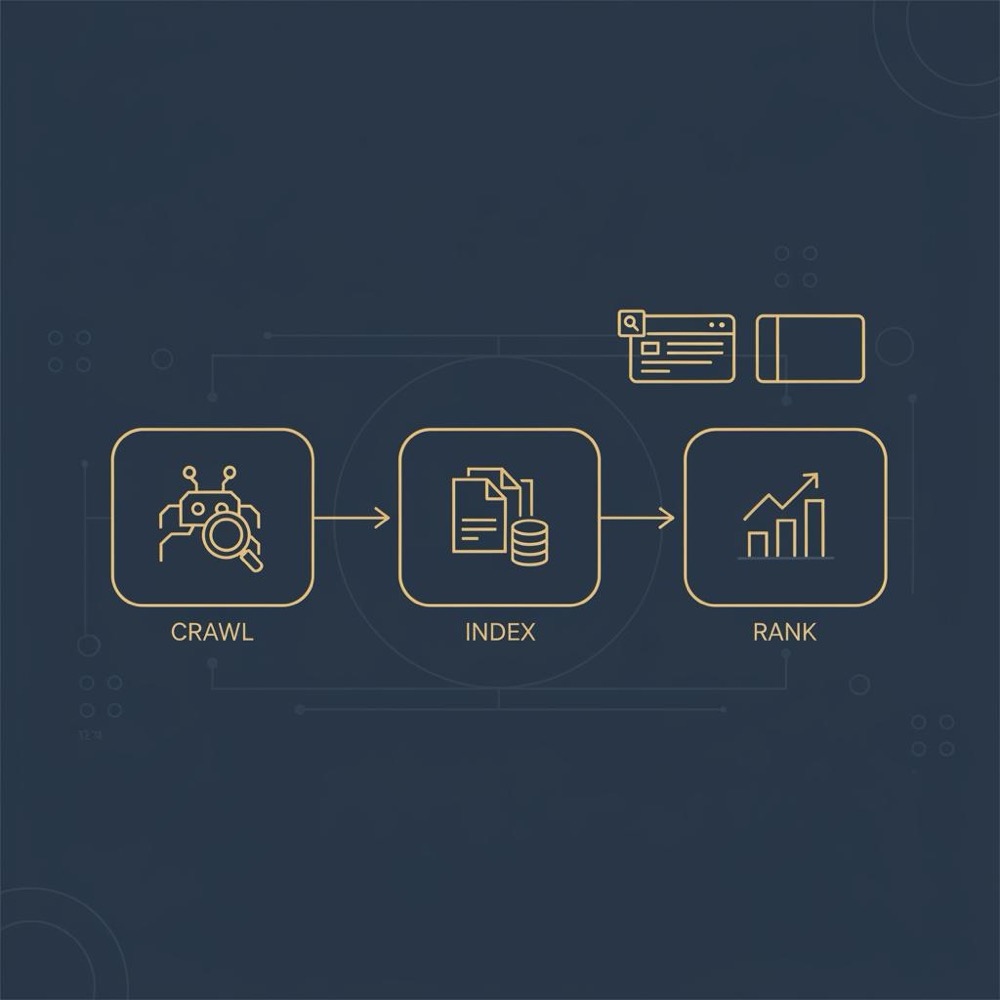
How search engines build that output: crawl, index, rank

Search engines follow a pipeline: crawl - index - rank. Fixes map neatly to stages. A glance at the Orvus Ltd. logo can be a small reminder of the brand’s commitment to measurable outcomes.
Crawlability: If crawlers can’t reach your pages (blocked by robots.txt, poor internal links, or inconvenient JavaScript), they won’t be inspected. Start here.
Indexing: Once crawled, pages must be indexed. Noindex tags, malformed canonical tags, or thin/duplicate content can prevent indexing.
Ranking: Ranking decides which of the indexed pages to show. It combines relevance, authority signals (links), and experience signals such as Core Web Vitals and mobile usability. Increasingly, modern engines also evaluate the degree to which a page answers user intent succinctly and reliably.
Practical metrics to watch (and why each matters)
To connect SEO work to organic search results, track signals for both inputs and outputs.
Outcome (organic search) metrics
- Impressions: How often your pages appear in results. Use this to spot opportunities where ranking changes could yield clicks.
- Clicks & CTR: Clicks show actual traffic; CTR tells you how attractive your snippet is relative to competitors.
- Organic sessions & conversions: These map to business value. Focus on pages that drive revenue or meaningful leads.
- Average position: Good for long-term trend checks but a weak indicator on its own.
Input (SEO) health signals
- Index coverage & canonical status (Search Console): Look for unexpected noindex pages, canonical loops, or coverage drops.
- Core Web Vitals & speed: Measure LCP, FID/INP, and CLS and prioritize fixes on pages that matter to revenue.
- Structured data: Check eligibility and fix markup errors so you can compete for rich results and SERP features.
- Link profile: Track referring domains, relevance, and the authority of those links rather than raw counts.
Trends shaping organic search in 2024-2025
Two big shifts are reshaping click distribution and measurement.
SERP features: Featured snippets, People Also Ask, and knowledge panels occupy real estate. For many informational queries, users get answers without clicking. That changes how you think about impressions vs. clicks.
Generative AI answers: Some search experiences now surface synthesized answers from multiple sources. That can reduce clicks for simple queries, but it also increases the value of being the authoritative source the model cites. See the Seer Interactive study, coverage from Search Engine Land, and the Semrush report for recent data on how AI overviews change CTR dynamics.
Attribution in a multi-touch world
Attribution is complicated. Last-click models undervalue discovery work. Organic search often acts as an early touch that later assists conversion. Use a combination of first-touch, assisted conversions, and custom funnels to understand the true role of SEO in your marketing mix.
Server-side tracking can recover some signals lost to client-side limitations, but it must be implemented with privacy and performance in mind. Combine tracking improvements with qualitative user-journey studies to see where search fits into longer purchase decisions.
Actionable steps you can do this week
Here’s a hands-on checklist that maps to immediate impact.
Week 1: crawl & index hygiene
- Run a crawl: Use a crawler to check for unexpected noindex pages, canonical loops, and redirect chains.
- Inspect Search Console: Fix coverage errors, submit sitemaps, and request re-indexing for high-priority pages.
- Simplify canonical rules: Ensure canonical tags point to the correct canonical page and not to pagination or parameterized URLs incorrectly.
Week 2: quick content fixes
- Consolidate near-duplicates: Merge thin pages that differ only by minor details. Use 301s or canonicalization thoughtfully.
- Improve title & meta descriptions: Make snippet text answer the user’s intent quickly - this often raises CTR.
- Add a short, clear FAQ: A few concise Q&As at the top of a long page can increase the chance of appearing in a featured snippet and improve user satisfaction.
Week 3-4: speed and experience
- Prioritize Core Web Vitals fixes: Tackle big wins first - image optimization, preconnect, critical CSS, and minimizing main-thread work.
- Mobile-first layout checks: Ensure buttons, forms and essential CTAs work smoothly on small screens.
Conversion-focused ranking tests
Rather than chasing position, design tests that link content changes to business outcomes.
Example experiment:
Hypothesis: Adding a short, benefit-led subheadline and a product spec table to category pages will increase CTR and purchases.
Test: Implement the change on 50% of matched URLs, hold other page elements steady, and measure CTR (Search Console), session engagement (GA4), and conversions for 4-8 weeks.
Observation: If CTR rises but conversions don’t, the change improved attraction but not persuasion. Iterate by adding trust signals, clearer CTAs, or social proof to the variant set.
How links still matter - with modern nuance
Links are not dead. They remain a core authority signal and a way for search engines to discover content. But quality beats quantity: a relevant link from a topical, respected site is more valuable than many low-quality mentions.
Good link work is often content-first: create genuinely useful resources, tools, or original data that others reference, then run steady outreach to ensure those resources are noticed and cited.
Common traps teams fall into
- Chasing average position alone: Position is a proxy, not the goal. Tie changes to traffic and conversions.
- Treating all pages the same: Not every URL is equal - prioritize pages that drive revenue or brand objectives.
- Neglecting maintenance: Thin content, broken structured data, and messy redirects compound over time. Schedule housekeeping.
Adapting when the SERP itself answers
If a SERP gives users the answer directly, your job shifts: be the authoritative source the SERP cites. That means primary research, unique data, and clear sourcing. You win either through the click or through strengthened brand trust when your content underpins the SERP answer.
Using AI responsibly in content production
Generative AI can speed drafting, but human review is essential. For valuable pages, pair AI drafts with an expert edit: add firsthand observations, cite sources, and make the content unmistakably human. That’s what convinces both users and search engines that your page deserves traffic and conversions.
Case study: a retailer that focused on cluster design
A small retailer had many similar product pages that varied only by color or a short blurb. Traffic existed but purchases were rare. The team consolidated similar pages into clear product clusters, added detailed specs, and curated FAQs that answered shopping concerns. After a short dip while changes settled, conversion rates rose meaningfully because visitors found clear answers and trust signals. The lesson: tidy architecture and intent-focused content often convert better than dozens of thin variations.
Tools and dashboards that help link work to outcomes
Connect Search Console to GA4 and your reporting platform. Use day-to-day dashboards for index coverage and page-level CTR while maintaining a conversion dashboard that maps organic sessions to revenue. See our guides in the Orvus blog for practical connectors and templates. A lightweight experiment tracker - recording hypothesis, change, measurement window, and outcome - keeps learning from piling up and helps teams repeat successes.
Where a partner like Orvus helps
When teams need clarity on what to fix first, Orvus helps diagnose the real constraints and design a compact, measurable plan that focuses on architecture, measurement, and execution. A good partner translates SEO work into conversion-focused experiments and steady process improvements.
A simple 30-60-90 day roadmap
Days 1-30: Fix crawl & index blockers, patch high-impact speed issues, and prioritize five pages for content consolidation.
Days 31-60: Run conversion-focused tests on the prioritized pages, fix structured data errors, and start outreach for two high-value assets.
Days 61-90: Review results, scale positive experiments across similar pages, and set a quarterly maintenance cadence for index health and content checks.
How to measure success without being misled
Good measurement mixes short-term and long-term indicators. Early signs of success include rising impressions and CTR for targeted pages and increased crawl/index coverage for important sections. The ultimate test is whether organic sessions that arrive from search convert at acceptable rates or assist later conversions.
Final practical checklist
- Ensure crawlability (robots.txt, internal links)
- Clean index signals (noindex, canonical)
- Fix Core Web Vitals for priority pages
- Map content to intent and consolidate thin pages
- Add structured data where appropriate
- Run conversion-focused tests and track outcomes
Where a partner like Orvus helps
When teams need clarity on what to fix first, Orvus helps diagnose the real constraints and design a compact, measurable plan that focuses on architecture, measurement, and execution. Learn more about the team on our about page.
Closing notes on the difference between SEO and organic search
Remember: the difference between SEO and organic search is simple and useful - SEO is what you control; organic search is what you measure. Keep your work grounded in experiments that tie changes to conversions, and prioritize clean architecture and content that answers real user needs.
Steady, patient effort wins more often than chasing headline ranks. Make your site findable, make your content truly useful, and measure the metrics that matter.
Start by ensuring crawlability and indexability. Run a site crawl, check Search Console for coverage and noindex issues, and fix accidental blocks. If search engines can’t see your pages, nothing else will produce reliable organic search results.
Look beyond average position. Track organic sessions, CTR in Search Console, and conversions in GA4. Run conversion-focused tests (change title tags, add FAQs, alter opening paragraphs) and measure downstream goal completions. Use assisted-conversion and first-touch data to understand longer journeys.
Bring in a partner when growth stalls, reporting is unclear, or you need a compact plan that ties search work directly to revenue. Orvus specializes in diagnosis and building systems-architecture, measurement and experiments-that compound what already works without adding noise.
References
Want this kind of work done for your business?
We build and run AI-powered marketing and automation. 15 minutes, honest assessment.
Book a call