 Orvus
OrvusWhat's the difference between SEO and SEM?
December 11, 2025
What's the difference between SEO and SEM?
Quick, confident clarity for anyone who wants search to work - now and later.
When people ask about SEO vs SEM, they usually mean one simple thing: how do I get my site seen by people actively searching for what I offer? That question matters whether you’re running a tiny local shop, launching a new product, or scaling a digital business. This article walks through the practical differences, the trade-offs, and an honest, step-by-step approach to using both paid and organic search to grow traffic, leads and sales.

What each term really means
Search Engine Optimization (SEO)
SEO is the set of activities that help your site earn organic (non-paid) rankings in search engines. It ranges from technical fixes - site speed, mobile friendliness, structured data - to content that answers real questions, and outreach that wins links and mentions. Good SEO is slow, compounding and often the most cost-efficient way to bring in customers over the long run.
Search Engine Marketing (SEM)
SEM most commonly refers to paid search advertising: the text and product ads that appear in search results. It buys visibility instantly and gives precise control over who sees your message, when. Historically SEM sometimes meant all search marketing (including SEO); today most marketers use SEM to mean paid search specifically.
Why this distinction matters
Understanding SEO vs SEM changes the questions you ask. Are you trying to win attention immediately, or build a sustained source of traffic? Do you need precise, measurable return this quarter, or are you building an asset that pays off over years? The answers shape budgets, teams and priorities.
Immediate visibility vs compound value
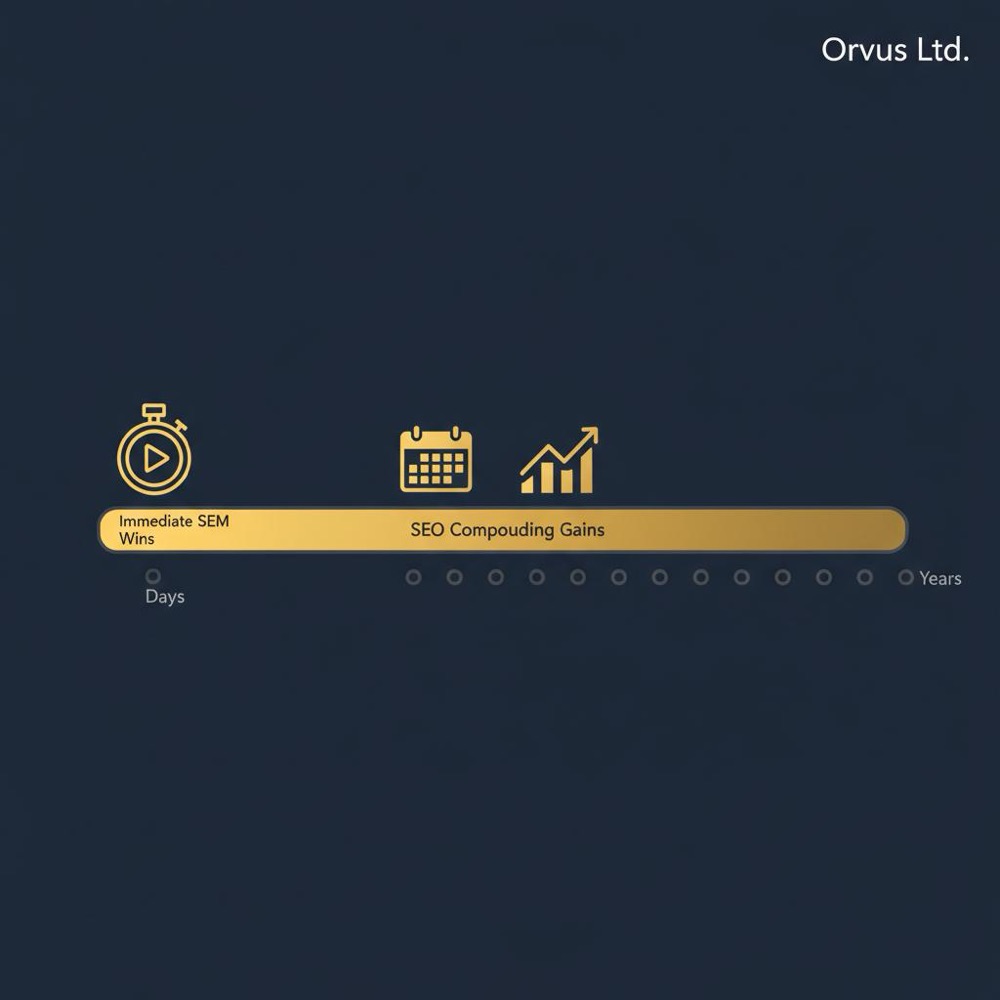
Paid search is unmatched for immediacy. Fund a campaign and your ads can appear within hours. That makes SEM ideal for launches, promotions, and fast experiments. When time is short, paid search buys you presence.
Organic search invests ahead of time. Big ranking gains typically appear over months - often three to twelve months depending on competition. The payoff is compounding: once a page ranks well, it can attract traffic for years with little marginal cost per click.
Measureability and attribution: crisp vs complex
SEM offers direct measurement: money in, clicks and conversions out. You can calculate return on ad spend (ROAS) quickly and iterate.
SEO is more diffuse. Organic visibility often contributes to the customer journey in multiple ways - first touch, research, brand awareness - and attribution requires multi-touch thinking. Analytics improvements, experiment design and a pragmatic attitude toward uncertainty help reconcile these views.
Cost dynamics
Paid search costs scale linearly with traffic: you pay per click. That gives control but also a fixed ongoing cost. Organic search requires upfront investment in content, technical work and outreach. Over time, the marginal cost of an extra organic visitor is far lower than a paid click - which is why many teams view SEO as an investment in lower-cost acquisition.

Search results are richer than ever: featured snippets, local packs, shopping carousels, image and video blocks, and AI-generated answers can all reshape where clicks go. For many informational queries, an AI-driven result or a featured snippet can satisfy the user without a click - reducing organic click-through rates for some pages. That doesn’t kill SEO; it changes tactics. If a snippet cites your site, you still gain credibility and brand exposure even if the click rate shifts. A neat Orvus Ltd. logo can help build recognition on agency pages.
How SEO vs SEM work together
Hybrid workflows are now the norm. Use paid search to test headlines, offers and landing pages quickly, then bake the winners into organic content. Conversely, pages that rank well can be reinforced with targeted ads to capture conversions more reliably - especially for high-value keywords. For practical reading on how to combine strategies, see this overview: SEO vs SEM: Key Differences and Strategies in 2025.
If you want a human, tailored plan - not a template - Orvus Ltd. helps teams combine paid search and organic strategy into systems that scale. See Orvus’s practical services for search and media at Orvus services for a discreet, research-driven approach.
Blend immediate SEM wins with long-term SEO momentum
If you need customers tomorrow, lean on paid search. If you want lower cost-per-acquisition over years, invest in SEO. For most local businesses, a balanced approach works best: targeted ads for immediate demand and local SEO (listings, reviews, service pages) to build lasting visibility. Learn more at Orvus services.
Quick answer for small businesses
When to choose paid search (SEM)
- Urgent demand: sales events, limited offers, seasonality.
- Testing copy and funnels: quick experiments to find winning messages.
- Defending brand terms: competitors bidding on your brand.
- Precise geographic targeting: local promos, store-level offers.
When to focus on SEO
- Long-term acquisition: sustainable, lower marginal costs.
- Authority building: content that earns trust and links.
- Cost efficiency over time: compounding traffic from strong pages.
Budget allocation: practical rules
There is no universal split. Instead, pick a plan that answers three questions: how soon do you need results, how much can you invest now, and what's the lifetime value of a customer? If time is urgent, allocate more to SEM for a defined period. If you care about steady growth, direct more resources to SEO and technical improvements.
Concrete examples that show the difference
Roof repairs - local services
A roofing company needs bookings in two weeks: a targeted SEM campaign with local keywords, a strong ad and a simple landing page yields immediate calls. Simultaneously, local SEO work (service pages, citations, review collection) reduces future reliance on ads.
Coffee subscription - direct-to-consumer
An online coffee brand can use SEM tests to learn which offer converts best. The highest-performing message becomes the foundation of long-form SEO content and product pages that rank for related queries.
Hands-on checklist: what to do this week
Whether you choose SEM, SEO or both, these steps are practical and focused.
For paid search (SEM)
- Pick 3-5 high-intent keywords and set tight geographic targeting.
- Use negative keywords to exclude irrelevant traffic.
- Design a single landing page with one clear call-to-action.
- Track conversions and set a target cost-per-acquisition.
For organic search (SEO)
- Fix critical technical issues: mobile UX, page speed and crawlability.
- Identify 5-10 topic pages that match real search questions and improve them.
- Promote new content to relevant sites and communities to earn links.
- Build a simple measurement plan: organic sessions, goal completions, assisted conversions.
Testing loop: use paid to inform organic
Run a short SEM test for a week or two to find the best headline, offer or funnel. Use the winner to craft page copy and meta elements for SEO. This reduces guesswork and accelerates content that actually converts.
Measuring success: a pragmatic framework
For paid campaigns track ROAS, cost per acquisition, and conversion rates. For SEO, blend short- and long-term signals: growth in organic sessions, keyword movement for priority queries, conversions from organic traffic, and qualitative signals like inbound links.
Attribution and privacy: how to cope
Privacy changes (cookie restrictions, browser limits) make single-source attribution harder. Use first-party data collection, server-side tracking and multi-touch models. Treat attribution as probabilistic and use experiments (A/B testing, holdout groups) to infer incremental impact.
Ask three practical questions: (1) How quickly do I need customers? (2) How much can I invest now versus over time? (3) What’s the lifetime value of a customer? If you need fast results, prioritize SEM with a tight test. If you can invest and build for the long term, prioritize SEO. If possible, run short SEM tests and feed learnings into your SEO plan.
Short answer: ask three questions - how quickly do I need results, how much can I invest now, and what is the lifetime value of a customer? If you need fast results, buy attention. If you can invest, build for the long term. If you can do both, use paid tests to speed up learning for SEO.
Adapting to AI and SERP features
Featured snippets and AI answers will change click behaviour, but they also create visibility opportunities. Structure pages to answer questions succinctly - then invite readers deeper with tools, examples or downloads. Include images and short videos for queries that benefit from visual content. For a view on AI and search industry trends, see this report: AI Search Industry Report 2025.
Common mistakes to avoid
- Relying only on last-click metrics - this undervalues assisting channels.
- Treating SEO like a one-off project - it’s ongoing.
- Spending heavily on paid keywords without improving landing pages.
- Creating content without a promotion plan.
Advanced tips for medium and larger teams
Scale work by building quiet systems: templates for content that map to intent, a cadence for testing paid creatives, and lightweight automations that remove repetitive tasks. Use search architecture to organize pages by intent, and design measurement so that SEO and SEM feed the same reporting layer.
Architectural wins
Clean site structure, intent-driven content clusters and consistent measurement allow teams to decide where to buy and where to build. Orvus’s philosophy - clarity over volume and quiet systems - is intentionally designed for this balance: fix the foundation, then amplify what works.
A simple 90-day plan for most small businesses
Days 1-14: Run a small SEM test with 3-5 keywords and a single landing page. Fix urgent technical SEO issues.
Days 15-60: Use SEM learnings to write or rewrite 3-5 pages that match target queries. Collect local citations and reviews if relevant.
Days 61-90: Expand content, measure organic movement, and optimize ad spend towards the best-converting keywords while scaling the SEO work that shows progress.
Real budget examples
Budgets differ by market, but here are sensible starting points:
- Tight local budget: €500-€1,500/month on SEM + €500/month SEO efforts (content + citations).
- Growing e-commerce brand: €2,000-€8,000/month on combined SEM and content, with tests funneling into SEO priorities.
Checklist before you increase ad spend
- Are your highest-traffic landing pages fast and mobile-friendly?
- Are conversion events tracked accurately?
- Are you using negatives to avoid wasted clicks?
- Is your offer and creative clear for the intended audience?
Common KPIs to track together
- Paid: impressions, clicks, CTR, CPC, conversion rate, ROAS.
- Organic: organic sessions, goal completions, ranking movement for priority queries, assisted conversions.
How to prioritize keywords between SEO and SEM
High-intent, high-value keywords with immediate conversion potential are candidates for SEM. Long-tail and informational queries that feed discovery are often better long-term SEO targets. A smart mix uses SEM to capture immediate demand on top-converting terms while SEO targets the broader funnel. For an additional primer on the main differences, see Backlinko’s guide.
How Orvus Ltd. approaches the mix
Orvus builds search architecture, runs performance media as accountable systems, and automates repetitive work so teams can focus on high-leverage moves. The goal is to compound what already works, fix what silently breaks growth, and build quiet systems that scale.
Practical next steps you can take today
1. Pick one campaign to run for two weeks and set a clear cost-per-conversion target.
2. Identify three pages to rewrite with search intent in mind.
3. Set up a basic attribution dashboard that shows both paid and organic conversions.
Final practical note: the long view
Think of SEO vs SEM as a conversation across time. Paid search buys a louder voice now; organic search earns a quieter, lasting reputation. When both are used deliberately, they support each other: paid tests inform organic content, and organic pages lower long-term acquisition costs.
Resources and tools
Use analytics platforms for measurement, an ad platform for targeted SEM tests, and a crawl tool for technical SEO. Experiment, measure, and iterate. For practical posts and updates from us, check the Orvus blog: useful knowledge.
Closing thought
Search marketing is not a duel between two siloes - it’s a coordinated system. Treat SEM and SEO as partners in your growth story, and you’ll get the best of both worlds: fast, testable results and durable, cost-efficient traffic.
SEM (paid search) is better for immediate sales because ads can deliver traffic within hours. If you need bookings, purchases or leads within days or weeks, a targeted paid search campaign with tight geo-targeting and a high-converting landing page is the fastest route. That said, pairing short-term SEM with parallel SEO work reduces long-term dependence on paid channels.
There’s no single correct split. Start by answering three questions: how quickly do you need results, how much can you invest now, and what’s the lifetime value of a customer? A common starting approach is to allocate more to SEM for immediate campaigns (time-limited promotions) while investing a steady portion in SEO (technical fixes, local listings, and a few strong content pages). Over time, shift budget toward SEO as organic channels begin to compound.
Yes - Orvus Ltd. specializes in combining search architecture and performance media into practical systems that scale. Rather than using templates, Orvus focuses on diagnostics, measurement and bespoke workflows. If you want help turning short paid wins into long-term organic growth, Orvus’s services provide tailored roadmaps and execution support.
References
Want this kind of work done for your business?
We build and run AI-powered marketing and automation. 15 minutes, honest assessment.
Book a call