 Orvus
OrvusWhat is a good hook sentence? A pragmatic guide to writing a hook
February 1, 2026
The advice combines academic writing guidance with usability and marketing practice, and focuses on clear, repeatable steps operators can use in content workflows. The emphasis is on testing variants and measuring downstream metrics, not on one fixed formula.
What a hook does: definition and attention mechanics
What we mean by a hook: relevance, curiosity, or value signal, writing a hook
A hook is a short opening that signals relevance, creates a reason to keep reading, and sets an expectation for what follows, a pattern taught in university writing centers as the core of effective introductions Purdue Online Writing Lab.
At a practical level a hook reduces cognitive friction by orienting attention and making the reader's next step clear, which increases the chance they continue reading; cognitive research links openings that reduce friction to higher engagement, though the effect size depends on audience and content type Frontiers in Psychology and research on web reading patterns How People Read Online.
quick micro edit routine to check a draft hook
Run in one minute
Think of a hook as a signal, not as showmanship. A clear relevance signal tells a reader why the page is worth their time. A curiosity prompt can work when the audience is already open to exploration. Choosing between those goals is a tactical decision based on who you expect to read the piece, and what action you want them to take Harvard College Writing Center.

Common hook types and the rhetorical job each does
Anecdote and scene-setting
An anecdote opens with a short, concrete scene that demonstrates the problem or benefit the piece will address. Example, "On launch day the checkout crashed, and the team learned where their funnel was weakest." Use an anecdote when empathy and narrative momentum help set up the argument Purdue Online Writing Lab.
Question and prompt
A question hook asks the reader something that matches their immediate need, for example, "Want a hook that actually makes readers stay for the first paragraph?" Use a question when you can state the reader's problem quickly and invite them to look for an answer Harvard College Writing Center.
Startling fact or statistic
A startling fact or statistic can interrupt scrolling and create curiosity; an example is, "Most visitors leave within seconds when value is unclear." For web contexts prefer short facts with a clear value cue so the reader knows why the number matters, consistent with usability research on concise value signals Nielsen Norman Group.

A concise claim tells the reader what the piece will deliver, for example, "Three edits to double email opens." Use this style on landing pages and blog leads when clarity and immediate utility are the primary goal Nielsen Norman Group.
Writing centers recommend that these types are choices, not prescriptions; match the hook type to audience and purpose rather than defaulting to one style Harvard College Writing Center.
A simple framework to write a hook that fits your audience
Step 1: name the immediate reader need
Step one is explicit. Write one sentence that names the reader's immediate need, for example, "You need a first sentence that keeps scanners on the page." That sentence becomes the anchor for the hook and the rest of the lead Harvard College Writing Center.
Step 2: pick the functional hook type
Step two is tactical. Choose a hook type that fits your goal, either a relevance signal, a curiosity prompt, or a succinct value statement. Treat the choice as a hypothesis to test rather than a rule, and prefer explicit value for conversion-focused pages HubSpot Blog.
Step 3: write short, check clarity, and set expectation
Step three is editing. Tighten the hook to one or two lines, make sure it names or implies the audience, and end the lead with a clear transition to the thesis or next section. For web readers scannability is important, so favor short words and direct phrasing Nielsen Norman Group.
Try these steps on one draft, then evaluate for Consultation
Try the three steps on one draft hook and see which variant feels clearest before you save the file.
After you test a draft, treat the hook as a measurable element in the content brief. Record which type you used and why, so future iterations learn from past outcomes HubSpot Blog.
Deciding which hook type suits your channel and goal
Academic essay and longform: clear thesis pathway
In academic and longform writing the opening often needs to narrow toward a thesis and provide roadmap signals, so minimalism and a clear transition are preferred to novelty Purdue Online Writing Lab.
Blog posts and landing pages: explicit value signals
For web posts and landing pages, concise hooks that state the value or outcome help scanners decide to commit, an effect observed in usability work on headlines and online hooks How Users Read on the Web and in research on concise value signals Nielsen Norman Group.
Email subject lines and social: scannability and curiosity
Short-form channels favor hooks that either signal a clear benefit in a few words or create a specific curiosity gap; marketing practitioners advise A/B testing subject lines and social copies to see which approach drives CTR in your audience HubSpot Blog.
A useful rule of thumb is this, choose clarity when someone must understand the offer quickly, choose curiosity when you can test for uplift and measure downstream engagement HubSpot Blog.
Practical templates and short examples to adapt
Five quick templates for blog, email, social, essay, and product page
Blog lead template: "If you want X, try Y to reduce Z." Example, "If you want fewer cart drop offs, try these three checkout edits."
Email subject template: "How to X in Y minutes" Example, "How to cut refund rates in 30 minutes."
Social post template: "Do you ever X? Here is one idea." Example, "Do you ever lose time to manual reports? Try this."
Essay opener template: "[Brief scene], which shows [problem], and raises the question of [thesis]." Example, "At the lab, the experiment failed, which shows structural limits, and raises questions about measurement methods."
Product page template: "A simple claim about outcome, plus one sentence on how." Example, "A faster checkout that reduces friction by simplifying steps."
A good hook sentence signals specific value or creates a measured curiosity gap, is scannable, names or implies the audience, and leads clearly to the next sentence.
To adapt a template, change one concrete detail to match your reader and replace generic language with a specific problem or audience term; this keeps the hook grounded and relevant.
Templates are starting points. Practitioners recommend testing variants in performance channels to see which wording moves real metrics before standardizing templates across teams HubSpot Blog.
How to A/B test hooks and measure impact
Key metrics to track for each channel
Choose metrics that map to the reader action you care about. For social and email the immediate metric is CTR. For blog content measure time on page, scroll depth, and conversion for downstream outcomes HubSpot Blog.
Designing simple experiments and iterating
Keep tests small and consistent. Test one variable at a time, reuse the same body copy, and run variants long enough to see stable trends. Record naming and versioning so results are interpretable across campaigns HubSpot Blog.
Remember that cognitive research shows opening effects vary by audience and context, so local validation is essential and you should not assume a universal winner Frontiers in Psychology.
Common mistakes and how to avoid them
Overpromising or vague openings
A common error is an overpromising or vague hook that raises expectations the content does not meet. Fixes include tightening the value signal and ensuring the opening aligns with the article's thesis Purdue Online Writing Lab.
Ignoring scannability and audience intent
Long, ornate openings that require effort from scanners often lose readers. Prefer short, direct phrasing online and name the audience or problem early to reduce friction Nielsen Norman Group.
Choosing novelty over clarity
Novelty for its own sake can create distrust if the content does not deliver on the implied promise; when in doubt choose clarity, especially in technical or academic contexts UNC Writing Center.

One practical corrective is to run a quick readability pass, then map the opening to the promised next sentence so readers get a coherent lead-in to the main argument.
A short checklist to edit and tighten your hook
Five quick editing checks
1. Does it signal a specific value? 2. Is it one or two lines? 3. Is it scannable? 4. Is the audience named or implied? 5. Does it lead to the next sentence?
A one-minute tightening routine
Read the hook aloud, remove filler words, replace vague nouns with concrete problems, and ensure the final clause points to the thesis or section that follows. Use the checklist as a habit in every content review Purdue Online Writing Lab.
Use the checklist as a habit in every content review Purdue Online Writing Lab.
Examples: converting weak openings into strong hooks
Four before-and-after rewrites across formats
Essay before, "In this paper I will discuss X." After, "When the data failed to replicate, the implication was that measurement needed redesign, which this paper examines." Why it works, the revision narrows quickly to the problem and signals the thesis Harvard College Writing Center.
Blog before, "This article covers ways to improve your checkout." After, "Three small checkout edits that reduce friction and raise completed purchases." Why it works, the revision names the outcome and is scannable for web readers Nielsen Norman Group.
Email subject before, "Open this email for tips." After, "Cut manual reporting time by 30 minutes, here is how." Why it works, the revised subject promises a specific benefit and suggests a quick read, making CTR more likely HubSpot Blog.
Social before, "Interesting thoughts on product." After, "You might be wasting time on manual reports, try this one change." Why it works, the change creates a concrete curiosity gap tied to a problem the audience recognizes HubSpot Blog.
When not to focus on a flashy hook
Situations that prioritise clarity over curiosity
There are contexts where novelty hurts more than it helps. In technical documentation, policies, and many academic introductions the priority is clear roadmap and thesis narrowing, not surprise or provocation UNC Writing Center.
Academic and technical contexts
Follow university guidance that introductions should lead the reader toward the thesis and avoid irrelevant flourish; a minimal, well signposted opening improves comprehension in these settings Purdue Online Writing Lab.
How hooks differ across platforms: practical constraints
Social and search-first snippets
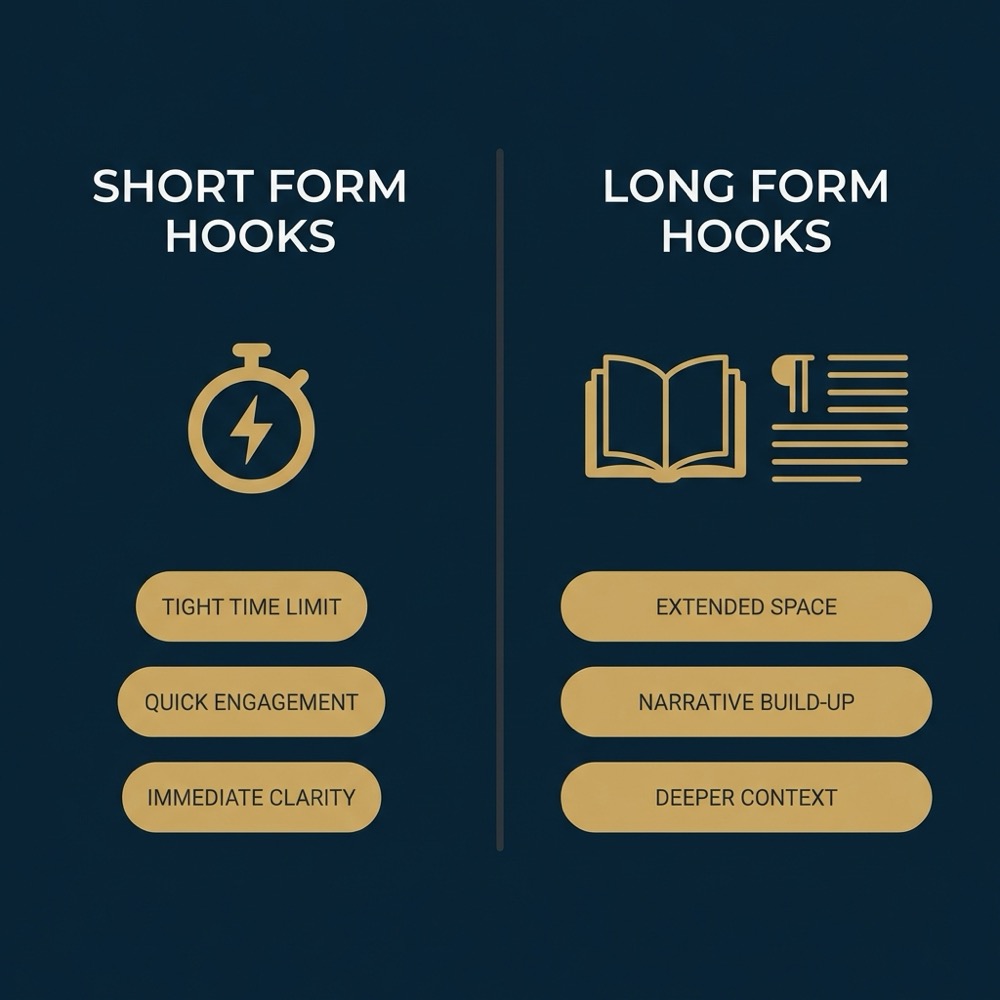
Short-form platforms impose character limits and favor immediate value or curiosity; map tests to CTR and use concise language that signals benefit quickly Nielsen Norman Group.
Longform and SEO-aware openings
Longer articles need openings that both engage and signpost the structure to search engines and readers. A clear lead that states the problem and outlines the sections improves usability and helps measurement across organic channels Website Reading.
Match your hook length to the platform constraint, and track channel-specific KPIs so you learn which format works for your audience.
Integrating hooks into content workflows and team review
Naming, versioning, and quick experiments
Add hook variants to your content brief and use explicit naming for tests, for example Hook-A, Hook-B, with a short note on the intended audience and metric to track. This makes results repeatable and learnable across cycles HubSpot Blog.
How to make hooks part of editorial checklist
Add the one-minute tightening routine to editorial reviews, require a stated hypothesis for each variant, and tie experiments to downstream KPIs so the team learns which phrasing supports conversion versus which supports longer reads. A systems builder can help embed naming and reporting systems without promising outcomes Harvard College Writing Center.
Summary: quick rules and next steps
Five quick rules to remember
Signal value, match the channel, keep it short, test variants, and measure downstream outcomes.
Next steps: test, measure, iterate
Immediate exercise, pick one page and write three hook variants, run a quick A/B test, and compare CTR or engagement to decide which variant to keep. Effect sizes differ by context, so local tests are the decisive evidence HubSpot Blog.
For web readers aim for one or two concise lines that clearly state a value or create a limited curiosity gap; scannability is important.
For essays prefer an opening that narrows toward the thesis, often using a concise scene or claim that sets up the argument.
Run small A/B tests in the channel you care about and track CTR and downstream engagement to see which variant performs for your audience.
Applying these steps in a disciplined way will give you more useful data than relying on general rules alone.
References
- https://writingcenter.fas.harvard.edu/pages/strategies-essay-writing
- https://www.nngroup.com/articles/how-people-read-online/
- our knowledge base
- https://www.nngroup.com/articles/how-users-read-on-the-web/
- our services
- https://writingcenter.unc.edu/tips-and-tools/introductions/
- https://www.nngroup.com/articles/website-reading/
- about Orvus
- orvus.net
Want this kind of work done for your business?
We build and run AI-powered marketing and automation. 15 minutes, honest assessment.
Book a call