 Orvus
OrvusIs Google a SERP? Guidance for search architecture
February 12, 2026
Operators and founders will find practical steps: how to inspect a live SERP, which schema types to consider, content patterns that improve eligibility, and experiment designs to validate business impact. The guidance is pragmatic and conditional: apply tests, measure, and iterate within your constraints.
What Google is vs what a SERP is
Definitions: search engine, search ecosystem, and SERP
At a high level, think of Google as the search ecosystem that collects signals, runs ranking systems, and delivers results. A SERP is the concrete page that Google renders for a specific query; it is the surface where users see organic listings, ads, and rich features. When you plan work, target the SERP as the unit you can observe and influence, not Google as a vague channel.
Distinguishing the two matters because the SERP is what users interact with. Many modern features sit on the SERP and change where attention lands, so treat page-level exposure as the measurement boundary for short term experiments. This practical difference is important when you design content, markup, and attribution for search architecture, and it shapes which pages you should test first. Google Search Central search features overview
Request a consultation on the Orvus services page
Run a quick intent-to-feature audit: map your busiest landing pages to the likely SERP elements they encounter. Orvus Limited can help as a systems partner for a focused audit and testing plan, without promising outcomes.
Why the distinction matters for systems and measurement
When reporting, avoid treating "Google" as a single, monolithic channel. The same property can appear in different feature contexts that drive different behaviors, so you need page and feature granularity to understand impact. Frame attribution around the SERP exposure and the landing page interaction rather than a generic channel label. See Orvus Ltd. about page.
For teams building search architecture, this means making decisions about content, markup, and funnels with the specific feature set in mind. Design content to match user intent and the feature opportunity on the SERP, then instrument metrics that link exposure to conversions so the work can be validated. What is a SERP feature? guide from Search Engine Land Conductor also offers guidance on result types.
Why the distinction matters for measurement and systems design
Attribution boundaries: page exposure, features, and revenue
Attribution boundaries shift when features change where users click. A knowledge panel or AI Overview can reduce visits to organic listings, even when overall interest in a query remains high. That is why feature-level impressions and clicks are necessary metrics when you try to link search work to revenue.
Search architecture should map content and markup to intent-feature pairs. That mapping makes it possible to test whether a change to markup or copy increases qualified leads or order conversions, rather than only moving raw clicks. For practical tracking, surface feature impressions in Search Console alongside landing page conversion metrics in analytics. SERP features and CTR study from an industry analysis
How search architecture maps to revenue signals
Design content flows so high commercial-intent queries land on pages instrumented for conversion events. Use concise answers and schema types where appropriate to increase eligibility for features that match the commercial funnel. Then connect those pages to revenue attribution paths so feature-driven traffic is visible in business reports.
When feature-driven traffic is measured at the page level, teams can prioritize work by expected commercial impact and measurement clarity. This reduces wasted effort on superficial feature chasing and focuses resources on changes you can validate. Google Search Central search features overview
Anatomy of a modern Google SERP
Core elements: organic listings and paid ads
Modern SERPs still include organic listings and paid ads. But those are now part of a richer canvas. The order, prominence, and mix can vary by query, device, and locale, so expect different placements for the same intent across sessions.
No. Google is the search ecosystem; a SERP is the individual results page Google renders for a query. Treat the SERP as the unit of work for inspection, optimization, and measurement.
Rich features: local pack, knowledge panel, snippets, carousels, AI Overviews (SGE)
Beyond links and ads, SERPs often show local packs, knowledge panels, featured snippets, image and video carousels, and AI-powered overviews. These elements change where users look and which page types earn clicks, so build content with feature eligibility in mind. Google Search Central search features overview
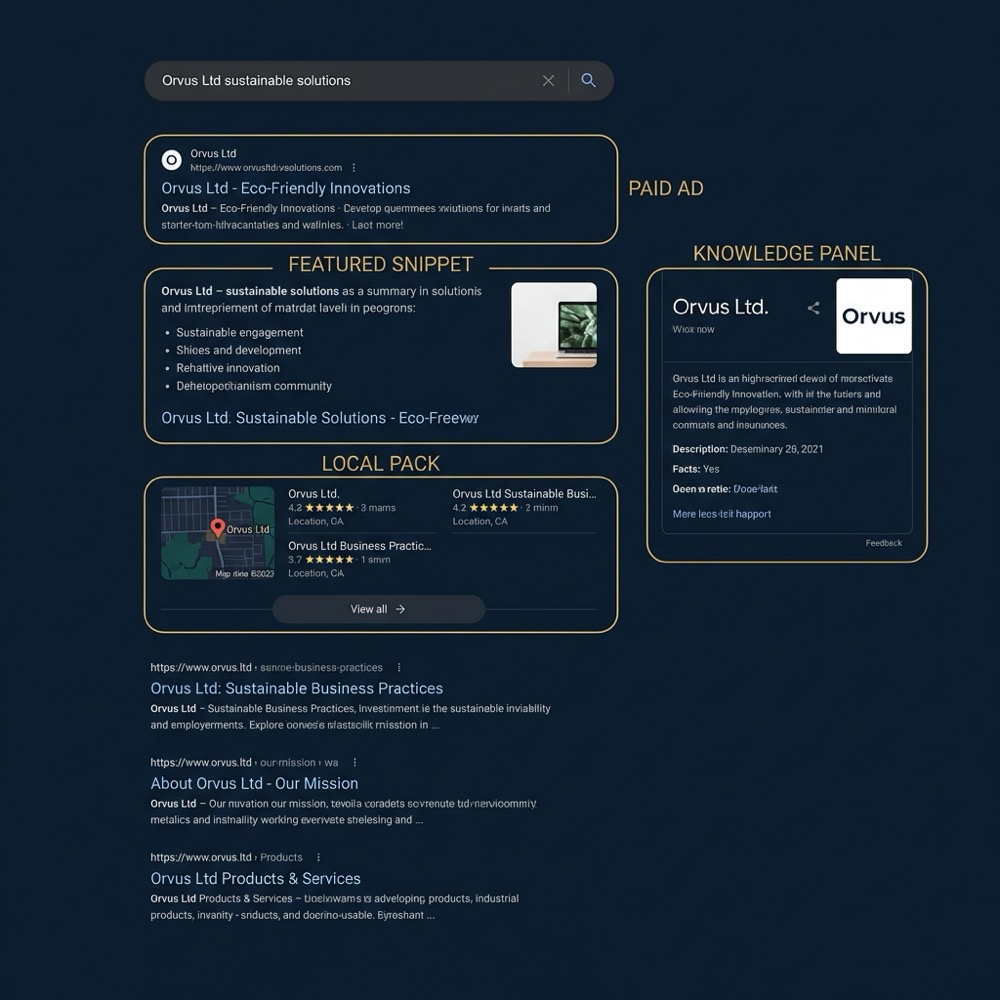
Eligibility is commonly influenced by structured data and content shape. Structured data can make your content clearer to the indexing systems and improve the chance that a particular element is shown, though inclusion is not guaranteed. Use markup and concise content to match the feature's expectations.
Anatomy recap and quick lens
Visualizing where attention goes on the page
Picture the SERP as zones of attention. Top of page and any prominent panel draw quick glances. Carousels and image blocks pull visual focus. Text-based snippets can capture fast answers. Mapping your content to these zones helps you choose placements and formats that align with user intent and business goals. Guide on optimizing for modern SERP features from a practitioner source Also see Semrush's guide.
How SERP features change user behavior and clicks
What studies show about CTR and feature presence
Industry analyses indicate that SERP features materially shift click distributions relative to a classic list of links. The presence of a snippet, knowledge panel, or AI Overview can draw clicks away from traditional listings, so expect shifts when features appear for target queries. SERP features and CTR study from an industry analysis
Because the magnitude of change varies by feature and by intent, you cannot assume a single outcome. Use controlled experiments and monitor query-level performance to see whether feature eligibility helps or reduces valuable traffic.

Why the effect varies by intent and feature type
Informational queries tend to favor answer-rich features that satisfy intent on the SERP, while transactional queries still funnel users to product or checkout pages. An AI Overview may satisfy quick informational needs, yet a product carousel is more likely to support shopping intent. Match effort to intent to preserve measurement clarity.
Treat initial wins cautiously. A rise in feature impressions might show higher visibility but not necessarily higher conversions. Always pair visibility metrics with page-level conversion metrics to validate impact. How to optimize for modern SERP features guide
The technical path: structured data and markup for SERP features
Schema.org vocabularies and Google guidance
The accepted technical route for many rich features is structured data using schema.org vocabularies, applied according to Google’s structured-data guidance. Properly used, schema helps systems understand the page purpose and the content elements you want to highlight. Google Search Central structured data overview
Common schema types include FAQ, HowTo, Product, LocalBusiness, Review, and Article. Use the types that match the page intent. Avoid overloading pages with mismatched types; correct application matters more than breadth. Schema.org core vocabulary

Common markup patterns that enable rich results
Implement markup for the content you want to surface. For example, FAQ schema supports question and answer pairs, Product schema surfaces price and availability, and HowTo schema provides ordered steps. After implementation, test with Google's Rich Results Test to check eligibility and error reports. Google Search Central structured data overview
Validate markup, then monitor Search Console for enhancement reports. Fix warnings and errors promptly. Correct markup is a necessary step, not a guarantee of feature appearance, so measure and iterate.
How to inspect a live SERP and diagnose feature appearance
Hands-on checks: view-source and Chrome DevTools
Start with manual checks. View the page source and inspect rendered DOM in Chrome DevTools to confirm the presence and structure of JSON-LD or microdata. Confirm that snippets and visible text match the content you marked up, since content mismatch often blocks eligibility.
Use the Rich Results Test and Search Console for structured data diagnostics. These tools will show whether Google recognizes your markup and will flag common errors you can fix. Google Search Central structured data overview
steps to inspect a SERP feature and page markup
Run these checks in this order
Tools: Search Console, Rich Results Test, third-party SERP APIs
Search Console surfaces feature impressions and enhancement reports. The Rich Results Test checks eligibility. Third-party SERP tools or APIs help with aggregated comparisons and trends across queries or competitors, aiding prioritization and monitoring. Use these tools together to triangulate cause and effect. Guide to types and inspection from Search Engine Land Nightwatch also explains SERP data in depth.
Document any differences between the rendered page and the structured data that Search Console reports. Often small DOM changes, templating issues, or deferred rendering can break eligibility; DevTools and the Rich Results Test are the fastest way to find these issues.
Framework: map intent to feature opportunity
Step 1: classify query intent and business value
Start by grouping queries by intent: informational, commercial investigation, transactional, and navigational. For each group, score business value by conversion likelihood and revenue per conversion.
Keep the process simple. High-value transactional intent gets higher priority. Informational intent can be valuable if it feeds commercial pages downstream, but instrument that path before heavy investment. Google Search Central search features overview
Step 2: map intent to likely SERP features
For each intent group, map the SERP features that commonly appear. Informational queries are candidates for featured snippets and AI Overviews; local queries map to local packs; product queries map to product carousels and Product schema. This mapping narrows technical work to the features that matter for intent.
Use historical SERP inspections and third-party tools to validate the mapping before large scale implementation. Feature frequency can vary by query and locale, so sample broadly. How to optimize for modern SERP features guide
Step 3: prioritize by effort and expected measurement clarity
Prioritize work where the required markup and content changes are feasible and where outcomes are measurable. Low-effort, high-clarity tasks like adding FAQ schema for clearly matched pages often belong near the top of the backlog.
Couple every prioritized item with a measurement plan: what feature impressions, clicks, and conversions you expect to move, and how you will test that movement. Prioritization without measurement invites wasted effort. Google Search Central search features overview
Content and UX patterns that improve eligibility for features
Answer-first copy and concise summaries
Write an answer-first lead for pages that target snippet-like features. Place the concise answer near the top so systems and users find it quickly. Follow the concise lead with supporting detail to serve longer sessions and conversion flows.
Concise copy increases the chances of being used in an answer box or AI Overview, but it should not remove useful depth from the page. Balance a short lead with layered content so both quick-answer users and deeper researchers are served. Guide on optimizing content for SERP features
Page structure, headings, and markup to support snippets
Use logical headings, short paragraphs, lists, and tables where appropriate. These structures help extraction for featured snippets and also match schema types. Ensure headings reflect queries and provide clear anchor points for concise answers.

When you add schema types, make sure the page content visibly contains the same information as the markup. Discrepancies between visible content and structured data reduce trust and eligibility. Google Search Central structured data overview
UX trade-offs: balance depth with concise lead answers
Sometimes a concise answer may reduce page time or session depth for certain queries. That is not inherently bad if conversions improve or the page better serves its intent. Test changes and measure conversion pathways before wide rollout.
A pragmatic pattern is to A/B test the answer-first lead on a sample of pages and measure both short term clicks and downstream conversion events. Use a phased rollout tied to the measurement plan to limit risk. Industry analysis on CTR and feature presence
Measurement: instrumenting attribution and experiments for feature-driven traffic
What to track: feature impressions, clicks, conversions
Track feature impressions and clicks in Search Console and tie those queries to landing page conversion events in analytics. Collect revenue attribution where possible so you can compare the business impact of feature exposure versus traditional organic traffic. Google Search Central search features overview
Experiment design and validation for feature changes
Design experiments that isolate the feature change. Options include holdout pages, phased rollouts, or split tests where platform and technical constraints permit. The goal is to attribute movement in conversions to the feature change rather than seasonality or query shifts.
In many cases, start with a small set of pages and a holdout group. Measure feature impressions, clicks, and conversion delta over a suitable window, and expand only when results are clear and repeatable. Analysis showing the variability of CTR shifts
Decision criteria: when to optimize for a feature versus traditional SEO
Business value and measurability
Ask three questions: does the feature match the query intent, is the expected traffic or conversion lift material, and can you measure the outcome clearly? If answers are yes, prioritize feature work.
Features that deliver clear measurement and align with commercial intent make better short-term bets than features that are purely visibility-focused without a conversion path. Prioritize accordingly. Optimization guidance for modern SERP features
Cost and technical constraints
Some features need only content changes; others require template work or backend data exposure. Estimate engineering effort and the risk of site-wide regressions. Low-risk, high-value items should be handled first.
If the cost of implementing required markup is high relative to expected gain, consider alternative investments in conversion optimization or paid search funnels until the case improves. Study on feature effects and variability
Typical mistakes and common pitfalls
Markup errors and over-claiming eligibility
Common errors include incorrect field names, missing required properties, and adding unrelated schema types. These mistakes generate errors in Search Console and prevent eligibility. Validate markup with the Rich Results Test before deployment.
Do not mark up content that is not visible to users or that misrepresents the page. Correctness matters more than quantity for structured data. Google Search Central structured data overview
Ignoring intent and measurement
Another frequent pitfall is optimizing for a feature without defining how success will be measured. This can create false positives where impressions rise but business metrics do not. Always tie feature work to conversion events and revenue signals.
Err on the side of conservative validation. Use holdouts and phased rollouts to confirm that feature changes deliver useful business outcomes before scaling. Evidence that outcomes vary and need measurement
Practical examples and scenarios
Ecommerce product pages and Product markup
Scenario: an ecommerce site adds Product schema and creates concise product summaries to target product carousels and rich snippets. Implementation includes structured Product data, clear price and availability fields, and an answer-first lead that highlights purchase differentiators.
Measurement plan: track product-related feature impressions in Search Console, clicks to product pages, and conversion rate for the rolled-out pages versus a holdout set. Validate before expanding the approach to the full catalog. Google Search Central structured data overview
Service business: local pack and FAQ markup
Scenario: a local service provider prioritizes local pack presence and adds LocalBusiness markup and FAQ schema to high-intent service pages. The page lead answers common booking questions, and FAQ markup structures Q and A pairs for potential snippet use.
Measurement plan: monitor local pack impressions and clicks, landing page bookings, and conversion events captured by the booking flow. If local visibility improves but bookings do not, investigate on-site friction or attribution gaps. Google Search Central search features overview
Implementation checklist and near-term priorities
Quick wins first: map intent to feature opportunities, add FAQ or Product markup where it matches page intent, and validate with the Rich Results Test. These moves often have low engineering cost and clear measurement paths. Google Search Central structured data overview See our knowledge hub Useful Knowledge.
Next, prioritize pages by commercial value and implement answer-first leads for pages targeting snippet-like features. Pair each change with a measurement plan and a holdout or phased rollout. Monitor Search Console enhancement reports and feature impressions. Google Search Central search features overview
Conclusion: treat SERPs as the unit of work for modern search architecture
Summary: Google is the ecosystem and the SERP is the concrete page you can inspect and influence. Build search architecture around intent-feature mapping, correct structured data, concise answer-first content, and instrumented measurement so you can validate outcomes.
Next step: run an intent-to-feature audit for your highest-value pages, implement low-cost schema where appropriate, and test with a clear measurement plan. This systems approach helps teams focus effort on changes they can observe and validate. Google Search Central search features overview Contact Orvus Ltd..
Google is the search ecosystem that creates and delivers results; a SERP is the specific results page a user sees for a query. The SERP is the practical unit to inspect and measure.
Structured data is the primary technical path for many rich features, but correct content shape and relevance also matter. Schema increases eligibility but does not guarantee placement.
Track feature impressions and clicks in Search Console, and tie those queries to landing-page conversions and revenue in analytics. Use holdouts or phased tests to validate impact.
If you have complex templates or many pages, prioritize by commercial value and measurement clarity before broad rollouts.
Want this kind of work done for your business?
We build and run AI-powered marketing and automation. 15 minutes, honest assessment.
Book a call