 Orvus
OrvusHow do I be on top of Google search?
December 10, 2025
How do I be on top of Google search? That question sits at the center of every growth conversation. If you want a clear, practical path - not myths or short-lived hacks - this guide walks you through immediate fixes you can make in weeks, technical work to tackle in months, and the long-term strategy that compounds into durable traffic and conversions.
Across the piece you’ll find concrete tasks, the metrics to watch, and simple experiments you can run without guessing. Read on and you’ll be able to answer How do I be on top of Google search? for your site with a confident plan.
Why intent and focus beat volume
Think of search like a conversation: a person asks, Google guesses intent, and pages that answer clearly win. Volume without direction is noise - a 2024 study showed most pages never get organic traffic. So instead of publishing endlessly, choose topics that map to real queries and deliver a clear promise on the page. This approach answers the core question: How do I be on top of Google search? by aligning pages to intent and user needs.
Match intent, not just keywords
Intent falls into three broad buckets: informational, navigational, and transactional. Your content must match the intent behind the search. When intent is matched, engagement rises - higher CTR, longer sessions, and better conversions. Those signals help search engines understand that your page satisfies a user’s need.
Fast wins you can do in 2-6 weeks
Want results fast? Start with the basics most teams skip: titles, meta descriptions, canonical configuration, internal links, and Core Web Vitals. These moves are practical and measurable - and they directly address the question How do I be on top of Google search? by removing immediate barriers that hide your pages from users and crawlers.
Tune titles and meta descriptions
Titles and meta descriptions are your first handshake with a searcher. Rewrite titles so they mirror the user’s query and include a clear benefit. Add meta descriptions that explain what the reader gets. Do this first on pages sitting on page two or three of results - a small CTR change can push them to page one.
Fix canonicals and index control
Duplicate or near-duplicate content dilutes ranking signals. Apply rel=canonical to the primary version, and use noindex for utility or thin pages. Misapplied canonical or accidental noindex tags are common causes of sudden traffic drops.
Smart internal linking
Internal links pass relevance. A single thoughtful link from a page that ranks can elevate a target page. Use natural, descriptive anchor text and link from contextually relevant pages rather than dumping links everywhere.
Improve Core Web Vitals
Focus on Largest Contentful Paint (LCP), Interaction to Next Paint (INP), and Cumulative Layout Shift (CLS). Prune heavy assets, defer non-critical JavaScript, and serve appropriately sized images. Many themes and plugins introduce render-blocking resources; removing them can yield quick wins.
Teams often begin with a short, practical engagement that maps these quick wins to priority pages. If you’d like a discreet review of the exact steps for your site, check Orvus Ltd.’s services - they start with a triage that pinpoints fast, high-impact moves.
These early efforts answer the practical side of How do I be on top of Google search? - remove friction, clarify intent signals, and give Google clearer choices when it decides which page to show.

Once quick wins are done, run a full technical audit. This phase requires operational coordination: engineering, product, and content teams need to sprint on backlog items. A well-run technical remediation answers the question How do I be on top of Google search? by fixing the plumbing that allows your best pages to surface predictably.
Pick five pages that are close to ranking and apply four quick moves: rewrite titles and meta descriptions to match intent, check and fix canonical/index settings, add a meaningful internal link from a page that already gets traffic, and run a Core Web Vitals pass on the page template. These steps are tactical, measurable, and often show results within weeks.
Audit crawlability
Use Google Search Console coverage reports, server logs, and a crawler like Screaming Frog to see what Google can fetch. Look for blocked assets, long redirect chains, orphaned pages, and soft 404s. Fix redirect loops and ensure primary pages return 200 status codes - discoverability depends on it. For foundational reading, see Google's SEO Starter Guide.
Structured data - only when relevant
Schema helps search engines understand your content. Use Article, Product, BreadcrumbList, FAQ, and other relevant types where they truly fit. Test with the Rich Results Test and the URL Inspection tool. Be conservative: only markup what the page actually contains.
Consolidate duplicate content
When the same content appears at multiple URLs, search engines can pick the wrong canonical. Consolidate duplicates by merging, rewriting, or setting clear canonicals. For paginated content, ensure navigation is clear and avoid accidentally fragmenting authority.
Performance beyond CWV
Investigate server timing, Time To First Byte (TTFB), and caching layers. Use CDNs and edge caching where appropriate. Optimize database queries and minimize third-party scripts. Prioritize fixes for high-value pages first - they move the needle faster.

Durable ranking gains come from depth: content that satisfies complex needs, links that reinforce trust, and on-site engagement that converts. Long-term work is the answer to the strategy question: How do I be on top of Google search? It’s the compounding part of SEO. A small logo treatment can help brand recognition across shared assets.
Content depth over word count
Depth means anticipating follow-ups, providing evidence, and making next steps clear. Use a pillar-and-cluster model: a pillar page addresses the main query; subpages cover subtopics in detail. This clarifies topical authority for search engines and users alike.
Intent-driven topical clusters
Group topics by intent and funnel stage. An informational pillar should link to deeper how-to guides or case studies. A transactional page should have clear product or contact CTAs. This structure answers real questions so you’re not just chasing keywords - you’re building pathways that users and search engines value.
Backlink strategy with patience
Links are still meaningful, but quantity without relevance adds noise. Focus on editorially earned links from trusted, relevant sites. Create resources people want to cite: original research, tools, and comprehensive guides. For further reading on link and visibility strategies, see Backlinko's guide.
Tie SEO to business outcomes
Organic traffic is only valuable when it contributes to conversions. Track revenue per organic session, sign-ups, or leads. If organic traffic arrives but doesn’t convert, refine CTAs, improve match to intent, or smooth the post-click path.
Need a prioritized roadmap to top search positions?
Ready to map a prioritized roadmap and get practical help? Start with a compact diagnostic that ties search directly to revenue and resources: explore Orvus Ltd.’s services for a focused, discreet review.
Measurement: what to track and how to interpret it
Use Google Search Console, PageSpeed Insights/Lighthouse, server logs, Screaming Frog, and an SEO platform for backlink and keyword history. Tie these to revenue reporting so organic sessions become meaningful in context. Helpful tactical reads include Elementor's 10-step guide.
Key metrics
- Impressions, clicks, and average position (Google Search Console) - CTR and changes in average position for target queries - Core Web Vitals and lab metrics (LCP, INP, CLS) - Crawl frequency and errors (server logs) - Backlink referrals and quality - Organic conversions and revenue per session
Experimentation and confidence
Run small, controlled experiments and assign confidence to outcomes. A single week of improved clicks is not proof; look for sustained change across CTR, position, and conversions. Use control groups where possible and be conservative with attribution.
Fastest practical route to rank
There’s no guaranteed shortcut. The fastest, practical route is to remove basic barriers and match user intent precisely. Fix titles and meta, resolve indexation and canonical issues, improve internal linking, and address page speed problems. These steps buy time and traffic while you build deeper authority.
A step-by-step plan you can follow
Here’s a repeatable sequence to answer How do I be on top of Google search? for your site:
Week 1-2: Triage and quick wins - Identify pages with traction (impressions or page-two ranking) - Rewrite titles and meta descriptions for those pages - Fix obvious canonical or indexation issues - Add a few high-quality internal links from pages that already get traffic - Run a Core Web Vitals pass on target templates
Week 3-8: Technical cleanup - Full site crawl and server log analysis - Fix redirect chains and soft 404s - Consolidate duplicate content - Implement or validate structured data where appropriate - Address critical server or CDN issues affecting TTFB
Month 3-12: Content and authority - Build pillar pages and topical clusters - Create resources that earn links (original data, tools, research) - Run outreach and partnership campaigns - Monitor organic conversions and iterate on post-click experience
Common pitfalls and how to avoid them
- Chasing high-volume keywords without intent: rank but no value. - Adding scripts and widgets that harm performance. - Treating links as a numbers game instead of seeking relevance. - Ignoring measurement: if you can’t show business impact, SEO is a hobby, not a program.
A simple anecdote
We once found a set of excellent guides that weren’t getting traction. Misapplied canonicals and untuned titles were the culprit. After fixing canonicals, rewriting twenty titles, and adding a few internal links, those guides gained impressions and clicks within three weeks. It was a reminder: foundations matter more than adding more pages.
Addressing E-E-A-T
Expertise, experience, authoritativeness, and trust are best served by clear author bios, transparent sourcing, and up-to-date, accurate content. For sensitive niches, document credentials and editorial policies. E-E-A-T is about signals you can control: clarity, sources, and consistency.
How to organize your team and priorities
Structure work into sprints with clear owners. Quick wins can be owned by content and SEO; medium-term remediation needs engineering and product involvement. Long-term authority work is cross-functional - content, PR, and partnerships. Keep change logs and a release calendar so you can correlate site changes with traffic swings.
How long will this take?
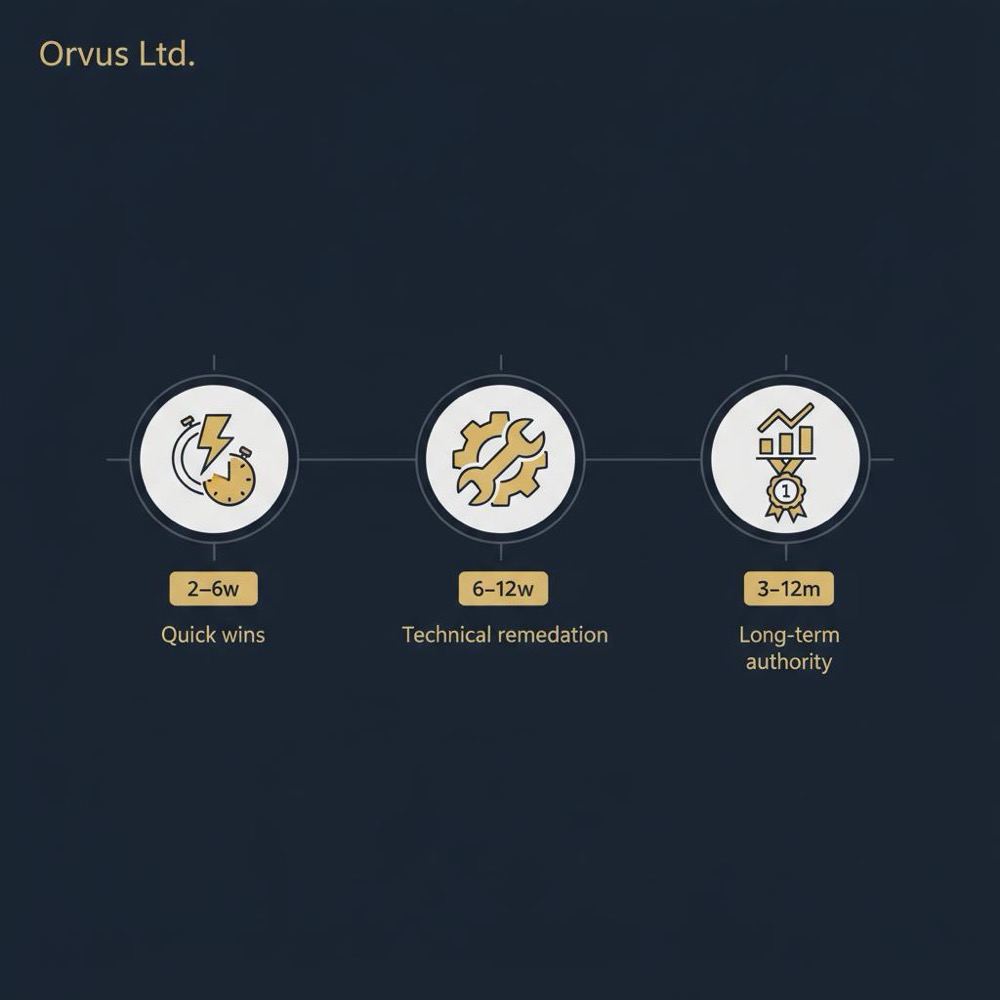
Expect quick wins in 2-6 weeks, technical remediation in 6-12 weeks, and noticeable authority gains across 3-12 months. Results vary by niche, competition, and site history. Small, consistent actions compound: that’s the key to answering How do I be on top of Google search? for the long term.
Practical checklist to act today
- Pick five pages close to ranking and apply quick fixes: titles, canonicals, an internal link, and Core Web Vitals checks. - Run a server log sample to confirm crawl behavior. - Identify one pillar topic and outline three supporting pages. - Build a list of one or two resources that could earn a link (data, tool, or research). - Set up a control group for experiments and record everything in a change log.
Final practical nudge
Pick five priority pages and apply the quick fixes. Monitor results and use that momentum to justify the technical work and content investment that follows. That sequence answers the immediate and long-term aspects of How do I be on top of Google search? - remove friction, match intent, then build authority.
With consistent work, measured experiments, and patient authority-building, a handful of pages can move from invisible to essential for your business.
You can expect measurable improvements from quick fixes in two to six weeks, technical remediation in six to twelve weeks, and larger authority-driven gains in three to twelve months. Results depend on your niche, competition, and site history.
Focus on intent. Volume without clear intent is wasted effort. Choose meaningful topics, map the queries people use, and deliver a clear promise on the page. That approach improves engagement signals that search engines reward.
Yes. Orvus Ltd. helps teams prioritize triage, technical fixes, and content strategy in a compact diagnostic and targeted engagement. Their approach is embedded, practical, and focused on tying search work to measurable business outcomes. Learn more at orvus.net/services/.
References
Want this kind of work done for your business?
We build and run AI-powered marketing and automation. 15 minutes, honest assessment.
Book a call