 Orvus
OrvusWhat is SEO meta in 1 click? A systems view
January 30, 2026
This guide explains what a one-click meta feature does, how those systems are typically built, and the practical QA and monitoring checks you should run before publishing at scale. The emphasis is operational: how to deploy metadata reliably and how to detect and fix regressions.
Quick answer: What is seo meta in 1 click?
Short definition
SEO meta describes the HTML metadata placed in the head element that communicates a page's title, the meta description, robots directives, and the rel=canonical link to search engines and browsers. This set of tags controls how a page is represented and how indexing or duplicate handling is signalled to search engines, according to official guidance from search providers and HTML standards Google Search Central snippets documentation.
When a one-click option is useful
A one-click meta option assembles those tags from site defaults, templates, and page-level values, then outputs ready-to-publish title, description, robots, and canonical tags to speed bulk updates and reduce repetitive work, provided teams validate length, uniqueness, and intent mapping Moz meta descriptions guidance. Learn more at the Orvus homepage.
A one-click SEO meta feature composes title, description, robots, and canonical tags from site defaults, templates, and page-level values, then validates length and uniqueness before publishing; it changes who supplies values and how quickly updates are applied, which is why QA and monitoring are essential.
The core seo meta elements and what each controls
Title tag: SERP appearance and CTR
The title tag is the primary label search engines show in results and it strongly shapes how a result appears and how users perceive it. Evidence from CTR analyses shows title choices correlate with click behaviour even when they are not the only factor that affects ranking SISTRIX CTR analysis.
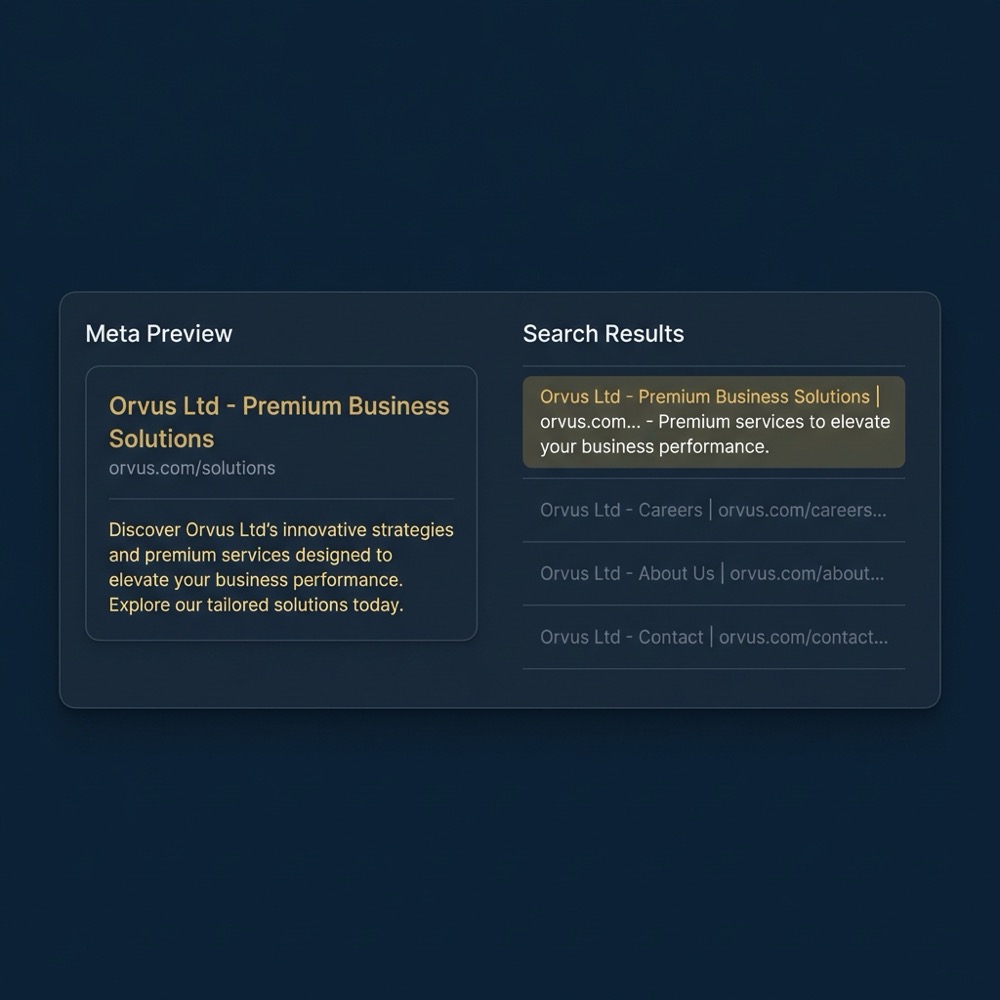
Title text lives in the HTML head and follows the semantics of the HTML living standard, so it should be precise, relevant to query intent, and unique per page to avoid confusing users and search systems HTML Living Standard reference.
Meta description: snippet and user click behaviour
The meta description is a short summary intended to help search engines select a snippet for the result and to influence click behaviour; it does not reliably change ranking but can improve the likelihood a user clicks when it aligns with intent Google Search Central snippets documentation.
Robots directives and canonical: indexing and duplication control
Robots meta tags and rel=canonical are the primary ways to signal indexing preferences and preferred URLs. These directives help search engines handle duplicate content and index only the pages you intend, following standard HTML semantics HTML Living Standard reference.
Operationally, treat these elements as control signals rather than ranking levers. Missing or inconsistent robots and canonical values are a common source of indexing surprises, so keep them visible in your generation and QA flows Google Search Central snippets documentation.
Other head metadata to be aware of
Beyond the core tags, other head metadata such as link rel=alternate or structured data influence how results are presented in SERP features. When you run a one-click workflow, decide which additional tags the tool should manage and which remain manual.

How title tags influence clicks: best-practice signals
What makes a clickable title
Clickable titles are concise, match query intent, and offer a clear value proposition, for example by including the primary content type and a concise differentiator. Practical writers balance keywords and clarity to reduce ambiguity and improve click signals, testing for how well titles match real queries Ahrefs guidance on title tags.
Keep titles unique and readable. When a single template would produce many duplicates, add conditional variables such as category or modifier to keep labels distinct and informative. See SISTRIX CTR analysis for evidence on CTR effects of title choices.
Common testing approaches for title variants
Teams often A/B test title variants or run sequential experiments on small control groups to measure CTR differences. Testing should use clear success metrics and stable time windows to avoid noise from seasonality or campaign changes SISTRIX CTR analysis.
Record which pages are in the control set and which are in the test group, and keep title changes reversible so you can roll back if a variant reduces clicks.
When to use templates versus handcrafted titles
Templates are the right choice for scale when intent is stable and pages share clear patterns, such as product listings or category indexes. Reserve handcrafted titles for high-value pages, ambiguous intent, or pages that drive revenue or lead volume, where nuance matters more than scale Ahrefs guidance on title tags.
Meta descriptions: writing, length, and Google's rewriting behaviour
Why meta descriptions matter for CTR
Meta descriptions help search engines select a snippet and guide user expectations; they influence CTR when they align with query intent, but they are not a reliable ranking signal on their own Google Search Central snippets documentation.

Length guidance and truncation risk
Length matters because overly long descriptions can be truncated in search results, which reduces clarity and may hurt CTR. Practical guidance suggests keeping descriptions within recommended limits and using preview tools to check snippet length before publishing Yoast meta description guidance.
For one-click generation, include a length check step and fallback text that prevents repeated boilerplate copy from appearing at scale.
How and why Google rewrites descriptions
Search engines may rewrite meta descriptions when they find page content or other signals that better match a user's query. Expect some automatic rewriting and monitor SERP snippets to learn when Google prefers on-page text over the supplied meta description Moz meta descriptions guidance.
When you rely on automation, log instances of rewritten snippets as part of your monitoring so you can adapt templates or prioritize manual overrides for affected pages.
Robots meta and rel=canonical: rules for indexing and duplicates
Common robots directives and their effects
Robots directives such as index or noindex and follow or nofollow tell search engines whether to include a page in their index and whether to follow its links. Treat these flags as operational switches that affect crawl and index behaviour Google Search Central snippets documentation.
Use noindex for pages that should not appear in search, such as internal search results or staging pages, and ensure your one-click generator supports explicit page-level overrides to prevent accidental indexing mistakes.
rel=canonical behaviour and best practices
rel=canonical indicates the preferred URL for duplicate or near-duplicate content and helps consolidate signals across variants. Implement canonical values consistently using standard HTML semantics to avoid split signals and indexing confusion HTML Living Standard reference.
When canonical targets are external or ambiguous, treat them as manual review items in your generation workflow to avoid unintended canonical chains.
When to use noindex, nofollow, and canonical together
Occasionally, you may use noindex with a canonical to guide indexing while also suggesting a preferred URL, but these combinations require careful handling and testing because search engines can treat signals differently in edge cases. Make the decision rule explicit in your templates and document exceptions for reviewers.
How a one-click meta generator actually works
Architecture: site level template page-level overrides
One-click meta systems usually follow a layered composition: site defaults provide global values, templates define structure for groups of pages, and page-level overrides allow exceptions. This flow lets teams scale while keeping control where it matters Moz meta descriptions guidance. See our services for examples of implementation patterns.
The generator should expose where each value comes from so reviewers can trace a published tag back to a template variable or a page field.
Quick QA preview for generated title and description
Run sample checks on 20 pages before bulk publish
Variables and templates: common fields and placeholders
Common template variables include primary keyword, category, product name, and modifiers such as brand or locale, plus safe fallbacks when values are missing. Design templates to insert fallbacks rather than leaving empty slots or repeating generic text.
Document each variable's intended use and acceptable values so content teams understand when to override a generated field.
Output validation and publishing flow
Before publishing, the system should run validation steps such as length checks, uniqueness reports, and intent alignment flags. Those steps reduce the risk of publishing overlong or duplicated metadata at scale Yoast meta description guidance.
Keep publishing in small batches and require a sign-off workflow for high-value templates to let teams catch edge cases before a wide release.
Templates are the right choice for scale when intent is stable and pages share clear patterns, such as product listings or category indexes. Reserve handcrafted titles for high-value pages, ambiguous intent, or pages that drive revenue or lead volume, where nuance matters more than scale Ahrefs guidance on title tags.

QA, monitoring and decision criteria for automated meta
Minimal QA checklist before bulk publish
Start with a sample audit that checks for length compliance, unique titles and descriptions, presence of canonical and robots tags, and intent alignment. A focused sample reduces the chance of systemic errors spreading across many pages Yoast meta description guidance.
Include a clear rollback plan in case a batch causes a negative change in metrics so you can revert quickly without extra churn.
When to prefer human-written meta
Prefer manual writing for pages that are high traffic, drive revenue, have ambiguous intent, or show poor CTR in prior tests. Human nuance often helps where templates produce flat, undifferentiated snippets SISTRIX CTR analysis.
Reserve automation for predictable pages where intent and format are stable, and tag high-sensitivity pages for regular human review.
Metrics and experiments to validate outputs
Track CTR, impressions, and click volume for sampled pages and compare generated meta against control groups. Use time windows that avoid traffic seasonality and run tests long enough to collect stable signals before drawing conclusions SISTRIX CTR analysis.
Instrument dashboards that show pages with unusual drops and flag pages where Google rewrites snippets frequently so you can prioritise manual intervention.
Common pitfalls and how to troubleshoot traffic regressions
Frequent automation mistakes
Common pitfalls include duplicated templated copy, overlong or truncated titles and descriptions, missing canonical or robots directives, and ignoring which SERP features a page is likely to appear in. These issues can reduce click volume or cause unexpected index behaviour Yoast meta description guidance.
Prevent these mistakes by adding automated uniqueness checks, enforced length limits, and sampling before wide publish.
Validate a one-click meta roll-out with Orvus services
Consider running the QA checklist and schedule a short sample audit to validate generated metadata before a full roll-out.
How to diagnose a drop in clicks
If clicks drop after a change, compare pre and post CTR and impressions for affected pages, sample the pages to check what snippet appears in the SERP, and verify canonical and robots values in the published HTML. That diagnostic sequence helps isolate whether a content change, a rewritten snippet, or a directive error caused the issue Google Search Central snippets documentation.
If rewritten snippets are common, review templates for relevance and consider manual overrides for high-value pages.
Roll-back and remediation steps
Remediation typically starts with reverting to a proven template or site default for the affected pages, running a smaller patch with stronger QA, and rechecking metrics after the smaller batch goes live. Keep the rollback process documented and fast to execute.
When problems persist, escalate to a systems review to check template logic, variable fallbacks, and canonical assignment across the site Moz meta descriptions guidance.
Implementation checklist and next steps
Ready-to-run checklist
Map high-value pages, design templates with clear variables and fallbacks, run a sample QA audit, publish in small batches, and monitor CTR and impressions for regressions. That sequence balances scale with control when deploying a one-click meta workflow Moz meta descriptions guidance.
Keep documentation for reviewers that explains when to override generated fields and how to trigger a rollback. See our blog for examples.
Sample test plan for a roll-out
Define success metrics, choose control groups, set measurement windows, and decide on minimum detectable effect sizes before you publish. Run tests on a stable subset of pages and extend the rollout as confidence grows.
Record all changes and results so you can learn which templates work and which need refinement.
When to escalate to a systems redesign
If you see persistent CTR drops, widespread snippet rewriting, or repeated canonical and robots errors despite QA, pause the roll-out and consider a deeper systems redesign that clarifies data sources and variable logic. A targeted redesign can remove silent breakpoints and reduce repeated failures.
Small teams often benefit from a compact diagnostic to prioritise the highest leverage fixes before committing to a large engineering effort.
seo meta includes the title tag, meta description, robots directives, and the rel=canonical link that live in a page's HTML head.
Meta tags help presentation and click behaviour but do not reliably act as a sole ranking signal; their main value is improving how results appear and how users click.
Use one-click tools for large sets of predictable pages and when you have a QA process to validate length, uniqueness, and intent mapping; reserve manual writing for high-value or ambiguous pages.
References
Want this kind of work done for your business?
We build and run AI-powered marketing and automation. 15 minutes, honest assessment.
Book a call