 Orvus
OrvusWhat does a SERP stand for?
January 26, 2026
The writing is aimed at operators, founders and marketing teams who need to decide whether to invest in content, technical fixes or paid capture. It keeps recommendations conditional and emphasises measurement and constraints.
What a SERP is and why it matters
SERP stands for Search Engine Results Page, the complete page of results and features that a search engine returns after someone issues a query, as described in official documentation from Google Search Central Google Search Central.

The term covers more than a ranked list of blue links. Modern pages combine organic listings, paid listings and feature elements such as snippets, panels and carousels that change how users find and evaluate answers Moz overview.
For operators and marketing teams, a SERP is a signal surface. Which features appear and how results are labelled affects traffic, user intent interpretation and the measurements you should trust when prioritising work Google Search Central.

How search engines build a SERP: crawling, indexing, ranking
Crawling and indexing explained - serp google
Search engines use crawlers to discover content and collect it into an index, which becomes the searchable set of documents a query can return; this collection step is the foundational input for any SERP Google Search Central.
The index is not a live mirror of the web. It is a curated store that contains the content the engine has been able to fetch, parse and record. Understanding that a SERP is produced from an index helps teams separate visibility signals from real time site changes Search Engine Land guide.
Ranking systems and the signals they use
Ranking algorithms order indexed content by relevance and a range of quality and user signals, rather than a single metric. Relevance, content quality and user interaction data are typical inputs into those systems Google Search Central.
Placement on a SERP is an output of indexing, ranking and page design. Visible position or a featured placement is not a simple, stable rank number; it is the result of many factors including query interpretation and interface choices Search Engine Land guide.
Anatomy of a modern SERP: paid, organic and common features
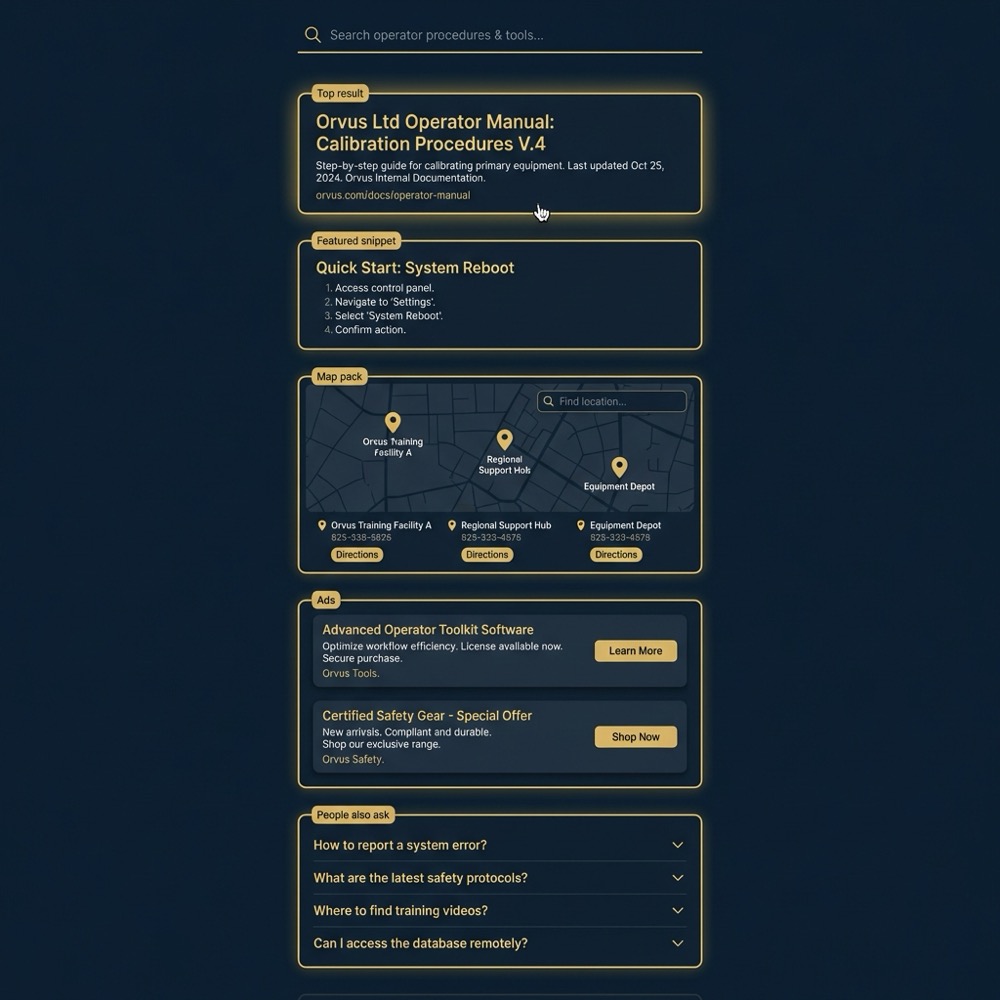
At a basic level, results on a SERP split into paid listings and organic listings. Paid results must be clearly labelled as ads, while organic results are the listings generated by the search engine's ranking systems Google Search Central.
Feature elements are common and often prominent. These include featured snippets, knowledge panels, local packs, People Also Ask, image and video carousels, shopping results and site links; they change how much screen space classic organic links receive Ahrefs blog on SERP features and reflect wider trends beyond Google Advanced Web Ranking.
Because many features can occupy prominent real estate, click behaviour and traffic distribution can shift away from traditional organic clicks. The prevalence and arrangement of features varies by query type, vertical and region, so treat observed SERP layouts as diagnostic rather than prescriptive SEMrush SERP features study. Large-scale analysis of feature prevalence can help quantify those shifts Nozzle analysis.
Assess your SERP exposure
Assess which features appear for your priority queries and note whether paid labels are present before making optimisation decisions.
Recognising ads and feature types is the first step in deciding whether to prioritise content, technical fixes or paid capture strategies. A quick inventory can surface whether organic snippets, shopping panels or local packs dominate the page for your queries Moz overview.
How AI Overviews and generative features affect what users see
What AI Overviews are and how they were introduced
Major search providers introduced AI Overviews and generative summaries to synthesise answers from multiple indexed sources and present condensed responses at the top of some SERPs Google Blog post on AI Overviews.
These features aim to help users get a quick synthesis, but they are presented as derived from indexed content rather than as a separate crawl or index process Google Blog post on AI Overviews.
How generative summaries relate to indexing and ranking
Generative features build on the same underlying index and ranking signals. They do not replace the need for indexable, high quality content; rather, they change how the engine surfaces that content in a consolidated form SEMrush SERP features study.
There are open questions about how these summaries affect click behaviour and conversion across verticals and regions. Industry studies offer snapshots but prevalence and impact continue to evolve, so monitor results for your queries rather than assume a fixed outcome Ahrefs blog on SERP features and consult academic studies for deeper analysis academic studies.
How to read a SERP: a decision framework for operators
Start with label checks. Confirm whether top items are ads or organic listings, and note which feature types appear. This quick verification reduces the risk of misattributing paid visibility to organic performance Google Search Central.
Next, map feature types to likely user intent. For example, shopping carousels often indicate commercial purchase intent, while People Also Ask boxes can indicate exploratory queries. Use these signals to decide whether to focus on content, product feed work or paid capture Ahrefs blog on SERP features.
A SERP stands for Search Engine Results Page. It is the page returned for a query and includes paid results, organic results and feature elements. For teams, reading the SERP diagnostically helps decide whether to prioritise content, technical fixes or paid capture, and to design measurement that ties search activity to outcomes.
Then check source signals. Look for site authority, where the content comes from and whether the snippet includes a date. These cues help estimate whether a given result is timely and reliable without assuming its position equates to trustworthiness Moz overview.
Finally, use the above checks to prioritise actions. If an organic snippet directly answers a high value query, content and site health work may be warranted. If paid carousels dominate, consider feed optimisation and paid capture as initial experiments before larger organic investments Google Search Central.
A compact framework to respond: search architecture, measurement and channel actions
When to prioritise content and technical SEO
Prioritise content and technical SEO when SERPs for target queries show organic snippets or site links that suggest users expect authoritative pages. Index presence and snippet fit indicate where content improvements and structural fixes can increase relevance Search Engine Land guide.
Search architecture is the systems-level work that aligns content to intent, fixes crawlability issues and ensures pages are indexable. For teams with constraints, small surgical changes to structure and canonicalization often provide clearer measurement signals than large unfocused content campaigns Google Search Central.
When to use paid media or creative testing
Use paid media when SERP features indicate demand capture opportunities or when immediate visibility is required for commercial queries. Paid tests can also validate whether creative or product positioning moves conversion before investing in organic changes Ahrefs blog on SERP features.
Creative testing and naming conventions are low friction experiments. They help determine whether searchers respond to different messaging and can inform both performance media and on-site copy adjustments without large upfront work Google Search Central.
Measurement: tying SERP activity to revenue signals
Measurement should focus on outcomes rather than rank. Tie search activity to conversions and revenue where possible, and avoid relying solely on position metrics that do not capture downstream behaviour Google Search Central.
Set up experiments that track user journeys from SERP feature impressions and clicks through to measurable actions. Where data quality is limited, use channel experiments and funnels to approximate attribution and validate hypotheses before larger investments Search Engine Land guide.
Common mistakes and pitfalls when evaluating SERPs
Misreading feature intent is a common error. Treat feature presence as diagnostic: a featured snippet does not always mean your content is best, and an AI Overview may summarise many sources Ahrefs blog on SERP features.
Ignoring labels and source signals leads to the wrong conclusions. Ensure you check ad labels and source authority before assuming an observed position reflects organic strength Google Search Central.
Run a short internal SERP audit to prioritise follow up
Run weekly for priority queries
Over-optimising for snippets without funnel context can waste effort. Snippet placement may increase visibility but not necessarily conversions; balance snippet work with tests that measure real user outcomes Search Engine Land guide.
Practical scenarios: reading SERPs for ecommerce and local services
Ecommerce: shopping results and product carousels
In ecommerce, shopping results and product carousels often take prominent SERP space. When these features appear, prioritise feed quality and paid shopping tests alongside product page relevance work Ahrefs blog on SERP features.
Quick first steps include validating product feed completeness, ensuring images and prices match landing pages, and running small paid tests to learn whether your product messaging converts on SERP impressions SEMrush SERP features study.
For local services, the local pack and maps entries are primary signals. Presence in the local pack often correlates with searchers ready to contact or visit, so local SEO and review management are priority diagnostics Ahrefs blog on SERP features.

Practical quick checks include verifying business listings, confirming citation consistency and prompting recent reviews. If maps or local pack entries are absent, consider a short paid local capture campaign while the organic profile is improved SEMrush SERP features study.
Across both scenarios, measure changes with small experiments and clear success criteria. Track whether a change in SERP layout or feature exposure moves conversion rates rather than assuming visibility equals impact Google Search Central.
Conclusion and next steps: prioritise by intent, measurement and constraints
Three takeaways: remember that SERP stands for Search Engine Results Page, treat feature presence as diagnostic rather than definitive, and use a simple decision framework to map observed features to content, paid or measurement actions Google Search Central.
Immediate diagnostics to run: check ad labelling, note which feature types appear for priority queries, and validate source authority and snippet date before acting. Use those signals to pick small experiments that answer whether changes move downstream outcomes Moz overview.
When a systems partner is helpful, Orvus Limited can often assist with search architecture, measurement and workflow design so teams can run and learn from small, traceable experiments without large upfront scope.
SERP stands for Search Engine Results Page, the full page returned by a search engine in response to a query.
No. Ads are paid placements and must be labelled as such, while organic results are ordered by the search engine's ranking systems.
No. AI Overviews synthesise indexed content but still rely on indexable, high quality sources; content and technical work remain relevant.
References
- https://www.google.com/search/howsearchworks/
- our services
- https://searchengineland.com/guide/what-is-serp
- https://ahrefs.com/blog/serp-features/
- https://www.semrush.com/blog/serp-features/
- https://www.advancedwebranking.com/blog/serp-features-beyond-google
- https://nozzle.io/blog/nozzle-analyzed-1-2-million-google-serp-features/
- https://arxiv.org/pdf/2306.01785
- orvus.net
- about Orvus
- our knowledge base
Want this kind of work done for your business?
We build and run AI-powered marketing and automation. 15 minutes, honest assessment.
Book a call