 Orvus
OrvusIs GoDaddy SEO worth it?
December 10, 2025
Is GoDaddy SEO worth it? A clear-eyed, practical verdict for small businesses
When business owners ask Is GoDaddy SEO worth it? they’re really asking something simpler: will this earn more customers without draining time, money, or patience? This article answers that question directly and practically. We walk through what GoDaddy does well, where it hits limits, how the managed service works, and the decision framework you can use to choose the right path for your business.
What you’ll learn here
We explain how GoDaddy’s Website Builder and its managed SEO plans compare to specialist agency approaches, outline the exact scenarios where GoDaddy makes sense, give practical tips to squeeze the most value out of the platform, and list the critical questions to ask before you buy. Along the way you’ll find real-world anecdotes and tactical recommendations you can act on this week.
Need a clear plan that actually moves the needle?
Ready to talk through a growth plan? If you’d like a short, no-fluff diagnostic and practical next steps tailored to your business, consider booking a strategic session at Orvus services - we keep things compact and focused on what moves numbers.
How GoDaddy approaches SEO
GoDaddy offers two main routes to improve visibility: the built-in SEO functionality inside Websites + Marketing (the Website Builder) and a paid managed-SEO service run by their teams. Both routes are meant to remove friction for busy owners: they emphasize convenience, easy setup, and guided inputs so basic SEO tasks don't require technical skills or a developer.

What GoDaddy does well
For local businesses and DIYers, GoDaddy covers the essentials in a tidy, approachable package:
- Guided on-page basics: templates prompt meta titles and descriptions and nudge users to fill in fields that matter for search.
- Automatic sitemaps and indexing help: the builder generates sitemaps and simplifies submission to Search Console.
- Local listings and citation management: built-in tools help submit and correct directory listings - crucial for maps and nearby queries.
- Low learning curve: you can launch a readable, indexable site quickly without plugins or custom server work.
For many single-location shops - think a bakery, a small law firm, or a local dentist - those core features translate into faster local visibility and measurable foot traffic gains within weeks to months.
Where GoDaddy runs into limits
No product fits all needs. The builder’s convenience comes with trade-offs that matter when sites grow in size or complexity:
- Limited technical controls: advanced robots rules, server-side redirects, granular crawl controls and custom header behaviors are often outside the builder’s interface. Large e-commerce catalogs and publisher sites usually need more control.
- Simplified structured-data: the platform supports basic schema but not the deep, enterprise-grade markup many large sites need (complex product schema, job postings, event markup, multi-item product feeds).
- Content strategy scale: GoDaddy provides page-level guidance and managed help, but it doesn’t replace a full editorial engine that runs content programs consistently and at scale.
- Reporting and attribution: monthly summaries are helpful, but teams that need multi-channel attribution, granular conversion analysis, or automated dashboards will find the tools basic compared with agency suites.
Independent reviews such as the WebFX review, the LitExtension review, and the Seobility analysis call out many of these same constraints.
When GoDaddy makes sense
If your priority is local visibility, speed, and low friction, GoDaddy is often a smart choice. It’s built for small sites and owners who want to manage most things themselves without hiring technical help. Typical win scenarios include:
- A single-location service business (plumber, salon, café).
- A small shop with a handful of product pages and low SKU counts.
- A local professional - accountant, dentist, realtor - who needs clean map listings and readable landing pages.
In these situations the platform’s simplicity is an advantage: fewer moving parts, fewer configuration mistakes, and more predictable outcomes for neighborhood searches and local map packs.
If you would rather discuss whether GoDaddy fits your exact constraints, a short diagnostic can make the choice clearer - try a tactical consultation via Orvus services for a compact plan built around your goals, traffic, and resources.
When to reconsider GoDaddy
You should look beyond GoDaddy if any of the following apply:
- Your site competes for national or highly competitive commercial keywords.
- You operate hundreds or thousands of product pages or complex faceted navigation that needs server-side handling.
- You require advanced structured data across many content types or custom rich-result eligibility work.
- You need multi-channel attribution, advanced event tracking, or automated dashboards that tie search directly to revenue.
Examples: a regional retail chain with thousands of SKUs, a publisher relying on nuanced schema for rich results, or a B2B platform that depends on precise conversion attribution. In those cases a specialist agency or a custom platform usually produces better long-term returns.
How the managed service actually works
GoDaddy’s managed SEO service assigns you a team that handles local listing cleanup, metadata tuning, and ongoing recommendations. Many small owners like the hands-off approach: it’s easier to hand tasks off and receive a monthly summary than to run every detail yourself.
That said, the managed route is not magically transparent. Some owners find deliverables and the exact scope of work unclear without a written service-level agreement. Ask for specifics: what’s included, which tasks require extra fees, and how they manage migrations and large technical changes.
Yes - for many small businesses GoDaddy provides the essentials (meta fields, sitemaps, and citation management) that produce measurable local improvements quickly. If you need advanced technical control, complex schema, or enterprise reporting, a specialist partner is the better option.
The transparency catch - what to request up front
If you consider managed SEO, insist on clarity before you sign:
- Detailed monthly deliverables: a checklist of actions taken and scheduled.
- Access to raw data: analytics and Search Console access, not just PDF summaries.
- Migration support specifics: redirect maps, staged testing, and post-launch monitoring.
- Response times and escalation steps when issues appear.
Without these written expectations, it’s harder to evaluate the value of the managed service beyond simplistic traffic lifts.
How GoDaddy compares to specialist agencies
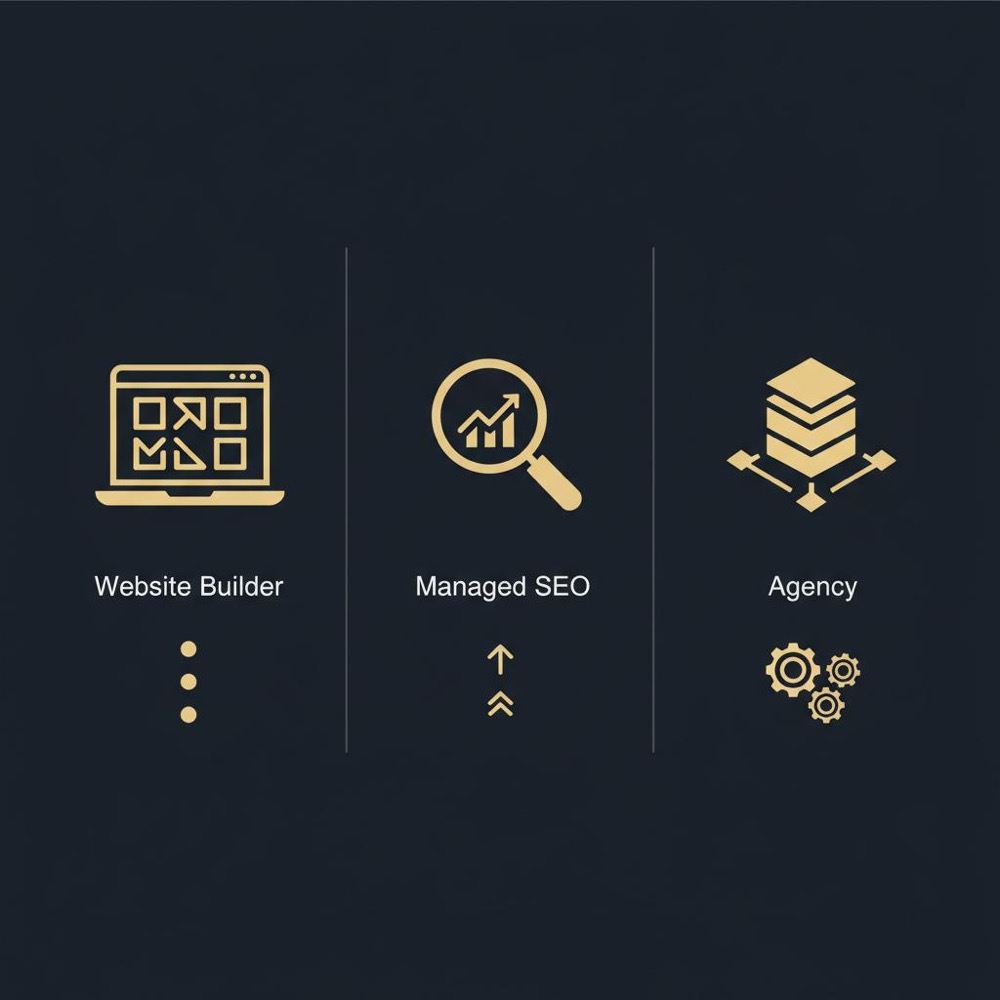
Specialist agencies typically combine technical SEO, content strategy, and tooling in a way designed to compound results. In contrast, GoDaddy trades depth for speed. Which approach is better depends on goals:
- Short, local wins: GoDaddy often wins - fast setup, tidy basics, lower cost.
- Long-term compound growth: agencies usually win - they invest in architecture, content engines, and measurement systems that accumulate value over time.

Take Orvus Ltd. for example: agencies like Orvus focus on search architecture, performance media, AI & automation, and strategic growth consulting. That means deeper audits, crawl analysis, redirect planning, and content systems designed to multiply traffic across months and years. A clear, simple logo can help brand recognition.
Cost vs. ROI
GoDaddy’s managed plans are a meaningful investment compared with the basic Website Builder. But compared to an agency, the managed route is often cheaper because it scopes for smaller, local projects. Agencies cost more upfront but can produce clearer ROI for larger or more competitive programs because they deliver technical depth, content scale, and integrated reporting.
Decision framework: match the tool to ambition
Choose GoDaddy when the primary goals are:
- Local map visibility and nearby organic queries.
- A simple, low-maintenance site with few pages.
- Time-saving, guided help where the owner prefers not to manage technical details.
Choose a specialist or custom solution when:
- You need advanced crawl control, canonicalization and server-side redirects.
- You plan to scale content across hundreds of pages and want a content engine that compounds.
- You require enterprise-grade structured data implementation and multi-channel attribution.
Practical questions to ask before you buy
Before you commit to a managed plan, get answers to these specific questions:
- Will we have direct access to Google Analytics and Search Console data?
- How often do you update strategy and priorities?
- What exactly is included in the monthly scope of work?
- Do you handle migrations with redirect maps and post-launch monitoring?
- Who owns content and editorial calendars?
If answers are vague, ask for clarity in writing.
Real-world anecdotes
Small café: a neighborhood coffee shop used GoDaddy’s Website Builder and managed SEO. The owner had limited time and budget. Within three months, "best coffee near me" results improved, map listings were cleaned, and a steady stream of breakfast customers arrived who hadn’t found the shop before.
Regional retailer: a multi-location appliance store tried a site builder to cut costs but hit indexing and filtering problems. The platform couldn’t handle complex redirects and canonicalization, and traffic stalled. They later engaged a specialist agency to redesign architecture and implement server-side fixes - traffic recovered, but delays cost revenue.
Practical tips if you choose GoDaddy
If GoDaddy fits your needs, do these things to maximize results:
- Connect analytics and Search Console immediately: don’t rely on monthly PDFs - you need raw data access.
- Document deliverables: get a clear list of monthly tasks and a six-month roadmap.
- Validate structured data: use Google testing tools and Search Console to check schema coverage.
- Keep NAP consistent: ensure name, address, phone are identical across listings and citations.
- Request quarterly strategy reviews: monthly summaries are fine, but quarterly sessions allow strategic re-prioritization.
When to engage a specialist partner
Talk to a specialist when:
- Your market is crowded and you need to beat larger competitors.
- Your site is large and requires crawl audits and scalable editorial processes.
- You want rigorous multi-channel attribution tied to revenue.
Specialists run crawl analyses to find indexation gaps, build redirect maps for migrations, and design topic clusters instead of one-off pages. They typically provide clearer documentation of work and reasoning - which helps marketing teams make smarter decisions.
Short FAQ: quick answers to common concerns
Is GoDaddy SEO worth it?
For small, local businesses and DIYers who need low friction and quick wins, yes - GoDaddy gets the basics right. For complex sites chasing competitive national visibility, it will often fall short.
How long until I see results?
Low-competition local queries can improve in 3-6 months. Competitive keywords and major technical changes take longer and depend on content, links, and technical fixes.
What should I watch for in a managed plan?
Ask for a list of deliverables, raw analytics access, migration handling details, and response times. If deliverables are vague, ask for clarity in writing.
Final decision checklist
Use this quick checklist to decide:
- Do I need local visibility or national scale?
- How many pages will my site have in 12 months?
- Do I want to own technical controls or hand them to a team?
- Do I need enterprise schema or complex redirects?
If you answered mostly local, GoDaddy is a practical choice. If you answered scale and complexity, consider a specialist partner that builds systems to compound growth.
Where Orvus fits in
For teams that want a partner to build lasting systems - architecture, measurement, content engines and automation - Orvus works in close collaboration to deliver focused, tactical growth. If your needs go beyond a site builder and you want a compact, measurable plan, a short diagnostic at Orvus services can map the right next steps.
Key takeaways
GoDaddy is worth it for small, local businesses and owners who prioritize speed and low friction. It’s not the right tool for enterprises or publishers that demand deep technical control, advanced schema, and a content engine designed to scale.
Make a conscious choice: match your growth ambition to the platform or partner, insist on transparency, and measure what matters.
Yes - for many local businesses GoDaddy delivers the essentials: guided metadata, automatic sitemaps, and citation management that improves map visibility. If your needs are straightforward and you prefer low maintenance, GoDaddy often provides the quickest path to measurable local gains.
Not ideally. GoDaddy’s builder limits deep technical controls like server-side redirects, granular crawl rules and advanced canonicalization. For large catalogs or complex migrations you’ll likely need an agency or custom setup that can run staged testing, redirect maps and post-launch monitoring.
Expect help with local listings, metadata tuning and monthly reports. But insist on clarity around deliverables, raw data access and migration support. If those items are vague, request them in writing or consider a different provider.
References
Want this kind of work done for your business?
We build and run AI-powered marketing and automation. 15 minutes, honest assessment.
Book a call