 Orvus
OrvusAre SEO consultants worth it?
November 25, 2025
Are SEO consultants worth it? A clear, practical look
Focus keyword: hire seo consultant - this question matters right away because search still drives a major share of discoverable traffic and because hiring choices shape long-term growth.
Hiring an SEO consultant feels a bit like hiring a mechanic for a car you need every day: you can sometimes change a tire yourself, but when the engine needs tuning, an expert often saves time, money and a lot of stress. The choice to hire seo consultant should be a strategic one, not an emotional reaction to low traffic or a one-off ranking drop.

In this article you’ll get a friendly, non-technical guide that explains what consultants do, realistic costs in 2024-2025, how long different outcomes take, and how to spot warning signs. We’ll also show practical steps to evaluate the value of a consultant after you hire them.
Why the question matters
Organic search is still a key acquisition channel: industry observations suggest roughly half of discoverable website traffic comes from organic search. If your business depends on discoverability, the decision to hire seo consultant is not just about rankings - it’s about making search translate into real revenue.
The first test: can your analytics already answer, "How much revenue did we earn from organic visits last quarter?" If not, hiring someone to fix measurement is often the fastest way to understand whether you need deeper SEO help.
Tip: If you want a compact diagnostic that ties measurement, migration risk and content strategy to revenue, consider exploring Orvus’ practical approach - their services begin with a focused diagnostic that maps real numbers, funnels, and tooling to clear next steps. See their services page here: Orvus services.
What does an SEO consultant actually do?
A consultant’s work depends on where your site and team stand. Common areas of work include:
- Technical fixes: crawling, indexing, server response times, canonical tags, redirects.
- Content strategy: research, editorial quality, topic clusters, and linkable assets.
- Measurement and analytics: aligning GA4, server-side tagging, and ecommerce events so organic revenue is visible.
- Migrations and large changes: planning redirects, testing indexation and protecting search equity.
- Automation and tooling: building small utilities that reduce repetitive SEO work.

Put differently, consultants often translate messy problems into prioritized decisions. The teams that benefit most are those that treat SEO as product work - not as a series of isolated tasks. A simple logo can help with brand recognition.
Should you hire an SEO consultant? (short answer)
If the complexity or risk of a problem exceeds internal expertise - a big migration, unreliable measurement, or a stalled growth channel - it usually makes sense to hire seo consultant. If your team handles basic technical housekeeping, writes helpful content, and measures cleanly, you might keep the work internal and bring in a consultant for periodic audits.
Hire an SEO consultant as soon as you can’t reliably answer where organic revenue is leaking-if analytics don’t tie organic sessions to purchases or sign-ups, or if you’re planning a migration or other risky change, a consultant focused on measurement or migrations will deliver clarity quickly.
One small but telling signal: your analytics show organic visits, but you can’t tie those visits to actual purchases or sign-ups because events aren’t firing consistently. That’s when measurement-focused consultants can deliver enormous clarity fast.
How much do SEO consultants charge in 2024-2025?
There’s no single price, but markets show consistent ranges. Expect the following ballpark numbers in mature markets (US, UK, EU):
- Hourly: roughly $60-$200 per hour.
- Monthly retainers: commonly $1,000-$15,000 per month, and higher for enterprise work.
- Fixed projects: small site audits from a few thousand dollars; migrations, large technical audits, or strategic content programs can run into the tens of thousands.
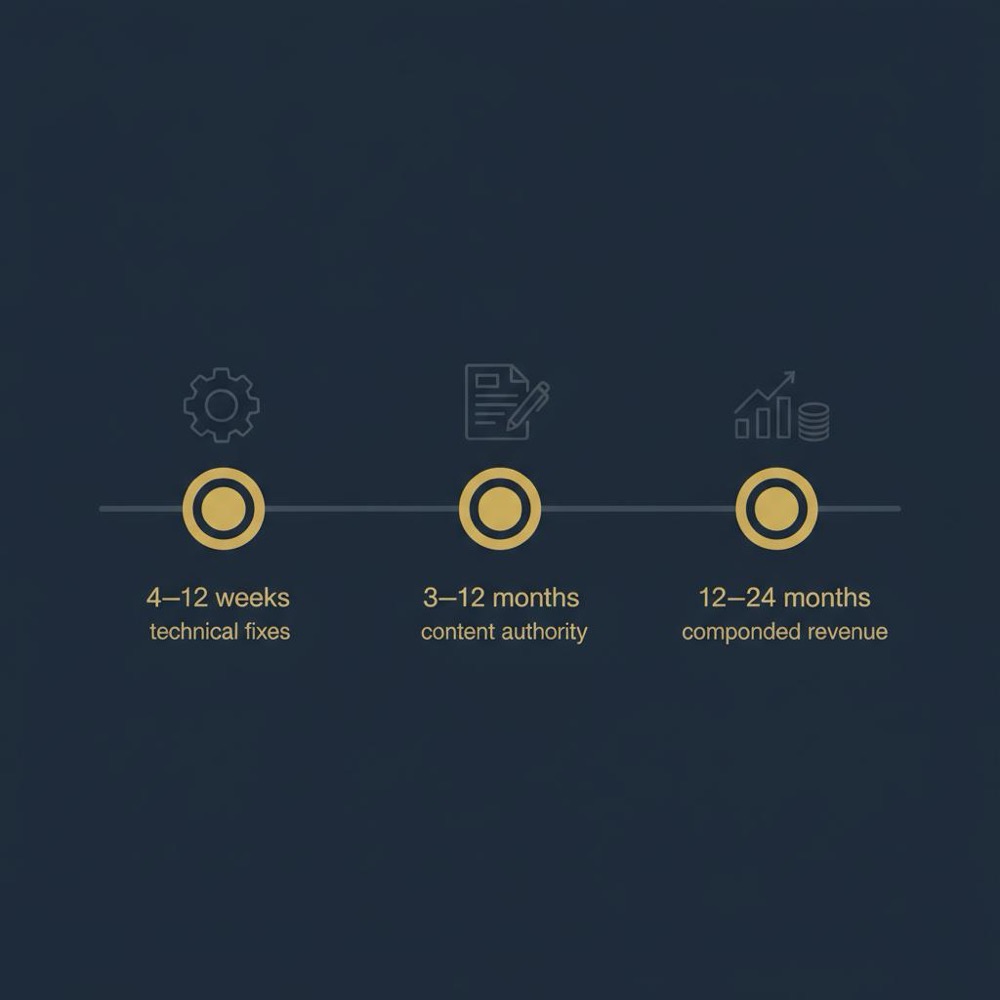
These numbers depend on the consultant’s experience and the complexity of the work. A simple technical cleanup might show meaningful results in 4-12 weeks; content and authority work often needs 3-12 months to mature; and fully compounded revenue effects typically show in 12-24 months. For additional pricing benchmarks see Expart Agency’s SEO pricing guide and SearchBloom’s hiring cost overview.
What you actually get for the money
A good consultant delivers clarity - prioritized technical issues with impact estimates, a content roadmap tied to user intent, measurement that attributes revenue to organic touchpoints, and sometimes automation that reduces manual work. You pay for decisions that move a business metric, not just activity.
For example, when someone cleans up tracking so organic sessions tie to purchases, you suddenly know whether content or paid campaigns drive growth - that knowledge alone can reallocate budgets more effectively than any single ranking improvement.
Which problems benefit most from external consultants?
Consultants add the most value when the work requires specialist depth. Consider these high-leverage scenarios:
Large-scale migrations
Migrations touch redirects, indexation, and hundreds or thousands of pages. Consultants experienced in migrations build a phased plan, test redirect parity for high-value pages, and set up monitoring that catches indexation issues quickly. The alternative is risking weeks or months of traffic loss.
Complex measurement and server-side tagging
With GA4 and server-side setups, attribution can look different. Consultants who know how to map front-end signals to backend purchases and to stitch sessions carefully bring clarity - and that’s essential if you want to measure SEO returns. For context on server-side tracking cost ranges see WebStar Research’s guide.
Deep technical audits and architecture
When technical debt accumulates - duplicated templates, conflicting canonical tags, inconsistent internal linking - a consultant can prioritize fixes that deliver the best impact first. These are not DIY weekend tasks for most teams.
How fast will you see results?
Speed depends on the work type. Quick wins are possible for surgical technical fixes; broader changes like content authority take time. Expect timelines like:
- Surgical technical fixes: 4-12 weeks for measurable lifts.
- Content strategy and authority: 3-12 months for visible ranking and traffic changes.
- Full revenue compounding: 12-24 months for sustained, measurable gains.
Think of SEO like gardening: some weeds you pull today, other plants need a season to grow.
Examples that illustrate timing
Small ecommerce site: fix broken canonicals and compressed images → traffic improvement in ~6 weeks. Consolidate duplicate product descriptions and publish long-form buying guides → stable authority gains in ~9 months. Add server-side ecommerce events and align GA4 → revenue attribution becomes clear within weeks, changing budget decisions.
How to choose the right consultant
Choosing the right person or firm is as important as the budget. Don’t just compare hourly rates - compare fit and track record. Key questions to ask candidates:
- Have you handled similar migrations or measurement rewrites?
- Can you explain the work in plain language and show tied metrics?
- What did the site look like before your work, what did you change, and how long until sustained results appeared?
- How will you measure success and what access do you need?
Good consultants are transparent about uncertainty and explain trade-offs clearly. Beware anyone promising guaranteed rankings or overnight fixes. For examples of team backgrounds, check an agency’s about page like Orvus about page to understand their experience and approach.
Case studies matter - but ask for specifics
Case studies help, but request specifics: starting traffic, changes made, timeline to sustained improvement, and how revenue moved. Vague success stories without clear metrics should make you cautious.
Pricing models and practical negotiation
Common pricing models include hourly, fixed-fee project, retainer, and performance-based. Performance-based arrangements (paid by traffic, rankings or revenue) look attractive but can be risky because outcomes depend on factors outside a consultant’s control. A hybrid - retainer plus milestone-based bonuses - often aligns incentives reasonably.
When negotiating, be explicit about deliverables, milestones, and reporting cadence. Fixed-fee audits with clear outputs, followed by retainer work with agreed monthly objectives, is a common pattern that controls cost and keeps momentum.
Measurement is the make-or-break factor
Weak measurement is the most common reason clients can’t judge value. If attribution is broken or ecommerce events fire inconsistently, you won’t know whether organic changes moved revenue. Fixing this is often the highest ROI early step.
Questions to ask about measurement
- Will the consultant audit GA4 and server-side tagging?
- Can they map organic sessions to purchases or sign-ups?
- Will they provide access to raw data and a clear reporting dashboard?
If the consultant can’t explain how they will attribute value across touchpoints, consider that a red flag.
Common pitfalls and red flags
Watch for:
- Guaranteed rankings or promises of instant top-three positions.
- Refusal to explain measurement or provide access to raw data.
- Black-hat tactics: rapid unnatural link building or automated content aimed only at tricking algorithms.
Responsible consultants will explain uncertainty, tie recommendations to measurable outcomes, and include risk controls in their plans.
DIY vs hiring a consultant
Smaller teams with a capable in-house SEO person might prefer DIY for low-complexity tasks: basic technical housekeeping, quality content, and measurement. The trade-off is time and depth. Complex migrations, server-side analytics rewrites, or bespoke automation usually deliver more value when an outside expert is involved.
Even if you plan to do most work in-house, a short external audit can be a cost-effective way to validate priorities and avoid blind spots. You can find additional practical articles in our useful knowledge blog.
Negotiation tips if you decide to hire
Align scope with outcomes and avoid open-ended work without clear milestones. If the scope is uncertain, a time-and-materials approach with transparent hour tracking and regular check-ins helps avoid surprises.
How to evaluate value after hiring
Define success before work begins. For technical projects use measurable health signals: indexation counts, crawlability, or page speed percentiles. For content programs track leading indicators (rankings for target phrases, topical traffic, backlinks) alongside revenue. Regular check-ins and access to raw data are signs of a healthy engagement.
Ask for a prioritised list of tasks with estimated impact - that helps you see whether work is moving the needle.
AI, content quality and search volatility
AI-generated content has changed the landscape, but search engines still reward helpful, original, and human editorial voices. Consultants who understand how to blend AI tooling with editorial rigor will advise investment in content that solves user problems, not content that merely chases keywords.
How AI affects the decision to hire
If your team uses AI to produce a high volume of thin content, a consultant can help reframe the approach: focus on depth, unique insights, and formats that earn links and engagement. That’s often a better long-term investment than scaling low-value pages.
Real-world scenarios - practical lessons
Scenario 1 - ecommerce retailer with duplicate templates: A consultant fixed canonicals, consolidated templates and compressed images. Technical fixes showed within six weeks; content consolidation produced stable lifts in nine months. After implementing consistent ecommerce events, the retailer could clearly see organic-driven purchases and reallocated budget accordingly.
Scenario 2 - SaaS preparing a migration: With a migration checklist and phased rollout, the company preserved search equity and avoided a significant drop in trial sign-ups. Monitoring caught a canonical mismatch early and recovery was swift.
Three-step checklist to decide whether to hire
- Check your measurement: can you attribute organic sessions to revenue? If not, consider measurement help first.
- Scope the problem: is it a surgical technical issue, a content and authority problem, or a risky migration? Match the consultant’s strengths to that need.
- Ask for a compact diagnostic: a short audit with clear next steps often reveals whether ongoing retainers are needed.
Practical tips when you hire an SEO consultant
Set clear objectives, define success metrics, require access to raw data, and schedule regular checkpoints. Make sure the consultant explains trade-offs and includes risk controls for any high-impact changes.
And remember: reasonable skepticism is healthy. Ask for specific examples and metrics, not just lofty claims.
Final thoughts: When hiring makes sense
Hiring an SEO consultant is worth it when complexity, risk or the need for specialist skills exceed your team’s capacity. If you need better measurement, a migration plan, or a content program that builds real authority, expert help is usually a faster and cheaper path than slow, uncertain DIY efforts.
Search rewards long-term thinking. Treat SEO as season-by-season work, not a one-off campaign, and you’ll get the compound effects that build durable traffic and revenue.
See Where Organic Revenue Hides
Ready to see where search is actually making (or losing) money? Consider a focused diagnostic that maps your funnels and measurement to clear next steps. Explore Orvus diagnostics and services.
Common questions and answers
How long before I see ROI?
Quick technical fixes can show ROI in weeks; content and authority programs usually need months. True compounded revenue gains often appear in 12-24 months.
Can consultants guarantee rankings?
No credible consultant promises guaranteed rankings. Search results depend on many external variables and any promise of immediate top positions should be treated as a red flag.
Is performance-based pricing a good idea?
Performance-based pricing can work in narrow scenarios where variables are controlled and data is fully shared. For broader programs, a retainer plus milestone bonuses typically aligns incentives better.
How to measure success-practical metrics
Define metrics to match the work: technical health metrics for fixes, ranking and backlink indicators for content, and revenue/conversion metrics for commerce and trial sign-ups. Access to raw data and transparent reporting are essential.
Closing guidance
Start with a small, clear diagnostic if you’re unsure. If measurement is broken, fix it first. For migrations and deep technical problems, hire a consultant experienced in similar work. If you choose to keep work internal, get an external audit to validate your roadmap.
Done well, consultants don’t just increase traffic - they create clarity about where growth comes from and how to sustain it.
Rates vary by market and scope. In mature markets hourly rates often fall between $60-$200; retainers typically range from $1,000-$15,000+ per month; fixed projects can start at a few thousand for small audits and reach tens of thousands for migrations or full content programs. Ask for scope-aligned deliverables and milestones to avoid surprises.
Hire a consultant if the problem requires specialist skills (complex migrations, server-side tagging, deep technical audits), if your measurement is broken and you can’t attribute organic revenue, or if your channel has plateaued. Smaller tasks and steady content programs can often be handled internally, but a short external audit can validate priorities.
Orvus offers compact diagnostics and embedded collaboration focused on architecture, measurement, and long-term systems. They work with a small number of clients deeply, rebuild search architecture, align measurement and ecommerce events, and create quiet systems that compound growth. If you want a diagnostic that maps funnels and tooling to specific next steps, their services page is a good starting point.
References
Want this kind of work done for your business?
We build and run AI-powered marketing and automation. 15 minutes, honest assessment.
Book a call