 Orvus
OrvusWhich is better for writing ChatGPT or grammarly? Guidance for teams
February 9, 2026
The goal is to help operators and marketing teams decide when to use an LLM, when to use a writing assistant, and how to combine them into a testable workflow that supports scale without sacrificing accuracy or compliance.
What each tool is and when teams use it
Teams evaluating the best ai for writing should start by separating scope and role. ChatGPT is a generative large language model used for drafting, ideation, rephrasing, and creating multiple variants quickly, which makes it useful early in content workflows OpenAI ChatGPT page.
Grammarly is a deterministic writing assistant focused on grammar, punctuation, clarity, and tone across editors; teams often use it for a final polish and consistent style enforcement Grammarly Business page.
Use an LLM for drafting and ideation and a writing assistant for mechanical polish and style enforcement; validate with a small pilot, protect sensitive data, and measure results before scaling.
The practical divide is simple: use an LLM for generation and a writing assistant for mechanical correctness and style. Reviews and comparative analyses of these tool types show that combining a generative model with a deterministic editor gives higher quality outcomes than using either alone Nature Machine Intelligence review. See also Coursera's comparison.
Typical users vary. Product and content teams use ChatGPT for idea generation and multiple draft variants, while editors and compliance teams rely on Grammarly integrations inside word processors and browser editors for exacting rules Grammarly Business page.
Head-to-head: core strengths and shared limits
Where each tool excels is consistent across many evaluations. ChatGPT shines at generative drafting, rapid rephrasing, and producing variants that can be fed into templates or automation, and it supports API-based automation for scale OpenAI ChatGPT page.
Grammarly excels at real-time suggestions for grammar, punctuation, clarity, and tone, and its editor plugins help keep writing consistent across teams Grammarly Business page. See Grammarly's comparison.
Both tools share limits you should plan for. Neither is a turnkey SEO measurement platform: a generative model can draft SEO-focused content when prompted, but it lacks crawl and reporting integrations; Grammarly does not provide SEO metrics, so you must keep dedicated SEO tooling in your stack OpenAI ChatGPT page.
When choosing a tool, consider integration points and how each fits existing workflows. Enterprise controls, accessibility of editor plugins, and API options are practical criteria that often decide adoption choices Grammarly Business page.
How to use them together: a practical two-step workflow
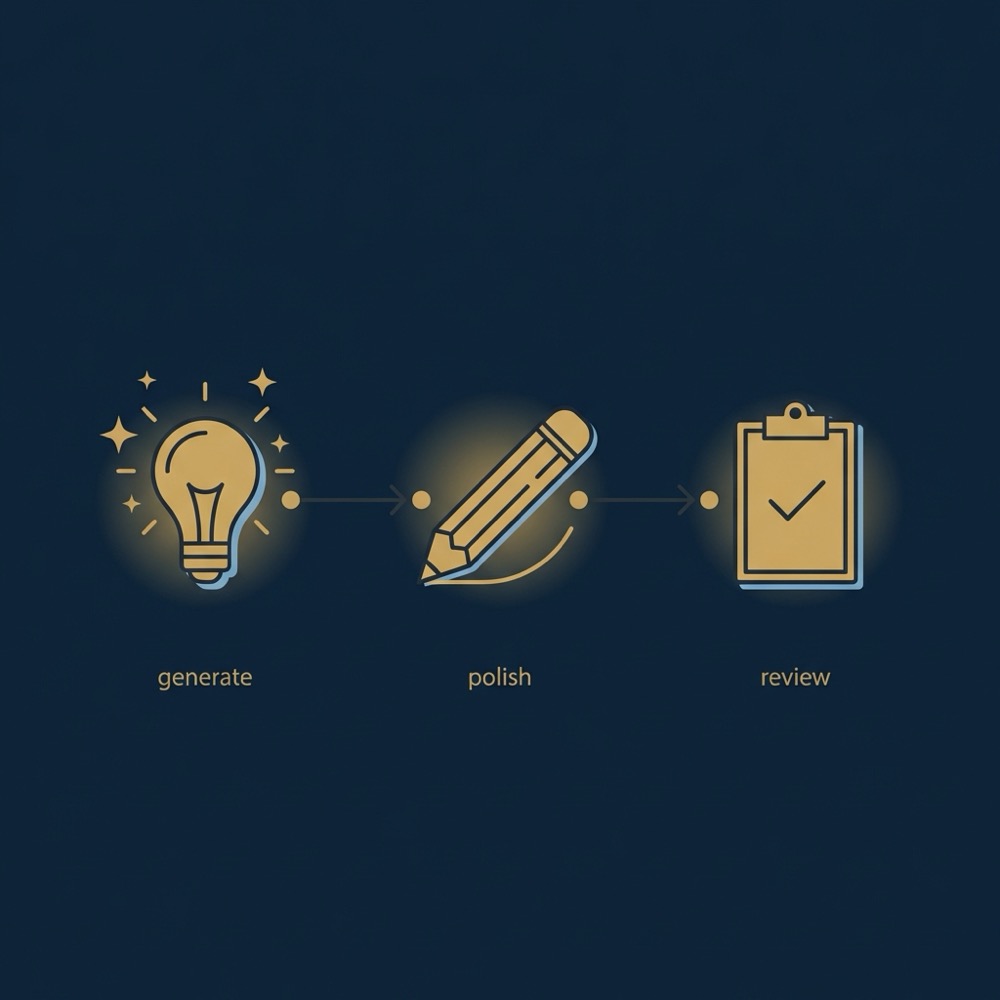
Adopt a two-step workflow: first generate a draft with an LLM, then run a focused editing pass with a writing assistant for polish and consistency; recent comparative analyses support this pattern as producing the most reliable output Nature Machine Intelligence review.
Inquire about a pilot with configuration and measurement support
Try a two-step pilot: generate several variants from prompts that include brand rules, then run them through an editor and a human reviewer to validate facts and voice.
Step 1, LLM drafting: use templated prompts that include audience, intent, and required constraints. Capture versions and use naming that makes A/B or quality audits easier. If you automate generation via API, include metadata on prompt, model, and version for traceability OpenAI ChatGPT page.
Step 2, focused editing: run generated drafts through the writing assistant to correct mechanics and enforce tone. Configure domain-specific vocabulary and policy checks where available, then assign a human editor to validate factual claims and brand voice Grammarly Business page.

Handoff rules matter. Use version control or a simple CMS workflow that logs who reviewed what and when. Explicitly mark generative drafts as 'needs fact check' and require a human sign-off for regulated or high-risk content Nature Machine Intelligence review.
Choosing the right tool for the task
Match tool to content type and stage - best ai for writing
Match tools to the content type and stage in your workflow. Creative briefs, brainstorming, and multi-variant drafts tend to benefit from an LLM. Compliance copy, contracts, and legal text require stricter human oversight and minimal generative exposure OpenAI policies page.
Team skills and scale also matter. If your team has reviewers and an editor workflow, adding a generative layer can increase output; if editing capacity is limited, prioritize deterministic edits and conservative use of generation Grammarly Business page.
Budget and integrations are decision drivers. Evaluate API costs, extension compatibility, and whether enterprise plans include controls your legal team needs. Pricing often determines how much automation you can responsibly run at volume OpenAI ChatGPT page.
Privacy, data handling, and enterprise controls
Privacy and data handling remain a practical constraint in 2026. Both vendors publish policies and offer enterprise controls, and procurement should map those controls to your compliance requirements OpenAI policies page.
Practical prompt rules: do not send sensitive personal data or regulated information into prompts unless your contract or enterprise settings explicitly cover it. Teams should document what is allowed and what is not when generating content Grammarly Business page.

Procurement checklist items include data residency, retention and deletion policies, audit rights, and contract language that clarifies usage and liability for generated content OpenAI policies page.
Integration, automation, and pricing considerations
Integration patterns differ. ChatGPT supports API access and subscription tiers that make automation and scaled generation feasible; choose models, rate limits, and logging that suit your volume needs OpenAI ChatGPT page.
Grammarly focuses on editor extensions and enterprise controls that integrate directly into writing applications; it is commonly deployed to enforce in-app policy and tone across teams Grammarly Business page.
When scaling content production, plan for governance and observable metrics. Costs accumulate from API calls, reviewer time, and license fees, so model scenarios for expected volume before committing to broad rollouts The Verge comparison.
SEO and measurement: what these tools do and do not provide
Neither ChatGPT nor Grammarly is a complete SEO solution. ChatGPT can be prompt-driven to create SEO-focused drafts but it lacks built-in crawl or report integrations; Grammarly does not provide SEO metrics, so your SEO tooling must remain central to measurement OpenAI ChatGPT page.
Treat generative output as an input to your search architecture rather than a replacement for SEO tooling. Keep crawl, keyword tracking, and technical audits in your stack and use generated drafts as content candidates to be measured and iterated upon Nature Machine Intelligence review.
content quality audit checklist
Use for lightweight audits
Simple measurement steps include establishing baselines, publishing controlled variants, and running iterative audits to see which prompts and edits produce durable improvements in engagement and quality Nature Machine Intelligence review.
Common mistakes and where teams lose time
One frequent pitfall is publishing LLM output without human fact checking; generative models can hallucinate and introduce factual errors if left unchecked, which wastes review time and damages trust Nature Machine Intelligence review.
Another error is assuming Grammarly replaces strategic editing or content architecture work. Grammarly helps polish language but does not design information architecture, which still requires editorial strategy Grammarly Business page.
Teams also lose time by skipping measurement and attribution steps. Without baseline metrics and controlled tests, it is easy to misattribute performance improvements to tools rather than to process or distribution changes Nature Machine Intelligence review.
Practical examples and scenarios
Ecommerce product descriptions: speed with accuracy. Use ChatGPT to generate several short descriptions that follow a template, then run a Grammarly pass and a human accuracy check before publishing to avoid errors and style drift Nature Machine Intelligence review.
Agency blog production: scale and style consistency. Use templated prompts for topic outlines, generate drafts with an LLM, then use Grammarly to capture tone and grammar rules. Maintain a brief editorial style guide and a reviewer rotation to keep voice consistent across high volume outputs The Verge comparison. See Clevertype's guide.
Compliance-sensitive copy: add extra review steps. For legal, medical, or regulated content, restrict prompts, avoid pasting PII, and require contractual enterprise controls or on-premise processing if available OpenAI policies page.
Sample prompts, editor settings and checklists
Prompt templates. A reusable prompt includes audience, desired length, tone, required facts to verify, and brand terms. Example: "Write a 150-word product description for X aimed at Y, tone: concise, include these features, and mark any factual claims as needs verification" OpenAI ChatGPT page.
Grammarly settings to check. Enable tone detection, set domain-specific vocabulary where possible, and configure policy enforcement options offered in enterprise plans to align with internal style guides Grammarly Business page.
Pre-publish checklist. Confirm no PII in prompts, run a grammar and tone pass, have a named reviewer verify facts, add SEO metadata, and log the publish event for measurement and audits OpenAI policies page.
How to test and measure impact in your organization
Run controlled A/B tests that compare generative output plus a polish pass against traditional workflows. Include qualitative scoring by editors and readers to capture nuance that metrics miss Nature Machine Intelligence review.
Metrics to track: engagement metrics, publishing time, error rate on factual claims, and downstream conversions attributable to the content. Log reviewer time so you can model total cost to publish Nature Machine Intelligence review.

Set an experiment cadence and governance. Run pilots with a defined measurement window, review results with stakeholders, and adjust prompts, editor settings, and governance before scaling The Verge comparison.
When to invest in automation or bespoke tooling
Invest in automation when you see sustained volume, repeatable templates, and recurring manual steps that bottleneck throughput. Common automation targets include prompt orchestration, editor integrations, and review dashboards. See Orvus services.
Trade-offs matter. Building internal tooling can reduce recurring operational work but requires maintenance. Buying vendor integrations is faster but may limit flexibility; adopt a pilot-first approach to validate ROI.
Orvus Limited can help teams map these choices into a practical plan that respects constraints and measurement needs, focusing on systems that compound and reduce friction in workflows.
A simple 30 to 90 day plan to adopt or revise your writing stack
Pilot phase, weeks 1 to 4. Define scope, choose a small content set, configure prompts and Grammarly settings, and run a limited publishing window with manual review and measurement OpenAI ChatGPT page.
Scale phase, weeks 5 to 12. Review pilot results, refine prompts and editor rules, introduce automation for repetitive tasks, and expand to more content types if quality guardrails hold Grammarly Business page.
Governance and handoff. Assign owners for prompt libraries, reviewer roles, and an experiment owner who decides when to scale. Keep iterative improvement and measurement central to avoid premature rollouts Nature Machine Intelligence review.
Conclusion: choose by task, measure, and iterate
The recommended approach is a conditional two-step workflow: use an LLM to generate drafts and a deterministic writing assistant for polish and consistency; this pattern is supported by recent reviews and comparative analyses Nature Machine Intelligence review.
Close with a practical admonition: protect privacy, require human review for factual claims, and measure outcomes with controlled tests before scaling. Those steps help teams turn tool choice into reliable, measurable improvements rather than unpredictable risk OpenAI policies page.
You can use ChatGPT for drafting and ideation, but it should be paired with human review and a writing assistant for fact checking, style consistency, and final polish.
Grammarly offers enterprise controls, but teams should avoid sending sensitive PII in prompts unless contractual terms or enterprise settings explicitly permit it.
Run controlled tests comparing generative plus polish against traditional workflows, track engagement, error rates, time to publish, and reviewer time, and use qualitative scoring by editors.
References
- https://openai.com/chatgpt
- https://www.grammarly.com/business
- https://www.coursera.org/articles/grammarly-vs-chatgpt
- https://www.grammarly.com/blog/grammarly-vs-chatgpt/
- https://www.clevertype.co/post/is-chatgpt-better-than-grammarly-the-ultimate-guide-for-beginners-in-2025
- our services
- https://openai.com/policies
- orvus.net
- our knowledge base
Want this kind of work done for your business?
We build and run AI-powered marketing and automation. 15 minutes, honest assessment.
Book a call