 Orvus
OrvusHow to deal with a bad Google review?
February 6, 2026
The playbook below is designed for operators, founders, and marketing teams who need a repeatable sequence that fits within real constraints. It emphasizes measurement and documentation so your decisions are tied to outcomes rather than emotion.
What a bad Google review is and why it matters
A bad Google review can mean different things: a legitimate customer complaint, a mistaken identity, or content that appears fraudulent or abusive. Understanding which bucket a review falls into is the first operational step because removal on policy grounds requires a clear policy violation rather than simply a poor rating.
Google’s Business Profile guidance explains the official routes and limits for review removal, and it distinguishes policy-eligible content from ordinary complaints, which guides whether to pursue flagging or remediation Google Business Profile Help.
Request a consultation to build a review-response workflow
When you see a harmful review, pause, document the details, and open the incident in your tracking system before replying publicly.
Reviews matter for discovery and conversion: consumers commonly consult review signals when choosing local businesses, so a single negative entry can influence perception and should be treated as part of your reputation workflow rather than as an isolated event BrightLocal local consumer review research.
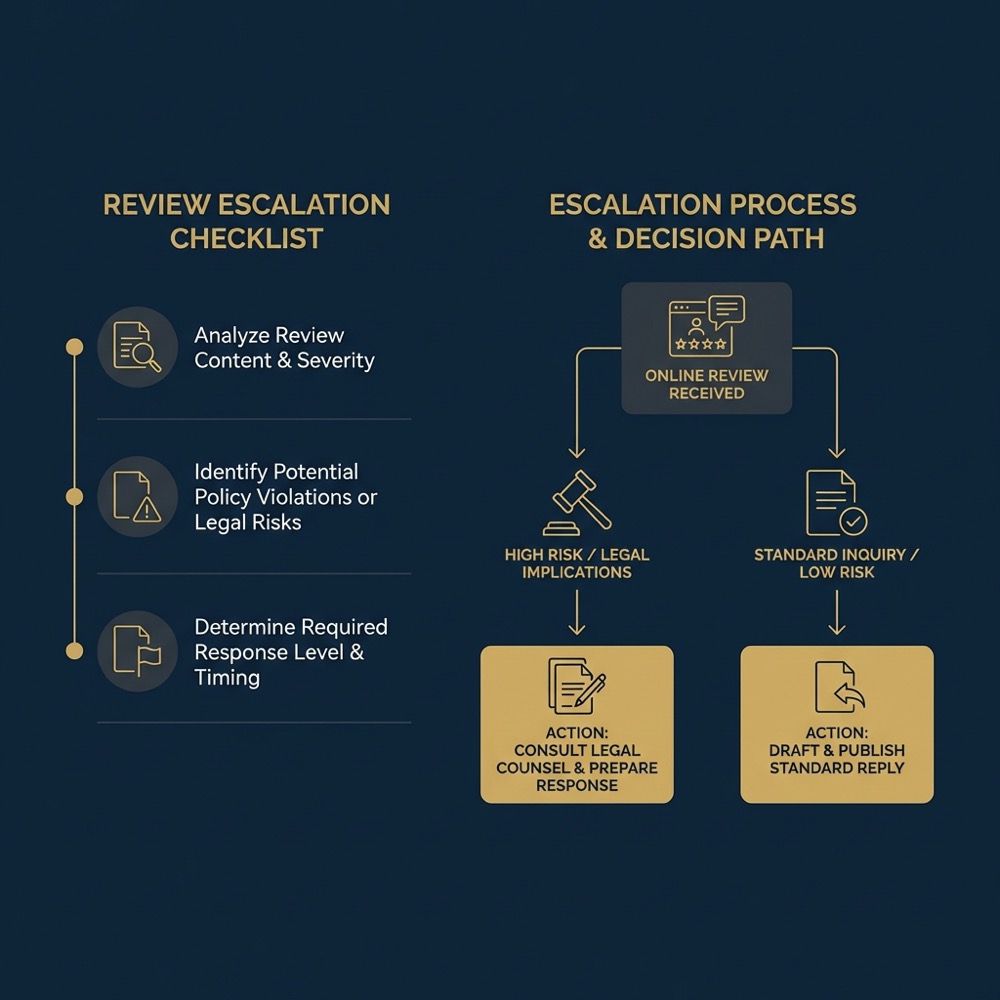
Operationally, treat every bad Google review as a two-track process: a short public reply that acknowledges the concern and a private remediation loop to resolve or verify the issue. If the review appears to violate policy or law, a parallel evidence collection and escalation track is needed.
A quick first-response framework for a bad Google review
Immediate checklist: pause, verify, and craft a short public reply
Within the first 24 to 72 hours, run a short verification sequence: confirm whether the reviewer matches a customer record, locate the transaction or interaction, and note timestamps and any relevant staff involved. Maintain calm language in this phase; the goal is to gather facts and signal willingness to address the issue.
Best-practice guidance encourages a prompt, measured public reply that acknowledges the concern and invites offline resolution, while private outreach attempts to remediate the situation BBB tips for responding to negative reviews.
Timing and who on your team should own the first response
Designate a single owner for first response, usually a customer service lead or a marketing operator who can access records and log actions. The owner should record the time of the review, the verification steps, and the content of any public reply so there is an audit trail for later escalation if necessary.
Keep responses short and factual. Avoid emotional language, debate in public, or promises that bind the company legally. Use a simple log entry that records who checked the transaction and what the immediate decision was: public reply, private outreach, or escalation.
When to flag a bad Google review and how Google’s policy route works
What Google’s Business Profile policy allows for removal
Google’s policy is focused on content violations: spam, hate speech, threats, explicit privacy violations, or content that is off-topic for a business review. Ordinary complaints about service, price, or expectations generally do not meet removal criteria and should be handled through reply and remediation instead Google Business Profile Help.
Treat it as a workflow issue: verify the reviewer and transaction, post a calm public reply, open private remediation, document every step, and escalate to platform or legal routes only when evidence supports those channels.
Practical steps to flag reviews inside Google Business Profile
If a review appears to violate policy, use the flagging option inside your Business Profile dashboard or the report link next to the review. When you submit a flag, include concise notes about why it violates the policy and reference any internal case IDs you created so Google support can correlate details if they follow up.
Expect timing to vary after flagging; Google reviews removal requests are evaluated against policy and not all flags result in removal. If the review is borderline or appears fraudulent, continue private outreach and evidence gathering while waiting for the platform decision.
How to document evidence before escalation
Collect concrete evidence immediately: transaction IDs, booking references, order receipts, timestamps of communications, staff notes, and photos or videos where relevant. Capture screenshots of the review and any profile details, and store all items in a central, timestamped folder or ticket.
Maintain an audit trail that logs who acted and when: who verified the transaction, who posted the public reply, and what private outreach was attempted. Regulators and legal channels require documented evidence when reviews are suspected to be fake or part of an incentivized scheme, so early documentation preserves options Federal Trade Commission guidance on fake reviews.
Public reply templates for a bad Google review
Below are short, adaptable public reply templates to use as a starting point. Each is designed to acknowledge the issue, show willingness to resolve, and move the conversation offline.
Scenario: service issue
"Thank you for your feedback. We are sorry to hear about your experience. We would like to learn more and resolve this promptly. Please contact us at [phone/email] and reference case ID [XYZ]."
Scenario: misunderstanding or wrong expectations
"We appreciate you taking the time to leave feedback. It sounds like there may have been a misunderstanding. Please reach out to us at [contact] so we can review your booking and clarify what happened."
Scenario: suspected fake or irrelevant review
"Thank you for the note. We take authenticity seriously and would like to verify details. If this was posted in error, please contact us so we can address it."

Keep public replies concise, avoid admitting liability, and do not offer compensation in public messages. Invite the reviewer to discuss offline and set a clear next step for follow-up. The public reply is as much about signaling to other readers as it is about addressing the reviewer, and a calm acknowledgment often reduces escalation Harvard Business Review guidance on responding to negative reviews.
Private escalation: outreach, mediation, and remediation steps

Private outreach should follow a clear script: acknowledge the complaint, request verification of the purchase or visit, propose a remediation path if warranted, and state a timeline for follow-up. Keep records of each exchange and avoid language that could be construed as coercive.
Example private script elements: acknowledge the issue, ask for proof of transaction or details, offer a remediation option tied to the evidence, and specify a follow-up date. If the reviewer provides evidence that supports their complaint, update internal records and consider whether a corrected public comment or review update is appropriate.
Mediation or partial remediation can be appropriate when the cost of repair is lower than the reputational risk, but decisions should be tied to constraints and data: verify costs, legal exposure, and how much the remediation would realistically affect customer retention.
When to use Google support versus the legal removal route for a bad Google review
There are three practical paths: flagging through the Business Profile interface for policy violations, contacting Google support for assistance when flags do not resolve the issue, and submitting a legal removal request if the content involves defamation, privacy breaches, or other legal claims. Each path has different evidentiary needs and timelines Google Legal Help on removal requests (see A Lawyer's Guide).
Flagging is appropriate when the review clearly breaches Google’s content policy. A legal removal request is for content that implicates legal rights, such as defamation or privacy violations, and typically requires documentary evidence and a clear legal argument.
guide which escalation path to take with minimal steps
Use internal case ID in all notes
When preparing a legal removal submission, assemble the audit trail, relevant communications, and any proof that the content is false or unlawfully intrusive. Expect variable processing times and that outcomes are not guaranteed, so treat legal routes as parallel to remediation and documentation efforts.
How to handle fake or incentivized bad Google reviews
Look for signals of fake or incentivized reviews: multiple reviews with the same phrasing, timing patterns that do not align with transactions, profiles with little activity, or ratings that spike suspiciously. These indicators justify a deeper validation effort before escalating.
If you suspect fraud or undisclosed incentives, preserve evidence immediately and report the pattern to Google via the support channels while also documenting the issue for potential regulatory follow-up. Regulators treat fake or paid reviews as deceptive practices, so documentation is essential before formal complaints FTC guidance on fake online reviews.
Measuring the impact of a bad Google review on search and local acquisition
Track local visibility metrics and downstream signals after a notable review appears. Useful signals include local pack placement, organic clicks to the local profile, click-through rate from search results, and conversion metrics tied to leads that originate from the local listing.
Common mistakes teams make when handling a bad Google review
Responding emotionally in public, deleting internal evidence, or skipping private outreach are frequent mistakes that reduce the chance of a good resolution. Defensive replies tend to escalate the situation and look poor to other potential customers.
Corrective actions are simple: use neutral templates, log every step, and follow the escalation checklist. Avoid conflating a poor review with a policy violation; attempting to flag ordinary complaints without documentation wastes time and can delay legitimate removals.
Practical scenarios and sample scripts for different bad Google review cases
Scenario A: legitimate service complaint - de-escalate and remediate
Public reply: "We are sorry to hear this. Please contact us at [contact] so we can review your experience. Case ID [XYZ]." Private outreach steps: verify transaction, propose remediation if supported, and follow up within the stated timeline.
If the customer accepts remediation and updates or removes the review, note the change in your audit trail. If not, escalate evidence to support a policy flag or a legal removal request only when justified by the facts.
Scenario B: mistaken identity or location mix-up
Public reply: "Thank you for the note. It appears there may be a location mix-up. Please contact us so we can confirm details and correct records." Private steps: verify dates, check overlapping locations or franchise records, and request the reviewer to confirm details before flagging.
If the reviewer confirms the mistake and updates the review, document the exchange and close the incident. If the review is unchanged but clearly mistaken, flagging with supporting evidence may be warranted.
Scenario C: clearly fraudulent or malicious review
Public reply: "We take authenticity seriously and will investigate this post. If you are the reviewer, please contact us to clarify. Otherwise we will report this to the platform." Private steps: capture profile details, timing, and language patterns; report to Google support and preserve evidence for regulators if patterns suggest coordinated fraud Google Legal Help.
Operational changes to reduce future bad Google reviews
Small workflow fixes reduce incidents: confirm transactions by email, add brief follow-up surveys after service delivery, and train staff to document exceptions when interactions diverge from standard procedures. These steps reduce confusion and produce more accurate review signals.
Embed review follow-up into routine workflows using simple tools: assign ownership for review monitoring, automate alerts for new reviews, and include a short remediation SOP so the first responder knows the next actions. Over time, these systems reduce friction and improve measurement and response consistency BrightLocal research on reviews and local business.
Decision checklist: what to do next after a bad Google review
Use a compact decision checklist: verify the purchase, decide whether to reply publicly, open private outreach, flag if there is a clear policy violation, and escalate to legal review if there are credible defamation or privacy concerns. Record timelines and assign a follow-up owner.
Schedule a short review of the incident after two weeks to measure whether remediation produced an update or whether further escalation is needed. Preserve all evidence and consult counsel when legal rights may be implicated; documentation will support either platform or formal legal processes Google Legal Help on evidence needs.

No. Google removes reviews that violate its content policies; ordinary negative feedback usually does not qualify for removal. Use a public reply and private outreach first, and preserve evidence if you believe the review is fraudulent or illegal.
Consider a legal removal request when the content involves defamation, privacy breaches, or other legal claims and you have documented evidence. Expect variable processing times and consult counsel for advice.
Pause, verify whether the reviewer matches a transaction, post a calm public reply inviting offline contact, log the incident, and start private outreach while collecting evidence.
If the situation raises legal questions, preserve your audit trail and consult counsel rather than relying solely on platform flags.
References
Want this kind of work done for your business?
We build and run AI-powered marketing and automation. 15 minutes, honest assessment.
Book a call