 Orvus
OrvusWhich AI tool is best for competitor analysis?
December 11, 2025
Which AI tool is best for competitor analysis? Practical guidance for teams who need reliable answers
AI competitor analysis tools have dramatically changed how teams find and act on competitive signals. In the last two years the difference feels like night and day: feeds that used to arrive as CSVs now come as short narratives, annotated evidence and API hooks you can wire into dashboards. That speed is useful, but it also creates new risks if you don't check where the numbers come from.
Why this matters now
The market has moved fast. Platforms now combine language models with crawlers, panel traffic estimates, backlink databases and social listening. The result: AI competitor analysis tools can often answer complex questions - like which competitor is gaining in paid search for a product - in one consolidated view. But the quality of that view depends on the freshness and coverage of the underlying sources. If you can’t trace an insight back to the crawl or panel slice that produced it, you will sometimes get confidently wrong recommendations. For a view on upcoming trends and tool directions, see this 2025 trends overview: 2025 trends in AI competitor analysis.

Before we go further, here’s one important practical tip: start every trial with real questions your team will actually use. Demos are polished; trials reveal gaps. A quick branding note: keep your team’s logo and asset list handy when tracking provenance.
If you want a pragmatic partner approach rather than a template-driven sale, consider learning more about Orvus’ services and how we build provenance-first workflows: Orvus Ltd. - Services. This is a tactful suggestion for teams that want help connecting tools to real decision processes.
How to think about capabilities
When evaluating any platform, break the problem down into four core capabilities:

1. Data coverage and recency
Does the vendor crawl the regions and sites you care about? How often do they reindex? Panel estimates vary wildly by geography and vertical; backlink crawlers capture different slices of the web. AI competitor analysis tools that lean on monthly indexes will look stale for fast-moving campaigns. Ask for a sample crawl log or timestamped evidence during your trial.
2. Analytic depth
Can the tool move beyond a pretty chart? A useful platform lets you slice keywords, inspect backlink anchors, and see landing page changes across time. If the AI offers explanations, check whether the explanations reference specific CSVs, crawl snapshots, or raw ad creative.
3. Integration and workflow fit
Will the product push signals into your CRM, BI layer or data warehouse? If the platform can only live behind a dashboard, it will be less useful than one that can send alerts into ticket systems, or export the raw evidence for your analysts to validate. Integration makes insights operational.
4. Explainability and provenance
Ask: can the system show the exact crawl, backlink snapshot or panel slice behind a claim? When an AI says a competitor is "accelerating", you should be able to click a provenance link and see the exact pieces of data that made the model decide that. Explainability is not optional anymore - it’s part of trustworthy decision-making.
Common pitfalls to watch for
There are recurring issues teams should anticipate:
Hallucinations: models sometimes invent patterns that aren't supported by the raw data. Provenance gaps: a polished narrative without evidence. Pricing surprises: hidden costs for API use, historical data, or high-query volumes.
Because these problems are common, successful teams treat AI as a hypothesis generator, not a decision engine. Use AI to surface leads; require evidence before you change budgets or product plans.
Run one near-term, high-impact question through the tool, then spend an afternoon tracing the result back to raw data (crawl snapshots, ad creative, backlink exports). That experiment reveals coverage, freshness and whether the vendor can export provenance - and it’s more revealing than multiple demos.
Run one near-term, high-impact question through the platform, then spend an afternoon tracing the answer back to raw sources. You’ll learn more in a single afternoon than in five demos.
Data sources: the foundation of useful AI
Different vendors assemble different stacks. Some rely heavily on external panels for traffic estimates; others emphasize large-scale crawls or bespoke connectors to ad networks. That choice matters. For instance, a platform that prioritizes panel-based traffic estimates may produce good monthly trends but miss short ad bursts that show up in daily crawls. Conversely, a platform with a massive backlink crawler might surface link spikes that panels won’t catch.
AI competitor analysis tools must be judged on both the type of sources and how fresh they are. Don’t accept high-level claims without seeing the sample evidence. Vendors should be able to show you the crawl IDs, timestamps, and panel slices that feed their insights.
Explainability in practice
Explainability can be implemented in simple, practical ways that make a big difference day to day:
- Attach a provenance badge to every insight that shows whether it came from a live crawl, a panel, or a modeled extrapolation.
- Allow export of the raw dataset that underpins a narrative.
- Log analyst overrides to create an audit trail of decisions.
These steps reduce the chance that an analyst will act on a model-generated summary without the proper checks.
These steps reduce the chance that an analyst will act on a model-generated summary without the proper checks.
For practical transparency checks and deployment precautions, see this guide: AI agents transparency requirements before deployment.
Pricing: what vendors don’t always tell you
Pricing commonly starts reasonable and grows as you scale. Typical charges include per-seat fees, query volumes, API usage, historical data exports, and storage. Teams that plan to automate large parts of their workflows must pay close attention to API costs and retention policies.
Simple tactics to manage cost:
- Ask for committed usage tiers or caps for high-volume API calls.
- Push heavy processing into your own pipelines where feasible and use the vendor for ingest and narrow features.
- Negotiate fixed prices for historical exports used in audits.
How teams get the most leverage
High-leverage setups combine a broad public data layer (search, traffic, backlinks, ads) with lightweight automation and dashboards that mirror your decision processes. Here are practical patterns that work:
1. Alerts wired into ticket systems
When a competitor changes pricing or launches a new landing page, an alert can create a ticket with the raw screenshots, crawl ID, and suggested hypothesis. That gives the product or pricing team immediate, auditable evidence.
2. Provenance capture layer
A thin internal service can capture every AI claim, attach the crawl snapshot and analyst note, and store that bundle in your data warehouse. This approach prevents vendor lock-in and keeps evidence in systems you control.
3. Lightweight automation for routine checks
Automations can convert alerts to checklist tasks: snapshot landing pages, fetch ad creative, and run a quick backlink analysis. Those automations reduce manual load and make validation faster.
Case study: a close call that saved time and money
We ran tests where an AI brief flagged a small rival as an emerging threat. The summary said the rival had increased branded search and hinted at new product messaging. On the surface it looked actionable. But when the team pulled the provenance links, the search bump was a single-country, single-day promo crawl event and the product messaging came from a handful of social posts. Because the company required raw evidence before acting, they treated the alert as a watch item instead of changing product strategy. That saved time and prevented a costly distraction.
Evaluation checklist for trials
Use this checklist during vendor trials to keep comparisons objective:
- Run three real queries: a keyword landscape shift, an ad campaign change, and a backlink spike.
- Request raw data exports that correspond to any AI summary.
- Test API latency and cost for automated workflows.
- Ask legal and security about retention windows and redaction features.
- Compare identical queries across two vendors to spot coverage differences.
Governance and privacy
Commercial CI tools make ingestion easy - sometimes too easy. If teams upload internal decks or customer files without controls, they risk exposing sensitive data. Practical steps worth taking now:
- Limit initial ingestion to public data during trials.
- Require contractual clauses for retention, deletion, and redaction.
- Build an internal screening layer that redacts or blocks sensitive material before it leaves your systems.
These measures protect privacy and keep compliance teams comfortable while preserving the benefits of vendor tools.
Standards and the market outlook
Three market-level improvements would speed better buying decisions:
- Standardized tests for data freshness and geographic coverage.
- Clearer provenance standards so vendors can show the exact evidence behind conclusions.
- Better technical and contractual controls for sensitive-data ingestion.
Industry groups and vendors would do buyers a favor by agreeing on repeatable evidence formats and test harnesses.
Which AI tool is actually best?
Short answer: it depends on your priorities. If you need rapid narrative synthesis for weekly standups, pick a platform with strong LLM features and social listening. If you need audit-ready claims that support pricing or product changes, prioritize data coverage, provenance and integration. For mid-market organizations, cost and predictable API pricing become critical. For enterprise teams, compliance and SLAs matter more. For a practical framework on applying AI to competitor analysis, see this guide: How to apply AI competitor analysis.
Across use cases, one principle holds: treat AI outputs as hypotheses and require traceable evidence before making high-risk decisions.
Practical vendor negotiation tips
Negotiations can be tricky. Vendors often offer attractive entry packages while reserving heavy features for expensive tiers. To protect your budget:
- Be explicit about API usage and ask for a capped price for automation scenarios.
- Negotiate fixed-rate access to historical exports you’ll need for audits.
- Ask whether you can perform heavy processing in your stack while using the vendor for data ingest.
Common questions teams ask
How to evaluate quickly if time is short?
Focus on three queries that matter most next quarter and demand raw exports for any conclusion the AI draws. If the tool can’t support those tests, it’s unlikely to be useful.
How to limit hallucination?
Design a workflow that requires human validation and provenance exports. Build a small rulebook that defines when an AI insight can trigger action vs. when it should create a watch item.
Can panel traffic estimates be trusted?
They are useful but imperfect. Compare panel estimates against server logs or GA4 to understand biases and adjust your decision thresholds accordingly.
How Orvus recommends building a provenance-first setup
Orvus Ltd. advises combining off-the-shelf AI CI features with a light internal layer that captures provenance and analyst validation. That could be as simple as a small database of AI claims linked to crawl IDs and a checklist an analyst must complete before a change is recommended. The goal is to reduce vendor lock-in and keep control over sensitive evidence.
Three quick experiments to try today
1) Pick one near-term decision question, run it through a vendor, and trace the answer to raw data. 2) Run the same query in two platforms and compare coverage. 3) Automate a single alert to create a ticket with raw evidence attached.
Putting it together: a simple workflow
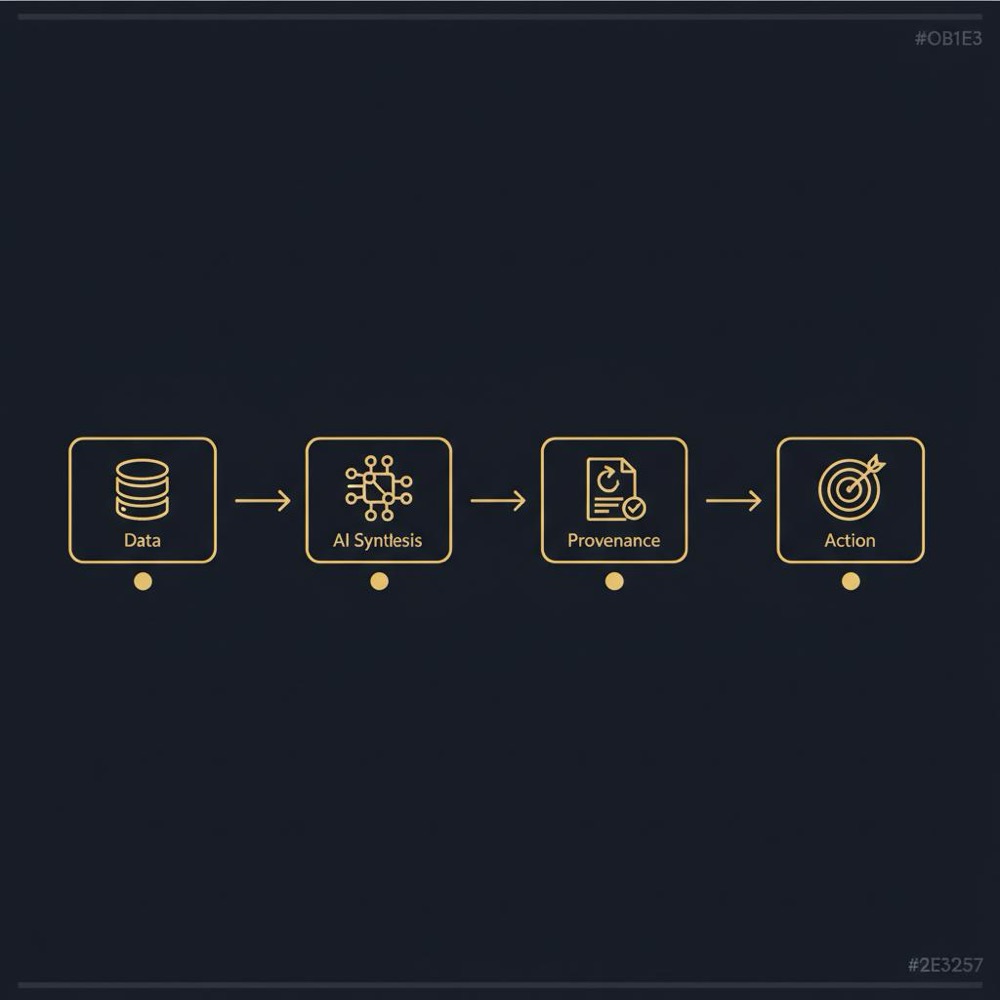
1) AI surfaces hypothesis. 2) System attaches provenance links and raw exports. 3) Analyst validates and annotates. 4) Automation creates a ticket or dashboard line item. 5) Team decides based on evidence. This pipeline turns a black-box statement into an auditable decision.
Longer-term moves that pay off
Invest in small, targeted automations rather than full-blown internal platforms. A thin provenance capture layer and a few connectors to your BI stack will pay dividends by making vendor outputs auditable and actionable.
Final evaluation rubric
Score vendors across these areas:
- Data freshness and coverage (is it hourly, daily, monthly?)
- Provenance and export capability
- Integration and API costs
- Explainability and model confidence indicators
- Privacy, retention, and contractual protections
Use these criteria to pick the tool that best maps to your team’s risk tolerance and decision cadence.
Key takeaways
AI competitor analysis tools are powerful hypothesis engines. They speed up insight collection and narrative synthesis, but they are not decision makers. The best results come from combining vendor capabilities with simple internal tooling that enforces provenance, integrates alerts into workflows, and keeps a human in the loop.
If you want a single suggestion to get started: run one live question, trace the answer to raw data, and build a tiny automation that converts validated insights into tickets. It’s the practical habit that reveals how a tool will behave in the real world.
Orvus’ practical advice: buy the capabilities that accelerate idea generation and invest selectively in the small integrations that make those ideas auditable and operational.
Ready to turn AI insights into reliable decisions?
Ready to turn AI insights into reliable decisions? Explore Orvus’ services to design provenance-first CI workflows and integrations that match your team’s needs: Get Orvus help building CI integrations.
Frequently asked questions
Is there a single AI tool I should standardize on?
Rarely. Most teams use multiple tools in complementary ways and stitch them together with a small integration layer. The right choice depends on whether you value speed, auditability, cost, or integration first.
How can teams reduce hallucination?
Require provenance exports, build a human validation step, and teach stakeholders how to read model confidence and provenance badges.
What are common budget surprises?
API-heavy workflows, historical data access and per-query pricing often drive unexpected costs. Negotiate caps and committed tiers where possible.
Parting thought
Tools are instruments, not oracles. The advantage comes from connecting those instruments to human judgment and engineering that automates the routine. Demand provenance, require validation, and design for the decisions you actually need to make.
Rarely. The right stack depends on priorities like speed, auditability, integration needs and budget. Many teams use multiple tools and stitch them together with a lightweight provenance layer so insights are auditable.
Make explainability a requirement, insist on provenance exports, and enforce a human validation step before acting on recommendations. Add a small checklist that analysts must complete before converting an AI insight into a decision.
Expect costs for heavy API usage, historical data access, and per-query billing. Negotiate committed usage tiers, ask for capped pricing for automation scenarios, and consider offloading heavy processing to your own infrastructure.
References
Want this kind of work done for your business?
We build and run AI-powered marketing and automation. 15 minutes, honest assessment.
Book a call