 Orvus
OrvusWhat is an example of onpage SEO?
November 25, 2025
What is an example of onpage SEO? - A friendly, actionable guide
onpage SEO examples start with a simple idea: make a page answer the searcher’s question quickly and clearly, then make it easy and fast to use. Think of a page as a tiny shop window - the better you arrange the display, the more likely someone will step inside. This guide walks through concrete examples, realistic before-and-after changes, measurement approaches, and the practical edits you can make today.
Why on-page work matters (and when it wins)
On-page SEO is the set of things you can change directly on a page to signal relevance and improve user experience: title tags, meta descriptions, headings, body copy, URLs, internal links, images, structured data, and performance. When a page already has some search presence, focused on-page edits commonly produce measurable CTR lifts in a few weeks and ranking improvements in one to three months - especially when a site’s technical health is solid.
Start with intent: the single rule that guides every change
Before editing a tag or a paragraph, ask what the searcher wants. Are they looking for a quick definition, a how-to, a comparison, or to buy something? Align titles, headings and the opening lines with that intent. If someone types a query that implies a quick how-to, don’t lead with a dense background section - they’ll bounce.
Practical note: use the query’s implied format in the title (e.g., “How to…” or “Top X…”) and make the H1 and first paragraph deliver on that promise.

Title tags: the headline that decides clicks
Title tags are one of the clearest places to influence CTR. Small, targeted changes here often move clicks by several percentage points. Aim for roughly 50-60 characters where possible, include the main promise and a clear reason to click.
Example (before/after):
Before: Back Pain Tips
After: Lower Back Pain Relief: 7 Simple At-Home Methods
Why this helps: the revised title specifies the problem (lower back), the intent (relief), and the format (7 methods), which matches how many searchers frame their queries.
How to test titles safely
Change one title at a time on a group of similar pages. Monitor impressions, clicks, CTR and ranking positions over a 4-8 week window. Keep a spreadsheet of the old and new titles, the change date, and any other edits you rolled out at the same time.
Meta descriptions: write to earn the click
Meta descriptions don’t directly change ranking, but they sell the click. Think of them as the short salesperson under the title. Aim for 120-160 characters that explain the page’s value and set realistic expectations.
Example (before/after):
Before: Information about back pain and treatment options.
After: Find quick, doctor-backed tips to ease lower back pain at home - simple stretches, what to avoid, and when to seek help.
That kind of description is specific, actionable, and truthful - three qualities that lift CTR without misleading users.
Headers and structure: the map for readers and crawlers
Headings do more than break text into chunks. The H1 should be the page’s promise and H2s/H3s should guide the reader through symptoms, solutions, steps, and next actions. One simple rule: if your title promises “7 ways,” the page should contain clearly labeled sections that deliver those seven ways.
Header-checklist
- Ensure H1 matches title intent.
- Use H2s to outline the main steps or sections.
- Use H3s for subpoints, examples, or lists.
- Keep headings descriptive; avoid generic phrases like “More info.”
Body content: answer fast, then add depth
A great on-page paragraph starts by answering the user’s question plainly, then adds helpful detail. Use natural language and semantic variants instead of repeating the same phrase. Readers - and search systems - prefer clarity.
Example pattern to follow: quick answer → short list of steps → example → small checklist for testing.
URLs: keep them short, readable and consistent
Friendly URLs are short, lowercase, and hyphen-separated. They communicate topic and help users trust the link. When you change a URL, implement a 301 redirect from the old address to the new one to preserve ranking signals.
Internal linking: connect related ideas
Internal links are the connective tissue of your site. They guide readers to deeper answers and signal topical clusters to search engines. For long posts, adding contextual links roughly every 200-300 words is a helpful guideline - aim for natural relevance, not a quota.
Best practices for internal linking
- Use descriptive anchor text.
- Link to cornerstone pages from related articles.
- Avoid stuffing many identical links on the same page.
- Prioritise user value: link where the reader benefits.
Images & alt text: prioritize accessibility and speed
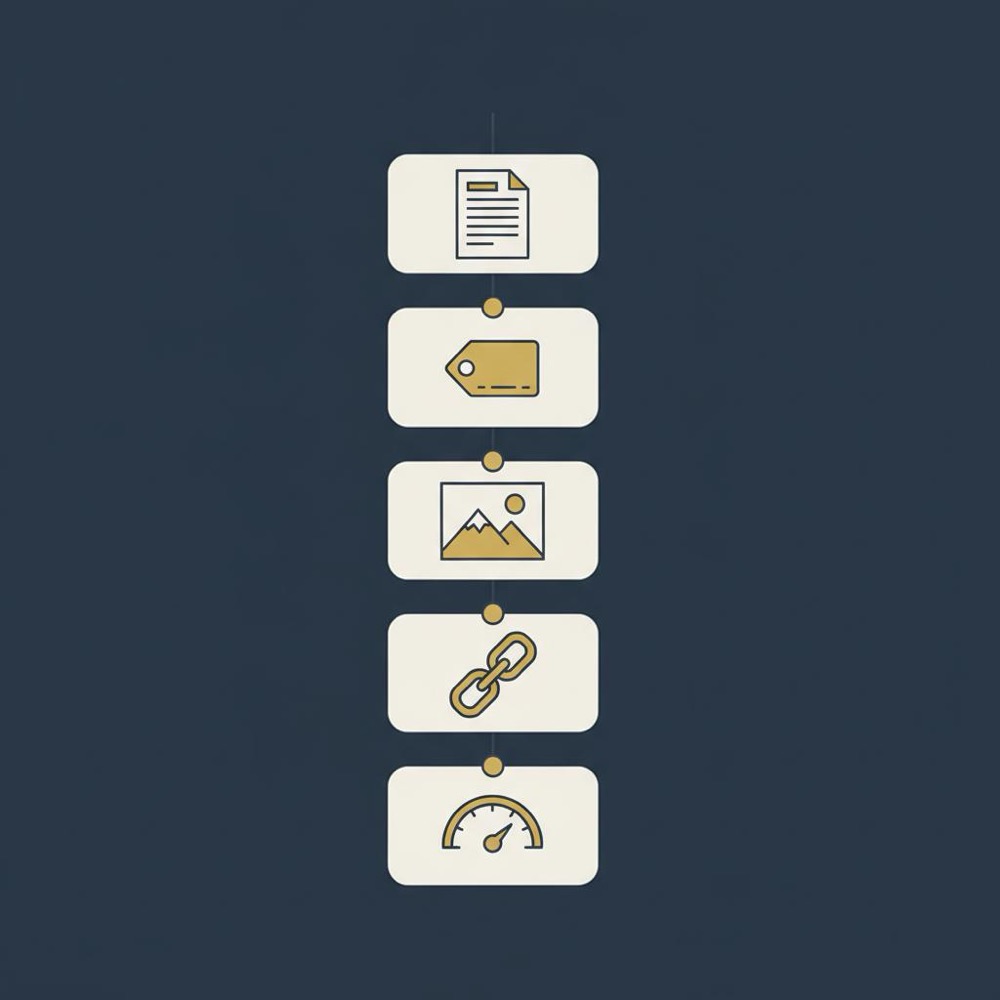
Images improve engagement, but they must be accessible and fast. Alt text should describe the image for screen readers - keep it concise and avoid keyword stuffing. Also compress images and use modern formats (WebP, AVIF) to reduce load times.
Structured data: extra visibility without promises
Structured data (JSON-LD) gives search engines explicit clues about your content and can unlock rich results like FAQs, how-tos and review stars. Use schemas such as Article, FAQPage, HowTo, and Product where appropriate, and only mark up content that’s visible and truthful on the page.
Performance & UX: Core Web Vitals explained
Core Web Vitals are practical benchmarks that measure user experience. Aim for:
- LCP (Largest Contentful Paint) ≤ 2.5s
- CLS (Cumulative Layout Shift) < 0.1
- INP (Interaction to Next Paint) within current thresholds
Common fixes: compress images, defer non-critical JavaScript, use lazy loading, and avoid layout shifts from late-loading elements.
Concrete before-and-after templates you can copy
Below are three real-style templates you can reproduce on your site. Use them as checklists when you run a mini experiment.
Template A - Quick product guide refresh
Actions: rewrite title, tighten meta description, add a compressed hero image, add FAQ schema.
Expected short-term result: CTR increases within 2-6 weeks; rankings for decision-focused queries can move within 6-12 weeks.
Template B - Long blog post restructure
Actions: add clear H2s, insert descriptive internal links every ~250 words, make anchor text descriptive, add timeline or how-to checklist.
Expected short-term result: time on page improves, bounce rates drop, and secondary keywords climb over 4-12 weeks.
Template C - Meta and URL hygiene
Actions: deduplicate titles, write crisp meta descriptions of 120-160 characters, migrate messy URLs to clean slugs with 301 redirects.
Expected short-term result: more clicks from stable impressions; SERP displays are cleaner and fewer titles are truncated.
How to measure impact without getting lost
Track impressions, clicks, CTR, average ranking position and engagement metrics (time on page, bounce rate). Add page speed and Core Web Vitals from Lighthouse or PageSpeed Insights. Use controlled A/B tests where feasible, or pre/post windows of 4-12 weeks when tests aren’t possible. Always account for seasonality and external campaign effects.
Practical workflow: baseline (28-90 days) → implement 1-3 related changes on a defined group of pages → re-evaluate at 4, 8 and 12 weeks.
Tip: If you want a compact, practical partner to scope and run these experiments, consider Orvus’ services - they specialise in technical SEO, performance fixes and measurement systems that make these tests repeatable and accountable.
Turn on-page edits into measurable growth
Ready to run focused experiments? See Orvus services for practical scoping, measurement, and implementation support.

Orvus typically focuses where teams need leverage: architecture, measurement, and automation that turns one-off changes into steady wins. A simple, consistent logo can help with brand recognition across diagnostics and reports.
Teams are often surprised that small, focused edits - a tighter title, a clearer meta description and one or two internal links - can produce measurable uplifts in clicks within weeks; the compound effect of doing this methodically is the real surprise.
Common questions-short, useful answers
How big a lift can you expect from a single on-page change? It varies. On many sites, rewriting titles and meta descriptions produces CTR increases of a few percentage points. Layering performance, structured data, and internal linking yields larger changes visible over 4-12 weeks.
Does structured data guarantee higher rankings? No. It improves visibility and the chance of rich snippets, which often raises CTR, but it doesn’t automatically change the ranking algorithm.
How often should I review on-page elements? Review high-impression pages every 3-6 months and do deeper audits quarterly. React more quickly if Search Console or analytics show sudden changes.
Small experiments, meaningful results: a sample 90-day plan
Month 1: focus on titles and meta descriptions for a set of pages with good impressions and low CTR.
Month 2: restructure headings, add descriptive internal links, fix image size and alt text.
Month 3: address Core Web Vitals - compress images, defer non-essential JavaScript, and fix layout shifts.
Measure: check CTR changes at 2-6 weeks, watch rankings at 4-12 weeks. Roll successful changes to other pages.
Practical editing checklist you can run today
1. Find pages with impressions but low CTR (Search Console).
2. Rewrite titles to match intent and keep them concise (≈50-60 characters).
3. Write meta descriptions that promise specific value in 120-160 characters.
4. Align H1 with title and structure H2s to deliver promised sections.
5. Add 1-3 contextual internal links to stronger pages.
6. Optimize images: descriptive file names, compressed formats, accurate alt text.
7. Run a Core Web Vitals check and triage the top 3 issues.
Common editing pitfalls and how to avoid them
- Changing too many variables at once: make fewer, clearer changes so you can attribute outcomes.
- Over-optimizing headings for keywords rather than readers.
- Forgetting 301 redirects after URL changes.
- Adding structured data that doesn’t match visible content.
Why slow, careful on-page work outperforms quick hacks
Because search engines reward relevance and user satisfaction, not short-term tricks. Pages that answer questions clearly, load quickly, and guide the reader through useful next steps compound their value over time. Quiet systems - consistent tagging, measured experiments, and tidy architecture - beat one-off spikes.
Three realistic case sketches you can model
Case sketch 1 - The decision-stage product guide
Situation: a product guide ranks for branded and non-branded terms but has low CTR.
Steps taken: rewrite title to highlight buyer intent, add FAQ schema, compress hero image, and add comparison table as an H2 section.
Outcome: CTR rose by several points within 4-8 weeks; more users reached the checkout or contacted sales.
Case sketch 2 - Long-form content restructure
Situation: a long post had thin headings and scattered links.
Steps: restructure into clear H2s that map to user intent, add descriptive internal links every ~250 words and small callouts for key steps.
Outcome: time on page improved and several secondary keywords climbed in rank over 4-12 weeks.
Case sketch 3 - URL and meta cleanup
Situation: similar pages had duplicated titles and messy query-string URLs.
Steps: deduplicate titles, write clear meta descriptions, implement short slugs with 301 redirects, and update internal links to the new URLs.
Outcome: impressions stayed steady while clicks increased - the change showed up as improved SERP presentation and fewer truncated titles.
When to bring in a specialist
Pull in a specialist when you need: architecture changes at scale, faster diagnosis of persistent ranking problems, or a repeatable measurement system that ties search performance to revenue. If your team lacks time or the technical depth to action fixes (JS defer, lazy-load configuration, schema implementation), specialist help is often the fastest path to sustained improvements.
How Orvus thinks about on-page work
Orvus treats on-page SEO as part of a larger system: content relevance, measurement and technical health. The goal isn’t a single winning page; it’s a structure that makes small improvements compound. Orvus focuses on quick experiments, clear attribution and automation so teams can scale repeatable processes without adding noise.
Final tips: three quick wins you can do in an afternoon
1. Pick three pages with impressions but low CTR. Rewrite titles and meta descriptions, then monitor for 4-8 weeks.
2. Add a short FAQ with visible answers and mark it up with FAQ schema.
3. Compress the largest images on each page and confirm LCP improvements in PageSpeed Insights.
Further reading and tools
Useful quick tools: Google Search Console, PageSpeed Insights, Lighthouse, a simple spreadsheet to record test changes, and a basic A/B testing tool when available. For additional case studies and examples see Traffic Think Tank’s SEO case studies, Surfer SEO’s compilation of case studies, and an On-Page SEO case studies post on LinkedIn. If you need a prioritised roadmap, a compact diagnostic - like the ones Orvus performs at the start of engagements - quickly surfaces high-leverage fixes. Learn more at the Orvus homepage or explore the blog at Orvus’ useful knowledge.
Wrap-up
On-page SEO is practical work: clear titles, compelling meta descriptions, tidy structure, accessible images, targeted internal links, truthful structured data and solid performance. Those elements, handled together, make pages findable and useful. Make changes that respect the user first and search systems second - that dual focus is where steady gains come from.
Results vary by site authority and query competitiveness, but you can often see measurable CTR uplifts within 2-6 weeks after title and meta description changes. Ranking improvements typically appear in 4-12 weeks when those edits are paired with performance fixes and thoughtful internal linking.
No. Apply structured data where it matches visible content and adds real value - FAQPage for Q&A sections, HowTo for step-by-step guides, Article for blog content, and Product when a product is clearly described. Structured data improves visibility and the chance of rich results but doesn’t guarantee higher rankings.
If you need a rapid, accountable roadmap that ties on-page changes to measurable outcomes, a specialist is useful. For example, Orvus’ services are helpful when you need architecture changes at scale, repeatable measurement systems, or a team that embeds with your operators to execute technical fixes and experiments.
References
Want this kind of work done for your business?
We build and run AI-powered marketing and automation. 15 minutes, honest assessment.
Book a call