 Orvus
OrvusWhat is the meaning of SEO ranking?
November 25, 2025
What is the meaning of SEO ranking? - A clear, human explanation
SEO ranking is not just a number on a search results page; it’s the visible outcome of many invisible checks that search engines run to decide which page best satisfies a user’s intent. In practice, an SEO ranking reflects relevance, authority, technical health and user experience - and those signals are combined into a single snapshot you see in the SERPs. Understanding how these pieces fit together is the fastest way to improve results in a predictable, measurable way.
In this guide you’ll find practical explanations, hands-on diagnostics, and step-by-step moves that teams can take immediately. We’ll use clear examples, simple tests, and real-world fixes so you can act, not just speculate.
For teams who want practical help implementing these steps, consider exploring Orvus strategic growth services. Orvus helps brands turn technical SEO, content and measurement into systems that scale - a handy resource when you need focused execution rather than another list of tips.
What follows is a friendly, practical map: we’ll unpack the core ranking pillars, walk through diagnostics, cover common myths, and end with an action plan you can use this week.

A fix to indexability or a large Core Web Vitals regression often gives the biggest quick boost. Many sudden drops are caused by accidental noindex tags, robots.txt blocks, or a recent technical change that slowed rendering. Correcting these issues lets search engines rediscover and re-evaluate pages quickly, producing visible improvements within days to weeks.
What search engines are trying to do
Search engines answer one simple question: which pages best match a user’s intent for a given query? That question drives every part of ranking. Engines analyze query context, historical behavior, and page content to infer intent - whether someone wants to learn, buy, navigate, or find something local. The resulting SEO ranking is their judgment at that moment.
Intent is the core of relevance
Consider two pages about fixing a leaky faucet: a step-by-step DIY guide with photos and a parts supplier’s product page. They share words but serve different intents. For a query like "how to fix a leaky faucet," the how-to guide will usually outrank the product page because it matches the user’s goal. Matching intent is why stuffing keywords no longer works; modern systems look for meaning and usefulness, not raw word counts.
Three core pillars that still matter
When you think about improving an SEO ranking, focus on three areas that consistently matter: relevance, authority, and technical health. A fourth set of signals - user experience metrics - is also influential and worth attention.
1. Relevance: content that answers intent
Relevance is about fit. Does the page answer the actual question the searcher had? Search engines use natural language understanding, query context and user behavior to estimate intent. Pages that are clear, structured and focused on the user’s question perform best. This means crafting concise intros, using headings that match likely sub-questions, and placing the most useful content within the first screenful.
Write to the person, not the engine. If you provide specific, original value - examples, short tutorials, local details or practical checklists - you’ll increase the chance a page ranks well for relevant queries. Remember: an SEO ranking is essentially a relevance score expressed as position in the SERP.
2. Authority: the web’s endorsement
Authority shows whether other people and sites vouch for your content. Backlinks still function like citations: high-quality, topically relevant links matter more than many mediocre ones. Anchor text, link placement and the surrounding context all influence the power of a link. A citation in a thoughtful article on the same topic is stronger than a link buried in a footer.
Link-building should be thoughtful, not frantic. Produce resources people want to reference - original data, calculators, guides - and cultivate relationships with writers and communities who naturally link to that kind of material. Over time, these signals help raise an SEO ranking across important queries.
3. Technical health: make crawling and rendering painless
Even superb content struggles if a search engine can’t find, crawl or render it. Indexability is the first gate: robots.txt, noindex tags, canonical mistakes or a missing sitemap can all prevent pages from appearing. Mobile-first indexing means the mobile experience is primary; if your mobile version is broken, the SEO ranking will reflect that.
Performance matters. Core Web Vitals - LCP, CLS and INP (or FID in older references) - measure how fast and stable pages feel to users. Poor scores can reduce visibility on competitive queries. Fixing performance generally involves compressing images, deferring non-critical scripts, serving modern image formats, and ensuring servers respond quickly.

Orvus Ltd. Logo
User experience signals: what they tell you
Click-through rate (CTR) and dwell time are correlated with ranking changes and are useful as diagnostics. If a page has many impressions but low clicks, improve the title and snippet. If people click and immediately return to the results, ensure the page delivers the promised answer and isn’t blocked by intrusive ads or confusing layout. These signals don’t act alone, but consistently bad user experience can lead to lower SEO ranking over time.
How modern updates changed the landscape
Search engines have been clear about focusing on quality. A notable 2024 update targeted low-quality, unoriginal content and led to a reported roughly 45% reduction in such content appearing in results. The takeaway is simple: content that doesn’t help users will be demoted - so originality, clarity and usefulness aren’t optional.
Measuring ranking in practice
No single metric tells the whole story. Combine rank tracking with Search Console, real user analytics and business outcomes. Use a rank tracker to observe trends but don’t treat absolute rank as gospel: results vary by location, personalization and device.
Search Console gives impressions, clicks, average position and CTR - essential signals directly from Google. Pair this with analytics that show whether organic traffic converts into signups, leads or purchases. If a page ranks well but produces no conversions, the intent or on-page experience needs work.
Common misconceptions, debunked
Myths linger because they used to be true. Meta keywords are dead. Raw keyword density is no path to higher placement. And AI content isn’t automatically penalized - what matters is whether it provides real value. An AI draft that’s polished by an expert, enriched with original insight, and tailored to readers can perform well. But unmodified, repetitive AI text risks being filtered out.
Practical 5-step action plan to improve your ranking
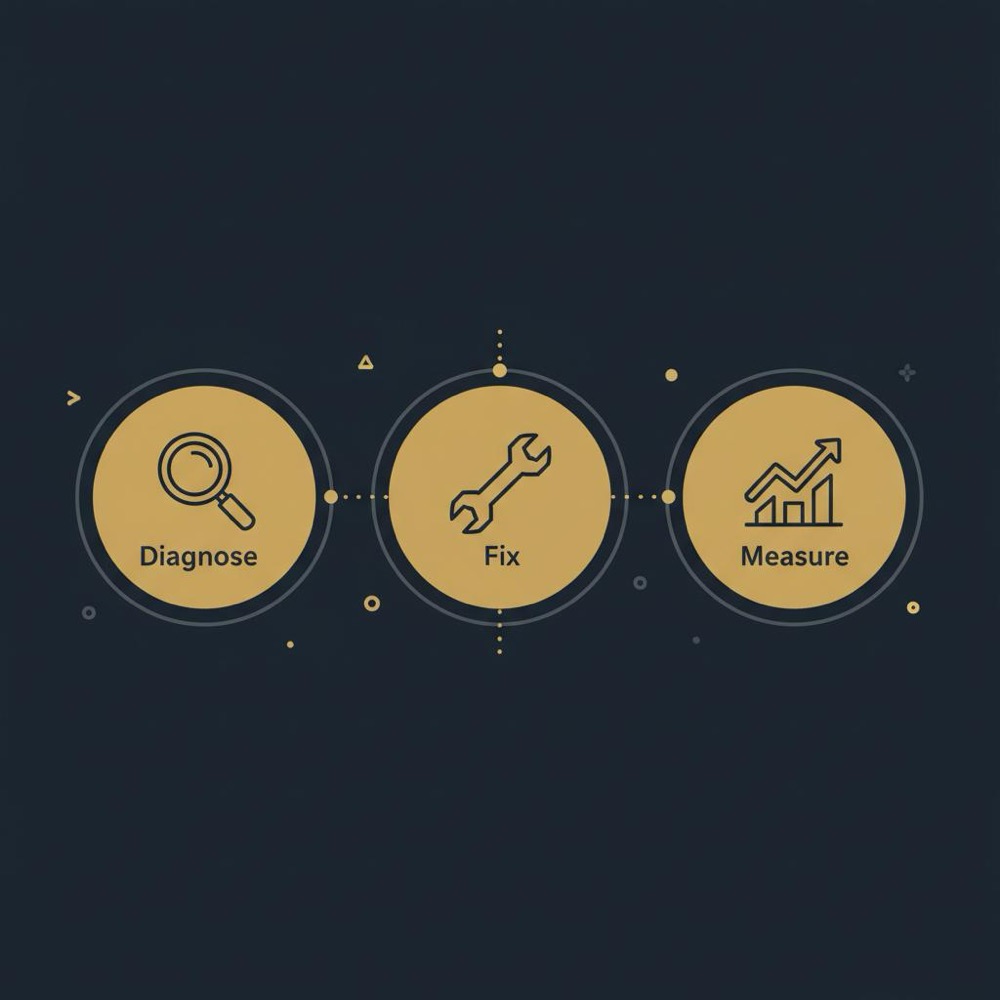
Here are five pragmatic moves that deliver the most consistent results for improving an SEO ranking:
1. Fix crawl and index problems
Check Search Console for coverage errors. Look for accidental noindex tags, robots.txt blocks, or sitemap issues. Review server logs to see what bots encounter. Fixing indexability is often the fastest way to restore visibility.
2. Match content to intent
Audit top-ranking pages for your target queries. What do they answer? Can your page meet or exceed that value with original examples, better structure or clearer instructions? Sometimes splitting content into separate pages for different intents helps more than one long, unfocused article.
3. Improve perceived performance
Use field and lab tests to find Core Web Vitals regressions. Practical fixes include compressing images, using lazy-loading for offscreen media, deferring render-blocking scripts, and tightening caching policies. If a CMS update introduced heavy scripts, roll back or refactor them quickly.
4. Build topical authority
Focus on earning links that make sense: original research, tools, and well-researched guides. Reach out to niche publications and communities offering value - a quote, a data set, or expert context - rather than a generic link pitch.
5. Optimize snippets and test CTAs
Improve title tags and meta descriptions to reflect user intent and increase CTR. Small changes often produce measurable improvements in clicks, which can positively affect early user behavior and give your page momentum in the rankings.
Diagnosing a sudden drop: a short case study
An ecommerce category experiences a sudden fall in organic sessions. Indexing looks intact, but Search Console impressions dropped. An audit reveals a recent CMS change that pushed large, uncompressed JavaScript and disabled server-side caching. Core Web Vitals regressed and LCP ballooned. The team restored caching, deferred non-critical scripts, and served modern image formats. Over the following weeks, impressions and clicks recovered as pages felt faster and more crawlable. This example shows how technical and user-perceived performance tie directly to SEO ranking.
Orvus Ltd. Logo
What we still don’t know (and how to act anyway)
Exact signal weightings remain proprietary. We don’t know precisely how many links equal a certain content depth score or exactly how behavioral signals are balanced. The good news: repeated observation shows the same priorities matter. Prioritize intent alignment, authority, and technical correctness and you’ll be on the right side of future updates.
How to organize teams around ranking improvements
Small teams should prioritize technical diagnostics (crawlability and performance) and then align content to intent. Larger organizations should coordinate across developers, content teams, PR, and product. Authority-building works best when editorial, PR and product collaborate to create linkable assets. Track meaningful business outcomes (leads, revenue) rather than vanity metrics.
Tools and measurement: what to use
Choose tools that help you act. Search Console is essential. Combine it with a reliable rank tracker, link analysis, and real user monitoring. Use lab tools to test fixes, but rely on RUM data to see how real users experience your site across networks and devices. The right toolset reduces guesswork and focuses teams on moves that actually affect SEO ranking.
What to avoid
Avoid tricks and shortcuts: keyword stuffing, manipulative link schemes, and mass-produced shallow content. These tactics may give short-term lifts but are brittle when quality filters tighten. Instead, publish fewer, better pages and invest in relationships that earn natural references.
Advanced topics - schema, SERP features and AI
Structured data helps engines understand content and can increase your chance of appearing in snippets, People Also Ask boxes, or rich results. Answer clear questions in short blocks (definition, steps, lists) and add schema where appropriate.
Generative AI is a powerful drafting tool. Use it to brainstorm headings, generate outlines, or create first drafts - but always add human insight, examples and verification. Search quality updates reward originality and penalize generic repetition, so first-hand expertise and unique data remain the best defensible long-term strategy for raising an SEO ranking.
FAQ highlights
How long before you see ranking changes after a fix? Technical fixes can sometimes show effects in days. Content and authority work often take weeks to months. Can you recover from a major update? Yes - with careful quality improvements, pruning thin content and rebuilding authority.
Practical examples of quick wins
Fix misplaced noindex tags, update titles to match user intent, compress large images, and remove a slow plugin - these are often low-effort, high-impact wins. A quick snippet rewrite can lift CTR and improve early user signals for a page that already ranks in the top 10.
When to ask for expert help
If your team is stuck, coordination is messy, or changes require deep technical fixes plus content strategy, a partner who combines technical execution with strategic clarity can accelerate progress. For a practical, embedded approach, teams sometimes choose Orvus to rebuild search architecture, measurement and execution plans quickly and quietly.
Turn SEO into a reliable growth channel with practical execution
Ready to turn SEO into a reliable growth channel? If you want help building the systems that actually move numbers, explore Orvus’s services and see how focused technical and content work can compound over time. See Orvus services and diagnostics
Wrapping up - steady craft beats shortcuts
Ranking is the result of many small, consistent choices: clarity in content, sound technical foundations, and real-world endorsements from other sites. Keep the user’s intent first, fix crawlability and speed, and invest in unique, useful content and relationships. Over months and years, these habits produce stable improvements in SEO ranking and better business outcomes.
Thanks for reading - now pick one fix from the five-step plan and try it this week.
It depends. Technical fixes (indexing, removing blocking tags, restoring caching) can sometimes show improvements in days. Content rewrites and authority-building usually take weeks to months because search engines re-evaluate signals over time and links need discovery and endorsement.
Yes. Recovery requires a focused approach: raise content quality, remove or consolidate thin pages, fix user experience issues, and rebuild authority with relevant citations. Quick patches rarely work; sustained, thoughtful improvements are the reliable path to recovery.
Use AI as a tool, not a replacement for human expertise. AI can draft outlines and first versions, but every page should be reviewed by an expert and enriched with original insight, first-hand examples or data before publishing. If you’d like help operationalizing AI in your workflow, consider the practical help available at Orvus: orvus.net/services/
References
Want this kind of work done for your business?
We build and run AI-powered marketing and automation. 15 minutes, honest assessment.
Book a call