 Orvus
OrvusHow to rank no 1 in Google search? A systems approach
January 29, 2026
Readers will find a clear checklist for technical must fixes, a content quality audit workflow, measurement and experiment guidance, and examples for common site types. The approach emphasises measurement, iteration, and converting successful tests into repeatable workflows rather than one off tactics.
What search ranking actually means and why "number 1" is ambiguous
Search ranking describes where a page appears in a set of results returned by Google for a query. The systems that generate those results are automated and evaluate many signals where relevance and quality are central, which affects what appears as top positions for different users and contexts How Search algorithms work. See analysis at Search Engine Land.
Position alone is an incomplete measure. A top slot for one query may send little traffic if the result is a knowledge panel, a map, or an answer box. Different SERP features change how a top position translates to clicks and conversions.

For teams, the important outputs are the behaviors that follow a click. Measure clicks, engaged sessions, and funnel outcomes alongside position to understand real impact rather than chasing a number on its own. Treat the position as one signal in a wider performance picture informed by measurement and experiments.
When planning work, remember that the same query can surface different result types depending on intent, device, and personalization. That is why aiming for a single numbered rank is often an oversimplification; what matters is relevance to intent and the real user task.
How Google’s ranking systems decide relevance and quality
Google states publicly that automated ranking systems use many signals and that relevance and quality are central to deciding which pages users see How Search algorithms work.
Quality raters provide human assessments using E-E-A-T language to describe helpful content, expertise, authoritativeness and trustworthiness. These raters do not directly set rankings, but their guidelines help refine algorithm development and quality definitions.

Because Google does not publish exact weightings for signals, the practical implication is clear: site level experiments and measurement are necessary to learn what works for your context. Rely on iterative testing rather than assuming universal factor weightings.
Why content quality and relevance (E-E-A-T) are central
Content quality in operational terms means the page helps the user complete the task implied by their query. That includes experience and expertise signals, clarity on who produced the content, and transparent sourcing in cases that demand trust. These ideas are core to the guidance human assessors use when evaluating helpfulness.
Practical checks for helpful content include matching intent, clear author or organisation context, appropriate depth for the query, and evidence or citations where needed. Use content architecture to map pages to intents so each page has a primary task and measurable success criteria.
Use the following checklist to audit content quality and relevance. Work through these items before broad rewrites or mass content production so effort is focused on pages that serve real user tasks.
- Intent match: Does the content answer the likely user question?
- Author signals: Is authorship or organisational responsibility clear where it matters?
- Depth: Is the content more useful than thin summaries on the same topic?
- Sourcing: Are factual claims supported by reliable references or internal data?
- Structure: Is the content organised to support scanning and task completion?
Begin a focused audit and experiment plan
Run a small content audit on your top converting pages first, document intent and top tasks, and prioritise revisions that add missing author context and clearer sourcing where it blocks user trust.
Surface level updates like changing titles or adding keywords without restructuring content architecture rarely move outcomes. Relevance and helpfulness are contextual, so focus edits on meeting user tasks rather than keyword density alone.
Technical SEO: the non-negotiable foundation
Technical SEO is a prerequisite because pages must be discoverable and interpretable by Google if any relevance signals are to matter. Start with indexability and crawlability checks to ensure the site is visible to search systems How Search algorithms work.
Concrete items to verify include robots directives, sitemap accuracy, canonical tags, status codes, hreflang where relevant, and consistent structured data. These elements tell search systems which pages to index and how to interpret content.

A short index and crawl diagnostic will reveal whether content changes are visible to Google. Run coverage reports and correct errors before investing heavily in content changes, because traffic shifts cannot be interpreted if pages are blocked or misindexed.
Canonicalization and proper HTTP status handling prevent index fragmentation. Structured data helps search systems understand entities and relationships on the page, improving how your content is interpreted and potentially how it is displayed in SERPs.
Page experience and Core Web Vitals: what to prioritise
Core Web Vitals are part of Google’s page experience considerations and can influence search performance alongside relevance and quality Core Web Vitals and page experience.
Prioritise measurable improvements that block users from completing tasks: loading speed for key content, interactivity for controls, and visual stability during task steps. These are practical levers when poor experience prevents conversions.
Start with technical indexability and measurement, audit high intent pages for helpfulness, run small controlled experiments, and convert winners into repeatable workflows.
Experience signals complement relevance. If content is strong but pages are slow or unstable, conversions and engagement can suffer. Conversely, fixing experience alone will not substitute for weak content. Treat page experience work as parallel to content investment and prioritise based on where the page fails users most.
Backlinks and external signals: correlation, not a rulebook
Industry analyses find that backlink quantity and quality correlate with higher organic positions, but those studies report correlation rather than disclosed causal weightings, so interpret them cautiously What correlates with Google’s top rankings. See further discussion at LinkBuildingHQ.
When assessing link opportunities, focus on relevance, referral likelihood, and authority in context rather than chasing raw counts. Links that are likely to bring engaged referral traffic tend to be more durable and operationally useful.
Avoid low quality link schemes. They are risky and often ineffective. Instead, build processes that encourage natural referrals and mentions from related sites and partners as part of broader content and outreach workflows.
Measurement, experiments, and attribution for ranking work
Position changes alone are noisy. Industry guidance recommends funnel level KPIs and controlled experiments to separate algorithm effects from other traffic shifts Google ranking factors and measurement recommendations.
Start with baseline segments and control pages. Use Search Console for position and impressions, and combine it with analytics event and conversion tracking to see whether ranking changes translate to meaningful outcomes.
a compact experiment and attribution checklist
Keep experiments small and measurable
Design experiments so that changes are isolated and results can be interpreted. Prefer small treatments on sets of comparable pages and extend only when results are clear. Attribution will always have limits; use multiple metrics to triangulate impact.
Document each experiment, record environmental variables like seasonality and channel promotions, and only scale changes when you see consistent signal across clicks, engagement, and conversions.
A step-by-step framework to improve ranking responsibly
Use a repeatable framework: discover, diagnose, prioritise, implement, and measure. Discovery includes content and technical audits. Diagnosis maps bottlenecks. Prioritisation balances impact, effort, and measurement risk. Implementation covers both content and technical work. Measurement closes the loop How Search algorithms work. Read more on the Orvus blog.
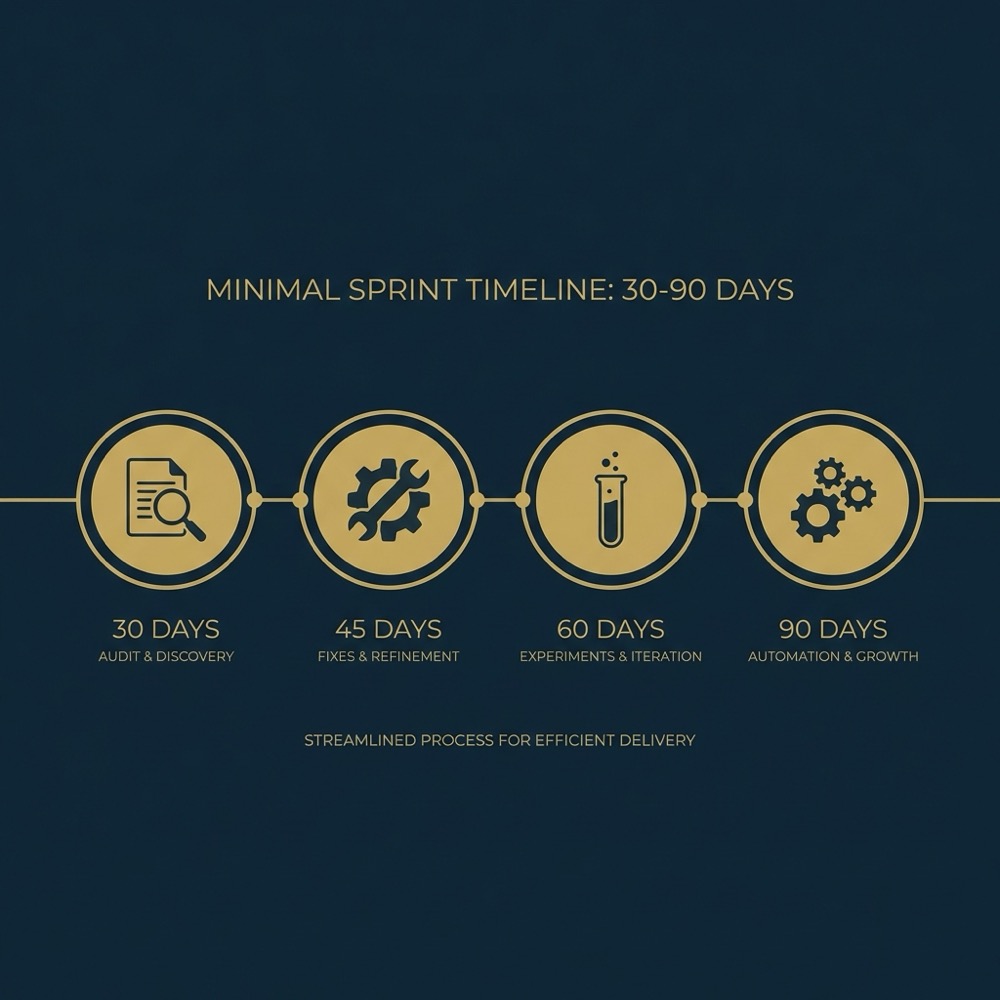
Sample 30 to 90 day sprint breakdown:
- Days 1 to 10: Discovery. Run crawl reports, identify index issues, and map top intent clusters.
- Days 11 to 30: Quick fixes. Resolve critical index or canonical errors and update 3 to 8 high intent pages with author signals and clearer structure.
- Days 31 to 60: Experiments. Run controlled content treatments on a small cohort of pages and track funnel KPIs.
- Days 61 to 90: Iterate. Scale successes into templates, automation, and reporting dashboards.
When changes succeed, convert them into systems: templates for content clusters, checks in deployment pipelines, and automation for recurring reporting. Systems compound; repeatable workflows reduce operational friction and improve decision making over time.
Teams with limited time can focus on audit driven fixes first, then move to content clusters and measurement once indexability and instrumentation are stable.
How to prioritise work: decision criteria and trade-offs
Use a simple rubric: score each action by impact, effort, and measurement risk. High impact, low effort and low risk should be prioritised. Record scores and use them to justify resource allocation.
Common trade-offs include choosing between small technical wins and larger content initiatives. If indexability or analytics is broken, pause broad content pushes until those foundations are fixed because measurement will be unreliable otherwise Google ranking factors and measurement recommendations.
When product or funnel issues block conversions, prioritise cross functional fixes. SEO work is most valuable when downstream funnels and attribution are functioning so gains can be realised and measured.
Common mistakes and traps that waste time and risk rankings
Chasing single metric wins like a position number can waste effort. Positions are noisy and can fluctuate for reasons unrelated to content quality. Instead run controlled experiments and track funnel level metrics to see if changes matter.
Other common mistakes include making large structural changes without backups or tests, and publishing mass low quality content. Those moves increase risk and often produce little durable value compared with targeted improvements.
Neglecting measurement is a frequent problem. Without reliable instrumentation teams cannot tell whether changes drive real outcomes. Restore tracking and coverage diagnostics before wide rollouts to limit wasted effort and avoid erroneous conclusions.
Practical examples and scenarios: ecommerce and service businesses
Ecommerce example. Start with index checks for category and product pages. Use product schema where it clarifies product attributes, ensure canonical strategy avoids duplicate listings, and build content clusters around commercial intent to support category conversion pages How Search algorithms work.
Service business example. For local intent, focus on reputation signals, local mentions, and content that demonstrates expertise for the services offered. Make author and organisational context clear and include trust signals appropriate to the service.
In both scenarios measure success with funnel metrics. For ecommerce track category to product engagement and checkout steps. For services track lead form submissions or calls and the quality of leads. Positions are supplementary evidence but not the sole KPI.
How AI and automation can support ranking work (and current unknowns)
AI and automation are useful operationally: they speed audits, surface content gaps, generate draft outlines, and automate recurring reporting tasks. These uses reduce recurring operational work and free teams to focus on decision making and execution.
There are open questions about how on site generative content signals are processed by search systems and whether they affect ranking directly. Those details are not published and require site level testing to validate effects in your context.
Use guardrails: always apply human review, verify factual accuracy, and avoid publishing unchecked generative content. Keep AI tooling in the role of an assistant that supports workflows rather than replacing human judgement.
Final checklist and next steps for a 30 to 90 day plan
Quick checklist to start: fix index and crawl issues, verify Search Console and analytics instrumentation, update a small set of high intent pages for clarity and author context, and run controlled experiments on comparable pages Google ranking factors and measurement recommendations.
Identify one low effort task to start this week, such as correcting canonical tags on key product pages or adding author context to three service pages.
Convert successful tests into repeatable templates and add checks into deployment workflows. Over time these systems reduce manual work and compound the value of incremental gains. Treat ranking improvement as ongoing systems work, not a one off campaign.
There is no single factor. Relevance and content quality combined with correct technical setup are fundamental. Focus on meeting user intent and ensuring pages are discoverable.
Timing varies by site, query, and competition. Use controlled experiments and funnel metrics to measure progress rather than relying on position changes alone.
AI can help with drafts, audits, and workflow automation but always apply human review, fact checks, and editorial oversight before publishing.
If you need a partner to help design and operationalise these systems, consider starting with a compact diagnostic that maps bottlenecks and prioritises high leverage work.
References
- https://developers.google.com/search/docs/fundamentals/how-search-works
- https://searchengineland.com/seo-2026-stay-same-467688
- our services
- about Orvus
- https://web.dev/vitals/
- https://ahrefs.com/blog/google-ranking-factors/
- https://linkbuildinghq.com/blog/how-to-improve-google-search-ranking-in-2026/
- https://www.semrush.com/blog/google-ranking-factors/
- our knowledge base
- https://developers.google.com/search/docs/appearance/core-updates
Want this kind of work done for your business?
We build and run AI-powered marketing and automation. 15 minutes, honest assessment.
Book a call