 Orvus
OrvusWhat is SEO in online marketing? A systems guide
January 29, 2026
The aim is pragmatic: show what to check first, how to connect content to funnels and which metrics matter for decision making. The suggestions are conditional and designed to fit different team constraints and data quality levels.
What online marketing seo means today
A short definition
Online marketing seo is the coordinated discipline of on-page, off-page and technical practices aimed at improving a website's visibility in organic search and supporting measurable business goals. That definition reflects how search engines evaluate pages today, with emphasis on helpful content, crawlability and user experience signals as central evaluation criteria Google Search Central guidance.
For operators, the practical implication is that SEO is not a single task, such as “add keywords”, but a system that links content, technical foundations and measurement so outcomes compound over time. Treating SEO as systems design reduces repeated rework and makes testing repeatable.

In a modern marketing stack, SEO sits alongside paid search and paid social as a channel that feeds top and mid funnel demand while also supporting long term discovery. When SEO is treated as a strategic system it can feed performance media insights into content and vice versa, improving overall channel efficiency.
Systems thinking shifts focus from isolated fixes to durable elements: content architecture, indexability, canonical rules and measurement pipelines. These elements create a stable search architecture that teams can instrument and improve over time Moz beginner's guide to SEO.
simple site readiness checklist for search architecture
Keep the checks short and repeatable
Why treat SEO as systems design in online marketing
What systems design means for SEO
Systems design treats SEO work as repeatable flows: discovery, content creation, technical implementation, testing and measurement. That structure makes tasks predictable and allows teams to instrument handoffs between content authors, developers and analysts.
By codifying these flows, operators can increase testing velocity and reduce one-off rework that often wastes effort. Industry analysis notes that consistent naming and reporting speeds up experiments and improves clarity when attributing impact across channels State of Search 2024.
Benefits of a systems approach for operators
A systems approach clarifies who owns each component of search architecture, from content templates to the technical checklist that keeps pages indexable. It also surfaces constraints such as team capacity, data quality and funnel structure so priorities reflect what will move business outcomes.
When constraints are explicit, teams can pick compact experiments and small automations that reduce recurring operational work and make measurement consistent. Over time this often leads to more stable, compounding effects without large ad hoc projects.

Core components of online marketing seo: on-page, off-page and technical
On-page SEO components
On-page SEO covers content relevance, headings, meta tags, internal linking and editorial review. Each page should have clear intent, a concise title and meta description, and an internal linking plan that helps users and crawlers find related content.
SEO in online marketing is a coordinated system of on-page, off-page and technical practices. Teams should treat it as systems design with clear measurement, editorial controls and technical foundations so efforts compound and map to business goals.
Off-page signals and link context
Off-page signals include links, referral traffic and the context in which a page is mentioned. Relevance and context matter more than raw volume; a few well matched references can be more useful than many unrelated links.
For operators, the actionable approach is to track referral patterns, monitor where useful mentions appear and prioritise outreach that supports content mapped to funnel stages rather than chasing volume.
Technical elements that enable indexing
Technical SEO ensures pages can be found and indexed. Key items are canonical tags, sitemaps, robots directives and structured data so search engines understand which pages to index and how they relate to each other.
Technical readiness is a prerequisite for on-page and off-page work to pay off, because content that cannot be crawled or indexed will not be visible to users through search.
Technical SEO foundations that should be non negotiable
Indexability and crawl budget basics
Indexability means search engines can access and process the pages you want indexed. That starts with a correct robots.txt, sensible use of noindex and an up to date sitemap that highlights priority pages.
Teams should check crawl errors, blocked resources and the size of the site relative to its crawl budget so prioritisation is data driven rather than guesswork Google Search Central guidance.
URL structure, canonicalization and structured data
A stable URL pattern and consistent canonical tags prevent duplicate content from diluting signals. Structured data helps clarify the type of content a page contains and can improve how search engines index and present that content.
Operators should treat canonicalization and structured data as standard parts of the technical SEO checklist to reduce indexing ambiguity and make measurement more reliable Moz beginner's guide to SEO.
User experience signals and Core Web Vitals
User experience metrics such as Core Web Vitals feed into search engine assessments of page quality. While Core Web Vitals are not the only factor, they are a measurable part of the technical baseline and should be monitored as part of search architecture.
Prioritise user experience fixes that reduce friction on high value pages, and measure changes so teams know whether adjustments improve both UX and engagement.
Search architecture and content architecture for funnels
Mapping content to funnel stages
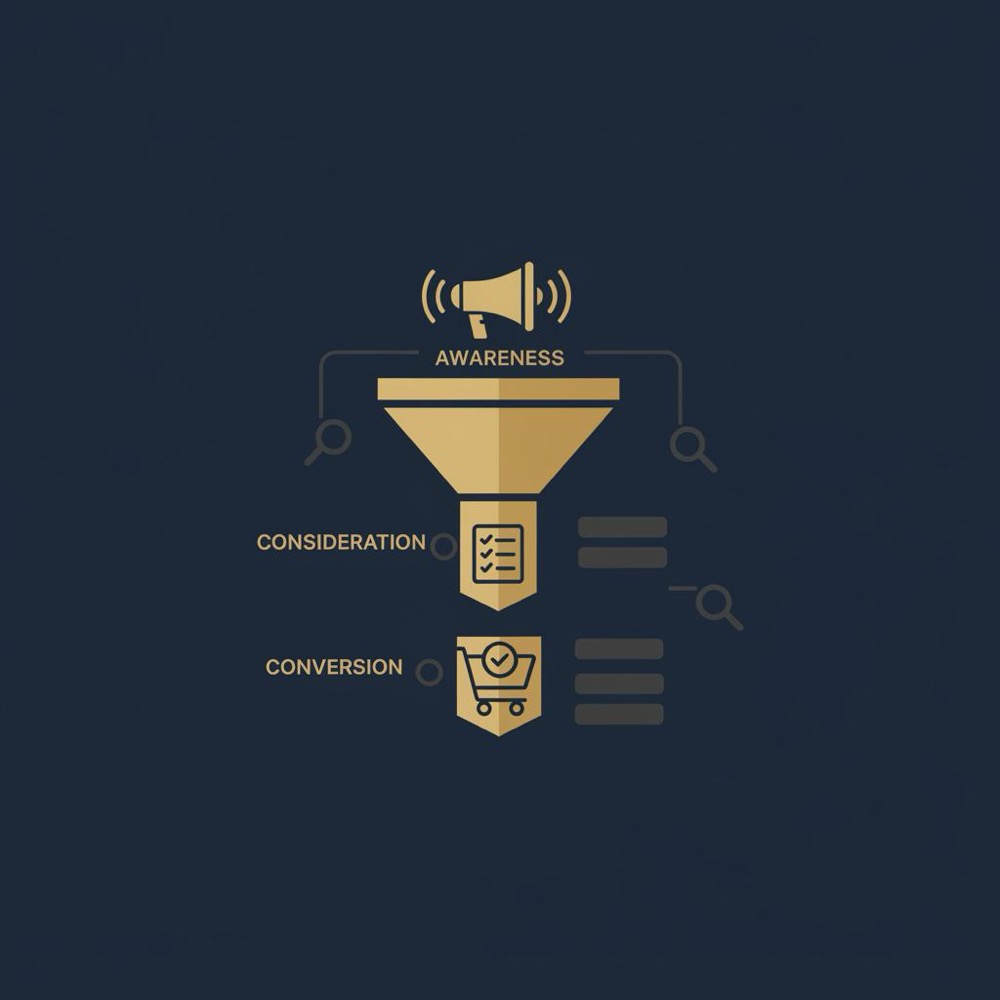
Content architecture maps pages to awareness, consideration and conversion stages so each page has a clear role. An awareness page aims to be discoverable and informative, a consideration page compares options or explains benefits, and a conversion page supports leads or transactions.
Site structure, taxonomy and URL patterns
Taxonomy and URL patterns affect discoverability and measurement. Logical paths, clear categories and predictable URL structures make reporting straightforward and help analytics attribute traffic correctly. See site architecture strategies.

Aligning naming and taxonomy with reporting conventions helps teams run repeatable tests and tie organic content to funnel metrics more cleanly, which supports faster decision making between organic and paid channels How SEO and paid channels work together.
Content quality, E-E-A-T and editorial processes
What E-E-A-T means for operators
E-E-A-T highlights experience, expertise, authoritativeness and trustworthiness as important aspects of helpful content. Search engines favour pages that demonstrate subject understanding, cite reliable sources and help users complete tasks.
Operators should design editorial systems that record authorship, citations and review stages so content quality can be reviewed and measured over time Google Search Central guidance.
Editorial controls and human review for AI drafts
AI tooling can accelerate drafting, tagging and metadata templating, but AI output should be treated as an input to editorial systems. Human reviewers must check factual accuracy, tone, and whether the content meets user intent.
Embedding AI within review workflows and monitoring performance metrics helps prevent quality drift and keeps automation aligned with the brand's content standards How SEO and paid channels work together.
Measurement: which SEO metrics matter and how to report them
Core metrics to track
Useful SEO metrics include organic sessions, query CTR, impressions, indexed pages and crawl errors. These metrics show how discoverable content is and where technical or content issues may block visibility.
Conversion metrics, whether leads or revenue, should be tracked alongside these signals so organic performance maps to business outcomes. Analytics systems commonly support assisted conversion attribution to show where organic participated in journeys Google Analytics measurement guidance.
Get a measurement checklist or diagnostics review
If you want a short measurement checklist or a diagnostic conversation about aligning reporting with funnels, consider downloading a simple checklist or contacting a consultant to review your naming and metrics.
Attribution and assisted conversions
Assisted conversion reports show how organic interactions contribute to multi channel funnels even when they are not the last click. Tracking assisted conversions helps teams value content that influences purchase decisions earlier in the funnel.
Make sure naming conventions across channels are consistent so assisted conversion data is not obscured by mismatched campaign or source labels State of Search 2024.
Making dashboards that inform decisions
Dashboards should prioritise a few actionable metrics: trends in organic sessions, CTR on queries that matter, crawl errors and conversion rates for key pages. Focus on metrics that inform a clear next step, such as content testing or a technical fix.
Consistent naming and reporting conventions increase testing velocity because teams can compare like for like across organic and paid channels and run short experiments that validate hypotheses.
How organic and paid channels can be aligned
Shared naming and reporting
Using consistent campaign names, landing page identifiers and conversion events across paid and organic reduces attribution noise. This consistency makes it easier to aggregate results and judge whether a paid test validates an organic hypothesis.
When naming is consistent, performance media and SEO can share learnings faster, which often shortens the time between hypothesis and decision How SEO and paid channels work together.
Using paid to validate organic hypotheses
Paid search and paid social are useful for validating content and funnel hypotheses before committing to large organic efforts. A short paid test can show whether a headline, angle or value proposition resonates with search or social audiences.
Use paid tests to inform content prioritisation, then measure organic uplift once the content is adjusted and published, keeping measurement consistent across channels.
AI and automation in SEO workflows: what to automate and what to keep human
Repeatable tasks suited for automation
Automation is suited to tagging, metadata templating, bulk redirects, crawling and reporting utilities. These tasks are repeatable and can reduce manual work while increasing consistency.
Internal utilities such as small dashboards and scheduled crawls help teams spot regressions quickly and free up time for higher value tasks like editorial review and testing How SEO and paid channels work together.
Areas that require human editorial judgement
Human judgement remains essential for quality, especially for factual accuracy, nuance and user intent. AI drafts should be reviewed for tone, accuracy and suitability before publication.
Monitor AI driven changes empirically and roll back or adjust processes if quality metrics fall, treating AI as an input rather than a publishing shortcut Moz beginner's guide to SEO.
Decision criteria: when to prioritise technical work, content or links
Quick diagnostic checklist
Start diagnostics with data quality: can you measure sessions, queries and conversions reliably? If measurement is unclear, prioritize analytics sanity checks and naming conventions.
If measurement is sound, choose the area with the highest funnel impact: fixes on conversion pages, content for high intent queries, or link work to support new content. The right choice depends on constraints like team capacity and risk.
Prioritisation by funnel impact and constraints
Use a simple framework: impact, effort and risk. Rank potential work by expected funnel impact, estimate effort and note constraints. Run short experiments that validate the hypothesis before larger scale work.
Prioritise small automations and reporting improvements that reduce repeated operational friction and make future tests easier to run.
Common mistakes and pitfalls in online marketing seo
Operational pitfalls
Common operational mistakes include treating SEO as a one off project, inconsistent naming, and poor handoffs between content and development. These errors create workflow friction and reduce testing velocity.
Corrective actions are often simple: define a content template, set a canonical policy and agree a naming convention for campaigns and pages so measurement aligns with structure State of Search 2024.
Measurement and attribution errors
Ignoring assisted conversions or having inconsistent reporting labels can understate organic value. Teams should ensure analytics events and channel naming are consistent so assisted conversion paths are visible.
Small investments in dashboards and naming discipline typically yield clearer decisions and fewer disputes about attribution.
Practical examples and scenarios for ecommerce and service businesses
Ecommerce example: category and product content architecture
For ecommerce, map category pages to awareness and product pages to conversion. Use supporting guides for consideration intent and measure each page type by appropriate KPIs, such as product add to carts and category CTR.
Technical checks for ecommerce often prioritize indexability of category pages, canonical rules for variants, and structured data for products so indexing reflects the catalog correctly. Consider site search improvements that can increase discovery 15 strategies to improve site search.
Service business example: local pages and lead capture funnels
Service businesses should prioritise local pages for discovery, trust signals such as reviews and clear lead capture forms for conversions. Map each local page to a primary conversion event and monitor assisted conversions from content that supports decision making.
Short experiments, for example testing headline variants via paid channels, can validate which messaging improves lead quality before rolling changes out to many local pages How SEO and paid channels work together.
A practical 90-day starter checklist for operators
Week by week priorities
Week 1 to 4: run an indexability and crawl audit, verify analytics events and build a content inventory. Flag high value pages for quick fixes. Reviewing on site search behaviour can be useful site search insights.
Week 5 to 8: implement priority technical fixes, align naming and run a content test on a few high potential pages. Use short paid tests to validate framing if measurement allows State of Search 2024.
Week 9 to 12: build reporting dashboards that track organic sessions, CTR on target queries and conversion events. Introduce small automations for tagging and scheduled crawl alerts to reduce repeated manual work.
Review results, adjust priorities and plan the next 90 day cycle based on observed performance and constraints.
Conclusion: how to start building searchable, measurable growth systems
Quick recap
SEO in online marketing is a coordinated set of on-page, off-page and technical practices that work together as a system to improve organic visibility and support business goals. The emphasis in 2026 remains on helpful content, crawlability and solid technical foundations.
Recommended next steps
Run a quick diagnostic: confirm measurement quality, check indexability and identify one content test to validate with a short paid experiment. Focus on small, repeatable improvements and measurement so gains compound over time. See a short useful knowledge collection for related topics.
Systems that connect search architecture, content architecture and measurement help teams make clearer decisions and reduce workflow friction, often with modest investment and iterative work.
Start with a diagnostic: verify analytics quality, run an indexability check, create a content inventory and fix obvious technical blockers before changing content at scale.
AI can speed drafting and templating but should be embedded into editorial review and quality monitoring; humans must check accuracy, tone and intent before publishing.
Begin with organic sessions, query CTR, indexed pages, crawl errors and conversions for key pages, then add assisted conversion reports as measurement quality improves.
If you need help framing a diagnostic or building repeatable dashboards, consider a targeted consultation that focuses on systems and measurement rather than one off deliverables.
References
- https://developers.google.com/search/docs/fundamentals/seo-starter-guide
- https://moz.com/beginners-guide-to-seo
- our services
- https://www.marketmymarket.com/site-architecture-seo-strategies-for-better-rankings/
- https://www.coveo.com/blog/improve-your-site-search/
- https://neilpatel.com/blog/site-search-killing-your-conversion/
- our knowledge base
Want this kind of work done for your business?
We build and run AI-powered marketing and automation. 15 minutes, honest assessment.
Book a call