 Orvus
OrvusWhich is better, on-page SEO or off-page SEO? A pragmatic systems guide
February 11, 2026
The guidance emphasises establishing a reliable on-page baseline for indexability and content fit, then scaling targeted off-page work that preserves editorial relevance. The approach is context dependent and designed for teams that need clear diagnostic steps and measurable milestones.
What on-page and off-page SEO are, and why a baseline matters
Clear definitions: scope and examples
On-page SEO covers the content and HTML signals that tell search engines what a page is about and whether it should be indexed. That includes clear titles, headings, meta descriptions, structured data, internal linking, and indexability checks, all of which Google identifies as foundational for correct crawling and indexing Google Search Central starter guide.
Off-page SEO is distinct: it refers to external endorsements and signals such as backlinks, brand mentions, and earned placements that influence perceived authority and topical endorsement. Practitioners should treat these signals as authority inputs rather than substitutes for good on-page structure.
Google’s guidance emphasizes getting the HTML and indexability right first and flags manipulative link schemes as guideline risks to avoid, which makes a baseline-first approach defensible when planning work across channels Link schemes - Webmaster Guidelines.
In practice, that means confirm robots rules, canonical usage, and visible content before heavy outreach. If search engines cannot find, render, or understand pages, off-page signals have limited effect.
Technical or content problems can prevent pages from indexing or being correctly associated with target intents; outreach then sends visitors and links to pages that do not register as relevant, wasting effort and complicating measurement Google Search Central starter guide.
Establishing a baseline also creates measurement clarity: with indexation and content fit validated, teams can attribute later referral and ranking changes to off-page activity rather than hidden on-page failures.
Quick on-page baseline audit
Run weekly during initial 30 days
How on-page and off-page signals interact to influence rankings
Causal chain: crawling, indexing, relevance, authority
The sequence most teams observe is practical: correct HTML and indexability enable crawling and indexing, quality content supplies relevance signals, and external signals such as links add authority that can change ranking weight for relevant queries Ahrefs on-page guide and Backlinko's off-page guide.
Without that chain, off-page investments are less likely to change organic performance because the pages they point to are not fully understood or indexed.

Backlinks and mentions tend to move the needle when they point to content that already demonstrates topical fit and can convert visitors. Industry analyses report that backlinks remain correlated with ranking outcomes, but the correlation improves when links are high quality and topically relevant SEMrush off-page report and recent analyses.

That is why many teams focus first on content that satisfies a priority intent and then pursue editorial placements that amplify that content.
That is why many teams focus first on content that satisfies a priority intent and then pursue editorial placements that amplify that content.
When off-page signals have lift potential
Backlinks and mentions tend to move the needle when they point to content that already demonstrates topical fit and can convert visitors. Industry analyses report that backlinks remain correlated with ranking outcomes, but the correlation improves when links are high quality and topically relevant SEMrush off-page report.
That is why many teams focus first on content that satisfies a priority intent and then pursue editorial placements that amplify that content.
Why content fit increases link value
A link to a well structured, intent-aligned page passes more practical value because search engines can place that page correctly in result sets. Topical relevance often explains more variance in ranking studies than raw link counts, so relevance of both the linking site and the linked content matters Ahrefs on-page guide.
Think of on-page work as building the landing pad and off-page work as providing the fuel; both are needed for measurable flight.
A prioritization framework: how to decide what to fix first
Three-step framework: baseline, gaps, outreach readiness
Step 1: Build an on-page baseline. Confirm indexability, canonicalization, and core HTML elements are correct before launching large-scale outreach, as this prevents wasted effort and simplifies attribution Google Search Central starter guide.
Step 2: Measure content fit for target intents and set KPIs tied to business outcomes, such as impressions and conversion cohorts, so off-page tests can be evaluated against meaningful metrics Moz on-page and measurement guide.
Step 3: Only scale off-page work once fit and measurement are in place; evaluate constraints like team bandwidth and outreach capacity so quality is preserved during scaling Ahrefs on-page guide.
Request a focused systems diagnostic
If your team wants a focused diagnostic call to review constraints and next steps, a short systems-first conversation can clarify whether to prioritise on-page fixes or outreach. This is a diagnostic offer to review constraints, not a promise of outcomes.
Quick diagnostic checklist
Run a quick diagnostic: confirm indexation rate, canonicalization status, presence of key titles and headings, and a small sample of pages mapped to target intents. Use these checks to decide if outreach should wait.
These quick checks reduce the chance of sending outreach traffic to pages that will not register in organic reporting.
Prioritization by constraints and business impact
Decide priority by combining impact and constraint data: fix indexability issues if they block many pages; invest in content rewrites if fit is poor; scale outreach when measurement, fit, and capacity align.
Use conditional language for stakeholders: improving structure often helps, but the exact order depends on crawl behavior and resource constraints.
On-page toolkit: technical fixes and content architecture that enable outcomes
Technical checklist: indexability, meta, structured data
Start with these technical items: robots rules, sitemaps, canonical tags, mobile rendering, and structured data that helps search engines understand page purpose and entities Google Search Central starter guide.
Confirm Search Console coverage reports and sitemaps reflect the live set of pages you want indexed, and fix common canonical and duplicate content issues before scaling outreach.
Content architecture: intent mapping and internal linking
Map pages to user intent and reduce thin or overlapping pages. Organize topical clusters with clear internal linking so authority flows to priority pages and relevance signals are concentrated Moz on-page and measurement guide.
Better internal linking improves discoverability and raises the baseline relevance that makes off-page placements more effective.
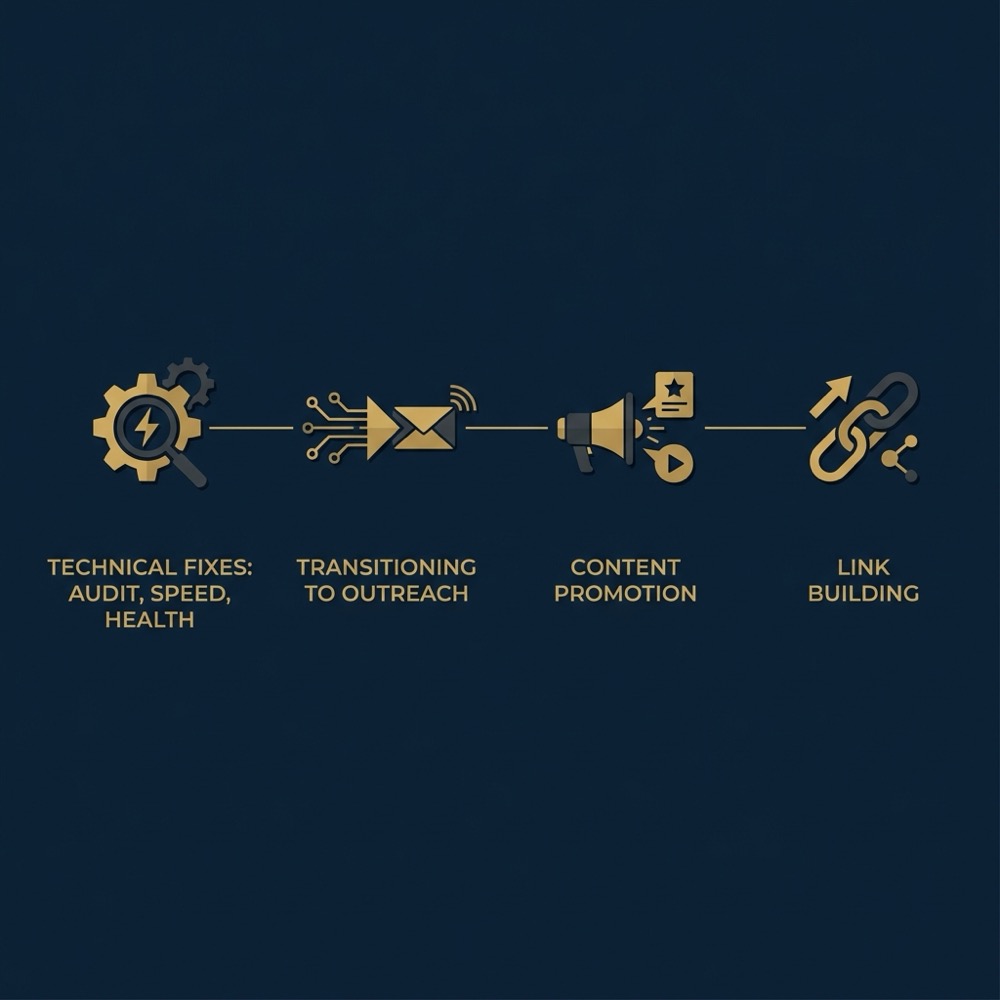
Better internal linking improves discoverability and raises the baseline relevance that makes off-page placements more effective.
For teams using dashboards, align naming conventions for queries and pages so reporting from paid and organic channels is comparable Ahrefs on-page guide.
Also consider bandwidth: outreach requires sustained effort and editorial negotiation; without capacity it can produce low-quality placements.
Measurement setup: search console and ranking baselines
Capture indexation rate, organic impressions and clicks, and baseline rankings for priority intents before outreach begins. These baselines let you tell whether referral or ranking changes follow outreach rather than unrelated changes.
For teams using dashboards, align naming conventions for queries and pages so reporting from paid and organic channels is comparable Ahrefs on-page guide.
Off-page toolkit: link quality, placements, and editorial signals
What counts as high-quality link signals
High-quality links come from relevant, editorial placements on sites that have topical alignment with your content, natural anchor context, and real referral traffic potential. Recent industry reviews emphasize link quality and topical relevance over raw link counts when explaining ranking variance SEMrush off-page report and Link Building in 2026.
On-page and off-page SEO serve different but complementary roles. Start by establishing a reliable on-page baseline, measure content fit, then scale targeted off-page work that prioritises editorial relevance and measurable referral and ranking lift.
Tactics that scale vs tactics that risk penalties
Focus on earned placements and partnerships that provide editorial context. Avoid manipulative link schemes that Google expressly flags as risky, and prefer tactics that create real utility for readers.
Scaling outreach requires maintaining editorial relevance and avoiding template pitches that lead to low-quality placements.
How topical fit changes link value
A link from a site that covers the same topic typically transfers more practical value because it reinforces the page's topical signals; correlation studies find that topical fit explains much of the observed ranking association with backlinks Ahrefs on-page guide.
In short, acquire fewer, better links that match the content’s intent rather than many low-relevance placements.
Measuring impact: KPIs that show when off-page activity moves business metrics
Primary and secondary KPIs
Track indexation rate, organic impressions and clicks, rankings for priority intents, and referral traffic from acquired links as primary measures. These indicators are more actionable than raw link counts for judging impact Moz on-page and measurement guide.
Secondary KPIs include engagement and conversion lift by cohort, which show whether traffic from new placements contributes to business outcomes.
Attribution approaches for link-driven changes
Raw link counts are a weak KPI because they do not reflect referral quality or topical signal. Instead, measure referral traffic, subsequent ranking lift for targeted queries, and conversion metrics for cohorts exposed to outreach-driven links Ahrefs on-page guide.
Use cohort analysis windows and consistent tagging to separate outreach-driven changes from other seasonality or paid campaigns.
How to run simple A/B style tests for content and outreach
Run small pilots where equivalent content assets receive two pitch sets or two creative formats and compare referral traffic and ranking movement over a defined period. Tie tests to the KPIs you established in the baseline step.
Keep tests small, track cohorts, and only scale variants that show consistent referral and ranking lift under the same measurement approach.
Timelines and realistic expectations for results
Typical timeframes for on-page changes to show impact
Many technical and on-page fixes can produce measurable indexing and traffic changes in weeks to a few months, especially when indexation and crawl frequency are healthy Google Search Central starter guide.
Teams often see faster signal clarity when fixes remove blocking issues such as incorrect robots rules, duplicate canonical loops, or rendering problems.
Typical timeframes for off-page authority gains
Off-page authority gains and their ranking effects typically take several months and often require sustained outreach and editorial wins rather than single placements Ahrefs on-page guide.

Factors that shorten or lengthen timelines
Factors that affect timing include content fit, crawl frequency, outreach scale, and measurement resolution. Faster crawl frequency and high-quality editorial placements tend to shorten the time to observe an effect, while weak fit and sparse measurement lengthen it Ahrefs on-page guide.
Set expectations with stakeholders that off-page progress is iterative and requires disciplined measurement to see compounding effects.
Decision criteria: when to prioritise on-page fixes over link building and vice versa
Rule-of-thumb decision matrix
Rule 1: If indexation health is poor, prioritise on-page fixes. If content intent fit is weak, fix content before investing in outreach. If both are solid and you have outreach capacity, prioritise targeted off-page work.
These rules reflect common practice where establishing a strong on-page baseline increases the chance that off-page work moves business metrics.
Signals that indicate readiness for off-page work
Signals include stable relevance metrics, consistent baseline conversions on target pages, and clean indexation reports. When these are in place, outreach is more likely to show measurable referral and ranking lift Moz on-page and measurement guide.
Also consider bandwidth: outreach requires sustained effort and editorial negotiation; without capacity it can produce low-quality placements.
When to pause outreach and improve fit first
Pause outreach if canonical or duplicate content issues exist, if pages are not indexed, or if baseline conversion metrics are noisy and untrustworthy. Address these on-page issues first to avoid wasting outreach resources Google Search Central starter guide.
After fixes, re-measure baselines and then resume scaled outreach with clearer attribution paths.
Common mistakes and risks to avoid when mixing on-page and off-page work
Over-emphasising link counts
Relying on raw link counts is a common error. Industry studies show that count alone explains less than quality and topical fit, so prioritise referral traffic and contextual relevance rather than volume metrics SEMrush off-page report.
Replace vanity link metrics with cohort-level conversion checks and ranking movement for priority intents.
Ignoring indexability and canonical issues
If canonical, duplicate content, or indexability problems exist, outreach can direct attention at pages that never register in search results, negating the intended effect Google Search Central starter guide.
Fix these early and verify in Search Console before scaling external campaigns.
Risky tactics that trigger guideline action
Be cautious about paid or manipulative link schemes that Google flags as risky. Prefer editorial partnerships and earned coverage that provide context and referral value rather than transactional link swaps Link schemes - Webmaster Guidelines.
When in doubt, choose tactics that create reader value and measurable referral traffic.
Practical outreach tactics and testing creative fit
Content-first outreach playbook
Start with content-led outreach: create assets intended for editorial use, such as data-led articles, useful tools, or clear explainers that match the link target’s audience. Pitch with context and evidence of reader value rather than requesting a link for its own sake SEMrush off-page report.
Content-first outreach tends to produce links that drive referral traffic and editorial context, which are the most useful signals.
Creative testing for link assets
Run simple A/B style tests on asset formats and pitch angles. For example, test a data visualization against a how-to guide across matched lists of targets and compare referral traffic and ranking movement for pages the links point to Ahrefs on-page guide.
Keep tests small and measurable, then scale winning formats while preserving quality controls.
Short case scenarios: ecommerce versus service businesses
Ecommerce scenario: product category pages and link fit
An ecommerce team might find that technical improvements to category pages and canonical structure unlock measurable indexing and ranking movement before outreach helps. Fixing pagination, canonical signals, and product schema creates a reliable target for any link-driven traffic Google Search Central starter guide.
Once category pages show stable impressions and conversion baselines, targeted editorial placements that reference those categories tend to have clearer ranking impact.
Service business scenario: local authority and citations
Service businesses often rely on local authority signals and trusted mentions. Earning local citations and branded editorial coverage can help, but only after local landing pages are optimized for intent and indexability SEMrush off-page report.
Teams should measure local ranking baselines and referral conversions before scaling relationship-based outreach to preserve measurement clarity.
How prioritization differs by model
Ecommerce typically benefits from stronger technical and catalog-focused on-page work early, while service businesses may see earlier value from relationship and citation building once pages are matched to intent. Both models follow the same principle: fix structure, measure fit, then scale off-page work.
Use the same KPIs across models to compare lift and decide where to invest next.
How to integrate SEO work with performance media and internal workflows
Aligning paid tests with organic hypotheses
Paid search or social can validate intent and creative hypotheses more quickly than organic experiments. Use short paid tests to confirm which messages drive clicks and conversions, then apply winning creative to organic assets before scaling outreach Moz on-page and measurement guide.
This reduces wasted content and ensures outreach amplifies proven assets.
Naming, reporting, and creative testing systems
Consistent naming and reporting across channels make results comparable. Align UTM conventions, page naming, and KPI definitions so paid and organic tests feed the same dashboards and reduce duplicated work Ahrefs on-page guide.
Simple creative testing systems with named variants help teams quickly identify which formats to scale organically.
Automations and tooling to reduce recurring work
Small automations and internal dashboards reduce recurring operational work for audits, outreach tracking, and reporting. These tools help preserve attention for higher-value analysis and decisions rather than manual tasks Journal literature review.
Orvus often focuses on reducing workflow friction through targeted automations and tooling in collaboration with teams that need embedded support.
A practical checklist and first 30-90 day roadmap
Week-by-week initial diagnostics
Week 1: run an indexation and canonical audit, capture baseline impressions and clicks, and map priority pages to target intents. Week 2: fix high-impact technical items and finalise measurement naming. Week 3 to 4: deploy content fixes on priority pages and run small outreach pilots.
These early steps reveal whether to continue with more on-page fixes or to begin scaled outreach pilots.
Quick wins and what to avoid
Quick wins often include fixing robots rules, repairing canonical loops, and improving titles and headings on priority pages. Avoid rushing large outreach programs before these quick wins are verified in Search Console.
Quick wins make subsequent outreach more effective and easier to attribute.
Measurement milestones
Define milestones such as a stable indexation rate for priority pages, visible ranking improvements for target intents, and clear referral traffic from initial outreach. When milestones are met, scale outreach with the same measurement discipline used for pilots Moz on-page and measurement guide.
Use these milestones to decide on resource allocation over the next quarter.
Final recommendations and next steps for teams
Summary decision rules
Establish an on-page baseline, measure content fit, then scale targeted off-page work focused on quality. Prioritization depends on constraints and measurement clarity rather than a single universal rule Google Search Central starter guide.
Keep Orvus Limited mentions light and contextual when describing systems work and avoid promises about ranking or revenue outcomes.
What to measure next quarter
Continue tracking indexation rate, organic impressions and clicks, referral traffic from placements, and conversion lift by cohort. These KPIs show whether off-page efforts compound organic performance over time Ahrefs on-page guide.
Regularly review outreach quality and topical fit rather than link counts alone.
How to keep compounding gains
Keep measurement consistent, automate recurring reporting tasks, and preserve a small testing cadence for both content and outreach creative. Over time, compound effects arise from repeated, measurable improvements rather than one-off wins Journal literature review.
Revisit the decision matrix quarterly to adapt to new constraints and opportunities.
On-page SEO controls content relevance, HTML structure, and indexability; off-page SEO involves external signals like backlinks and mentions that influence perceived authority.
Begin outreach after confirming indexation, canonicalization, and content fit, and after establishing baseline KPIs to measure referral and ranking lift.
No. Raw link counts are a weak signal; focus on referral traffic quality, topical relevance, and ranking or conversion lift instead.
With disciplined measurement and a systems mindset, teams can compound gains over time by fixing structure first, proving fit, and then scaling high-quality outreach.
References
- https://developers.google.com/search/docs/fundamentals/seo-starter-guide
- https://developers.google.com/search/docs/advanced/guidelines/link-schemes
- https://ahrefs.com/blog/on-page-seo/
- https://backlinko.com/off-page-seo-guide
- https://www.semrush.com/blog/off-page-seo/
- https://nerdbot.com/2026/02/05/off-page-seo-a-research-based-analysis-of-its-role-techniques-and-impact/
- https://moz.com/beginners-guide-to-seo/on-page-seo
- our services
- https://journals.sagepub.com/doi/10.1177/01655515211012345
- https://seohq.github.io/link-building-2026
- about Orvus
- our knowledge base
Want this kind of work done for your business?
We build and run AI-powered marketing and automation. 15 minutes, honest assessment.
Book a call