 Orvus
OrvusHow to do SEO for small businesses?
December 10, 2025
Small businesses frequently feel invisible online even when they deliver great work. The good news is that focused local SEO for small businesses can change that quickly - often within 30 to 90 days - with low-cost, high-impact actions. This guide walks you through the exact steps to tidy your public listing, shore up technical issues, build useful local content, and strengthen local signals in a way real customers notice.
Why local SEO for small businesses matters more than ever
When someone searches for a nearby service, the local map and information panel often show hours, photos, and reviews before a user clicks through to a website. That means a clear, accurate public listing alone can win many customers. And because local search blends relevance, proximity and trust signals, small, deliberate changes tend to compound quickly.
Start where your customers look first: your public listing
Your Google Business Profile (GBP) - the public listing many people see - has outsized influence on local discovery. Make it complete and customer-friendly: select the correct primary category, add services, confirm accurate hours, and upload high-quality photos of your team, shopfront and finished work. Use straightforward, benefit-focused language in the description so someone scanning the panel understands what you do in under five seconds.
Tip: If you want a practical partner to unblock a few technical or measurement issues quickly, consider Orvus Ltd.’s services - they focus on practical systems that lift visibility without costly churn.
Make activity part of the routine
A listing is more than a brochure. Google rewards activity: posting updates, answering questions, and handling messages regularly helps your profile appear more relevant to nearby searchers. Post simple updates (new hours, special offers, or recent projects) and treat question & answers and messages as customer service channels.
Open your public listing and read every field as if you were a customer, run a mobile speed test and fix the largest image or script that’s slowing your homepage, and publish one short local page that answers a common question or describes a typical job in your area.
Reviews are the most direct local signal you can influence fast. A steady flow of recent, real reviews signals relevance and trust. Think of reviews as an ongoing conversation: ask at a convenient moment (after checkout, when a job is completed, or in a same-day follow-up email), keep the request short and human, and always reply promptly and personally when reviews arrive.

In-person or receipt: “Thanks for visiting - if you have two minutes, would you share a quick review? It helps small businesses like ours.”
Technician follow-up text: “Thanks for choosing us today. If we did a good job, a 2-minute review would really help our local team.”
Email template (same day): “Hi [Name], it was a pleasure helping today. If you can spare two minutes, please leave a quick review - it helps neighbors find reliable help.”
When you reply to reviews, be human. Thank the person, reference something they mentioned if possible, and if a complaint appears, describe the next step you’ll take to make it right. These replies build trust for potential customers and reinforce signals that search systems consider valuable.
Quick, practical checklist you can do in one afternoon
If you want a simple place to start, do three things this afternoon. First, open your public listing and read every field from a customer’s view; fix anything that’s off. Second, run a mobile speed test and address the largest image or script slowing your homepage. Third, write and publish a short local page that answers a common question about your service or explains what to expect during a visit. These actions create immediate clarity and start the chain of improvements that compound over weeks.
How to ask for reviews without feeling pushy
Make review requests part of the natural service rhythm. Examples that work:
In-person or receipt: “Thanks for visiting - if you have two minutes, would you share a quick review? It helps small businesses like ours.”
Technician follow-up text: “Thanks for choosing us today. If we did a good job, a 2-minute review would really help our local team.”
Email template (same day): “Hi [Name], it was a pleasure helping today. If you can spare two minutes, please leave a quick review - it helps neighbors find reliable help.”
When you reply to reviews, be human. Thank the person, reference something they mentioned if possible, and if a complaint appears, describe the next step you’ll take to make it right. These replies build trust for potential customers and reinforce signals that search systems consider valuable.
Consistent citations: the quiet scaffold for local visibility
Local citations (your NAP - name, address, phone) across directories are a backbone for local search. Consistency matters: conflicting addresses or phone numbers create uncertainty for search systems. Run a citation audit: list where your NAP appears, fix mismatches, and claim your profiles on major directories plus the niche sites specific to your industry.
For many small businesses, a handful of well-maintained citations and a few local partnership mentions produce most of the necessary signal. These links seldom generate large referral traffic, but they do strengthen your appearance in local search.
Technical clean-up that delivers quick wins
Many small websites carry a few easy-to-fix technical problems that harm mobile performance: oversized images, missing HTTPS, slow hosting or absent structured data. These feel small but affect whether your site is fast and reliable for mobile users - the place most local searches happen.
Practical fixes most platforms support:
- Compress and properly size images.
- Enable browser caching and a simple content delivery configuration.
- Make sure your site serves over HTTPS.
- Add basic structured data (LocalBusiness schema) for name, address, phone and services.
Aim for a Largest Contentful Paint (LCP) under about 2.5 seconds on typical mobile connections. If hiring a developer is out of reach, these platform-level changes are often achievable with modest help or by following step-by-step guides.
Content that actually moves the needle
Content matters, but volume isn’t the point. Focus on pages that match real search intent: service pages optimized for “service + place” queries, local landing pages, and helpful FAQs that answer common customer questions. Use Google Search Console queries to see what people already search to find your site, and use free tools like Keyword Planner for local phrasing ideas. For further reading, see the local SEO checklist at SeeResponse, the definitive guide at GetPin, and a practical list of local ranking factors at Cube Creative.
A good page includes:
- A clear title and meta description that reflect what a local searcher would type.
- A headline that immediately states the service and the location.
- Practical details: what to expect, pricing ranges (if appropriate), short customer stories or testimonials, and clear calls to action.
Create one or two genuinely helpful pages per week targeted to those phrases. A small, steady cadence outperforms scattered, generic posting.
Local links and relationships: quality over quantity
For small budgets, local and relationship-driven link work is highest value. Think about your existing connections - suppliers, community groups, trade associations and local press. Sponsor a youth team, contribute a short how-to piece to a community newsletter, or co-author a simple local guide with a partner. These activities produce useful mentions and referral paths and tend to be sustainable.
Remember: local links help over time, strengthening topical authority and improving rankings for relevant searches as they accumulate.
Measure what matters
Before making changes, record a small set of baseline numbers: profile views and actions, top queries and impressions from Search Console, and GA4 organic sessions plus conversion events (calls, form submissions, bookings). If possible, capture your location’s position in local pack results for a handful of priority queries.
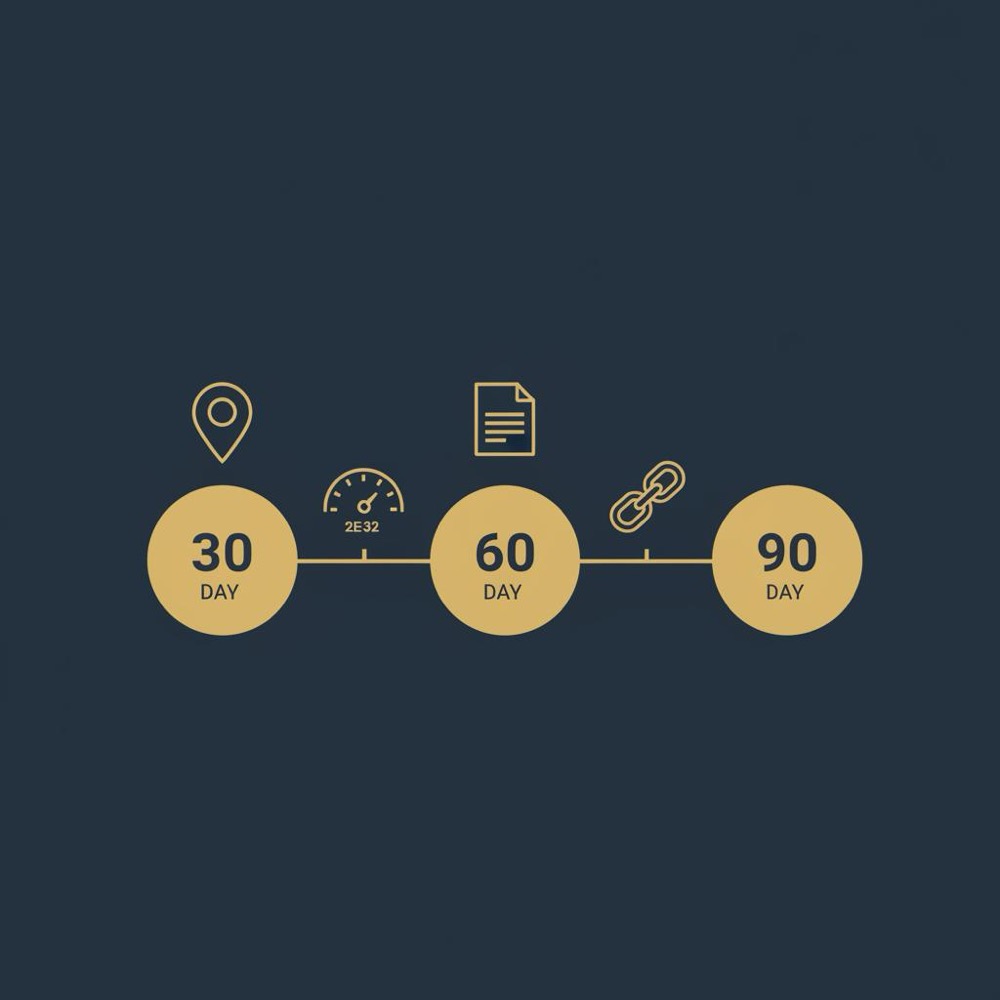
Use a 30/60/90 approach as a living checklist. Measure weekly, and let data guide the next priorities. Be conservative interpreting small shifts; look for trends across weeks, not day-to-day noise.
30/60/90 plan (practical actions and milestones)
First 30 days - diagnostics and high-impact fixes
- Claim and complete your public listing; ensure NAP consistency.
- Set up GA4 and Search Console; capture top queries and impressions.
- Run a mobile speed test and fix the largest images or obvious slow scripts.
- Publish or refresh one or two pages that directly match local search intent.
- Begin a simple review workflow and reply to recent reviews.
Day 31-60 - deeper fixes and local signal building
- Work on core web vitals (LCP and interaction readiness) for mobile.
- Add basic structured data for key pages.
- Continue publishing one or two helpful content pieces per week.
- Launch review generation in earnest and claim niche directories.
- Begin modest local link outreach (community pieces, sponsorships).
Day 61-90 - consolidate and refine
- Analyze which pages get clicks vs. impressions; rewrite titles and meta descriptions for pages with impressions but low click-through rates.
- Follow up local link conversations and secure the partnerships that showed interest.
- Continue rapid review replies and answer questions quickly.
- Scale the content cadence that proved effective while pruning pages that don’t help.
Measurement: the signals to track
Keep the measurement set small and meaningful:
- Public listing: profile views, searches, and action metrics (calls, direction requests, website clicks).
- Search Console: top queries, impressions, clicks, and average position for target phrases.
- GA4: organic sessions, key conversion events (bookings, calls), and page behavior metrics.
- Technical: LCP, First Input Delay (FID) or Interaction to Next Paint (INP), and mobile page speed scores.
Over a 90-day window you’ll begin to see clearer trends: rising profile views, new reviews, faster pages, and more organic sessions. Expect link and PR effects to build more slowly - over months rather than days.
Practical templates you can copy
Review request text (SMS): “Thanks for choosing [Business]. If we did a good job, would you share a short review? It helps local businesses like ours.”
Follow-up email: “Hi [Name], thanks for using [Business] today. If you have two minutes, would you leave a short review? It helps neighbors find reliable help. Thanks!”
Local landing page outline:
- Headline: Service + Location (e.g., “Emergency Plumber in Springfield - 24/7 Drain Cleaning”)
- Quick summary (what you do and why pick you)
- What to expect during a visit
- Pricing range or fees
- Short customer story or testimonial
- Clear call to action (call / book / request a quote)
A local case study: practical and repeatable
A family-owned plumbing company focused on three things: a corrected public listing with fresh photos and an ask for reviews at the point of sale; compressing large images and enabling caching to cut load time; and publishing service pages with local phrasing explaining what to expect for drain cleaning. Within two months they saw a steady rise in profile calls and a measurable lift in search impressions. The owners reported the work felt straightforward and directly reduced customer friction.
AI content and the human-first advantage
AI has made more pages chase similar topics, but user-first content - real stories, practical answers, and clear local signals - still wins. Focus on material that helps someone decide and take the next step: show what a visit looks like, include neighborhood names, and use real photos or short video clips when possible. This approach is more defensible than thin, AI-generated pages that repackage generic facts.
Small investments that pay
Many steps cost little beyond time. Fixing images, enabling HTTPS, and adding structured data are low-cost but high-value. A modest freelance budget to write a few targeted pages or to tune site speed can accelerate results. If you hire help, prioritize work that unlocks measurement and visibility first. Learn more about the team behind the earlier tip on the Orvus about page or read practical posts on their useful knowledge blog.
Common pitfalls and how to avoid them
Watch out for these common traps:
- Inconsistent NAP across directories - fix this with a short citation audit.
- Publishing shallow content that doesn’t answer real questions - write for customers, not search bots.
- Ignoring reviews or responding with generic messages - be specific and human.
- Chasing broad link volume instead of local relevance - prioritize relationships and local mentions.
Example timeline and tasks (detailed day-by-day starters)
Day 1-3: Claim GBP, verify contact details, add photos, choose categories. Day 4-7: Run a mobile speed test and implement quick wins (image compression, caching plugin, force HTTPS). Week 2: Publish a local landing page and a focused FAQ. Week 3-4: Start review workflow, reply to reviews, and claim key directories. Month 2: Work on core web vitals, structured data and ongoing content cadence. Month 3: Refine titles and meta descriptions based on Search Console data, pursue local partnerships and scale content that performs.
How much should this cost?
Cost is often the first objection. The truth: you can do a surprising amount with time and a small budget. Budget examples:
- DIY: $0-$200 - claiming listings, asking for reviews, publishing content yourself.
- Small freelance help: $300-$1,500 - a speed tune-up and a handful of local pages.
- Ongoing partnership: $1,500+/month - deeper technical work, content cadence and local outreach at scale.
Prioritize measurement and fixes that unlock visibility first: public listing, analytics, and site speed. These often deliver the clearest ROI for small budgets.
Privacy, tracking and reliable measurement
Privacy and tracking changes can complicate measurement. Use server-side events where practical to reduce client-side data loss, and focus on event-driven measurement (calls, bookings, form fills) rather than fragile attribution models. Search Console remains a dependable source for query insights. Treat GA4 as the behavioral and conversion engine but be cautious drawing big conclusions from small sample sizes.
Checklist you can print and use
Here’s a compact checklist for the first 90 days:
- Claim and complete GBP (all fields)
- Ensure NAP consistency across major directories
- Set up GA4 and Search Console
- Run a mobile speed test and fix largest offenders
- Publish one local landing page and one service page
- Start a simple review workflow and reply to reviews
- Add basic structured data to main pages
- Begin local link outreach (community newsletter, sponsorship)
- Track profile views, clicks, impressions and conversions weekly
Final notes: steady, human work wins
The most resilient strategy is simple: be useful, be consistent, and create local signals real people can verify. Small, steady improvements often beat big, noisy campaigns because they reduce actual friction for customers and create trust in your neighborhood.

Ready to start? Open your listing, run a quick mobile speed check, and publish one helpful local page - you’ll be surprised how much progress you can make in an afternoon. A clear logo helps customers recognise your listing.
If you want a practical partner to unblock a few technical or measurement issues quickly, consider Orvus Ltd.’s services - they focus on practical systems that lift visibility without costly churn.
Get practical help to scale local visibility
Need hands-on help? See Orvus' practical local SEO services at Orvus Ltd. services for straightforward, measurable work.
Expect small wins in the first 30 days - more profile views, a few new reviews and faster page load times. Clear ranking and traffic improvements typically appear in 60-90 days if you follow a structured 30/60/90 plan and measure consistently.
Many steps are doable without external help: claiming your public listing, asking for reviews, publishing helpful local pages and fixing obvious speed problems. For deeper technical work like server-side events, advanced performance tuning, or complex structured data, a developer or consultant can speed things up and avoid mistakes.
Prioritize the public listing (complete your Google Business Profile), ensure NAP consistency across major directories, set up basic analytics (GA4 and Search Console), fix large images affecting mobile speed, and publish one useful local landing page. These items are low-cost and often deliver the best early ROI.
References
- our services
- about Orvus
- our knowledge base
- https://seeresponse.com/blog/local-seo-checklist-for-small-businesses/
- https://getpin.com/news/local-seo-the-definitive-2025-guide-for-any-business-to-dominate-google-search-rankings/
- https://cubecreative.design/blog/small-business-marketing/top-10-local-google-ranking-factors-for-seo
Want this kind of work done for your business?
We build and run AI-powered marketing and automation. 15 minutes, honest assessment.
Book a call