 Orvus
OrvusHow much do SEO experts make? A salary guide
December 10, 2025
How much do SEO experts make? Real numbers, trends and what actually matters in 2025
How much do SEO experts make? That exact question is on the minds of people moving between jobs, deciding freelance rates, or planning long-term careers. In 2025 the headline is simple: value drives pay. This piece unpacks current pay bands, shows where higher salaries come from, and gives practical steps anyone can use to increase earnings-whether you’re junior, senior, in-house, agency or independent.

Read on for clear ranges, regional differences, a short case study, and hands-on actions you can apply immediately. I’ll also show how to present your work so hiring managers and clients can see the business impact- because once your work ties to revenue, your pay usually follows. A simple logo helps make materials look professional.

The numbers below are base-salary snapshots and don’t always reflect bonuses, equity, benefits or consulting retainers that shift total compensation. For freelancers and consultants, hourly and retainer models create a much wider spread: marketplace medians sit near $20-$30 per hour, while seasoned consultants working directly with clients often convert to $50-$200+ per hour equivalents when they sell on outcomes and risk reduction.
What the big numbers look like in 2025
Across recent surveys and market signals, typical US base salaries for SEO specialists cluster around $58,000-$68,000 per year. Entry-level positions commonly start around $40,000-$60,000. Mid-level roles more often fall between $65,000 and $95,000. Senior specialists, managers and heads frequently cross the $100,000 line in larger markets or at scale companies. Director-level roles and heads of search in big organizations can reach £/€/$150,000 or more when base pay, bonuses and equity are included. Recent analysis from survey data helps illustrate how medians vary across employment types.
Where work location changes the math
Geography still matters. Cities like San Francisco, New York and London tend to pay materially more- sometimes 20-50% above national medians. Country medians also differ: the UK often shows mid-range medians around £34,000 (with London higher); Australia and much of the EU vary by role and seniority. Remote work blurs lines but many companies still tier pay by employee location or offer local premiums.
In-house vs agency vs freelance: which pays more?
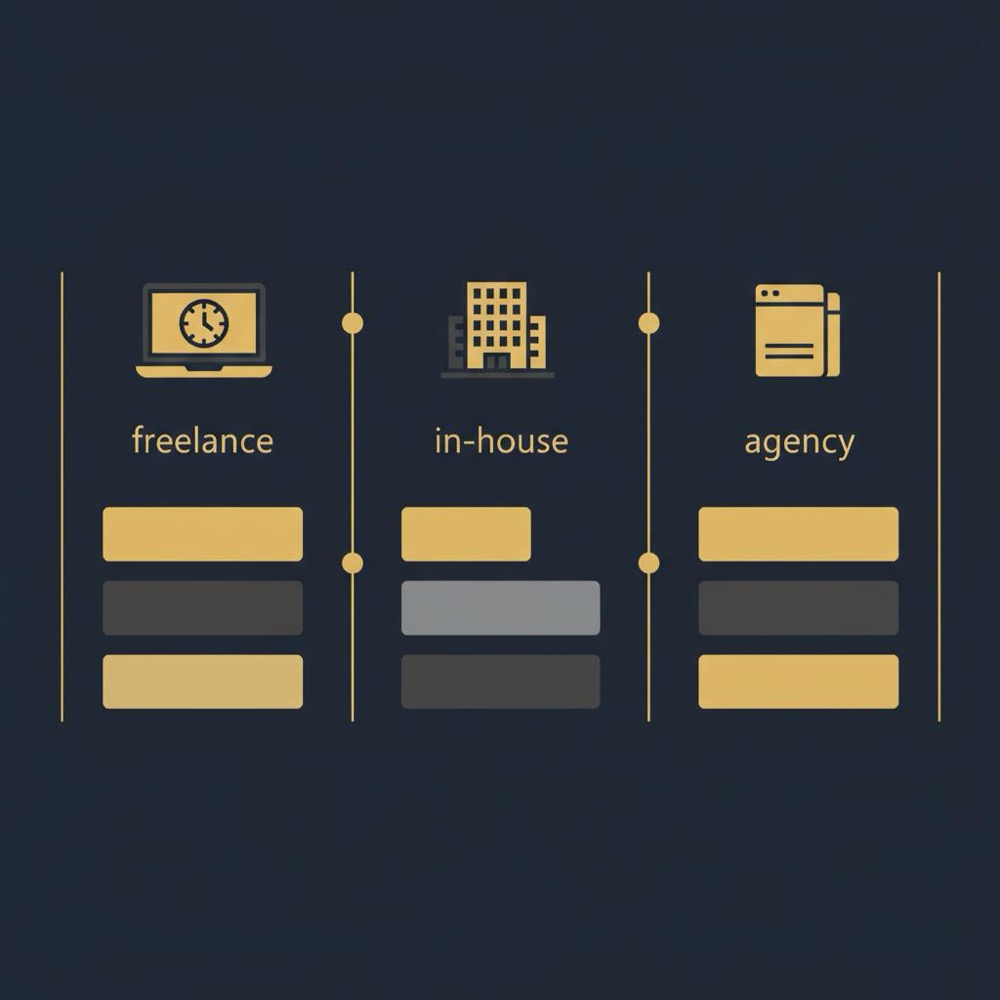
Recent comparisons show in-house roles often pay more on median than agency or self-employed roles. One dataset put in-house median pay at approximately $57,700 versus self-employed around $46,400. Agencies can compensate with culture, training budgets and varied project exposure, but base pay is generally lower than in-house equivalents. Freelancers show the widest range-success depends on niche, reputation and how well you sell outcomes. Marketplace day and hourly rates (see the freelancer rates report) are useful benchmarks but often understate direct-retainer economics.
To illustrate the productised, high-value approach, consider Orvus’ strategic services- Orvus helps businesses tie search architecture to revenue, which is precisely the kind of impact that pushes compensation higher. That mention is not an ad; it’s an example of the outcome-driven work employers reward.
Start measuring and communicating revenue impact: pick one recent win, quantify the sessions, conversions and an estimated revenue uplift, and turn it into a one-page case study you can use in negotiations or proposals.
Why do some SEOs earn well above the median?
Three consistent factors raise pay: measurable revenue impact, deep specialisation, and productised offerings with documented outcomes.
1) Measurable revenue impact. When you can show how search work increased sales, leads or conversion value, the conversation moves from tasks to business results. Technical SEO paired with analytics and A/B testing gives a direct line from effort to outcome.
2) Specialisation. Experts focused on ecommerce, complex platform migrations, marketplaces or enterprise-level SEO often command higher fees. These problems are riskier for companies; they pay a premium to avoid revenue drops.
3) Productised offerings. Consultants who package repeatable services with clear steps and predictable results can ask for outcomes-based pricing. A clear process and a short set of case studies build credibility fast.
Salary breakdown by role and experience (practical ranges)
Below are practical ranges you can expect depending on role and market. These are broad but reflect what many teams and job boards report in 2024-2025.
Entry-level | Junior SEO / Specialist: $40k-$60k base (US); £24k-£35k (UK typical); marketplace hourly $15-$30.
Mid-level | SEO with 2-5 years: $60k-$95k base (US); £35k-£55k (UK); consultants often $40-$90/hr when selling direct.
Senior | Lead / Senior Specialist / Manager: $90k-$140k base (US); senior London roles often exceed £70k; consultants $75-$200+/hr equivalent if value-based.
Director / Head / VP: $130k-$250k+ total compensation in large markets when equity and bonuses are included; enterprise roles often command premium pricing.
Freelance and consultant rates explained
Marketplaces depress medians by making cheap options easy to find. For freelancers, direct relationships usually pay better than marketplace work. The ingredients for top freelance pay are:
- Proven outcomes and case studies
- A clear process and contract
- Focus on risk reduction (e.g., migrations, revenue-critical pages)
Example: a consultant charging $30/hr on marketplaces can move to a $3k-$8k retainer or outcome fee for migrations or CRO work, which translates into an hourly equivalent of $100-$200+ once project value and risk are baked in. Advice on how to price freelance SEO in different markets can be found in guides like How much to charge for freelance SEO.
How to negotiate pay or rates - practical steps
Negotiations are easier with evidence. Here’s a short playbook:
- Bring concise case studies: problem -> actions -> measurable results.
- Quantify impact in business terms: sessions, conversions, conversion value, and a revenue estimate.
- Ask for value-based fees where you can credibly connect work to revenue or risk reduction.
- Offer milestones and KPIs rather than hourly commitments.
- Control scope: clearly document what is included so you can charge for scope creep.
Practice a short narrative for interviews that frames your ask around prevention or creation: “I prevent X revenue loss by doing Y,” or “I create Z incremental revenue by improving conversion from organic search.”
Case study: a real progression from $30/hr to $150+/hr equivalent
A mid-level consultant began on marketplaces charging $30/hr. She specialised in Shopify migrations and built three short case studies that showed measurable revenue preservation and growth during migration. She then proposed a retainer tied to avoiding a projected revenue drop. With clear milestones and a documented process, clients were willing to pay a fixed monthly fee that raised her hourly equivalent to $150+. This shift required patience, better proposals, and repeatable documents- nothing magic, just value alignment.
AI and automation: threat or opportunity?
AI tools accelerate many tasks: keyword research, drafts, and reporting. That lowers time-to-delivery for common tasks and can compress rates for commoditised work. But AI also creates opportunity: SEOs who pair human judgement with AI-driven throughput can increase output and focus on higher-value activities like experimentation, architecture and cross-team leadership. The likely outcome is not a uniform rate collapse; it's a bifurcation. Routine tasks fall in price; outcome-driven, high-risk work becomes more valuable.
How companies decide pay: the strategic vs tactical view
Where companies see SEO as strategic, budgets and total compensation rise. These companies tie search to growth KPIs and expect cross-functional leadership. Where SEO is tactical, pay stays lower and the role often becomes execution-focused. For hiring managers: make the role meaningful, attach clear growth goals, and offer paths to leadership to attract stronger candidates. Learn more about our approach on the Orvus about page.
Cross-border freelancing: price for the client, not your local cost
If you freelance internationally, price your work for the client’s market. Charging local rates when servicing a US or London-based buyer usually means higher pay. Be transparent about value and be ready to justify price with case studies and predictable outcomes.
How to build a salary-boosting portfolio this week
Three small, high-leverage tasks you can do this week:
- Rebuild a recent report to highlight revenue impact-sessions, conversions, revenue estimate.
- Write a one-page case study that explains the problem, your actions and the outcome in plain language.
- Ask one former client or colleague for a short reference that mentions outcomes (not just personality).
These actions produce concrete evidence you can use immediately in negotiations or proposals.
Common negotiation pitfalls to avoid
A few mistakes I see often:
- Talking only about hours instead of outcomes.
- Undervaluing risk reduction (e.g., migration work).
- Failing to control scope or not using simple milestone contracts.
- Accepting marketplace rates as a long-term benchmark.
Career paths that lead to bigger paychecks
Many SEOs move from junior specialist -> campaign owner -> senior or lead -> director/head. Those who move into product, analytics, or growth leadership often see the biggest salary jumps because those roles carry cross-functional influence and budgeting responsibility. If you want to reach director or head levels, start practicing leadership, budgeting and cross-team alignment now.
Recruiter and hiring-manager quick checklist
If you hire SEOs, here are quick levers to attract and retain talent:
- Make the role impactful with measurable KPIs.
- Offer clear progression and training budgets.
- Consider modest equity or performance bonuses for senior hires.
- Be transparent about pay bands and expectations.
Regional deep-dive: US, UK, EU and APAC differences
US: Wide spread. Coastal tech hubs pay more; expect a 20-50% premium in SF or NYC vs national medians. Midwestern and smaller markets are closer to the lower end of ranges.
UK: Median figures around £34k are a useful baseline. London and senior roles exceed this substantially- specialists and leads in London often command 20-60% uplifts.
EU: Wide variation by country and city. Northern and Western Europe typically pay more than Eastern Europe for the same seniority.
APAC: Markets like Australia and Singapore often pay more than region averages; many APAC roles mirror UK bands more than local medians.
Long-term outlook: what to watch in 2025-2027
Watch for two parallel trends: more AI-assisted execution lowering some mid-tier rates, and stronger demand for senior judgment, experimentation and technical depth. Standardised outcome benchmarks for freelancers could emerge, making freelance pricing more transparent. Companies that treat SEO as an engine of growth will continue to pay more for people who own outcomes.
Practical examples of value-based pricing
Value-based pricing ties fee to impact. Examples:
- Migration assurance fee: fixed price to ensure no revenue drop during a platform migration.
- Revenue-share pilot: small retainer + percent of incremental organic revenue above a baseline.
- Conversion-lift package: guaranteed improvement in checkout conversion for a fixed fee, with a cap and clear KPIs.
These models require trust and transparent measurement, so start small and build documented proofs.
Checklist: skills that increase your pay
Focus on skills that are hard to automate and clearly tied to outcomes:
- Technical SEO & site architecture
- Analytics and experimentation design
- Content strategy tied to intent and monetisation
- Project leadership for high-risk changes (migrations, reorganisations)
- Communication: translate work into business language
Sample email to start negotiating a raise
Use this short template in conversations:
Hi [Manager], I’d like to request a salary review based on recent impact. Over the past 6 months I improved organic sessions by X% and increased conversions by Y%, which we estimate added $Z in revenue. I’d like to discuss aligning my compensation with this contribution and the market ranges for similar roles. When can we chat?
Final practical steps you can take this week
1) Choose a recent win and create a one-page case study. 2) Recalculate the revenue impact. 3) Reach out to one contact for a short reference focused on outcomes. These three moves create leverage fast.
Turn SEO into predictable revenue with a short diagnostic
Short Q&A: direct answers to common salary questions
What is the average SEO salary? It depends by country and role, but in the US base specialist salaries typically fall in the $58k-$68k range.
How much do SEO experts make in 2025? Senior experts and heads in large markets often reach six figures; directors and heads can push past £/€/$150k when bonuses and equity are included.
What’s a typical SEO consultant hourly rate? Marketplaces show medians near $20-$30/hr; direct consultancy and retainer work often translates to $50-$200+/hr equivalents for experienced providers.
Pay in SEO is not fixed- it reflects the value you create. Shift how you describe your work from tasks to revenue and you will almost always improve your negotiating position. Small, consistent improvements to measurement, storytelling and packaging compound over time into tangible salary gains.
Location has a significant impact. Cities like San Francisco, New York and London typically pay 20-50% more than national medians. Many employers also tier remote pay by location rather than offering a single global salary. If you freelance internationally, price for the client’s market rather than your local cost base when targeting premium clients.
Yes-but it depends. Freelancers can earn more if they specialise, build trust with direct clients and sell on outcomes. Marketplace medians are lower ($20-$30/hr), but consultants with proven results can convert to $50-$200+/hr equivalents through retainers, fixed-fee projects and value-based pricing.
Quantify impact: show sessions, conversion changes, and an estimated revenue effect. Use short case studies (problem → actions → result) and ask clients for outcome-focused references. Frame asks around prevention or value (e.g., “I prevented X revenue loss” or “I created Y incremental revenue”) and propose milestone-based contracts or outcome-linked fees.
References
Want this kind of work done for your business?
We build and run AI-powered marketing and automation. 15 minutes, honest assessment.
Book a call