 Orvus
OrvusHow can small business owners use AI?
November 24, 2025
How small businesses can move from curiosity to real results with AI
AI tools for small businesses are no longer a futuristic luxury - they're practical helpers that can save time, reduce errors and lift customer experience when used with care. This guide walks through the most useful applications, a simple pilot plan you can run in 4-8 weeks, the metrics to watch, and the governance steps that keep risk low.
Small teams often feel the promise of AI but not the path. The good news: modern tools let non-technical teams get results quickly, and you don't need large budgets or a PhD to start seeing benefits.
Tip: If you'd like hands-on help designing a sensible pilot and documenting governance checks, consider working with Orvus Ltd. Their small-team approach focuses on realistic pilots that match budgets and timelines - see their services here.

Below you'll find a practical, human-friendly roadmap plus examples and checklists you can adapt to your business.

The simplest high-value pilot is a chatbot or automated triage for common customer queries (shipping, returns, basic product questions). Start with a subset of traffic (e.g., 20%), define baseline response time and % resolved without escalation, run 4-8 weeks, log errors and human corrections, and compare KPIs to baseline.
Why this moment matters
The AI landscape changed fast: cheaper cloud compute, prebuilt models, and no-code tools turned once-complex projects into accessible pilots. By 2024, generative systems moved from labs into real business workflows; a BCG study on AI adoption highlights how many organizations struggle to achieve and scale value. For small business owners, that means more options and lower cost of entry - but success depends on clear goals and careful measurement.
What actually moves the needle
Not every AI idea creates value. The highest-impact areas for small teams are:
Marketing: better content and smarter targeting
Use AI to draft social posts, create email variants, or test headlines quickly. The key is measurement: track open rates, click-throughs, conversion and cost-per-lead. A fast test cycle - write, send, measure - lets you learn what really works without overcommitting.
Customer service: speed without losing trust
Chatbots and automated triage can answer common questions and free humans for complex issues. Good pilots measure first-response time, resolution rate without human escalation, and customer satisfaction. When baseline service is manual and slow, these pilots often show clear ROI.
Operations automation: fewer repetitive tasks
Automating invoice processing, extracting data from forms, or connecting systems that previously required copy-paste can save hours every week. Combine simple RPA steps with document-understanding AI to cut errors and let staff focus on higher-value work.
Finance: faster, clearer numbers
AI helps with cashflow forecasting, auto-categorizing expenses, and flagging anomalies. These tools accelerate accountants' workflows - they aren't replacements, but they do improve accuracy and speed when historical records are clean.
Product and service improvement: iterate with data
Use AI-driven analytics to spot patterns and run focused A/B tests on pricing, bundles, or recommendations. Let data guide small, reversible changes rather than big rewrites.
A simple staged roadmap that works
Success is more likely when you move in stages. The roadmap below is intentionally compact so it fits small teams and limited budgets.
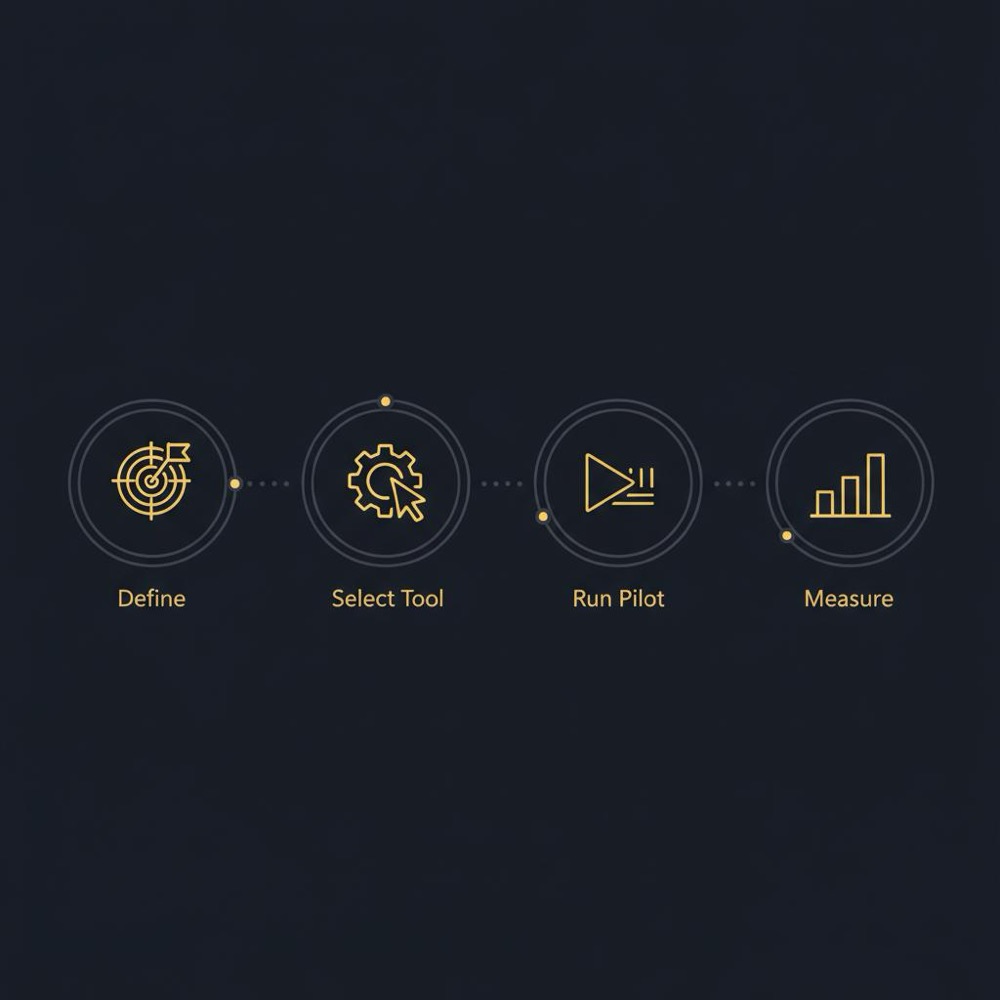
1) Pick one focused problem
What irritates your team or customers every week? That friction is often the best place to start. Define the single metric you will use to measure success - e.g., average response time, percent of invoices auto-processed, conversion rate on a signup form.
2) Set a short timeline and clear KPIs
Pilots of four to eight weeks are long enough to collect data but short enough to stay reversible. Put baseline numbers on paper before the pilot starts - without them, judgments become subjective.
3) Choose the simplest tools that do the job
Low-code and no-code platforms are often the fastest route. Ask vendors about data policies, retention, and whether customer inputs are used for model training. Keep the dataset small and relevant for the pilot.
4) Run the pilot, log everything, and iterate
Collect inputs, outputs and human corrections. Track false positives and common failure modes. At the end, compare the chosen KPIs to baseline. If the results are positive, plan integration and scaling steps; if not, document lessons and either iterate or stop.
Measuring ROI: realistic expectations
Case studies often show strong returns in customer service and repetitive operations. Microsoft's collection of customer transformation stories provides many real-world examples you can compare to small-firm pilots: Microsoft customer transformation examples. But measurable ROI depends on three things:
- Baseline maturity: If your current process is manual and slow, gains are often larger.
- Data quality: Clean history makes forecasting and classification much better.
- Integration effort: Isolating a model from your CRM or accounting system limits value; integrations cost time and should be part of your plan.
Also value soft benefits: saved employee time can translate into better service, and faster answers often improve customer loyalty even if immediate revenue gains are modest.
Regulation, privacy and legal basics
New rules like the EU AI Act and updated data-protection guidance make documentation and data minimization essential; see Deloitte's State of Generative AI report for context. For a small firm, practical steps include:
- Document why you use each model and what data it needs.
- Ask vendors about retention and whether your data trains their models.
- Prefer options to opt out of vendor-side training.
- Keep human-in-the-loop for sensitive decisions and log inputs/outputs for audits.
These steps keep compliance manageable and build customer trust.
Risk management: governance, mapping, controls, monitoring
Use a scaled version of NIST-style risk management:
Governance
Assign ownership - in small firms that can be one manager or a tiny committee - and define approval rules for new pilots.
Mapping
Map where customer data flows: what stays in-house, what goes to vendors, and who can access it.
Controls
Use role-based access, anonymization/pseudonymization and vendor agreements that limit training on your data.
Monitoring
Track model performance and data drift. Set simple thresholds that trigger human review and schedule periodic audits.
Practical checklist: run a 4-8 week pilot
Here is a one-page pilot checklist you can copy:
- Use case: e.g., chatbot triage for shipping and returns
- Owner: name of project lead
- Duration: 4-8 weeks
- KPIs: baseline response time, % resolved without escalation, CSAT target
- Data: subset of recent messages, pseudonymized where possible
- Tool/vendor: low-code chatbot platform with clear data policy
- Rollout: 20% of traffic first week, 50% after adjustments
- Human fallback: always available and logged
- Reporting: weekly metric log and a final short report
Common questions and clear answers
How much does a pilot cost? Many low-code platforms have affordable monthly plans. Factor in staff time and minor integration work. A small, focused pilot often fits within a modest subscription plus a few full days of staff effort.
Build vs. buy? For most small firms, a vendor-first approach is faster and cheaper for pilots. Building in-house is sensible only when a use case is strategic and the business can sustain engineering resources.
Vendor due-diligence: key questions to ask
Before giving a vendor access to customer inputs, ask:
- Do you retain inputs? For how long?
- Do you use customer inputs to train your models?
- What access controls and logs do you provide?
- Do you offer contract language to prevent model training on our data?
- Can we export our data easily if we stop the service?
These questions protect you from unexpected data use and make it easier to audit systems later.
Real examples: practical, not theoretical
Here are two short case studies that show the types of gains small firms can expect.
Retailer: chat-first customer care
A small online store routed common queries about shipping and returns to an AI assistant, starting with 20% of traffic. After six weeks, first-response time dropped from hours to under an hour. Staff focused on complex tickets, and repeat purchases improved slightly. Cost was a few hundred dollars per month and a few hours of setup.
Professional services: invoice automation
A consultancy automated invoice entry for a subset of suppliers. Data-entry time fell by half and error rates dropped. The initial investment paid back quickly against payroll savings and fewer corrections.
Scaling: when to expand a pilot
If KPIs move in the right direction and error modes are understood, plan for scaling. Scaling often requires:
- Deeper CRM/accounting integration
- Stronger logging and monitoring
- Defined SLAs with vendors
- Internal training so staff know how to handle edge cases
Make sure integrations are planned into cost and timeline estimates.
Practical templates you can copy
Use these short templates in early planning:
Pilot one-page plan (copyable)
Use case: [one sentence]
Owner: [name]
Duration: 4-8 weeks
KPIs: [baseline and target]
Data: [subset description]
Tool/vendor: [name]
Rollback plan: [how to stop]
Weekly report (copyable)
Week number, traffic split, key metrics vs baseline, notable failures, next actions.
Human-centered rollout tips
Communicate with staff and customers from day one. Tell customers when they might interact with automated systems and offer an easy path to human help. For staff, show how the tool reduces boring work and frees time for higher-value tasks.
Pitfalls to avoid
Watch out for:
- Rolling out broadly without baseline metrics.
- Giving vendors access to full customer records before a plan exists.
- No human fallback for sensitive decisions.
- Expecting instant perfection - models need monitoring and tuning.
Advanced: when to consider custom models
After repeated, successful pilots, you may want custom models or tighter integrations. Consider this only when the use case is core to your business and you have the data or budget to support ongoing model maintenance.
How to measure success in practice
Make sure your success measures are simple, numeric and visible. Sample metrics by use case:
- Chatbot: average response time, % resolved without escalation, CSAT
- Invoice automation: % auto-filled correctly, hours saved per month
- Marketing: open rate, CTR, conversion rate, cost-per-lead
Put a dashboard in place and check it weekly during the pilot.
How to handle customer concerns
Be transparent: label automated responses, give a clear path to a human, and explain how you protect customer data. Most customers appreciate speed and clarity more than magic.
Ready-made vendor features to prefer
Choose vendors that offer:
- Data-minimization controls
- Options to opt out of training
- Exportable logs and data
- Role-based access and audit logs
Budgeting rough guide
Costs vary, but a simple pilot often involves:
- Tool subscription: $20-$500/month depending on features
- Staff time: a few days to a couple of weeks across team members
- Minor integration or setup fees: variable
Compare these costs to payroll saved or time reallocated to higher-value tasks.
Questions small business owners often ask (and short answers)
Can I start with free tools? Yes - free tiers can prove concepts. But watch for data retention and training policies.
What about bias or fairness? Use human review on sensitive decisions, log outputs and keep a simple escalation path for disputed outcomes.
Will vendors keep my data? Ask explicitly. Prefer vendors who provide contractual assurances and opt-out options for training.
Where to go next
Pick a single small problem and write the one-page pilot plan above. Run 4-8 weeks, measure, and decide. If you'd like support designing a pilot and documenting governance,
Orvus Ltd. works with small teams to design sensible pilots and to document governance and vendor checks that matter. Their approach is collaborative and practical; learn more about their small-business services on the Orvus services page.
Ready to try a low-risk AI pilot?
Ready to try a low-risk AI pilot? Get expert help to design a clear, measurable 4-8 week pilot tailored to your budget and team. Visit Orvus Ltd.'s services to start.
Final practical checklist
Before you start: pick one measurable problem, set a 4-8 week timeline, pick a vendor with clear data policies, log everything, and keep human fallback in place. Small, visible wins build confidence and reduce risk.
With care, AI becomes a tool for sensible growth rather than a leap into the unknown.
FAQ snapshot
See the full FAQ below for common concerns and tactical answers.
Start with a focused pilot using a low-code or no-code tool that offers a free tier or small monthly plan. Limit the pilot to a narrow dataset, run it for 4-8 weeks, and measure a single KPI (e.g., response time or % auto-processed). Factor in staff hours for setup and monitoring, and choose vendors with transparent data policies.
Minimize data you send to vendors by pseudonymizing records, strip unnecessary fields, and ask vendors if they use inputs to train models. Use role-based access, encryption, and clear vendor contracts that limit retention. Keep sensitive decisions human-reviewed and log inputs/outputs for auditability.
Yes - Orvus Ltd. offers small-team support to design measurable pilots, perform vendor checks, and document governance. Their approach emphasizes realistic timelines (4-8 weeks), clear KPIs and a human-centered rollout to reduce risk while testing value.
References
- our services
- our knowledge base
- about Orvus
- https://www.bcg.com/press/24october2024-ai-adoption-in-2024-74-of-companies-struggle-to-achieve-and-scale-value
- https://www.microsoft.com/en-us/microsoft-cloud/blog/2025/07/24/ai-powered-success-with-1000-stories-of-customer-transformation-and-innovation/
- https://www.deloitte.com/us/en/what-we-do/capabilities/applied-artificial-intelligence/content/state-of-generative-ai-in-enterprise.html
Want this kind of work done for your business?
We build and run AI-powered marketing and automation. 15 minutes, honest assessment.
Book a call