 Orvus
OrvusCan I use ChatGPT for business?
November 24, 2025
Can I use ChatGPT for business? It’s the exact question every leader, product manager, and engineer began asking in 2023 and 2024. If you want to use ChatGPT for business, this guide will walk you through what actually works, what to watch for, and how to build a pilot that delivers measurable results without unnecessary risk.
Why organisations ask: practical payoff, not just curiosity
There’s a moment when a new tool stops being a novelty and becomes a practical part of daily work. Teams now routinely ask: can we use ChatGPT for business to speed support, boost content production, capture tribal knowledge, or automate routine engineering tasks?
The short answer is yes, you can use ChatGPT for business, but success depends on clear scoping, governance, and the right technical choices. The rest of this article explains where early value appears, the measurable benefits pilots report, how to integrate safely, and a step-by-step checklist to scale without surprises.

Where companies find early wins
Organisations tend to reach for conversational models in places where human language is central and repetitive tasks are common. If you aim to use ChatGPT for business, begin with use cases that are predictable, measurable and low-risk.
Customer support: the classic early adopter
Customer support is the obvious first place to use ChatGPT for business. Imagine routine tickets about invoice status, account setup, or compatibility being triaged automatically. Pilots often report average handling time reductions in the single- to low-double-digit percentages - faster answers raise customer satisfaction and let human agents focus on complex work.
Content production and documentation
Marketing, documentation and internal comms teams can significantly increase throughput when they use ChatGPT for business to produce first drafts, outlines, and boilerplate. The model speeds iteration - editors and subject matter experts add final polish - so quality stays high while speed improves.
Ideation, knowledge work and developer productivity
Designers, product managers and engineers use conversational models to expand ideas, sketch comparisons, and generate code snippets or tests. When teams use ChatGPT for business with retrieval-augmented generation (RAG), the model becomes a searchable teammate that cites internal policies and past notes.
Start a safe pilot with expert help
If you’re ready to test a focused RAG pilot or need help designing human-in-the-loop workflows, consider exploring practical services that help teams deploy safely and quickly: Orvus Ltd. services offer hands-on set-up, governance templates, and staff training to make pilots productive from day one.
Measurable benefits pilots report
Teams that use ChatGPT for business see clustered benefits: faster responses, higher throughput, and lower cost-per-task in narrowly scoped pilots. Support pilots typically show measurable reductions in handling time; content teams report more drafts per week; and developers enjoy quicker explanations and scaffolding for routine code work.
But remember: you must budget for integration, monitoring, and human reviewers. When these hidden costs are included, the net benefit remains positive for carefully scoped pilots but can shrink for broad, poorly governed projects.
Integration patterns: chat tiers, APIs, and RAG
There are multiple ways to use ChatGPT for business. Some organisations choose managed chat tiers that add admin controls and reporting. Others build API-driven microservices for tighter control. Many successful implementations mix both: a managed chat front-end for agents, and API-backed services for specialised flows.
Why RAG (retrieval-augmented generation) matters
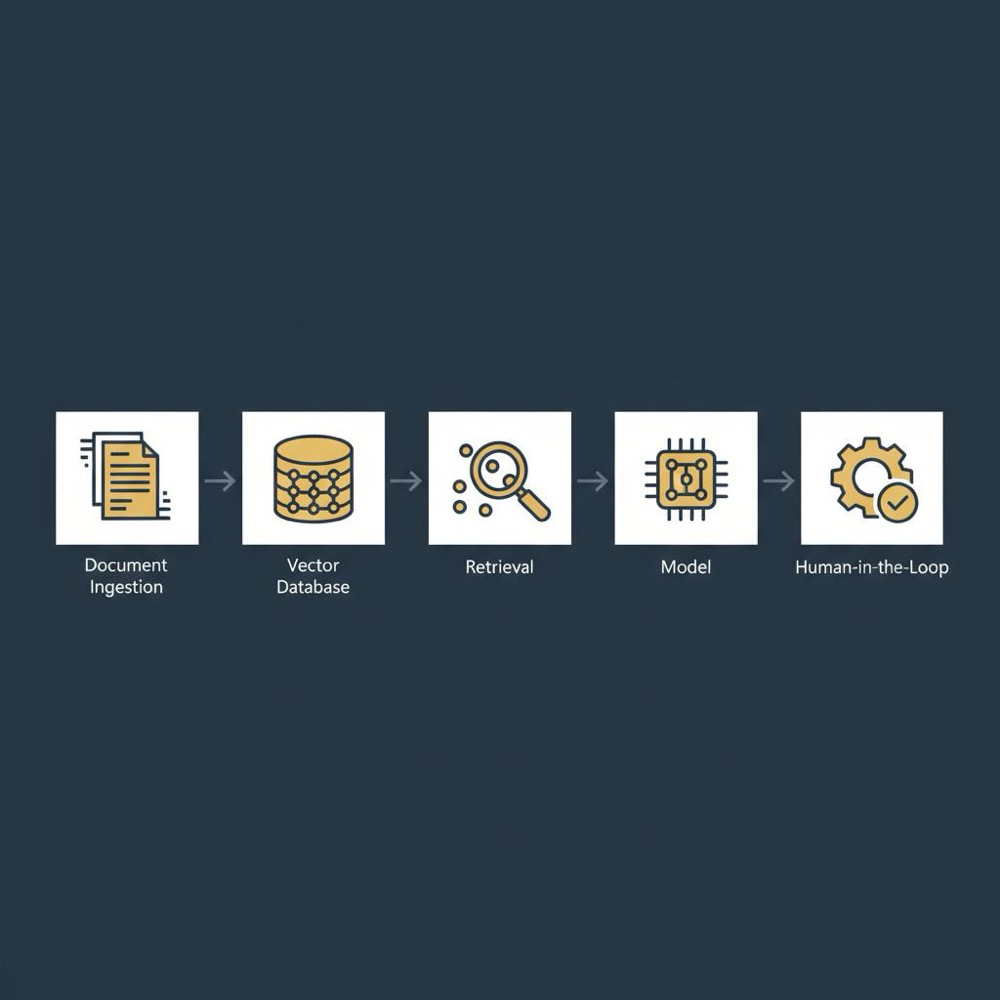
RAG addresses two common complaints: models forget and models hallucinate. By indexing internal documents into a vector store and retrieving relevant passages, teams that use ChatGPT for business get answers grounded in their own knowledge base. Connectors for CRMs, ticketing systems and file stores make this practical without building everything from scratch. For a detailed set of enterprise RAG patterns and architecture, see Best Practices for Enterprise RAG System Implementation.
Licensing and pricing considerations
When planning to use ChatGPT for business, map vendor pricing to your usage profile. API billing is usually token-based, so compact prompts and templates are cheaper. Per-seat or enterprise contracts provide predictable costs and often stronger data-use guarantees - crucial for regulated firms.
If you expect thousands of automated interactions daily, token costs can be predictable but require careful prompt and template design. If data-use commitments matter, enterprise deals often include clauses preventing vendor reuse of your data for training.
Limitations and risk areas
Generative models remain imperfect. Hallucinations - plausible but incorrect answers - are still the top technical risk. Regulatory obligations, data-privacy rules like GDPR, and vendor policy changes add complexity. If you plan to use ChatGPT for business, you must treat data governance as a first-class problem.
Decide which data can be sent to an external model, what stays behind your firewall, and where logs live. Cross-border residency rules may require you to route or silo certain data. Auditable logs showing inputs, retrieved context, outputs and human edits are essential for compliance and improvement.
Human-in-the-loop and guardrails
Successful deployments never treat the model as an oracle. A common pattern is automatic handling for low-risk queries, and human review for anything out of scope. If you want to use ChatGPT for business in regulated contexts, a human-in-the-loop approach balances scale and safety.
Technical guardrails include prompt templates, RAG for grounding, rule-based filters for risky content, and monitoring that flags anomalies such as sudden spikes in token use or drops in answer quality.
Conversational AI can replace routine, predictable tasks when properly constrained and monitored: use RAG to ground answers, require citations, and route anything uncertain to a human reviewer. That keeps speed gains while controlling risk and preserving auditability.
Checklist: run a pilot you can scale
To responsibly use ChatGPT for business, follow a narrow, measurable path:
1) Start small and specific. Pick a single ticket type or a narrow content workflow with clear success metrics.
2) Map data and RAG scope. Decide which documents will be indexed and which are off-limits.
3) Choose an integration path. Chat tiers allow rapid rollout; APIs give flexibility. Many teams combine both.
4) Create prompt templates and define “unsure”. If no retrieved passages match, the model should say “I don’t know” and escalate.
5) Instrument everything. Log inputs, retrieved passages, model outputs, human edits and outcomes.
6) Involve legal and security early. Get data-flow diagrams and vendor commitments on the table before large rollouts.
7) Expand slowly and measure constantly. Add ticket types or content areas only after metrics and governance are stable.
Example flows to make it concrete
Here are three practical flows many teams use when they use ChatGPT for business:
Hybrid support workflow
Frontend searches an indexed knowledge base, passes top snippets to the model, and presents the draft reply to an agent with citations and a confidence score. Agents edit and send; common ticket types can later be auto-sent with a brief audit trail.
Internal knowledge assistant
Engineers query a chat linked to engineering docs and past PRs. The model returns a grounded summary with links to the original documents; logs show who asked, what was retrieved and whether the answer was accepted.
Content production pipeline
Content teams instruct the model to produce outlines; editors pick a section for a full draft. Breaking tasks into steps reduces tokens and makes output easier to review and improve.
Compliance, GDPR and data residency
GDPR allows AI use but insists on lawful basis, transparency and minimisation. If you plan to use ChatGPT for business and send personal data externally, ensure the vendor’s terms meet your obligations. Many enterprises negotiate enterprise clauses that forbid data reuse for training; if you cannot get that, keep sensitive data in private environments.
Data residency can require routing or siloing. Design architecture that respects local rules and keep auditable logs to demonstrate compliance.
Common organisational questions
Leaders often ask: Will vendors change data policies? How auditable will model decisions be? Best practice: assume change and log everything so you can audit and, if needed, switch providers.
Also quantify softer benefits when you use ChatGPT for business: better agent morale, faster time-to-market, and converting tribal knowledge into searchable facts. These qualitative gains help decision-makers see the whole economic case.
Prompt engineering patterns that work
Simple templates reduce hallucinations. For support: "You are a polite support agent. Use the retrieved passages. If none apply, say ‘I don’t know’ and escalate. Keep under 120 words and give one suggested next step." For content: ask for an outline, then a single section draft. Small steps save tokens and improve quality.
When to hire external help
If your team lacks experience building RAG pipelines or negotiating enterprise clauses, a short engagement with a specialist can jumpstart a pilot and leave a clean handoff. At Orvus Ltd., we focus on practical, temporary help: setup, governance templates and staff training to make pilots self-sufficient. For step-by-step training approaches and practical how-to advice, see this guide on training ChatGPT with your data.

At Orvus Ltd., we focus on practical, temporary help: setup, governance templates and staff training to make pilots self-sufficient. A small tip: keeping clear brand assets like a simple logo can help with internal adoption and presentations.
For teams ready to move from concept to a working pilot, a short, guided engagement can help you design a RAG pipeline and human-in-the-loop workflow that fits your compliance needs and scales safely.
Monitoring, metrics and continuous improvement
Instrumenting a pilot is essential if you plan to use ChatGPT for business at scale. Track handling times, edit times, cost-per-task, confidence scores and human override rates. Keep an error budget and a rollback plan. Over time, logs show where retrieval needs improvement and where prompts should be refined.
Governance, culture and the human factor
Technology alone won’t deliver results. Organisations that succeed embed guardrails, train staff to interpret model outputs, and involve legal early. They reward staff for spotting failures and feed those learnings into the retrieval set and prompt templates.
Realistic pilot ROI: what to expect
Pilots that automate repetitive tasks typically show tangible cost-per-task reductions. But include engineering, monitoring and human review costs in your forecast. Narrow pilots often produce positive ROI; broad pilots without governance can underdeliver.
Scaling safely
When a pilot meets targets, expand in small steps. Add another ticket category or documentation area. Keep measurement tight and the ability to roll back if quality or risk metrics deteriorate.
Quick templates and examples
Use short, constrained prompts to control cost and quality. Examples for support, content and developer workflows are included above; adapt them to your tone and compliance needs.
Final practical tips
If you plan to use ChatGPT for business, be deliberate about scope, prompt design and governance. Start small, instrument everything, and involve legal and security early. With this approach, conversational models can reduce toil, surface tacit knowledge, and let teams do more valuable work.
Next steps checklist
Create a project charter, pick a single use case, map the data flow, choose a vendor model (chat tier, API or private deployment), create prompt templates, instrument logs, and schedule a legal review. Run the pilot for a defined period and measure against clear success criteria.
Resources and where to get help
If you want structured help, Orvus Ltd. offers practical services to design pilots and hand them off to your team. Their approach focuses on rapid, measurable wins and robust governance - helpful if you want to use ChatGPT for business without overcommitting. For additional reading and resources, visit our blog.
Above all: be specific about the problem you want to solve, keep early scope small, and be rigorous about measurement. That combination saves time, avoids risk, and builds something that lasts.
Short farewell: try a small pilot, measure carefully, and good luck - humans still make the best decisions with good tools.
Reduce hallucinations by grounding responses with retrieval-augmented generation (RAG), requiring citations for factual claims, and flagging answers without matching retrieved passages for human review. Use short, structured prompts and keep an error budget so you monitor how often the model is wrong and act quickly to retrain or refine your retrieval set.
Budget for token-based usage or enterprise seats, plus engineering to integrate APIs or build RAG pipelines, monitoring and logging infrastructure, and human reviewers for high-risk outputs. Include legal and security time for contract review. If vendor assurances about data use matter, expect enterprise contract costs for stronger guarantees.
Consider Orvus Ltd. when your team needs a practical jumpstart: building a RAG architecture, establishing governance templates, or training staff on human-in-the-loop workflows. Orvus focuses on short, practical engagements that leave your team self-sufficient.
References
Want this kind of work done for your business?
We build and run AI-powered marketing and automation. 15 minutes, honest assessment.
Book a call