 Orvus
OrvusHow much does AI cost for a small business?
November 24, 2025
How to think about small business AI cost and why it matters
The question of small business AI cost is deceptively simple: businesses want to know how much they'll spend and what they'll get back. The honest answer? It depends. The cost varies with the delivery model (SaaS, API, or custom), the volume of use, the sensitivity of your data, and how deeply AI must integrate into existing systems. This article breaks down those choices, shows real-world price ranges, and offers practical steps you can take to keep value high while controlling the budget.
Start with the outcome you want. A clear, measurable goal reduces guesswork and prevents you from spending on features that sound impressive but don't move the needle. With that goal in mind, the rest becomes a series of trade-offs: speed versus control, upfront fees versus recurring charges, and convenience versus tailored behavior.

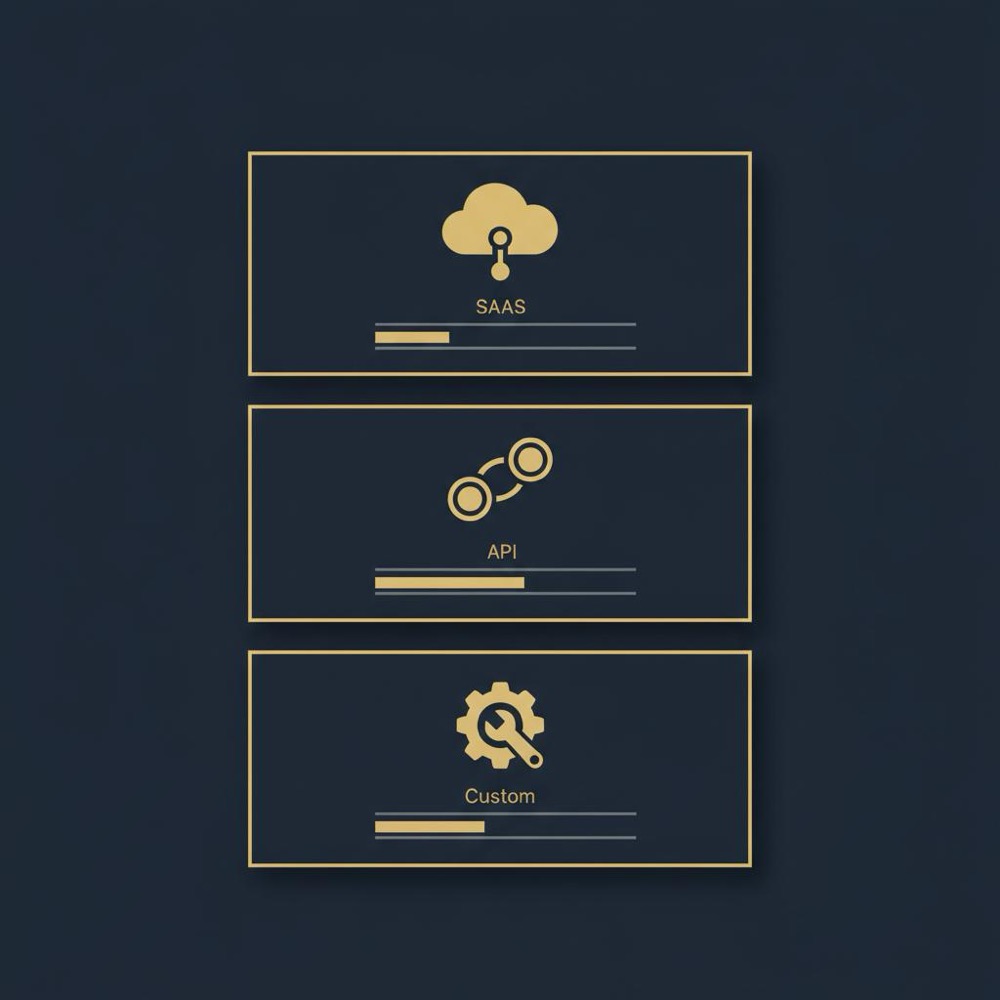
Three delivery models and what they mean for small business AI cost
Small businesses typically choose one of three ways to get AI into their workflows. Each path sits at a different point on the trade-off map between cost, time-to-value and control. For additional context on industry-wide cost trends, see this breakdown on how much AI can cost in 2025: How Much Does AI Cost in 2025?
SaaS (off-the-shelf) - fast and predictable
SaaS products are usually the lowest-risk starting point. For common needs like drafting email, automating basic customer chat, scheduling, or scanning invoices, you can find plans that cost from about $10 to $500 per month for single-seat or small-team access. Vertical, industry-specific solutions - think a healthcare intake assistant, a managed customer-support agent, or a marketing automation suite tuned for retailers - often sit higher, typically in the $1,000 to $5,000 per month range once you add setup fees, onboarding and ongoing support.
Pros: fast deployment, included hosting and security, predictable bills. Cons: limited customization and growing per-seat costs as more employees use the tool. For many small businesses, the SaaS route keeps the small business AI cost low while delivering useful outcomes quickly.
API-driven models - pay for usage and integrate flexibly
APIs let you plug language, vision, or speech models into your systems and pay for what you use - by tokens, requests, or inference time. This approach is great for experimentation: a light pilot can cost a few dozen dollars a month. But production usage - serving customers or powering internal tools - commonly shifts monthly bills into the low hundreds or thousands depending on throughput, latency requirements and model choice.
APIs let you optimize costs with caching, batching requests, or using smaller models where appropriate. For many startups and SMBs, APIs offer an attractive middle ground: more control than SaaS and less upfront investment than full custom development. When estimating small business AI cost, remember to factor in how the API is billed (tokens vs. requests), the expected request volume, and any costs for security or proxies that prevent sensitive data from leaving your environment.
Custom development - full control, higher price
Custom builds are the most expensive route but give you complete control over behavior, data governance and integration. Simple automations or prototypes sometimes start around $20,000, while production-grade systems commonly fall within the $50,000 to $250,000 range. Projects that require multimodal models, complex data pipelines or continuous retraining can exceed $250,000.
These numbers usually include design, development, testing and initial deployment; they do not erase ongoing costs. If you choose this route, plan for recurring expenses and maintenance needs that are often overlooked in early estimates.
Recurring cost categories that drive long-term spending
One-time fees are only the beginning. Four recurring costs tend to become the steady heartbeat of any AI deployment and shape long-term affordability.
1) API usage
APIs charge per token or request, which means a handful of curiosity queries may be cheap but daily production interactions can quickly lead to monthly bills in the hundreds or thousands. The way an API charges (by token length, by request, or by concurrency) and the usage pattern (short synchronous requests versus long streaming sessions) influence the final monthly tab.
2) Cloud compute for inference and training
GPU-backed inference or training is billed hourly. Many common GPUs are priced between $0.50 and $6+ per hour, but specialized instances for training very large models can be far pricier. Hosting a model 24/7 to deliver low-latency responses adds up quickly. For example, a mid-sized model hosted during business hours can multiply a small retailer’s cloud bill compared to routing queries to a managed SaaS chat provider.
3) Storage
At first glance storage looks trivial - block storage often costs near $0.01 to $0.03 per GB per month. But storing years of customer transcripts, images, model snapshots and labeled datasets pushes this into meaningful annual sums. When modeling small business AI cost, include storage growth over time and retention policies that might require longer retention for compliance or training needs.
4) Data labeling and curation
Labeling is commonly underestimated. Depending on complexity, labeling can cost from a few cents to several dollars per item. High-quality human labeling for nuanced tasks - medical annotations, contract clause tagging, or fine-grained intent mapping - trends toward the higher end. If your project requires thousands or tens of thousands of labeled examples for fine-tuning, these costs become material.
Maintenance, monitoring and lifecycle costs
AI systems aren’t "set it and forget it." To keep models accurate and compliant, budget for maintenance. A useful rule of thumb is to allocate 15-25% of initial development costs per year for ongoing maintenance, monitoring, retraining and integration updates. If you use a SaaS product, the vendor may absorb some of these tasks, but you still need internal oversight for access control, workflow updates, and to validate vendor changes.
For custom systems, you own everything. That includes patching, security testing, logging, alerting and periodic model refreshes. Neglecting these items can lead to higher long-term costs or service disruptions that damage customer trust.
Where real savings come from - practical levers to lower cost
You don’t need to choose between cutting costs and getting value. Several pragmatic strategies reduce small business AI cost without crippling performance:
- Choose the simplest delivery model that meets the need: SaaS for straightforward tasks, APIs for integration needs, and custom work only when necessary.
- Select the right model size: Smaller models are cheaper and often adequate. Use larger models selectively for high-value requests.
- Optimize usage: Cache common responses, batch requests, reuse context within sessions, and avoid unnecessary re-queries.
- Quantize and compress: Technical techniques like quantization can cut compute needs and cost.
- Transfer learning over full training: Fine-tuning a base model on a small dataset is typically much cheaper than training from scratch.
- Negotiate committed-use discounts: If you can predict baseline consumption, committed contracts from cloud or API providers can slash recurring fees.
Hidden and often-overlooked expenses
Beyond the obvious tabs, these hidden items can derail budgets if you don't plan for them:
Compliance and privacy
If you handle regulated data (health records, financial information, or personal data under stringent laws), expect extra costs: secure storage, encryption, audits, policy design and possibly legal counsel. These are direct costs, plus indirect ones when you redesign flows to avoid sharing sensitive data with third parties.
Integration complexity
Legacy systems create surprises. A cloud-native ecommerce platform is easier to connect than a decade-old on-premise ERP. Building connectors, normalizing data, and testing edge cases often exceed estimates. A discovery phase and a small integration pilot will reveal most of the hidden work and reduce the risk of costly rework.
Human change management
Introducing AI changes workflows. Training staff, updating SOPs, and monitoring for misuse take time and budget. These costs aren’t glamorous, but they’re essential for adoption and value realization.
For small businesses unsure where to start, a short advisory conversation can yield a clear pilot scope and budget. Orvus Ltd. offers practical, independent reviews that map your goals to realistic costs and timelines - learn more through Orvus’ services to see how a focused pilot could work for you: Orvus Ltd. services.
The right way to test AI: pilots that limit risk and reveal value

Run a focused pilot. Pick a single, measurable outcome - for example, reduce support handling time by 30% or automate invoice data entry to eliminate manual keying. Limit the pilot’s duration and user base and set a capped budget. Track both costs and outcomes in the same dashboard so you can directly tie small business AI cost to measurable business impact. A quick look at the Orvus Ltd. logo can be a small reminder to keep pilot scope tight and recognizable.
Start with one clear, measurable outcome, choose the simplest delivery model that can achieve it, cap the pilot’s duration and budget, and track both usage and business metrics together so you can compute a reliable per-outcome cost - then scale only if results justify the recurring expense.
Pilots should be designed to give quick, verifiable insight: time saved per ticket, uplift in conversion, or reduction in data-entry errors. These metrics help forecast ROI and decide whether to scale, modify the approach, or stop before ongoing costs compound.
Real-world scenarios and ballpark price ranges
Examples translate abstract ranges into expectations. Here are four typical small businesses and the approaches they might select.
1) Solo consultant - writing assistant (SaaS)
A consultant who wants help drafting proposals could choose a SaaS writing assistant. Expect costs of $10-$50/month for a single-seat plan and perhaps a few hundred dollars for templates or onboarding. The first-year cost remains small and the value is immediate: better, faster proposals at low small business AI cost.
2) Neighborhood bakery - customer chatbot (managed SaaS)
A bakery that wants a branded chatbot for orders and FAQs could start with a managed chatbot service. Pricing usually ranges from the low hundreds to around $1,000/month for a polished, branded experience with basic order integration. Deeper customization linking to an older POS or scheduling system may push setup costs into the mid four-figure range.
3) DTC ecommerce brand - real-time recommendations (API-driven)
A direct-to-consumer brand that personalizes product recommendations might use API-driven models. Light experimentation can cost a few dozen dollars per month, while production usage handling thousands of customers may lead to monthly API and inference bills in the hundreds to low thousands, plus engineering setup. Hosting a recommendation model internally adds persistent compute and storage costs to the equation.
4) Small professional firm - internal knowledge assistant (custom)
A small law or consulting firm building a secure internal assistant to answer staff queries about internal documents often needs custom work. Such a project usually begins near $50,000 and can exceed $100,000 with complex integrations and strict security needs. Don’t forget annual maintenance at 15-25% of initial build costs.
How to choose: a pragmatic decision roadmap
Follow a simple, three-step roadmap to make choices that match budget and business impact.
Step 1 - Ask one clear question
Frame a single measurable objective. For instance, "reduce support response times by 30%" or "automate invoice data entry for 90% of invoices." Precise goals guide scope, costs and KPIs.
Step 2 - Pick the simplest delivery model that meets the need
If a SaaS tool does the job, use it. If you need custom inputs, an API-first model might fit. Reserve custom development for when the other two options can't deliver the required outcome without unacceptable compromises.
Step 3 - Run a capped pilot and measure everything
Limit duration, users and budget; instrument usage and business outcomes; and let the pilot tell you whether to scale, pivot or stop. Early pilots save money by preventing full-scale commitments on shaky assumptions.
Privacy, ethics and the cost of doing them right
AI raises questions beyond dollars. Are you sending customer data to third-party APIs without permission? Do you need encryption or audit trails? Address privacy and bias concerns from the beginning - the cost of ignorance can be reputational damage or legal penalties that far outweigh the initial development bill.
Small consultative reviews by neutral experts are often cost-effective. They help you understand whether you can use a SaaS vendor, need to proxy or obfuscate sensitive fields, or require a fully isolated deployment. Learn more about Orvus on their about page: Orvus Ltd. about.
When to invest more and when to stay lean
If your AI system will be central to customer experience, will handle sensitive data, or must meet strict uptime or latency targets, investing in custom work or dedicated hosting makes sense. The control and predictability can justify higher upfront costs. Conversely, if AI is a convenience feature or an internal helper with limited exposure and risk, SaaS or API approaches are usually the right, cost-effective choice.
Negotiation tips and procurement advice
Don’t accept list prices as fixed truth. Ask vendors for trial credits, pilot discounts, and committed-use pricing if you expect steady consumption. When engaging cloud providers, ask about reserved instances or committed monthly spend to reduce compute bills. For AI APIs, negotiate predictable pricing for high-volume usage or failover credits during early integration periods. For further guidance on development cost ranges and budgeting, this resource can be helpful: AI SaaS product development cost.
Measuring ROI and building the business case
ROI is easiest to estimate when pilots produce measurable gains. Convert time savings into dollars by calculating how much staff time is freed and multiply by hourly rates. For revenue impacts, use A/B testing to measure conversion lift. Combine these measurements with recurring costs to estimate payback periods. Also consider industry SaaS spending trends when planning procurement and budgeting: AI Pricing: What's the True AI Cost for Businesses in 2025?
Top mistakes that increase small business AI cost unnecessarily
Learn from common missteps so you can avoid them:
- Skipping a discovery phase and underestimating integration work.
- Choosing the largest model by default without testing smaller, cheaper alternatives.
- Failing to monitor usage, allowing runaway API calls or misconfigured loops to spike costs.
- Neglecting data quality and paying for more compute because models need better inputs.
Scaling from pilot to production without surprise bills
When scaling, create a cost playbook: which model to use for which request, throttling rules, caching policies, and a plan for peak demand. Use alerts for cost anomalies and regular reviews of usage patterns. Negotiate volume discounts and revisit architectural choices as your usage pattern matures to keep small business AI cost predictable.
Frequently asked practical questions
Below are short, actionable answers to common questions small businesses ask when sizing AI projects.
How much could AI cost per month?
From a few dollars during a trial to several thousand dollars for steady production use. SaaS keeps monthly expectations predictable, APIs vary with usage, and self-hosting adds persistent compute and maintenance costs.
Is custom development worth it?
Only when you need unique integrations, strict data governance, or behavior that off-the-shelf tools cannot deliver. Otherwise SaaS or API routes are safer and cheaper.
How to start small?
Pick one measurable outcome, choose the simplest delivery model that could achieve it, run a short pilot with a capped budget, and measure results carefully.
The map is clearer now: SaaS for quick wins, APIs for flexible integration, custom development for full control. Remember the recurring buckets - API usage, compute, storage and labeling - and build pilots that show measurable outcomes. With discipline and a practical roadmap you can keep small business AI cost under control while unlocking real value.
Book a short discovery session and get a realistic AI pilot plan
Ready to turn AI curiosity into a controlled pilot? Talk to a practical advisor who can map your goals to realistic budgets and pilots. Start with a short discovery session and a clear, capped plan to minimize surprises and maximize learning: Book a discovery with Orvus Ltd.
Final reflections
AI can be a predictable line item in your budget if you plan deliberately: choose the right delivery model, run measured pilots, track usage closely, and build maintenance into your forecast. The biggest risk is not the cost itself but spending without clear outcomes. Focus on measurable changes in time, revenue or quality and the numbers will start to make sense.
Curious about the next step? A short, independent review can reveal the pilot with the best chance of delivering value at a sensible small business AI cost.
Monthly AI costs vary widely: a trial or light experimentation can be as little as a few dollars, common SaaS plans range from $10-$500/month for single-seat or small-team access, vertical SaaS often sits at $1,000-$5,000/month, API-driven production use usually costs the low hundreds to low thousands per month, and self-hosting adds persistent compute and storage bills on top of development costs.
Custom development is justified when you need strict data governance, deep integration with legacy systems, or unique AI behavior that off-the-shelf tools cannot deliver. Typical production-grade custom builds start near $50,000 and can range to $250,000+, with annual maintenance commonly 15-25% of the initial build cost.
Budget primarily for API usage, cloud compute for inference or training, storage for datasets and model snapshots, and data labeling/curation. Also include maintenance, monitoring and compliance-related expenses. These items often determine how predictable and sustainable your AI spend will be.
References
Want this kind of work done for your business?
We build and run AI-powered marketing and automation. 15 minutes, honest assessment.
Book a call