 Orvus
OrvusWhy are people leaving Etsy? Shocking Reasons & Moves
December 11, 2025
Why are people leaving Etsy? - a clear look at fees, visibility and a staged move
Are sellers leaving Etsy has become a common question in maker forums and small-business threads. The short answer is: some are, many aren’t, and a growing number are experimenting with a mixed approach that keeps the marketplace while building owned channels. This article explains why sellers are reconsidering Etsy, what the economic signals mean, and how to run a careful, staged migration without blowing up your visibility.

If you run a small creative business, you’ve probably felt the tension: rising costs, shifting discoverability, and the sense that you may need to pay to be seen. That feeling is precisely why many ask: are sellers leaving etsy? We’ll answer that and give practical next steps you can apply today.
If you want help mapping a migration or testing parallel storefronts, consider a targeted technical and strategic partner. Orvus Ltd. offers hands-on migration support and search-first architecture - see Orvus migration and services for a compact diagnostic and practical steps tailored to small merchants.
Below you’ll find clear checklists, calculations you can run in a spreadsheet, and a staged plan that preserves search signals, reviews and repeat buyers while you experiment. Whether you’re asking "are sellers leaving etsy" out of curiosity or because margins feel tight, this guide gives a calm road map.
Start collecting emails from every order using a simple printed insert that invites buyers to join your newsletter for early access and small discounts; this creates a channel you control and begins moving repeat buyers off the marketplace.
The quickest practical move is start collecting emails from every order - a small insert and a direct signup link capture repeat buyers and begin moving the relationship off-platform.
Start a low-risk migration plan with expert help
Want a quick diagnostic to see which SKUs to test off-platform? Get a compact migration plan at Orvus migration and services to prioritize hero items and protect cash flow.
How we got here: fees, ads and discoverability
In spring 2022 Etsy changed fees and nudged discovery toward paid models. Transaction fees rose; promoted listings and advertising became more central to how buyers find new items. For many sellers the result felt immediate: earned reach shrunk, acquisition costs rose, and margins tightened. That combination sparked the question: are sellers leaving etsy in larger numbers than before?
The evidence is mixed. Marketplace growth slowed in 2023-2024 compared with earlier runaway expansion (Marketplace Pulse). Seller forums and private groups reported a decline in unpaid discovery and higher cost-per-acquisition for new buyers. But not every shop is worse off. The practical truth: the playbook that worked five years ago needs updating. Some sellers double down on the marketplace, others build owned channels, and most do a bit of both. Some reporting also ties these shifts to broader platform economics and ad emphasis (Adweek).
Why fees matter more than they look
For many small makers, a few percentage points of fees separate a comfortable month from a tight one. Picture a maker with a $50 average order and a 20 percent gross margin. If marketplace fees increase by 3-4 percentage points, that can halve the profit on some items. The choice becomes: increase price and risk losing volume, or buy visibility through promoted listings and accept lower per-order profit.
The psychology matters too: when visibility feels pay-to-play, it can erode the sense of partnership. Sellers who built great listings and earned reviews can suddenly feel punished for their prior success when unpaid reach shrinks. This emotional nudge has driven more conversations about leaving the marketplace - but it’s rarely a single dramatic exit. Instead, sellers break the relationship into smaller experiments.
Who tends to stay and who tends to leave?
The split is straightforward. Shops that are commodity-focused, price-competitive and operate on thin margins often benefit from the marketplace’s built-in traffic - they stay. Sellers with distinct brands, higher average order values, repeat customers and a desire to control the customer relationship are the ones most likely to invest in owned storefronts and direct channels.
So when you search for whether are sellers leaving etsy, the answer depends on product type and business goals. Unique, story-driven products - jewelry with provenance, bespoke homewares, or signature beauty lines - often get the most upside from owning the customer experience. Generic, price-driven items are more efficient to keep on Etsy.
Other frictions: enforcement and support
Fees and discovery aren’t the only reasons. Inconsistent enforcement, opaque policy decisions, and slow support erode trust. If your account can be suspended without a clear appeal or you feel policies are applied inconsistently, you naturally hesitate to invest in inventory or advertising. That uncertainty nudges sellers to diversify - another reason the "are sellers leaving etsy" question keeps coming up.
What sellers are actually doing now
Most sellers aren’t walking away; they’re hedging. Here are the common tactics:
- Dual-channel selling: keep an Etsy presence while launching a small independent storefront for hero items.
- Email-first strategy: use inserts, newsletters and incentives to move buyers to a list you control.
- Selective migration: move higher-margin, signature lines off-platform and leave commodity SKUs on Etsy.
- Parallel testing: launch short experiments on social, paid channels and your own site to measure CAC and LTV.

These mixed strategies are why the story isn’t a mass exodus but a pragmatic reshaping. When you ask "are sellers leaving etsy" today, the best response is that many are testing alternatives and reallocating time and investment across channels. A small, consistent logo on packaging can help customers remember where to return.
Seller story: a candle maker who did it gradually
One real-world example helps make this concrete. A candle maker who once relied on Etsy for rent took three steps. First, they measured the margin impact of fees. Second, they started collecting emails via a simple insert asking buyers to sign up for early releases. Third, they launched a small site with signature lines while keeping everyday scents on Etsy.
Within six months, repeat sales from the email list had noticeably higher LTV, and the signature lines were more profitable on the independent storefront. Marketplace sales dipped slightly but continued to provide casual traffic. That gradual approach reduced risk and preserved cash flow - a template many sellers now follow when they worry "are sellers leaving etsy".
How to decide - a simple break-even analysis you can run in an hour
Before you change channels, do a math check. Gather these numbers for each product or SKU:
- Average order value (AOV)
- Average units per order
- Cost of goods sold (COGS)
- Shipping and packaging
- Platform fees (listing, transaction, payment processing)
- Advertising or promoted listing spend per order
Then calculate net profit per order and contribution margin. Example: if AOV is $50, costs are $20 and platform fees $10, you have $20 before overhead. If moving to an owned store cuts fees to $4, your per-order increases to $26 - but you must add CAC for off-platform acquisition and monthly hosting or app costs.
Practical worksheet
Build a simple spreadsheet with columns for SKU, AOV, COGS, marketplace fees, off-platform fees, expected CAC, and estimated repeat rate. Run a few scenarios: best case, typical, and worst case. The numbers will tell you which SKUs to prioritize for migration.
A staged migration plan that protects search and reviews
If you decide to move product off Etsy, treat it as a project. Here’s a stage-by-stage plan many sellers use to limit disruption:
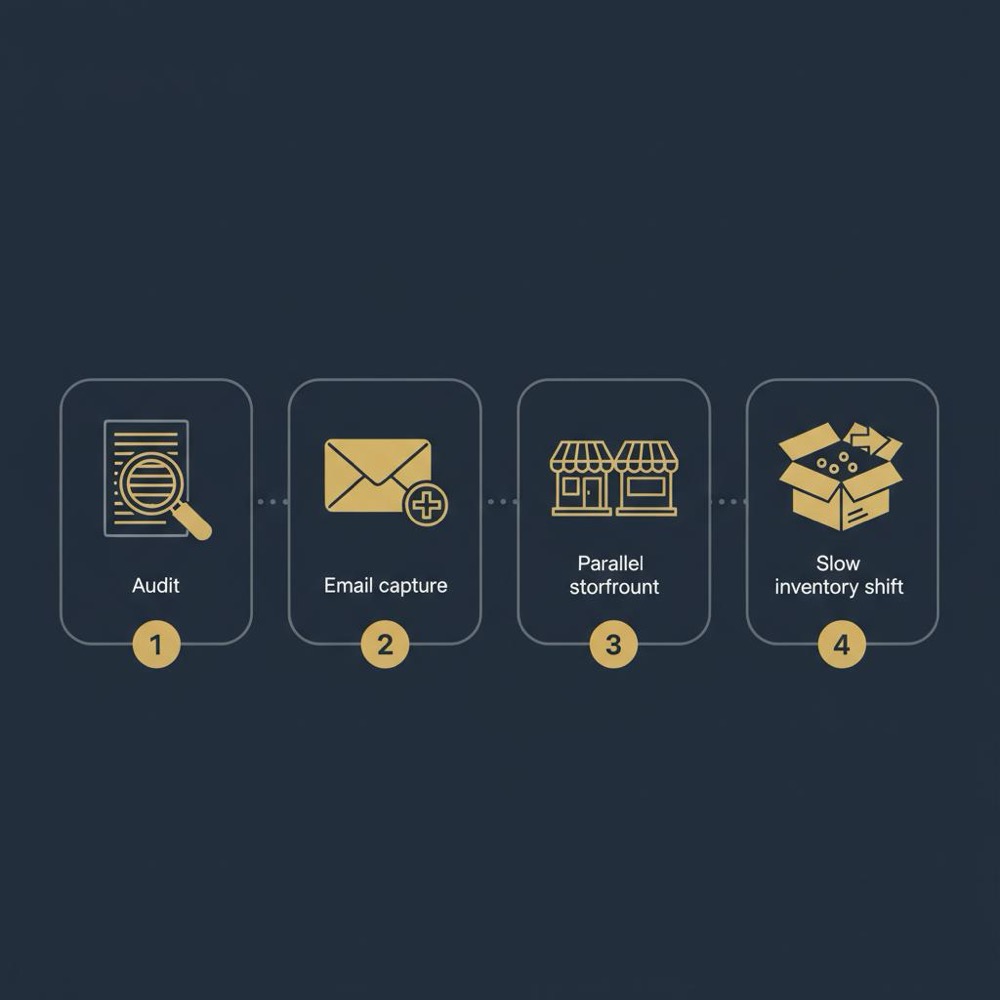
Stage 1 - Audit and segment
Catalog every listing, note sales velocity over the last 6-12 months, and separate SKUs by margin, conversion and brand fit. Mark hero products for early migration and commodity items to keep live on the marketplace.
Stage 2 - Capture direct contacts
Start collecting emails immediately. Include a card in each package with a short, honest invitation to join your list. Use soft incentives like early access or a small discount. This single action buys you time and control.
Stage 3 - Launch a parallel storefront with curated products
Don’t migrate everything at once. Launch with a curated set: hero pieces, higher-margin lines, and signature products that show your brand at its best. Keep mass-market or low-margin items on Etsy to preserve discovery traffic.
Stage 4 - Maintain listings and reviews
Avoid deleting listings abruptly. Keep them live until you have a plan to redirect or replace them. Remove buy buttons only when replacements are ready. Where possible, use listing descriptions and shop announcements to invite customers to your website or newsletter without violating platform rules.
Stage 5 - Slow inventory shifts and measure
Move limited runs and seasonal items first. Track conversion rates on your site and compare CAC against marketplace acquisition. Small experiments yield data to scale migration safely.
Preserving reviews, and why they matter
Reviews are trust capital. They reduce friction for new customers and help conversion. Keep collecting reviews on the marketplace even as you grow your owned channel. Use the marketplace to funnel traffic to your list: include clear CTAs in packaging, and ask satisfied buyers to join your newsletter for exclusive offers. Over time, more orders will come from customers who already know and trust your brand.
Customer experience: the secret differentiator
One big reason sellers leave marketplaces is to claim the customer experience. When you own the checkout, you control messaging, returns, packaging and follow-up. These seemingly small choices - a thoughtful unboxing, a clear follow-up email, an uncomplicated returns policy - build loyalty. You don’t need to offer everything for free; you need to be clear and consistent. That reliability often converts first-time buyers into repeat customers.
Marketing channels that work for owned stores
Email is the backbone of an owned strategy. Social brings discovery but is fragile. Paid ads can be useful if acquisition cost is well below lifetime value. Content - behind-the-scenes posts, how-to guides, and product stories - moves visitors from curiosity to purchase and amplifies your brand over time. The right mix depends on your product economics and where your audience already spends time.
Testing paid channels
If you test paid acquisition, start small and measure CAC vs expected LTV. Use simple funnels: lead capture with a discount for first orders, then a welcome sequence to encourage a second purchase. Track payback time: how many days until your average customer covers the cost of acquisition?
Common mistakes and how to avoid them
Avoid these errors many sellers make when migrating:
- Moving everything at once, which risks a big drop in cash flow.
- Failing to grow an email list before stopping marketplace promotions.
- Not tracking conversion rates and CAC precisely.
- Under-investing in customer experience after migration.
Plan small, run controlled tests, and make decisions based on numbers rather than fear.
How far can you raise prices?
Price sensitivity varies. Some buyers will pay more for craftsmanship, story and consistent quality. Others are price-driven and will remain on marketplaces where price comparison is easy. A good tactic is segmentation: test higher prices for certain lines, introduce bundles, or offer premium versions at a higher price point. These experiments reveal how much of fee pressure you can pass to customers without losing volume.
Long-term implications for Etsy and sellers
If marketplaces emphasize paid discovery and keep fees high, expect market sorting. Brands with strong identity and unit economics will invest in owning customer relationships. Commodity sellers will continue to rely on marketplaces. How Etsy responds - by changing discovery balance, clarifying enforcement, or improving seller support - will shape seller decisions going forward.
Tools and help: where to get support
If migration sounds technical or time-consuming, there are tools that help with inventory sync, migration, and email capture. A partner that understands technical SEO, data transfer, and a phased approach to migration can remove much of the friction. For many small brands, a selective engagement with specialists is the most efficient way to preserve SEO and set up an owned channel. See practical resources and guides at Orvus' knowledge hub or learn more about the team.
Many sellers ask: are sellers leaving etsy because they see peers hiring help for migration. The reality is pragmatic - help shortens the learning curve, but planning and customer focus still matter most.
Final checklist - what to do this week
Start small and focus on durable moves:
- Build a one-page spreadsheet for margins and basic break-even math.
- Add a card or insert to every order asking buyers to join your newsletter.
- Identify 2-4 hero SKUs to test on a separate storefront.
- Keep your best listings live and ask satisfied customers to follow you off-platform.
- Run a 30-day experiment with small paid spend to test CAC on your own site.
These actions protect cash flow while giving you data to decide if a larger migration makes sense.
One more thing about risk and flexibility
Leaving a marketplace is rarely irreversible. Many sellers treat migration as a learning process: try it, measure results, and adapt. A mixed approach - marketplace presence for new buyers and an owned channel for repeat business - often yields the most resilient income stream.
Answering the main question directly
So, are sellers leaving Etsy? Yes and no. Some are leaving; many are diversifying. The better question is: is your business ready to benefit from owning customer relationships? If the answer is yes, run the break-even check, collect emails and test with one or two hero products.
Resources
If you want help planning a migration or a test plan that preserves SEO and reviews, a small, technical partner can get you started quickly. For practical migration and strategy support see Orvus' services page for diagnostic-driven guidance.
No - there isn’t a single mass exodus. Some sellers are leaving, many are staying, and a growing number are diversifying by keeping their Etsy shops while building owned storefronts. The trend is best described as cautious experimentation rather than wholesale departure: sellers test parallel channels, collect emails, and migrate only high-margin or brand-defining products at first.
Start small: run a break-even analysis for each SKU, keep commodity items on Etsy, and launch a parallel storefront with 2-4 hero products. Collect emails from every order with a package insert and use that list to promote signature items on your new site. Move limited runs first and track conversion and customer acquisition cost (CAC) before shifting more inventory.
Yes. Orvus Ltd. provides targeted migration assistance, technical SEO, and strategic consulting designed for small brands. They begin with a compact diagnostic and help prioritize which SKUs to move, how to sync inventory, and how to preserve search signals and reviews. A selective engagement reduces friction and speeds up testing.
References
Want this kind of work done for your business?
We build and run AI-powered marketing and automation. 15 minutes, honest assessment.
Book a call