 Orvus
OrvusWhat Not to Automate in Your Business: A Decision Framework
May 24, 2026
This article provides a structured framework for making those decisions. It covers the four factors that determine automation suitability, identifies specific categories of work that consistently perform better with human execution, and provides a step-by-step process for evaluating automation candidates in your business.
The framework is built for solo operators and small teams who need practical criteria, not theoretical principles. It assumes you face real pressure to automate for efficiency but cannot afford to damage customer relationships or erode competitive advantages in pursuit of operational gains.
Why Automation Decisions Matter More Than Automation Itself
Between 40 and 60 percent of automation initiatives fail to deliver their expected value. This failure rate, documented across multiple McKinsey studies, tells us something important: the problem is not automation technology. The problem is automation judgment.
Most businesses approach automation as a default good. If a task can be automated, the thinking goes, it should be automated. This frame treats automation as purely an efficiency question. The real question is effectiveness. Efficiency measures how fast or cheaply something gets done. Effectiveness measures whether it gets done well, whether it produces the outcome you actually need.
The distinction matters because some business functions lose value when automated. Customer relationship management becomes transactional. Strategic decisions lose contextual nuance. Creative work flattens into template execution. These are not automation failures in the technical sense. The systems work as designed. They fail because the decision to automate was wrong from the start.
What separates successful automation from failed automation is not better tools or smoother implementation. It is better decision-making about what not to automate in the first place. This article provides a structured framework for making those decisions in your specific business context, with clear evaluation criteria for each category of work.
The real cost of automating the wrong things
When you automate the wrong function, you do not just waste the implementation cost. You create ongoing damage that compounds over time. A customer service interaction automated too aggressively erodes trust with every exchange. A strategic process handed to a system loses the judgment calls that made it work. An employee communication automated for efficiency destroys the relationship capital you spent years building.
These costs rarely show up in the initial business case for automation. The proposal shows time saved, labor cost reduced, error rates improved. What it does not show is the customer who stops buying because the interaction feels mechanical, the strategic opportunity missed because the system cannot recognize context, the employee disengagement that follows impersonal management.
The financial impact appears slowly, which makes it easy to miss the connection. Customer satisfaction scores drift down. Strategic initiatives deliver less than expected. Employee turnover ticks up. By the time you connect these outcomes to automation decisions made months or years earlier, the damage is embedded in how your business operates.
What the 40-60% failure rate tells us
The automation failure rate is not random. It clusters around specific types of work. Tasks requiring empathy fail when automated. Tasks requiring creativity fail when automated. Tasks requiring contextual judgment fail when automated. The pattern is consistent across industries and company sizes, as reported in Harvard Business Review research on automation limits.
This pattern suggests that automation decisions need a framework, not just a cost-benefit analysis. You need clear criteria for identifying which functions will lose value when automated, which will maintain value, and which will gain value. The framework that follows provides those criteria, organized around four factors that determine whether automation will help or hurt a specific business function.
The Four-Factor Decision Framework
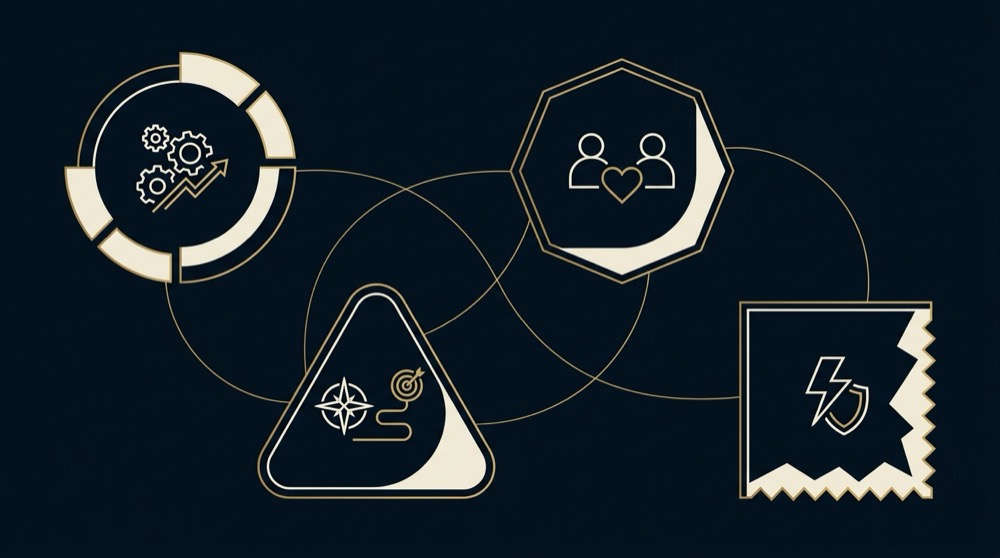
Every automation decision should be evaluated against four factors: task complexity and judgment requirements, customer impact and relationship value, strategic importance and competitive advantage, and error tolerance and recovery cost. These factors interact. A task might score low on complexity but high on customer impact, which changes the decision. The framework requires evaluating all four dimensions, not just checking boxes.
Task complexity and judgment requirements
Task complexity measures how much contextual judgment the work requires. A simple task follows clear rules with predictable inputs and outputs. A complex task requires interpreting ambiguous information, weighing competing priorities, or adapting to novel situations.
Automate simple tasks. Keep complex tasks manual or use automation only as support. The boundary is not about difficulty. It is about whether the task requires judgment calls that depend on context a system cannot access. Scheduling a meeting based on calendar availability is simple. Deciding which meetings matter enough to schedule is complex.

Evaluate judgment requirements by asking whether the task needs information beyond what a system can access. If success requires understanding unstated customer concerns, recognizing patterns across unrelated business areas, or adapting to circumstances that do not fit standard categories, the task requires judgment. Those tasks should stay manual.
Customer impact and relationship value
Customer impact measures how directly the task affects customer experience and relationship strength. High-impact tasks shape how customers perceive your business, whether they trust you, and whether they continue buying from you. Low-impact tasks support operations but do not directly influence customer relationships.
Evaluate customer impact by identifying which tasks customers notice and remember. If a customer would describe the task when explaining why they like or dislike working with you, it has high impact. If the task happens invisibly in your operations, it has low impact. High-impact tasks should stay manual or use hybrid approaches that preserve human elements.
Relationship value adds another dimension. Some customer interactions build relationship capital that pays off over time. Others are transactional exchanges that do not accumulate value. Relationship-building interactions should almost never be fully automated, even when automation is technically possible and more efficient.
Get the Decision Matrix
The decision framework becomes more powerful when you can score and compare tasks systematically. A structured scorecard helps you evaluate automation candidates against all four factors consistently, making it easier to identify clear wins and avoid costly mistakes. Download the automation decision matrix to start evaluating your own business tasks with a repeatable process that documents your reasoning and tracks outcomes over time.
Strategic importance and competitive advantage
Strategic importance measures whether the task contributes to decisions that shape business direction, resource allocation, or competitive positioning. Strategic tasks include market analysis, product direction, partnership evaluation, and resource prioritization. Operational tasks execute decided strategies.
Automate operational tasks that execute strategy. Keep strategic tasks manual. The distinction is not about seniority or job title. It is about whether the task involves choosing direction or following direction. A junior employee making tactical decisions about customer communication is doing strategic work. A senior executive approving automated reports is doing operational work.
Competitive advantage adds specificity. Some tasks create differentiation that customers value and competitors struggle to copy. These tasks should rarely be automated, even when they are operationally simple. If your business competes on personalized service, automating service interactions destroys your advantage. If you compete on creative problem-solving, automating problem-solving destroys your advantage.
Error tolerance and recovery cost
Error tolerance measures how much damage an error causes and how easily you can fix it. High-tolerance tasks allow mistakes that are cheap to correct. Low-tolerance tasks create expensive problems when they go wrong.
Automation increases error frequency in specific ways. Systems make consistent mistakes. They mishandle edge cases. They fail when inputs do not match training data. They cannot recognize when they are wrong. These failure modes matter more for low-tolerance tasks where recovery is expensive or impossible.
Evaluate recovery cost by asking what happens when the task goes wrong. If an error damages a customer relationship, creates legal exposure, or requires extensive manual correction, recovery cost is high. Those tasks need either human execution or hybrid approaches with human oversight at decision points.

The four factors interact. A task might be simple and low-impact but strategically important, which argues against automation. Another task might be complex but high-tolerance, which argues for hybrid automation with human review. Evaluate all four factors together, not in isolation.
Customer-Facing Functions: Where Automation Erodes Value
Customer interactions are the highest-risk category for automation. Research consistently shows that automating customer-facing functions reduces satisfaction by 25 to 40 percent compared to human-handled interactions, according to customer experience studies across industries. This is not a technology problem. It is a judgment problem about which interactions should stay human.
Relationship management and personalized service
Relationship management includes any interaction where the customer expects recognition, continuity, or personalization based on history. Account management, ongoing service relationships, and repeat customer interactions all fall into this category. These interactions build trust and loyalty over time. Automating them converts relationship capital into transactional efficiency.
The damage is subtle at first. Customers do not immediately leave when you automate relationship management. They notice that interactions feel less personal. They sense that context from previous conversations is lost. They stop volunteering information because they are talking to a system, not a person. The relationship weakens gradually until they have no reason to stay when a competitor offers similar service.
Personalized service works the same way. Customers value personalization because it signals that you understand their specific situation and care enough to adapt. Automated personalization, even when technically sophisticated, signals the opposite. It shows that you optimized for scale over individual attention. For small businesses competing against larger companies, this distinction often determines whether you win or lose the customer.
Identify touchpoints where customers expect recognition, continuity, or personalized attention based on relationship history. Account management, ongoing service relationships, complex problem resolution, and any interaction where trust and loyalty accumulate over time will suffer most from automation. These interactions build relationship capital that converts to retention, referrals, and pricing power. Automating them trades long-term competitive advantage for short-term efficiency.
Complex support and problem resolution
Complex support means situations where the customer’s problem does not fit standard categories, where the solution requires judgment about tradeoffs, or where the customer is frustrated and needs empathy more than efficiency. These situations require a person who can understand context, adapt the approach, and make judgment calls.
Automated support works for simple, high-frequency problems with clear solutions. It fails for everything else. The failure is not that the system cannot provide an answer. The failure is that the system cannot recognize when its answer is wrong, cannot adapt when the standard solution does not fit, and cannot provide the emotional acknowledgment that frustrated customers need.
Problem resolution adds another layer. When something goes wrong, customers want assurance that someone understands the problem and will fix it. Automation provides neither. It provides a ticket number and a process. For small businesses, this is often where you lose customers permanently. They came to you because they wanted a relationship with a business that cares. Automated problem resolution proves that you do not.
The 25-40% satisfaction penalty
The satisfaction penalty for automated customer interactions is well-documented. Studies show drops between 25 and 40 percent when businesses automate relationship management, complex support, or personalized service. The penalty is larger for small businesses than for large ones, because small businesses attract customers who specifically want human interaction.
This matters more than it appears. A 30 percent satisfaction drop does not mean you lose 30 percent of customers immediately. It means customer relationships weaken, referrals decrease, price sensitivity increases, and churn accelerates over time. The compounding effect is larger than the initial percentage suggests.
For solo operators and small teams, the calculation is even clearer. You cannot compete on scale, so you compete on relationship quality. Automating customer interactions trades your competitive advantage for operational efficiency. That trade rarely makes sense, even when the efficiency gains look attractive in isolation.
Strategic and Creative Work: The Judgment Gap
Strategic and creative work requires contextual judgment that current automation cannot replicate. This is not a philosophical claim about human uniqueness. It is a practical observation about what automation does well and what it does poorly. Systems excel at pattern matching within defined parameters. They fail at recognizing when parameters should change, when context invalidates patterns, or when novel situations require novel responses.
Why strategic decisions resist automation
Strategic decisions involve choosing between competing priorities with incomplete information and uncertain outcomes. Should you enter a new market? Should you change pricing? Should you partner with this company? These decisions require weighing factors that do not reduce to clear metrics: competitive dynamics, customer psychology, organizational capability, market timing, risk tolerance.
Automation can support strategic decisions by providing data, running scenarios, or highlighting patterns. It cannot make the decisions. The judgment required is not about calculation. It is about interpretation. What does this data mean for our specific situation? Which risks matter most? What are we optimizing for? These questions require context that extends beyond what any system can access.
Research from MIT Sloan Management Review on strategic decision-making shows that automation consistently underperforms human judgment when decisions involve ambiguity, novel situations, or tradeoffs between incommensurable values. The gap is not closing. As automation improves at pattern matching, the remaining work becomes more concentrated in areas requiring judgment.
Creative tasks and brand voice
Creative work includes content strategy, brand voice development, messaging, design direction, and any task where originality or distinctive style matters. Automation can execute creative work once direction is set. It cannot set direction. It cannot recognize when existing patterns should be broken. It cannot develop a distinctive voice that differentiates your business.
The quality degradation is measurable. Automated content sounds generic because it optimizes for patterns in training data, not for distinctiveness. Automated design looks like every other automated design because systems converge on similar solutions. Automated messaging fails to connect because it lacks the specificity and personality that make messages memorable.
For small businesses, this matters strategically. You cannot outspend larger competitors on distribution, so you need to win on message quality and brand distinctiveness. Automating creative work optimizes away the differentiation you need to compete. The efficiency gain is real, but it costs you the thing that makes customers choose you over alternatives. Understanding how to build content systems that preserve your voice while gaining efficiency becomes critical for maintaining competitive advantage.
Crisis response and complex problem-solving
Crisis response requires rapid judgment under uncertainty with high stakes. A customer is angry. A system is failing. A partner relationship is breaking down. These situations need someone who can assess context, adapt approach, and make judgment calls without perfect information.
Automation fails at crisis response because crises are definitionally outside normal parameters. The system was built for normal operations. A crisis is abnormal operations. What you need is someone who can recognize the situation, understand what is at stake, and choose an approach that fits the specific circumstances.
Complex problem-solving works similarly. When a problem does not fit standard categories, when the solution requires combining insights from unrelated domains, or when success depends on recognizing what is different about this situation, you need human judgment. Automation can help by providing information or running scenarios, but it cannot solve the problem.
People Management: The Empathy Requirement
People management includes performance feedback, reviews, sensitive HR communications, conflict resolution, and any interaction where employee trust and motivation depend on feeling understood and valued. These functions require empathy and nuance that automation cannot provide. Automating them damages the relationships that make teams work.
Performance feedback and reviews
Performance feedback works when employees believe the feedback comes from someone who understands their work, recognizes their efforts, and wants them to succeed. Automated feedback, even when accurate, lacks these qualities. It provides data without context, criticism without empathy, and direction without relationship.
The damage is not that employees reject the feedback. The damage is that they stop trusting the process. If feedback is automated, it signals that management does not care enough to pay attention personally. Employees respond by treating feedback as a compliance exercise rather than a development opportunity. Performance conversations become transactional rather than developmental.
Reviews compound the problem. An annual review should synthesize a year of work, recognize growth, address challenges, and set direction. Automation can compile data, but it cannot provide the synthesis and judgment that make reviews valuable. An automated review tells employees that their work matters less than operational efficiency.
Sensitive HR communications
Sensitive communications include anything involving personal circumstances, difficult news, or situations where empathy matters more than efficiency. Discussing performance problems, handling personal leave, addressing conflicts, or delivering bad news all require human judgment about tone, timing, and approach.
Automating these communications is not just ineffective. It is actively harmful. It tells employees that the organization values process over people. It damages trust in ways that extend beyond the specific communication. When employees see that difficult conversations are automated, they conclude that management does not care enough to handle hard situations personally.
The efficiency argument for automating sensitive communications misses the point. These communications are not frequent enough to create significant workload. The time saved is minimal. The relationship damage is substantial. This is one of the clearest cases where automation costs more than it saves, even when you only count measurable outcomes like turnover and engagement.
Trust-building that automation undermines
Trust accumulates through repeated interactions where someone demonstrates competence, reliability, and genuine concern. Management trust builds when employees see that managers pay attention, understand their work, and make fair decisions. Automation interrupts this accumulation.
When management functions are automated, employees stop seeing evidence of attention and understanding. They see systems and processes. The trust that depends on personal relationship cannot form. This matters more for small businesses than large ones, because small businesses depend more heavily on strong relationships to retain talent and maintain culture.
The alternative is not refusing all automation in people management. It is being selective about which functions to automate and which to keep manual. Automate administrative tasks like scheduling, time tracking, and benefits enrollment. Keep manual any function where trust and relationship matter: feedback, reviews, sensitive communications, and decisions that affect people’s work or careers.
Your Competitive Differentiators: The Small Business Exception
Small businesses compete differently than large ones. You cannot win on scale, distribution, or brand recognition. You win on things large competitors cannot easily copy: personalized service, deep expertise, flexible adaptation, relationship quality. These differentiators are often the first things businesses automate when they pursue efficiency. This is a strategic mistake.
Identifying your unique value proposition
Your unique value proposition is not what you do. It is what you do differently or better than alternatives. For most small businesses, the differentiation is not product features or price. It is how you deliver, how you interact, how you adapt to individual customer needs.
Identify your differentiators by asking what customers mention when they explain why they chose you or why they stay. If they mention personal attention, that is a differentiator. If they mention flexibility or customization, that is a differentiator. If they mention expertise or advice, that is a differentiator. These are the functions you should not automate, even when automation would be more efficient.
The test is simple: if automating this function would make you more similar to larger competitors, do not automate it. Your competitive advantage as a small business is being different from large competitors in ways customers value. Automation often erases those differences in pursuit of efficiency that you do not need as much as you need differentiation.
When personalization is your advantage
Personalization means adapting your service, communication, or product to individual customer circumstances. It is expensive. It does not scale well. It is exactly what large competitors struggle to provide. If personalization is why customers choose you, automating it destroys your competitive position.
This does not mean you cannot use automation at all. It means you cannot automate the personalization itself. You can automate data collection, scheduling, or administrative tasks that support personalization. You cannot automate the judgment calls about how to adapt to each customer. Those judgment calls are your competitive advantage.
The automation trap for bootstrapped businesses
Bootstrapped businesses face acute pressure to automate because labor is expensive and time is limited. The temptation is to automate aggressively to reduce costs and free up time for growth. This logic is sound for some functions. It is dangerous for functions that constitute your competitive advantage.
The trap is that automation often looks like the solution to resource constraints. You are stretched thin, so you automate customer service. You need more time for strategy, so you automate relationship management. You want to scale, so you automate personalization. Each decision makes sense in isolation. Together, they erode the differentiation that made customers choose you.
The alternative is selective automation. Automate back-office functions, administrative tasks, and operational work that does not touch customers or shape competitive positioning. Keep manual the functions that customers notice and value. This approach is slower and less efficient in the short term. It preserves your ability to compete in the long term. For solopreneurs, building the right marketing systems means understanding which customer touchpoints to preserve and which to streamline.
The Hybrid Approach: Automation as Support, Not Replacement
The choice is not between full automation and no automation. Hybrid approaches use automation to support human work rather than replace it. These models consistently outperform both full automation and purely manual processes, with research showing 30 percent higher customer satisfaction for hybrid approaches compared to full automation.
Augmentation versus full automation
Augmentation means using automation to handle routine elements while preserving human judgment at decision points. A customer service interaction might use automation to pull customer history and suggest responses, but a person reads the context, adapts the message, and makes the final call. A strategic analysis might use automation to compile data and identify patterns, but a person interprets implications and decides action.
The distinction is where judgment happens. Full automation puts judgment in the system. Augmentation puts judgment in the person and uses the system to provide information and handle routine execution. This structure preserves the benefits of automation, speed and consistency, while avoiding the costs, loss of context and relationship damage.
Implementing augmentation requires designing systems that support human decision-making rather than replacing it. The system should make it easy for the person to access context, see relevant information, and execute decisions quickly. It should not make decisions automatically or push the person toward predetermined responses.
Where hybrid models outperform
Hybrid models work best for tasks with routine elements and judgment elements. Customer service is mostly routine questions with occasional complex situations. Strategic analysis is mostly data compilation with judgment about implications. Content creation is mostly formatting and distribution with judgment about message and voice.
Structure hybrid models by identifying which elements are routine and which require judgment. Automate the routine elements fully. Provide automation support for judgment elements but keep the decision with a person. This structure is more complex than full automation, but it performs better for tasks where context and relationship matter.
Research documented in Gartner studies shows that organizations using hybrid approaches report higher customer satisfaction, better employee engagement, and fewer automation-related problems than organizations using full automation. The performance gap is consistent across industries and company sizes.
The 30% satisfaction advantage
The satisfaction advantage for hybrid approaches is substantial. Studies show 30 percent higher scores compared to full automation, with the gap largest for complex interactions and relationship-based services. The advantage comes from preserving human elements at points where they matter most while gaining efficiency where automation helps.
This advantage translates into business outcomes. Higher satisfaction drives retention, referrals, and pricing power. The operational efficiency of automation remains, but without the relationship damage that full automation creates. For small businesses, this combination is often optimal: you gain efficiency without sacrificing differentiation.
Implementing hybrid approaches requires more design work than full automation. You need to identify decision points, structure information flow, and train people to use automation as support. The additional complexity is worth it for functions where customer impact or strategic importance is high.
Common Automation Mistakes and How to Avoid Them
Automation mistakes follow predictable patterns. Understanding these patterns helps you avoid them in your own decisions. The most common mistakes are automating before standardizing, ignoring customer impact in efficiency calculations, and falling into the sunk cost trap with automation tools.
Automating before standardizing
Automating a messy process creates an automated mess. The system executes the process faster and more consistently, but if the process itself is poorly designed, automation amplifies the problems rather than solving them. This mistake is common because automation seems like an opportunity to fix process problems. It is not. It is an opportunity to execute good processes more efficiently.
Avoid this mistake by standardizing before automating. Document the current process. Identify inefficiencies, unnecessary steps, and decision points. Redesign the process to be simpler and clearer. Test the redesigned process manually. Only then consider automation. This sequence ensures that you are automating a process worth executing, not just executing a bad process faster.
The time investment in standardization pays off twice. First, you often discover that the standardized manual process is good enough, which means you avoid automation costs entirely. Second, when you do automate, the implementation is simpler and more successful because you are automating a clean process.
Ignoring customer impact in efficiency calculations
Efficiency calculations typically measure time saved and cost reduced. They rarely measure relationship damage, satisfaction loss, or strategic opportunity cost. This creates a bias toward automation because the benefits are concrete and measurable while the costs are diffuse and delayed.
Avoid this mistake by explicitly evaluating customer impact before deciding to automate. Ask which customers will notice the change, how they will perceive it, and whether it will strengthen or weaken the relationship. If the answer is that customers will perceive the change negatively, the efficiency gain needs to be large enough to justify the relationship cost.
For most customer-facing functions, the relationship cost exceeds the efficiency gain. Customers notice when interactions become automated. They interpret it as the business caring less about them personally. This perception damages loyalty and increases churn. The efficiency saved is often less than the revenue lost from increased churn.
The sunk cost trap with automation tools
Once you invest in an automation tool, there is pressure to use it fully to justify the investment. This pressure leads to automating functions that should stay manual, simply because the tool makes automation easy. The sunk cost trap turns a tool investment into a strategic mistake.
Avoid this trap by separating tool decisions from automation decisions. Decide what to automate based on the framework in this article. Then choose tools that support those decisions. Do not let tool capabilities drive what you automate. The fact that a tool can automate something does not mean you should automate it.
When you find yourself automating a function primarily because the tool makes it easy, stop and reevaluate. Apply the four-factor framework. If the function scores high on customer impact or strategic importance, keep it manual regardless of how easy automation would be. The tool cost is sunk. Making bad automation decisions to justify that cost only compounds the loss.
Applying the Framework: A Step-by-Step Process
The framework becomes practical when you apply it systematically to your actual business tasks. This process walks through inventory, evaluation, and decision-making in a repeatable way that you can use for any automation candidate.
Inventory and categorize your tasks
Start by listing all tasks that you are considering for automation. Include customer-facing tasks, internal operations, strategic work, and administrative functions. The goal is a complete inventory of automation candidates, not a filtered list of obvious wins.
Categorize each task by type: customer-facing, strategic, operational, administrative, creative, people management. This categorization helps you apply the framework consistently. Customer-facing tasks need special attention to relationship impact. Strategic tasks need evaluation of judgment requirements. Operational tasks are often good automation candidates if they are standardized.
Document who currently performs each task, how much time it takes, and what the output is. This information becomes the baseline for evaluating automation impact. You need to know what you are changing before you can evaluate whether the change makes sense.
Track and score automation candidates against the four-factor framework systematically
Score each factor 1-5, with 5 being highest complexity/impact/importance or lowest tolerance
Score each task against the four factors
Evaluate each task using the four factors: complexity and judgment requirements, customer impact and relationship value, strategic importance and competitive advantage, error tolerance and recovery cost. Use a simple scoring system, one to five for each factor, where higher scores indicate more complexity, more impact, more importance, or less tolerance.
Complexity score: Does the task require contextual judgment, adaptation to novel situations, or interpretation of ambiguous information? High scores mean the task is a poor automation candidate. Low scores mean automation is feasible.
Customer impact score: Will customers notice this task? Does it affect their perception of your business or the strength of your relationship? High scores mean automation risks relationship damage. Low scores mean automation is safer.
Strategic importance score: Does the task contribute to competitive advantage or strategic decisions? Is it part of what differentiates your business? High scores mean automation may erode competitive position. Low scores mean automation is strategically neutral.
Error tolerance score: How much damage does an error cause? How easily can you recover? Low tolerance means high scores and suggests automation needs human oversight. High tolerance means low scores and suggests full automation is acceptable.
Make and document your decision
Use the scores to make a keep-or-automate decision for each task. Tasks with high complexity scores, high customer impact scores, high strategic importance scores, or low error tolerance scores should generally stay manual or use hybrid approaches. Tasks with low scores across all factors are good automation candidates.
Document your decision and rationale for each task. Write down why you decided to automate or keep manual. Include which factors were most important and what tradeoffs you considered. This documentation serves two purposes: it makes your reasoning explicit and reviewable, and it provides context for future decisions about the same tasks.
The decision is not permanent. Business context changes, automation technology improves, and your competitive position evolves. Document when you will review each decision. For strategic tasks and customer-facing functions, review annually. For operational tasks, review when technology or business model changes significantly.
Building Your Automation Strategy
Individual automation decisions add up to an automation strategy. The strategy should be coherent: it should reflect clear principles about what you automate and what you keep manual, with regular review to ensure decisions remain sound as context changes.
Start with clear wins, avoid gray areas
Begin your automation strategy with tasks that score low across all four factors: low complexity, low customer impact, low strategic importance, high error tolerance. These are clear wins where automation provides efficiency without meaningful downside. Administrative tasks, data entry, scheduling, and routine reporting often fall into this category.
Avoid automating gray-area tasks until you have experience with automation in your business. Gray areas are tasks with mixed scores: high complexity but low customer impact, or high customer impact but low complexity. These tasks require careful judgment about tradeoffs. Build your automation capability with clear wins before tackling gray areas.
This sequencing also builds organizational confidence. Early automation successes make it easier to resist pressure to automate everything. You can point to specific wins and explain why you are being selective about additional automation. This is easier than defending a no-automation position.
Review decisions quarterly
Automation decisions should be reviewed regularly, not treated as permanent. Business context changes. Customer expectations shift. Technology improves. Competitive dynamics evolve. A decision that made sense last year may not make sense now.
Quarterly reviews work well for most businesses. Review your automation decisions, check whether the original rationale still holds, and evaluate whether any manual tasks have become good automation candidates or any automated tasks should return to manual execution. The review does not need to be lengthy. It needs to be systematic.
Track outcomes for automated tasks. Measure whether efficiency gains materialized, whether quality remained acceptable, and whether customer satisfaction held steady. Use this data in your quarterly reviews. If an automated task is underperforming, return it to manual execution or implement a hybrid approach.
When to revisit a no-automate decision
Some signals indicate that a previous decision to keep a task manual should be reconsidered. The task becomes more standardized over time, which reduces complexity. Customer expectations change, making automation more acceptable. Technology improves, making hybrid approaches feasible where they were not before. Your competitive advantage shifts, making a previously strategic task less important.
Revisit no-automate decisions when you see these signals, but apply the same framework. Do not automate just because technology improved or the task became easier to automate. Evaluate whether the four factors have changed enough to justify a different decision. In many cases, the answer will still be to keep the task manual.
The goal is not maximum automation. The goal is optimal automation: automating what should be automated while preserving human execution where it creates more value. This requires ongoing judgment, regular review, and willingness to reverse decisions when context changes. Build these practices into your automation strategy from the start.
There is no universal percentage. The right automation level depends on your business model, competitive advantage, and customer expectations. Most small businesses should automate 30-50% of tasks, focusing on back-office operations, administrative work, and standardized processes while keeping customer-facing functions, strategic decisions, and competitive differentiators manual. The key is selective automation based on task complexity, customer impact, strategic importance, and error tolerance rather than pursuing maximum automation.
A task is too complex to automate when it requires contextual judgment, adaptation to novel situations, or interpretation of ambiguous information. Ask whether success depends on understanding unstated concerns, recognizing patterns across unrelated domains, or adapting to circumstances that do not fit standard categories. If the task needs information beyond what a system can access or requires judgment calls that depend on context, it should stay manual or use a hybrid approach with human oversight at decision points.
Partial automation is possible without major satisfaction loss, but full automation typically reduces satisfaction by 25-40%. The key is using hybrid approaches: automate routine inquiries and information retrieval while keeping complex problems, relationship management, and personalized service manual. Customers accept automation for simple, transactional interactions but expect human attention for anything involving judgment, empathy, or relationship continuity. Small businesses should be especially cautious, as personalized service is often a primary competitive advantage.
The framework in this article provides clear criteria for making those choices. Apply it systematically, document your decisions, and review them regularly as context changes. The goal is not maximum automation. The goal is optimal automation that preserves value while gaining efficiency where it actually helps.
References
Want this kind of work done for your business?
We build and run AI-powered marketing and automation. 15 minutes, honest assessment.
Book a call