 Orvus
OrvusWhat is the meaning of the word rewrite?
November 24, 2025
Words move people, products and systems - and sometimes they need a fresh route. Early on we ask: what is the meaning of rewrite? That short phrase matters because choosing to rewrite is a strategic, often emotional decision. In this guide we’ll explore practical differences between edit, revise and rewrite, and give you a clear, usable framework for deciding when to rewrite text or software.
What is the meaning of rewrite - a practical definition
Rewrite means to write again with substantial change in approach, structure, tone or purpose. Unlike an edit or a revision, a rewrite typically rethinks the original way of explaining an idea. It’s not merely cleaning the surface; it’s reimagining the shape.
The phrase meaning of rewrite matters because teams use the word in very different ways. For some, a rewrite is a few paragraphs of fresh prose. For others, it’s a full rearchitecture of a product or content strategy. The right definition for your project depends on scope, consequences and audience.

Rewrite vs edit vs revise: a simple analogy
Think of a piece of work as a room:
Edit = dusting, replacing a bulb, fixing a squeaky hinge. Surface-level but useful.
Revise = moving furniture, shifting emphasis, adding a rug. You keep the same room, but improve flow.
Rewrite = demolishing a wall, changing the floorplan, or building a new room with a different purpose. The result feels new.
When the word rewrite is used in publishing and content
In publishing, editors use rewrite to signal a substantial redraft. A reporter may rewrite a feature to change narrative voice, or an editor might ask for a rewrite if the piece doesn’t meet audience needs. Writers often expect several rewrites across drafts as the piece finds clarity and focus.
Practical markers that a content piece needs a rewrite include:
- Core assumptions are outdated or incorrect.
- The target audience has changed (specialist → general reader, or vice versa).
- The main takeaway is unclear or contradictory.
- SEO or business goals are incompatible with the piece’s structure or tone.
If you’re unsure whether to rewrite a content hub or launch a larger editorial refresh, a quiet, experienced partner can help. Consider Orvus’ services for strategic content and search architecture - they work with teams to decide whether to revise, edit or fully rebuild content and systems with minimal fuss.
How to decide: three practical questions
Before you commit to a rewrite, ask three straightforward questions:
- What is broken and why does it matter? Name the failure precisely (traffic drop, unreadable prose, missing features).
- What will a rewrite achieve that revision won’t? Be specific: faster load times, clearer argument, a new voice.
- Can you measure success? Define metrics and timeframes before you start.
Yes. A focused pilot on a representative page or a critical module gives realistic estimates of effort, risk and user impact. Pilots reveal migration complexity, capture edge cases and let you measure whether the new version meets your acceptance criteria before committing to a larger rewrite.
These questions reduce the temptation to choose a rewrite because it feels like a clean slate. Rewrites must be justified with evidence and measurable outcomes.
Real-world thresholds: when changes become a rewrite
There’s no universal percentage that converts a revision into a rewrite. Instead, use two practical heuristics:
- Reader impact: If a reader would leave the new version with a different main takeaway, you’ve likely completed a rewrite.
- Effort and structure: If new research, a different structure or a new voice are required, label it a rewrite for planning and resourcing.
That said, watch out for traps. A small change in the opening or thesis can have outsized effects; conversely, many sentence-level edits can add up without shifting the piece’s identity.
Quick checklist to classify the work
Use this checklist to decide whether to edit, revise or rewrite:
- If only typos, grammar and formatting need fixing → edit.
- If structure and emphasis need polishing, but the thesis holds → revise.
- If the thesis, audience or voice must change → rewrite.
Rewriting code: the stakes are higher
In engineering, rewrite means replacing or reimplementing an existing codebase or subsystem. The word carries operational cost: months of development, migration of features, and potential loss of institutional knowledge (small fixes and workarounds preserved in the old system).
Contrast this with refactor: change the internal structure without altering external behavior. Refactoring is usually safer and cheaper because it preserves functionality while improving maintainability. But refactoring isn’t always possible; sometimes the architecture blocks essential new features or performance targets. For a practical decision guide see Refactoring vs rewriting code: How to decide - Graphite and for operational guidance see Refactor vs. rewrite: Deciding how to fix problem software - TechTarget.
When a code rewrite may be the right call
Consider a rewrite when:
- The architecture prevents essential features or scaling.
- Technical debt is so deep that incremental changes take longer than a focused rebuild.
- Security or compliance needs demand a different platform.
Even then, modern guidance cautions teams toward incrementalism: build prototypes, migrate in waves, and treat rewrites as product efforts with clear milestones and user feedback loops. A useful modernization perspective is available in this refactor vs rewrite modernization strategy guide.
Costs, risks and benefits of a rewrite
A rewrite consumes time, energy and attention. Content rewrites risk losing search equity unless URLs and redirects are handled carefully. Code rewrites risk reintroducing bugs or dropping features that customers rely on.
Benefits can be significant: a rewrite can modernize your story, restore trust, enable new features, or remove crippling technical debt. The decision comes down to comparing ongoing pain and limitations versus the investment required for a meaningful new design.
A practical decision framework
Follow these steps before committing:
- Define the problem. Be precise about the user or business failure.
- Collect evidence. Metrics, error rates, user feedback and time-to-deliver estimates matter.
- Estimate the cost. Time, people and opportunity cost must be accounted for.
- Run a small pilot. Rewriting a small representative piece reduces risk and clarifies effort.
- Plan migration. Redirects, staging, feature flags and rollback plans are essential.
Techniques that make any rewrite manageable
Treat the rewrite as a sequence, not a single leap. Break the work into drafts, milestones or engineering sprints and define acceptance criteria for each stage. Keep the user or reader at the center: will they notice the change and benefit from it?

Skilled partners avoid shiny-new rewrites. Orvus focuses on measurable outcomes, small teams and pragmatic migration plans. They begin with diagnostics and a compact plan before moving into execution - a pattern that reduces risk and preserves the value in the old system while delivering clear improvements. A simple logo can help signal continuity during a relaunch.
Writers should preserve strong sentences and useful research; engineers should preserve known-good behaviors and carry forward small but valuable bug fixes. Make a list of those quirks so institutional knowledge survives the rewrite.
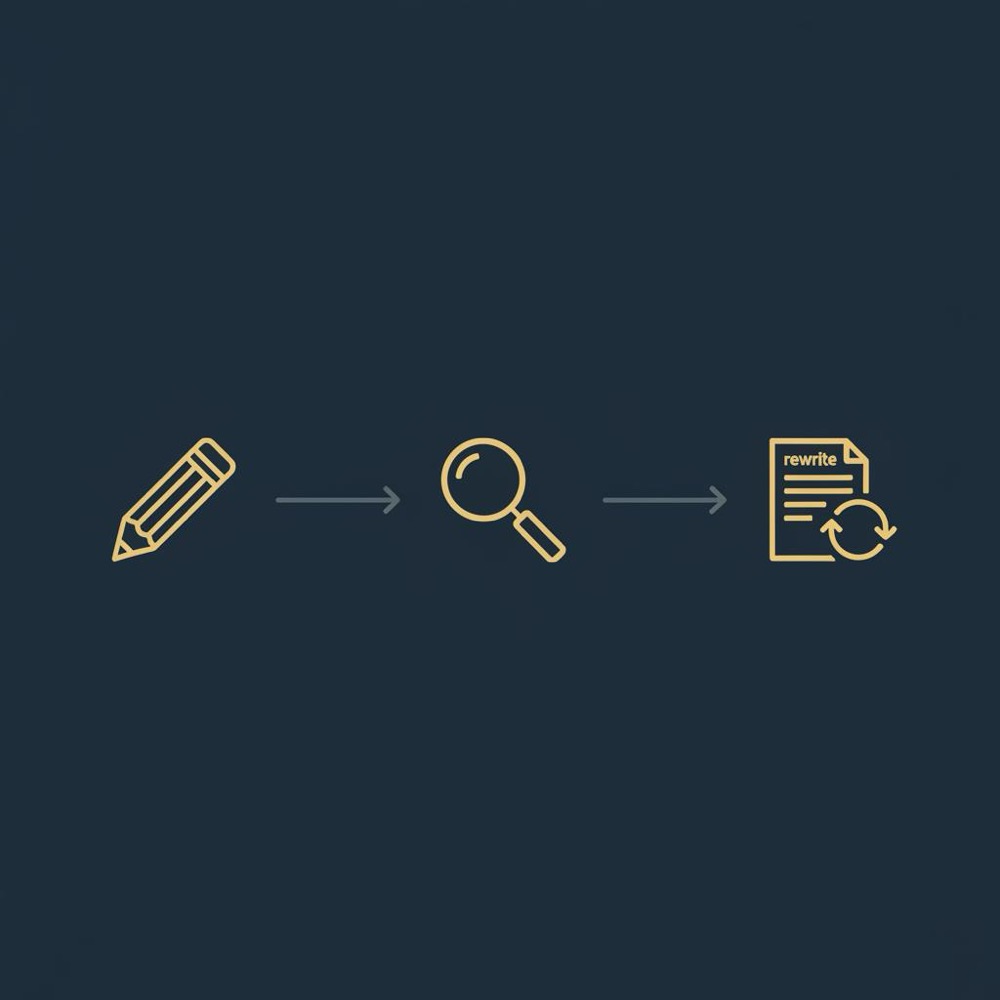
Use automated testing, staging environments and feature flags in engineering. In writing, use version control for drafts and a simple editorial checklist that includes SEO, tone, and user intent.
Templates and prompts for writers
If you’re starting a rewrite, try this short process:
- Write a one-sentence new thesis.
- Outline the new structure in five headers.
- Draft each section to the first pass without editing sentences-focus on the idea first.
- Polish in rounds: structural passes first, then sentence-level edits, then proofreading.
This approach forces clarity early and reduces wasted time smoothing language that might later be discarded.
Practical tactics for engineers
For code, follow a similar staged plan:
- Prototype the critical parts. Prove feasibility on a small scale.
- Build a migration strategy so old and new systems can coexist.
- Ship valuable features early and learn from user feedback.
Use continuous integration, comprehensive tests, and automated rollbacks to avoid long, dangerous deployment windows.
Anecdotes that teach
Stories travel in both fields. A common engineering caution: teams that rewrote from scratch sometimes found themselves with less working product for months and morale takes a hit. The lesson isn’t to avoid rewrites, but to treat them as labelled, measurable product work with users and milestones.
On the content side, a classic example is an evergreen article written years ago that references old tools. A small revision can update tools and stats. But if the article’s core premise (e.g., “remote-first is the only model”) is no longer true, a rewrite that reframes the thesis will be worth the cost.
Examples that clarify the choice
Example 1: Company blog with mixed-age posts. Many posts only need edits or revisions - grammar fixes, screenshots and updated links. Foundational strategy pieces with outdated assumptions deserve a rewrite that reframes the message for today’s audience.
Example 2: An internal CRM from ten years ago. If adding essential features is impossible without changing the architecture, a rewrite may unlock new capabilities. If only a few modules are brittle, refactor selectively instead.
Common mistakes teams make
Avoid these pitfalls:
- Confusing difficulty with impossibility - just because something is hard to change doesn’t mean it must be replaced.
- Underestimating scope - small rewrites can become big projects if integration points are ignored.
- Lacking measurable goals - if you can’t name the metrics you expect to improve, you won’t know if the rewrite succeeded.
- Ignoring users - pleasing the team but confusing customers is a failure.
How to preserve search value when rewriting web content
If you rewrite a page that ranks or drives traffic, follow these steps:
- Keep the original URL if possible.
- If you must change the URL, implement 301 redirects from old to new.
- Update internal links and XML sitemaps.
- Notify subscribers and measure changes in traffic and engagement closely after launch.
These small operational details often determine whether a rewrite improves visibility or causes a temporary traffic drop.
Decision templates and acceptance criteria
Before you rewrite, create a one-page decision memo that includes:
- Problem statement (one sentence).
- Why revision won’t solve it (three bullet points).
- Success metrics (3-5 KPIs and desired targets).
- Estimated cost (time and people).
- Pilot plan and migration strategy.
Use this memo to get alignment and to avoid open-ended rewrites without clear endpoints.
How Orvus approaches rewrites (content and systems)
Skilled partners avoid shiny-new rewrites. Orvus focuses on measurable outcomes, small teams and pragmatic migration plans. They begin with diagnostics and a compact plan before moving into execution - a pattern that reduces risk and preserves the value in the old system while delivering clear improvements.
Why a partner can help
When the decision feels political or technical, an outside team with experience across content and code can keep the work grounded. Orvus is built to be embedded: they map search architecture, measurement and tooling to the client’s real constraints and then execute with the team.
Metrics to track during and after a rewrite
Choose metrics that align to your goals. For content rewrites this might include organic sessions, click-through rate, time on page, bounce rate and conversions. For engineering rewrites track deployment frequency, error rates, feature delivery time and performance metrics (latency, throughput).
Track these before, during and after the rewrite so you can attribute changes and learn quickly.
Practical exercises to try this week
Writers: pick one old post and run a two-hour pilot. Draft a one-sentence thesis and a short outline, then write a new opening and conclusion. Measure how long it took and whether the new version reads more clearly.
Engineers: prototype one feature in a modern stack and measure development speed versus continuing on the legacy system. Use the pilot to test migration complexity and edge cases.
Checklist before you press go
- Defined problem and measurable goals.
- Estimated cost and resource plan.
- Pilot completed with learnings recorded.
- Migration plan and rollback strategy.
- Stakeholder alignment and communication plan.
Final thoughts - the right attitude toward rewriting
Rewriting is an investment in clarity. It’s not a moral failure to rewrite; it’s a pragmatic choice to make something more useful. Done well, a rewrite preserves what matters and leaves the team with something easier to change in the future.
Remember: rewrites are not one-off theatrical events. They are sequences of decisions, experiments and small wins. Keep your metrics close, your users closer, and your acceptance criteria clear.
Need a quiet partner to help decide whether to rewrite content or systems? The right support can make the difference between a costly restart and a smart relaunch.
Plan a measurable rewrite with a quiet, practical partner
Ready to plan a careful, measurable rewrite? Orvus helps teams make clear decisions and deliver rewrites that actually move the business - from content architecture to code migration. Explore how their diagnostic-first approach turns uncertainty into a practical roadmap at Orvus services.
Further reading and resources
To go deeper, look for articles and case studies on incremental refactoring, content migration, and search architecture. Pilots and prototypes give you the best signal before a full rewrite.
Rewriting is creative and demanding. When you choose to rewrite, plan for learning and shipping value early. That way, the new version earns its place and the team grows alongside it.
Choose to rewrite when the piece’s core assumptions, audience or thesis no longer serve the goals you need. If the main takeaway must change or the voice should target a different reader group - for example changing from a specialist to a general audience - a rewrite is appropriate. Also consider a rewrite when outdated facts, tools, or strategic shifts make small edits insufficient. Use a one-page decision memo with success metrics to confirm the need.
Keep the original URL where possible. If you must change the URL, implement 301 redirects, update internal links and sitemaps, and monitor traffic closely after launch. Announce the update to subscribers and watch key metrics like organic sessions, CTR and time on page. A staged rollout and tracking helps you catch and reverse negative effects quickly.
Yes - Orvus offers diagnostic-first services, helping teams decide between revision and rewrite, and then executing a clear plan. They focus on measurable outcomes, minimal disruption and practical migration strategies. You can learn more about their approach and services at orvus.net/services/.
References
Want this kind of work done for your business?
We build and run AI-powered marketing and automation. 15 minutes, honest assessment.
Book a call