 Orvus
OrvusWhat is a 3 month SEO plan?
November 25, 2025
What is a 3 month SEO plan? - Quick definition and why it matters
A 3 month SEO plan is a focused, measurable sprint that lays the groundwork for long-term organic growth. In twelve weeks you prioritize the highest-impact technical fixes, clean up content that confuses search engines, publish a short list of intent-driven pages, and set up clear measurement so every change is visible. A 3 month SEO plan is not a promise to outrank everyone overnight; it is a practical way to remove barriers, create momentum, and prove that SEO investment is working.
Think of a 3 month SEO plan like fixing a house: you inspect the foundation, repair what’s broken, clear out the clutter, then dress the rooms people use most. Do that well and visitors stay longer, trust your pages more, and you begin to build the kind of steady traffic that compounds. For more on the team behind these sprints see our about page.
Orvus Services is an example of a partner who runs compact 12-week programs that focus on architecture, measurement, and content-helpful if you want an embedded team to move quickly without the noise of long proposals.
Below is a practical 12-week roadmap, checklists, measurement templates and real-world tips so you can run a 3 month SEO plan for a small business, a mid-size brand, or a client. For more resources see our blog.
A well-run 3 month SEO plan can produce tangible, measurable results-especially for sites with technical debt or thin content-by prioritising fixes that improve crawlability and user experience, publishing a handful of high-intent pages, and setting up measurement that shows progress. Larger ranking wins still take more time, but the 12-week sprint creates the foundation for sustained growth.
Why a 3 month SEO plan? The thinking behind a time-boxed sprint
SEO is a long game by nature, but that makes three months a useful time-box: it forces prioritization and delivery. A 3 month SEO plan helps you pick the high-leverage problems-technical blockers, thin content, slow pages-and fix them in a way that’s measurable. Rather than diffuse, ongoing work, a 12-week sprint gives you a sequence: audit, remediate, create, measure.
Who benefits most from a 3 month SEO plan?
Small businesses, regional retailers, or sites that haven’t had regular technical care are ideal candidates. So are teams that need a clear handover to longer engagements. Even competitive sites can use a 3 month SEO plan to create a focused baseline before investing in ongoing content scale and outreach.

How the 12-week structure works (overview)
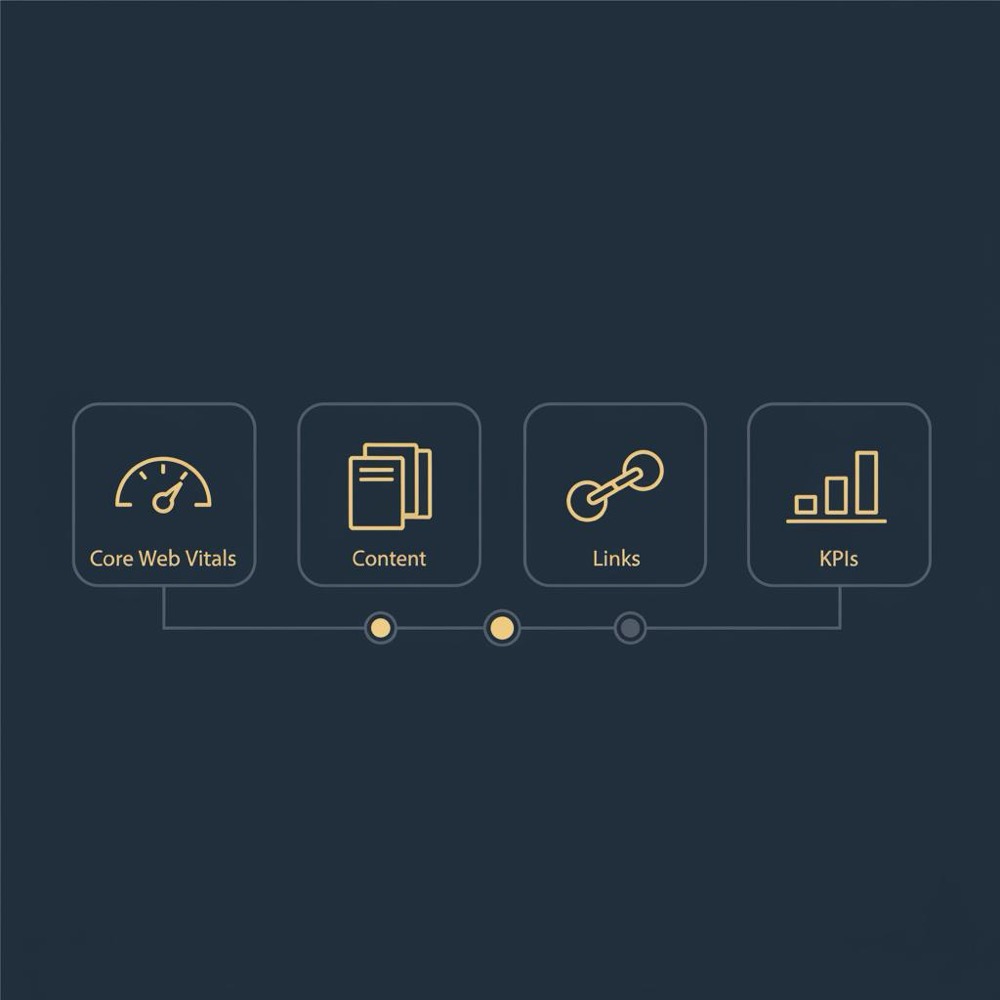
A practical 3 month SEO plan focuses on five core activities: a comprehensive audit and benchmark, technical fixes that improve crawlability and speed, URL-level content and canonical work, intent-driven content creation, and an initial outreach push for links. Alongside those tasks you must set up reporting (at least GA4 and Search Console) so every action can be measured against baseline KPIs.
Weeks 1-2: Audit, benchmarking and KPI setting
The first two weeks are all about learning the site and agreeing what success looks like. Run a full content inventory and a site crawl. Check the backlink profile. Pull Core Web Vitals data and verify analytics are accurate. If GA4 is missing, install it and confirm conversion events before you change anything.
Must-have deliverables for weeks 1-2:
- Content inventory with keep/consolidate/remove decisions
- Site crawl report highlighting indexation, redirect chains and duplicate titles
- Backlink snapshot (referring domains and flagged toxic links)
- Core Web Vitals baseline by priority template
- Clean GA4 + initial KPI dashboard
Set KPIs that map to business outcomes: organic sessions, impressions, a handful of priority keywords, CTR, conversions (leads or sales), pages indexed and Core Web Vitals. Keep KPIs simple so the 3 month SEO plan remains focused.
Weeks 3-6: Technical remediation and on-page fixes
Now that you know the anatomy of the site, spend the next four weeks fixing the issues that most directly hurt crawlability and user experience. This is the backbone of any good 3 month SEO plan.
Key technical priorities
Hosting and server: slow servers or misconfigured CDNs are a common drag. Consider moving to better hosting or tuning server settings for priority templates.
Core Web Vitals: bring LCP under ~2.5s, CLS close to 0.1, and INP under ~200ms on your most important pages. Practical moves include deferring non-critical JS, switching images to modern formats, and lazy-loading below-the-fold resources.
Indexing and canonicalization: ensure priority pages are indexable, canonical tags point correctly, and noindex tags or robots rules aren’t blocking important pages.
Redirects and broken links: remove redirect chains and fix broken links-these reduce crawl budget waste and improve user journeys.
On-page and URL work
For the pages you want to move, make sure each has a clear intent and a single canonical. Update meta titles and descriptions to reflect user intent and include your target phrase where natural. Remove thin or duplicated pages, and where consolidation is needed, implement 301 redirects and merge content sensibly.
Weeks 6-10: Intent-driven content and initial outreach
With the technical foundation repaired, the next phase focuses on content that matches search intent. The goal in this 3 month SEO plan is to publish 6-12 high-quality pages that are designed to capture relevant search traffic and support conversions.
Content selection and quality
Pick topics aligned to buyer journeys and keywords you can realistically rank for, given the site’s current authority. Each piece should be structured with clear headings, scannable paragraphs, useful internal links, and a clear next step for the user.
Quality thresholds: a significant page answers a user’s question thoroughly, has unique value, and includes internal links and CTAs. One high-quality guide can outperform five thin pages-prioritize depth and utility.
Internal linking strategy
Use internal linking to funnel authority from higher-traffic pages to deeper pages you want to lift. Create sensible hub pages where appropriate and avoid over-optimizing anchor text. Internal links are a free, high-impact lever in any 3 month SEO plan.
Realistic outreach
Link building in the first three months should be modest and targeted. Re-engage existing contacts, offer genuinely useful resources, and aim for a few high-quality mentions rather than dozens of low-quality placements. Track referring domains as a KPI so you can show progress.
Weeks 10-12: Measurement, small tests and next roadmap
The final three weeks are about measurement and learning. Compare the current metrics to the baselines captured in week one and build a clear report that maps actions to outcomes.
What to measure: crawlability improvements, pages indexed, Core Web Vitals progress, impressions, organic sessions, CTRs, conversions, and movements for priority keywords.
Run small A/B or content tests to improve CTR and conversions-two headline variants or alternative meta descriptions on priority pages are simple, low-risk tests that often yield actionable insights.
Expected short-term outcomes: what’s realistic in 90 days?
For under-optimized sites, a 3 month SEO plan often yields measurable improvements: better crawl rates, Core Web Vitals moving into target ranges, and organic sessions increasing by a modest but meaningful amount. A common early improvement range for such sites is 10-30% growth in organic sessions across three months.
Remember: ranking for highly competitive keywords often needs more than three months. Use the 12-week plan to clear obstacles, build a set of useful content, and create measurement that guides the next phase.
KPIs and how to track them
Keep KPIs focused and trackable. Use GA4 for sessions and conversions and Google Search Console for impressions, average positions and CTR. For technical diagnostics, use a crawler (Screaming Frog, Sitebulb or similar) and Core Web Vitals reports from CrUX and Lighthouse.
Make a small dashboard that displays: organic sessions, impressions, top 5 keyword positions for priority terms, CTR, conversions, pages indexed and Core Web Vitals for priority templates.
Resourcing: how much time and who does what
Typical resourcing for a small-business 3 month SEO plan ranges from 40 to 120 hours spread over 12 weeks. Roles you’ll need include:
- Project lead / SEO specialist to run the audit and manage tasks
- Developer to implement technical fixes
- Content writer to create priority pages
- Outreach/contact manager to pursue link opportunities and partnerships
For small teams, roles often overlap-keep decisions fast and approvals minimal to maintain momentum.
Sample weekly deliverables for a 12-week sprint
A sample schedule helps set expectations. Deliverables you can point to include:
- Weeks 1-2: content inventory, crawl report, Core Web Vitals baseline, GA4 setup
- Weeks 3-6: server and asset fixes, resolved redirect chains, canonical fixes, meta updates
- Weeks 6-10: 6-12 finished content pieces, internal links implemented, small outreach log
- Weeks 10-12: performance report comparing baseline KPIs to current metrics, A/B test results, roadmap for next 90 days
Minimum content production targets and quality thresholds
During the content phase aim for one to two significant pages per week. A significant page should:
- Answer a real user question
- Be structured and scannable with clear headings
- Contain internal links and a relevant CTA
- Offer unique value not already available on the site
Quality beats quantity: one well-researched article can beat several thin pages.
Practical link and outreach advice
In the first three months, focus on relevance over volume. Reach out to partners, suppliers, or customers and offer a resource they would find naturally useful. Guest posts can work, but the emphasis should be on usefulness rather than link-stuffing. Track referring domains and prioritise authority.
Common risks and how to manage them
Common risks in a 3 month SEO plan include inaccurate analytics, slow developer response, CMS constraints and unrealistic expectations for link growth. Mitigate these by:
- Ensuring GA4 is installed and events are tested early
- Documenting CMS workarounds and a timeline for permanent fixes
- Setting client expectations about measured link growth
- Logging scope creep items for the next roadmap
Communication template for agencies
Clear, concise communication matters. At kickoff share a one-page plan with weekly deliverables and what you need from the client. Send short weekly updates that list completed items, current metrics vs baseline, and the three priorities for the coming week. End the engagement with a concise report and a recommended roadmap for months four through six.
Tools you actually need

You don’t need every tool on the market. The essentials for a 3 month SEO plan are Google Search Console, GA4, a site crawler (Screaming Frog or Sitebulb), and Core Web Vitals data from CrUX or PageSpeed reports. Use Lighthouse or WebPageTest for deeper performance diagnostics as needed. For comprehensive audit checklists see Backlinko’s 18-step SEO audit, Analytify’s WordPress SEO audit checklist, or Wonkrew’s website audit checklist. A clear visual identity like the Orvus Ltd. logo helps readers remember a brand.
A real example (brief case study)
A regional retailer ran a 12-week plan focused on fixing a misconfigured CDN and consolidating thin product pages. They published four buying guides that matched search queries. By week eight their Core Web Vitals improved and organic sessions rose ~20%, with a noticeable lift in phone leads. The 3 month SEO plan provided momentum and a clear roadmap for the next quarter.
When to go beyond 3 months
Large sites, international targets, and highly competitive niches require longer engagements. Use the 3 month SEO plan as a diagnostic and momentum phase. Months four through six are ideal for scaling content, deepening outreach, and running more complex UX experiments.
Quick checklist to start a 3 month SEO plan
Begin with these steps:
- Run a content inventory and site crawl
- Verify GA4 and set conversion events
- Fix critical technical items that block crawling and speed
- Publish intent-driven content (6-12 pieces over weeks 6-10)
- Measure everything and build the next roadmap
Templates and practical snippets
Use these short templates during a 3 month SEO plan:
Weekly update template: Completed: [items]. KPIs: sessions/impressions/top keyword positions. Next week: [top 3 priorities]. Needs from client: [access/approvals].
Content brief template: Target keyword & intent, target URL, primary heading, 3 subheadings, internal links, CTA, references.
Simple A/B tests to try in weeks 10-12
Try two headline variants on a landing page, or two meta description variants across a handful of pages. Small tests often reveal big CTR differences and are easy to implement and measure with Search Console and GA4.
Checklist of do’s and don’ts for a 3 month SEO plan
Do: prioritize technical blockers, keep content useful, measure before and after, and set simple KPIs. Don’t: chase vanity metrics, publish thin content for volume, or overload the scope mid-sprint.
Closing practical advice
Run the 3 month SEO plan as a disciplined sprint. Keep deliverables visible, measure early changes, and use what you learn to shape the next 90 days. Small wins compound-the goal of this sprint is to clear obstacles, publish practical content, and build a measurement system that makes future investment obvious.
Get a focused 12-week SEO sprint with clear deliverables
Ready to move faster? If you want hands-on support to run a 3 month SEO plan with clear deliverables and an embedded team approach, learn more about how Orvus helps brands with compact growth sprints at Orvus Services.
Short farewell: This guide equips you to start a focused, measurable 3 month SEO plan-fix the basics, publish high-value content, and measure carefully. Good luck, and may your next quarter be the one where small wins add up.
The first two weeks should focus on audit and benchmarking: a content inventory with keep/consolidate/remove decisions, a full site crawl to detect indexation and redirect issues, a backlink snapshot, a Core Web Vitals baseline, and a verified GA4 setup with initial KPIs. These artifacts give you the baselines you need to measure impact across the rest of the 3 month SEO plan.
Aim for 6-12 significant content pieces during the content phase (weeks 6-10)-about one to two high-quality pages per week. Each piece should answer real user intent, include internal links and a clear CTA, and offer unique value. Quality is more important than quantity: one well-researched guide can outperform many thin pages.
Yes. Orvus Ltd. specialises in compact, practical growth sprints that combine technical SEO, content architecture and measurement. If you prefer an embedded partner who focuses on high-leverage fixes and clear deliverables, Orvus Services offers tailored 12-week programs that can accelerate progress and create a roadmap for longer-term growth.
References
Want this kind of work done for your business?
We build and run AI-powered marketing and automation. 15 minutes, honest assessment.
Book a call