 Orvus
OrvusHow to optimise a website for voice search?
January 31, 2026
The emphasis here is pragmatic and operator focused. You will get a technical checklist, content templates for question and answer pairs, schema guidance, local optimisation checks, and a compact measurement approach that relies on Search Console, analytics, and controlled testing. The goal is to reduce friction and create repeatable workflows that fit your constraints.
What voice search is and why it matters
Voice search is a conversational query modality where users speak questions or commands instead of typing short keywords. In practice, these queries often read like natural questions and the answers that engines choose are short, direct, and spoken back to the user, so content architecture should prioritise clear question and answer formats and eligibility for spoken responses, and that is central to any voice search SEO approach.
Usage scenarios differ from traditional typed search. People use smart speakers at home, voice on mobile when they are on the move, and assistants inside apps or cars, which means the context for queries is often immediate and task oriented. Industry adoption data shows continued growth in voice assistant usage and strong local intent for many queries, which changes prioritisation for businesses with physical locations Voice Assistant Consumer Adoption and Trends 2024.
Identify pages that match question and answer patterns
Run this across top landing pages first
From a systems perspective, optimising for voice is not a separate project but an architecture decision. You want content that is discoverable by crawlers, short answer blocks that can be extracted, and local signals where relevant. Search engine guidance also highlights that speakable and other structured data can help engines find answerable content, so structure and markup belong in the checklist for site readiness Speakable structured data.
Voice eligibility is about being a reliable source for concise answers, not about guaranteeing a spoken placement. Engines often surface spoken answers from featured snippets or clearly structured content, so your work focuses on making content eligible rather than promising selection Featured snippets.
How voice queries differ from typed searches
Voice queries are longer and more conversational. Instead of isolated keywords, users ask full questions like "where can I get same day tyre fitting near me". This shape should change keyword research towards natural language and question formats, which helps content match the way queries are spoken.

Query intent also shifts. Voice queries are more often local, immediate, and task oriented. People ask for directions, opening hours, or quick steps to complete a task, and that increases the importance of local signals and concise answers for many businesses. BrightLocal's survey material highlights the prominence of local intent in voice behaviour, which should influence prioritisation for local businesses Local Consumer Review Survey 2024.
For practical research, treat voice search keywords as question based long tail targets. Use content templates that start with the question as a heading followed immediately by a short answer, then expand with supporting detail below. That pattern improves extractability and aligns with conversational search optimization practices.
Technical foundation for voice eligibility
Mobile-first indexing is a prerequisite. A page must render and index correctly on mobile to be considered for spoken answers, so confirm that your mobile rendering matches desktop output and that key answer blocks are visible to crawlers.
Book a consultation to map voice eligibility and priorities
Run a quick mobile render and indexing check in Search Console, then measure Core Web Vitals for the pages you expect assistants to use.
Page speed and perceived latency matter for voice eligibility. Voice responses favour concise answers from pages that load reliably on mobile devices, so addressing Core Web Vitals and reducing time to interactive helps make content usable for assistants Core Web Vitals.
Check crawlability and canonicalisation. Verify robots.txt, ensure canonical tags are correct, and confirm that pages render critical answer blocks when crawled. Use live URL inspection in Search Console to confirm indexing and rendering behaviour. If a page is blocked from indexing or its answer is hidden behind scripts that fail to render, it will be ineligible.
Testing steps are straightforward. Use Search Console's URL inspection to confirm index status, run a mobile user agent render, and review the rendered HTML for the answer block. If the answer is not present in the rendered HTML, engines cannot extract it reliably for spoken responses.
Content architecture for voice: answer-first writing and FAQs
Write answer-first. Put the concise answer directly after a clear question heading so engines and assistants can extract a short spoken reply. A strong pattern is heading as the question, one or two sentence answer, then a short supporting paragraph or list. That structure aligns with how featured snippets and short answers are selected Featured snippets.
Use FAQPage or QAPage schema to mark Q and A pairs where appropriate. Schema.org's FAQPage is a practical way to make Q and A content machine readable and complements clear on-page headings and answers FAQPage schema.
Keep spoken answers concise. For voice, aim for a single sentence or two that directly answers the question, then follow with supporting details. Use simple language and avoid packing the short answer with caveats. Where a brief step list helps, use bullets because list formatting is easier for assistants to interpret and for users to scan.
Organise content so question and answer pairs are discoverable and measurable. Group related Q and A pairs on a single resource when it makes sense, or surface single question pages for high intent queries. Ensure each page has a clear primary question near the top so analytics and Search Console landing page data can map behaviour back to your content architecture.
Local optimisation for voice queries
Local signals matter more in voice than in many typed queries. When users speak a local query, assistants often default to map results or a short spoken answer that uses local business data, so prioritise Google Business Profile accuracy, consistent NAP, and local schema for listings.

Simple checks include verifying business name, address, phone, hours, and categories in the Google Business Profile. Ensure citations across directories are consistent and that review signals are collected and managed, since review presence influences local eligibility and user trust.
On the site, add local schema and clear contact or location pages. Make the address and opening times machine readable and visible without requiring interaction. For mobile users who follow a voice answer to your site, a fast, clear mobile UX that shows directions and contact actions is crucial Core Web Vitals.
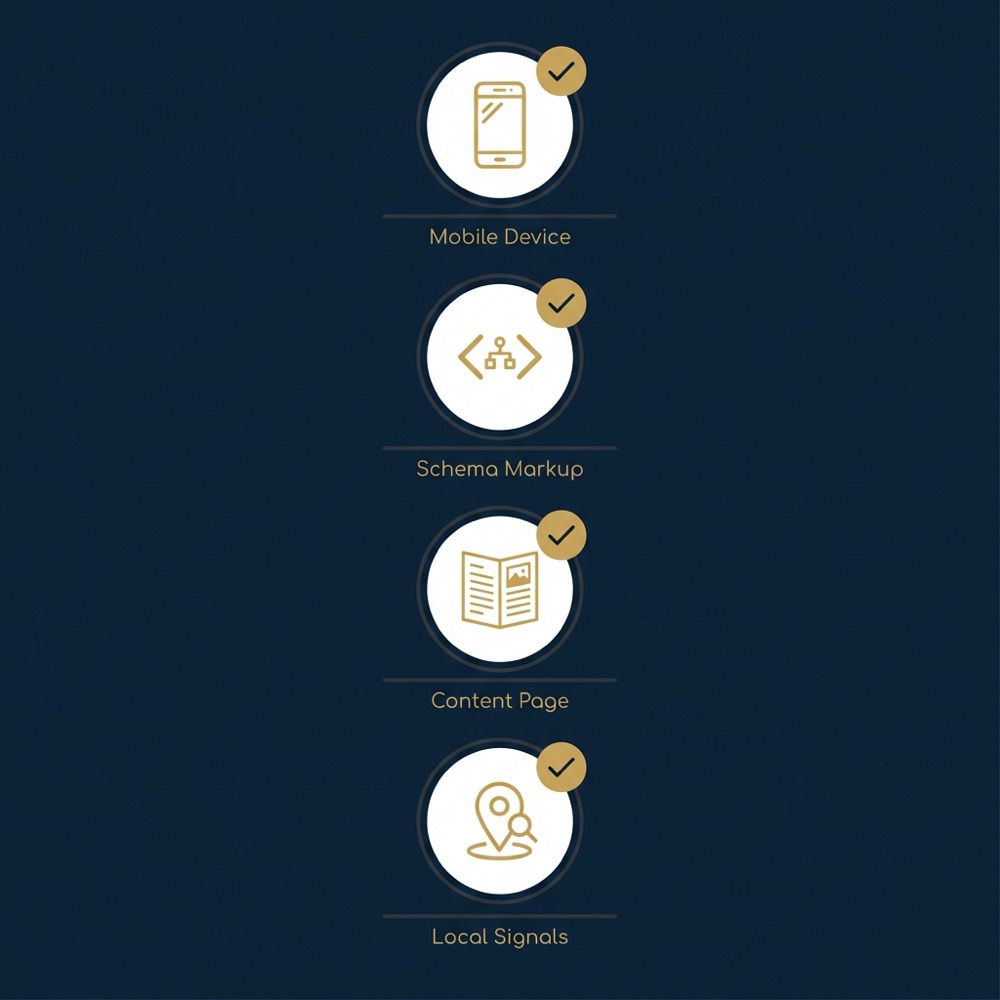
Monitor local behaviour and ranks for "near me" queries and other local patterns. Use landing page filters and location dimension reports to infer where voice and local traffic overlap, then prioritise improvements where you see the most local demand.
Structured data and speakable markup: what to use and how
Speakable markup is useful for clearly identified sections of content that can be read aloud by an assistant, but it is most appropriate where short answerable sections exist and match the documented guidance from search engines. Implement speakable where the content is naturally read as a short spoken answer and test carefully to avoid overuse Speakable structured data.
Decide between FAQPage and QAPage based on content intent. FAQPage works well for collections of short question and answer pairs intended for users, while QAPage is better for user generated Q and A structures. Both are schema.org types and act as practical signals to help engines identify machine readable Q and A content FAQPage schema.
Validate structured data with the Rich Results Test and the Search Console reports for enhancements. After implementation, watch the enhancements report for errors or warnings and run the Rich Results Test on representative pages to confirm markup is syntactically correct and present in the rendered HTML.
Measuring voice performance and testing approaches
Direct voice traffic is rarely explicit in analytics, so use inference. Search Console query reports, landing page filters, and a focus on queries that look like questions or contain local signals can help you identify pages that are likely used for voice answers. Track changes in featured snippet presence as one proxy for voice eligibility Featured snippets.
Run controlled content experiments. Create a few pages optimised for question formats and concise answers, publish, and monitor query and landing page changes over several weeks. Compare pages that use FAQ schema and speakable markup to similar pages without markup to see if there is a measurable difference in snippet or query behaviour.
Confirm the page renders and indexes correctly on mobile, and that a concise answer is present in the rendered HTML near a clear question heading.
Expect opaque answer selection. Search engines do not publish exact weights for markup or content forms, so iterative testing and observation is necessary. Keep records of experiments, snippets gained or lost, and any changes in related query impressions to inform further work Voice Assistant Consumer Adoption and Trends 2024.
Common mistakes and pitfalls to avoid
One common error is focusing on keywords rather than conversational intent. Targeting isolated keywords can miss the phrasing users actually speak, so shift research toward question based long tail targets and natural language variations that match user queries.
Neglecting technical readiness is another frequent pitfall. Pages that fail mobile rendering or load slowly will not be reliable sources for voice answers, so run Core Web Vitals checks and fix blocking issues before investing heavily in content changes Core Web Vitals.
Incorrect or overused structured data can cause problems. Don’t mark up content that is hidden to users, and avoid adding speakable or FAQ markup where the answers are not concise or not meant to be read aloud. Validate markup and correct errors reported in Search Console to prevent noisy implementations FAQPage schema.
Practical mini-audit and implementation checklist
Quick crawl and index checks. Use Search Console URL inspection to confirm the page is indexed and to view the rendered HTML. Check robots.txt and ensure canonical tags point to the correct canonical version of each question page.
Content edits for conversational queries. Identify high value pages, add a clear question heading, place a concise one sentence answer immediately after it, and expand with supporting details below. Consider adding FAQPage markup where multiple related Q and A pairs belong together.
Local and structured data verification. Confirm Google Business Profile fields, NAP consistency across citations, and implement local schema on contact pages. Validate any FAQ or speakable markup with the Rich Results Test before deploying across many pages Speakable structured data.
Prioritise fixes by impact. Start with pages that already receive impressions for question style queries or have snippet presence, then address technical blockers like mobile rendering or Core Web Vitals. Track changes in query impressions and landing pages after each set of edits.

Next steps and prioritisation for teams
Begin with the technical blockers that prevent a page from being indexed and rendered on mobile, then move to content edits that create clear question and answer structures, and finally add local signals and schema where relevant. This order tends to give clearer returns on effort because eligibility must come before optimisation.
When constraints are complex, run a compact diagnostic to map bottlenecks and prioritise a 30 to 90 day plan. For repeatable tasks, consider small automations or tooling to scale testing and monitoring, which reduces recurring operational work and improves decision making clarity.
Keep spoken answers to one sentence or two, giving a direct response then offering details further down the page.
No. Structured data helps signal answerable content but does not guarantee selection; it should be combined with clear answer formatting and technical readiness.
Start with pages that already attract question style queries or have snippet presence, and fix any mobile rendering or speed issues first.
When constraints require it, consider a compact diagnostic or small automation to scale testing and monitoring. That approach aligns with systems design and helps teams focus on the highest leverage changes over time.
References
Want this kind of work done for your business?
We build and run AI-powered marketing and automation. 15 minutes, honest assessment.
Book a call