 Orvus
OrvusWhat is my SERP rank? A guide to measuring and monitoring
January 29, 2026
The approach here is pragmatic. Use Google Search Console for aggregated trends, a rank tracker for repeatable local snapshots, and manual checks to confirm SERP features and UX. The goal is not to chase a number but to find signal you can act on within your constraints.
Quick answer: what does a serp ranking mean?
A serp ranking is the position a specific URL appears on a search engine results page for a given query, a definition explained in Google's overview of how search works How Search Works. For operators this is a contextual label, not an absolute performance measure. The number tells you where a URL was placed in one sample or an aggregate set, but it does not capture who saw the result or which SERP features were present.

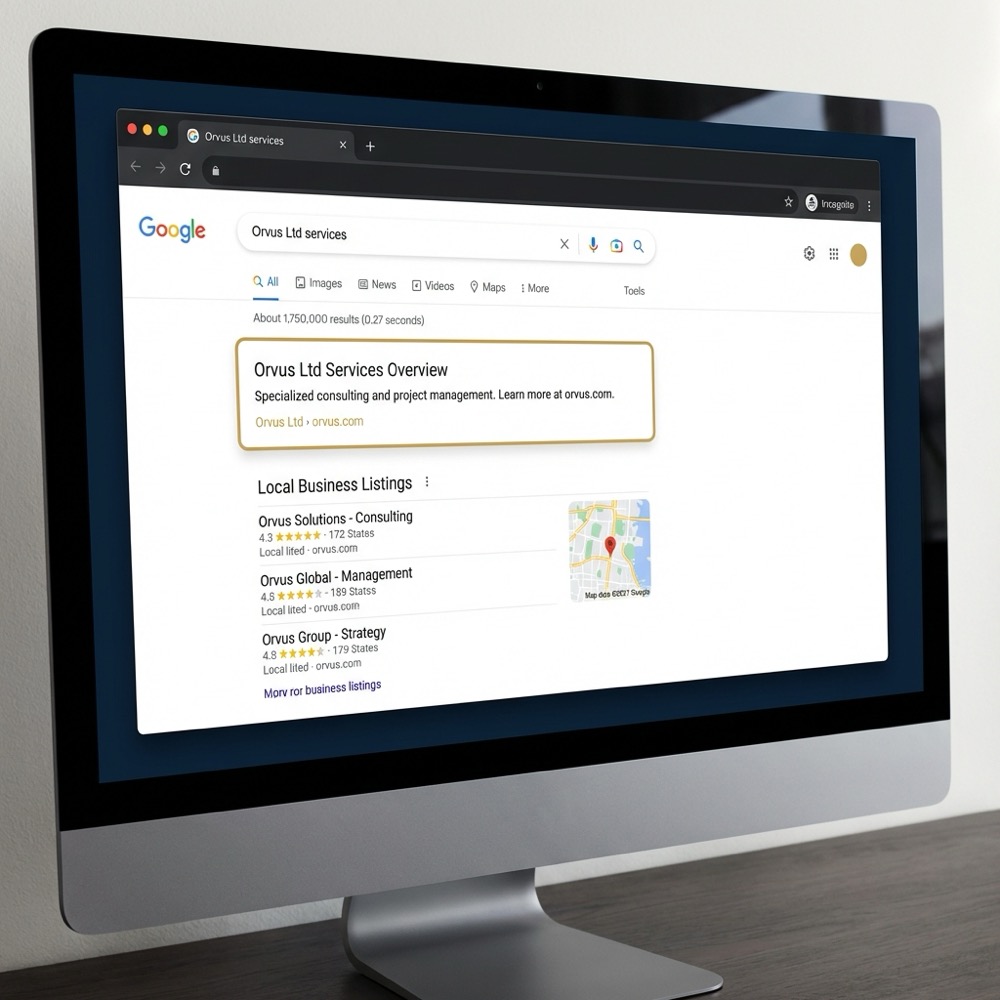
A numeric rank can be useful when you need a quick check of visibility for a specific query or when comparing controlled snapshots. It is often the first signal operators request when investigating traffic drops or testing metadata changes. Use the number as an indicator, then follow with broader checks that measure clicks and conversions.
Why a numeric position is not the whole story for serp ranking
Observed positions vary by personalization, location, and device, so a single number can be misleading; Google describes how query results depend on context and user signals About the Performance report. A result that appears high in one place may be lower or absent in another place or device. Treat live samples as contextual snapshots. See an explainer of average position for more detail Average Position.
Beyond user context, SERP features change how much attention organic links receive. Elements like featured snippets, local packs, shopping panels and knowledge panels take visible space and can reduce clicks to standard links. This reweights the practical value of a numeric position and means that high rank does not always equal high organic traffic.
How Google Search Console reports position data for serp ranking
Google Search Console's Performance report shows an average "position" across the impressions captured by the selected filters, which is useful for trend detection and query grouping About the Performance report. That average is calculated across many impressions and contexts, not as a single live snapshot of a single user query. For a technical definition of impressions and position see Google's guidance What are impressions, position, and clicks? and metric references such as GSC Position metric.
quick controlled-check steps to reduce personalization when validating position
Use these steps for one-off validations alongside a tracker
Use the Performance report to spot direction and to compare query clusters or pages over time. For example, filter by page and a small set of queries, then watch position trends alongside clicks and impressions. This helps connect visibility shifts to actual traffic changes and supports prioritisation.
Limitations are practical: the position metric aggregates across locations, devices, and personalization, so it can hide localised drops or gains. When a narrow localised problem appears, GSC will show the aggregate effect but not necessarily the exact place where a ranking regression started.
Manual checks: when to do live queries and how to control noise
Manual Google searches are valuable for spot checks and to see SERP features as a real user would, but they are noisy and biased by personalization and local signals; guides on manual checking recommend controlled settings for more reliable results How to Check Your Google Ranking: 7 Ways to See Where You Rank. Avoid treating one browser query as definitive.
Practical steps reduce noise. Use a private or incognito window, set an explicit location when available, and test on the target device type. Repeat the check from a second controlled environment if the result will change an operational decision.
Manual checks answer UX and feature-presence questions more directly than aggregated metrics. They show whether a featured snippet, knowledge panel, or shopping carousel is visible and how the page appears to a real user in a specific location and device.

Third-party rank trackers: what they provide and their limits for serp ranking
Rank trackers automate scheduled checks, collect historical trendlines, and provide localised SERP snapshots for chosen locations and device types, which helps when you need consistent sampling over time How to Check Your Google Rankings (7 Ways). They are designed to be repeatable and scalable for monitoring many queries.
A SERP rank is the position a URL appears for a specific query; use it as one signal within a three-source monitoring approach combining Google Search Console, a rank tracker, and controlled manual checks.
Trackers use sampling methods that differ from Google Search Console. That methodological difference explains why tracker positions and GSC averages often diverge: one is a sampled snapshot under controlled conditions, the other is an aggregated metric across real impressions and users. Use trackers to detect localized regressions and to provide a stable alarm system.
Choose trackers with location and device granularity that match your audience. Their value is operational: they reduce manual work, expose local patterns, and enable scheduled reports and alerts aligned to your cadence.
How SERP features change the value of a position in your serp ranking
Primary SERP features that alter real estate on the page include featured snippets, knowledge panels, shopping panels, and the local pack; these features can capture large attention and reduce clicks to the classic blue links according to CTR studies and search behaviour analysis Google Organic CTR Study. The presence of those features makes a numeric rank only part of the story.
There are cases where a lower numeric position can perform better than a higher one. For example, if a shopping panel dominates a product query, the first organic link may receive fewer clicks than a second position on a different query without shopping features. Always check feature presence when interpreting rank changes.
Include feature checks in diagnostics. Note whether a snippet or local pack appears, and then measure clicks and conversions rather than relying solely on position to inform prioritisation.
A practical monitoring framework for serp ranking
Combine three sources: Google Search Console for authoritative aggregated signals, a rank tracker for consistent sampling and localisation, and periodic manual checks for UX and feature presence; GSC is useful for trends while trackers and manual checks provide snapshots and context About the Performance report. For additional reading and practical examples see our blog Orvus blog.
Request a consultation to streamline monitoring
Use a three-source approach: watch GSC for trends, run scheduled tracker snapshots, and do controlled manual checks to confirm feature presence and UX.
Suggested cadence: run daily or every-other-day tracker checks for high-priority queries, review GSC weekly to spot direction and query clusters, and perform monthly controlled manual checks for the most important pages. Adjust frequency to match team bandwidth and business rhythm. Learn more about Orvus Ltd. on the about page Orvus about.
Prioritise pages by traffic and conversion impact rather than chasing numeric position alone. Focus limited resource on pages where a change in visibility has a measurable business effect, and document the action you will take when an alert triggers.
Setting up a rank-tracking system: locations, devices, and filters
Select locations and device mix that reflect your real audience. Map tracking locations to reporting segments so that insights roll up cleanly into your dashboards and decision cycles Rank Tracking: How to Monitor Your Search Rankings.
Adopt consistent naming and reporting conventions for queries, pages, and segments. Consistent labels make trend comparison reliable and support creative testing across content and paid funnels.
Match tracker cadence to resource constraints. If daily checks are not sustainable, a focused weekly snapshot for priority queries retains signal while reducing noise and operational cost.
Interpreting differences: reconciling GSC averages with tracker positions
Common causes of divergence include sampling windows, location choices, device mix, personalization, and aggregation methods, all of which change how position is reported or observed About the Performance report. Recognise that each source answers a different question.
Use a simple heuristic. Trust GSC for aggregate trends, query clusters, and to tie visibility to clicks and impressions. Treat tracker snapshots as diagnostic signals for local regressions or campaign checks that may warrant immediate investigation.
Document the differences and keep a single source of truth for attribution decisions. When a divergence affects an important metric, run controlled manual checks to confirm the presence of SERP features and local effects before escalating.
Decision criteria: when to prioritise fixes, testing, or monitoring for serp ranking
Prioritise pages by traffic and conversion value before committing time to rank-focused work. Use GSC to identify pages where position movement coincides with drops in clicks or impressions About the Performance report. This keeps effort aligned to impact.
When intent is unclear, run content and metadata tests to clarify user intent and measure the change in clicks. If indexing, coverage, or crawl issues appear, treat those as technical fixes with higher priority because they block visibility improvements.
Document hypotheses and measurement approach for every test. Position data can be noisy, so a clear hypothesis and measurement window reduce false positives and support better decisions.
Common mistakes teams make when tracking serp ranking
One common mistake is over-reliance on a single metric. Teams often treat a single GSC average or one tracker snapshot as definitive without context, which can misdirect effort How to Check Your Google Rankings (7 Ways).
Ignoring SERP features and localisation is another frequent error. If the page competes in queries dominated by shopping panels or local packs, failing to measure feature presence will hide the real reason traffic changed. Ensure feature checks are part of your workflow.
Inconsistent naming, reporting, and cadence undermines trend analysis. Establish conventions and stick to them so that historical comparisons are meaningful and tests are repeatable.
Practical examples: two short scenarios applying the serp ranking framework
Scenario A: an ecommerce product appears to rank well by tracker snapshots but traffic is weak. Start by reviewing GSC to confirm whether impressions and clicks track with the reported positions; then run a controlled manual check to see if a shopping panel or product carousel dominates the SERP Google Organic CTR Study. If features are the issue, the right actions include improving product feed visibility or testing alternative queries rather than chasing a higher blue-link rank.

Scenario B: a local service shows a sudden tracker drop in one city. Validate with location-filtered GSC data and run a manual query from that city or a controlled simulation to confirm the local pack or map markers changed About the Performance report. If localisation is the root cause, focus on local signals and citations rather than broad site-wide content changes.
Both scenarios end the same way: prioritise the page by conversion impact, document the hypothesis, and choose the smallest test or fix that answers the diagnostic question.
Summary and practical next steps for monitoring serp ranking
Three steps to start: review GSC trends to spot meaningful movement, run scheduled tracker snapshots for locality and device checks, and perform controlled manual checks to confirm SERP features and UX About the Performance report.
Consider systems-level work when recurring blindspots appear: revisit content architecture, measurement design, or automation that reduces manual checking. Systems work is appropriate when the same patterns repeat and operational friction prevents reliable monitoring.
Decisions should depend on funnel, data quality, and team constraints. Use the three-source monitoring approach as a baseline and adapt cadence and scope to what your team can sustain.
A SERP rank is the position a specific URL appears on a search engine results page for a given query. It is a snapshot and can vary by location, device, and personalization.
Use both: trust Google Search Console for aggregate trends and clicks, and rely on a rank tracker for consistent localized snapshots and alerts. Reconcile differences with controlled manual checks.
Match cadence to priority: daily or every-other-day for critical queries via trackers, weekly reviews in GSC for trends, and monthly manual checks for UX and feature presence.
If your team needs a compact diagnostic or help designing a monitoring cadence that fits constraints, a short systems review can clarify the highest leverage next steps.
References
Want this kind of work done for your business?
We build and run AI-powered marketing and automation. 15 minutes, honest assessment.
Book a call