 Orvus
OrvusWhat are SEO marketing examples?
November 25, 2025
SEO examples are more than lists of tactics - they're the small, observable changes you can make to help real people find your content and take action. This guide collects practical, human-focused SEO examples that you can test and measure, from on-page copy to technical fixes, local signals to e-commerce rules and video metadata. Read on for ready-to-run mini-projects, measurement plans, and governance tips for 2024-2025.
Why practical SEO examples matter now
Search engines are getting smarter; people are getting busier. The best SEO examples combine clear intent alignment, honest information and a fast, reliable experience. That three-part mix (intent, usefulness, performance) is what turns impressions into clicks and clicks into conversions.
How this guide is built
This article groups SEO examples into actionable sections: on-page, technical, content, local, e-commerce, link building and video. Each section includes mini experiments you can run in a week and the metrics to watch. Where appropriate, practical notes explain how to test and which small changes are likely to move the needle first (see real-world case studies at AIOSEO).
Ready to run a focused SEO test?
Get help running your first test: If you want a practical partner who helps run focused experiments and ties search to revenue, consider working with Orvus' practical SEO services to design a 30-90 day test plan that fits your constraints and goals.
Below you'll find direct examples and step-by-step mini-projects. Each is written with a busy operator in mind - nothing theoretical, all of it doable with modest effort.
On-page SEO examples: write for intent and real clicks

On-page changes are often the fastest way to test improvements. Here are plain, testable SEO examples for copy and structure that produce noticeable CTR and engagement gains.

1. Title and meta: promise, clarity, and specificity
A classic quick win: rewrite title tags and meta descriptions to answer the searcher's expected question. Instead of a generic "Salad Bar," try a focused title like "Healthy Lunch Near Me - Fresh Salad Bowls in [Town]." Test two versions across a batch of category pages for four weeks and compare click-through rate (CTR).
2. Headings that map intent
Use semantic headings (H1 = main topic, H2 = subtopics, H3 = supporting details) so both humans and machines see the page's structure. An e-commerce product page example: H1 = product name; H2 = "Who it's for"; H2 = "Key benefits"; H3s under each benefit for features. This helps skimming readers and improves query matching.
3. Internal linking as signposts
Internal links are low-friction ways to move relevance and help discovery. Use descriptive anchor text - e.g., link to your buying guide with "how to pick running shoes for flat feet" rather than "click here." For a quick experiment, add three contextual internal links from your top-10 pages to product or pillar pages and watch pages-per-session and conversion events.
Run an A/B of two title templates across a set of category pages: one emphasizing urgency (e.g., "Limited-time - Buy X") and one emphasizing clarity (e.g., "Buy X - Key Benefits & Shipping"). Measure CTR, sessions, and conversions over four weeks; the results reveal whether copy or other factors are the primary limiter for clicks.
Technical SEO examples: make crawling and experience smooth
Technical health is the scaffolding that allows content to perform. Here are technical SEO examples that focus on crawlability, canonical handling and perceived speed.
1. Crawlability and clear architecture
Organize important pages so they're reachable in a few clicks from the homepage. If your site has deep nested categories, create bridging pages or hub pages that collect and surface important content - this reduces orphan pages and helps new content get indexed faster.
2. Canonicals and parameter handling
When filters or variants produce near-duplicate URLs, decide which URL you want indexed and use canonical tags deliberately. Alternatively, use noindex for parameterized views that have no unique value. A practical test: pick a filtered category that creates many URLs, canonicalize to the clean category page, and monitor index coverage and impressions over four weeks.
3. Core Web Vitals and perceived speed
Improving page speed often starts with images: serve modern formats (WebP or AVIF), compress assets and set explicit image dimensions to prevent layout shifts. Reducing third-party scripts and deferring non-critical JS also helps. Run a controlled image-compression test on 50 pages to watch LCP and engagement metrics change.
Content SEO examples: clusters, pillars and human editing
Content that reliably attracts organic traffic often follows a cluster model: a long-form pillar page that answers a broad question and multiple supporting pages that dive into subtopics. Here are content-first SEO examples to apply this approach (see replicable strategies at Rebus Advertising).
1. Build a pillar and cluster network
Create a long-form pillar that broadly answers a key query and link out to specific cluster pages that explore sub-questions. Example: a pillar on "home coffee roasting" with clusters for equipment, roast profiles, and a shopping guide. Test results by measuring organic sessions to the pillar and the referral flow from cluster pages (see our useful knowledge blog for similar examples).
2. Refresh cadence and editorial reviews
Set a realistic update cadence: monthly for seasonal content, six to twelve months for evergreen pillars. For a quick win, pick a high-traffic pillar and add an FAQ section and a short video transcript. Promote the update through email or social and watch organic sessions and dwell time.
3. AI-assisted drafts with human oversight
Use AI tools for outlines and first drafts, but always put a human editor in the loop. Practical governance includes editorial style guides, fact verification, and a policy that every AI draft receives a human rewrite before publish. Run an A/B test: AI-assisted + human edit versus fully human piece to see differences in engagement.
Local SEO examples for small businesses in 2025
Local search still drives foot traffic. The following local SEO examples help small businesses be both visible and trustworthy in local packs.
1. Optimize Google Business Profile thoroughly
Fill every applicable field, add authentic photos, update opening hours and list products/services. For service-area businesses, use the service-area setting instead of creating multiple addresses. Track calls and direction requests as primary KPIs.
2. Citation consistency
Ensure NAP (name, address, phone) is identical across directories. Inaccurate citations create friction for both search engines and customers. A simple audit of top 20 citations and a correction plan can materially improve local visibility.
3. Reviews as ongoing workflow
Reply to reviews - thank happy customers and acknowledge concerns in negative reviews with an offer to resolve. This builds trust and signals activity to local ranking systems. For a fast test, prioritize responses for one week and track any changes in calls or direction requests.
For practical help applying these local SEO examples, teams often find it useful to work with a focused partner. Orvus' SEO services specialize in compact diagnostics and test-driven plans that fit real operational constraints, helping businesses turn small local wins into measurable results.
E-commerce SEO examples and checklist
E-commerce sites bring scale and complexity: many SKUs, variants, and faceted filters. These SEO examples address common e-commerce pitfalls.
1. Unique, benefit-focused product content
Each product page should have a clear title, benefit-led description, structured data (price, availability, reviews) and user Q&A where possible. Consolidate thin or duplicate descriptions into one richer version and use schema to make attributes explicit.
2. Faceted navigation rules
If filter combinations generate low-value pages, prevent them from being indexed. Use canonical tags to prefer primary category pages, add noindex where appropriate, and configure URL parameters in search console for cleaner crawling. A targeted test: pick ten filter-created URLs and apply canonical tags to see index coverage changes.
3. Pagination and discovery
Ensure important content is reachable through primary category pages. If pages are only discoverable through deep paginated lists, consider creating hub pages that aggregate or summarize key items so they can be crawled and indexed easily.
Link building examples: relevance and story over volume
Links that move the needle are about relevance and narrative. Here are outreach and content examples for modern link building (see practical case studies at Search Logistics).
1. Localized, data-driven digital PR
Create a timely, local data angle and send it to a handful of relevant outlets. One focused pitch to municipal or industry blogs can produce a few high-relevance links that drive targeted referral traffic.
2. Build resource pages people cite
Develop genuinely useful reference pages - lists, calculators, or research - that naturally earn links. Promote them through targeted outreach, not mass email blasts. The goal is relevance, not volume.
3. Relationship-based outreach
Pick a small list of sites with shared audiences and invest time in personalized outreach. Explain why your content benefits their readers rather than why they should link to you. That honesty often wins more placements.
Video SEO examples: make your content searchable and shareable
Video now appears across search results and often drives high-engagement visits. These SEO examples focus on metadata, transcripts and distribution.
1. Metadata and chapters
Write intent-matching titles and concise descriptions. Use chapters so viewers can jump to the part they need - this improves watch time and viewer satisfaction. Include a short, keyword-aware transcript for crawlability.
2. Embed and repurpose
Embed videos in related articles and use transcripts as the basis for a blog post or FAQ. Short clips for social channels can drive views back to the full video on your site or YouTube channel.
3. Structured data for videos
Add videoObject schema where appropriate to increase the chance of rich results. Even small videos (product demos, unboxings, testimonials) can produce strong engagement increases when embedded on product or pillar pages.
KPIs and measurement: what to watch and how to interpret it
Pick KPIs that match your goal. Commonly useful metrics include organic sessions, CTR, assisted conversions, revenue per organic session, Core Web Vitals and index coverage. For local businesses, add calls and direction requests from Google Business Profile.
Attribution realities in 2025
Privacy changes mean some conversion paths will be incomplete. Use server logs, CRM events and assisted-conversion models to triangulate impact. Controlled experiments and change logs become more valuable when direct attribution is noisy.
Operational trends 2024-2025: governance, experience and measurement
Three operational realities shape modern SEO work: AI governance, user experience, and creative measurement. Here are practical rules you can apply today.
1. AI in the workflow - governed, not replaced
Use AI for speed (outlines, drafts), but enforce editorial checks: source verification, named human inputs, and a final human rewrite before publishing. A simple governance checklist prevents factual errors and keeps tone natural.
2. UX as credibility
Fast pages and stable layouts build trust. Core Web Vitals are a proxy for perceived quality - invest in faster assets and remove or defer non-critical scripts.
3. Measurement that tolerates uncertainty
Combine multiple data sources and run experiments. A/B tests on title templates or meta descriptions, controlled content experiments across clusters and small technical tests (image compression on a subset) all teach you what works under current constraints.
How to run small tests that teach you something
Testing should be focused. Pick one signal, change it, and measure. Document the hypothesis, change, measurement window and metrics. Here are quick test ideas:
Title template A vs B on 20 category pages - measure CTR over four weeks.
Compress images on 50 pages - watch LCP and bounce rate.
Publish one AI-assisted + human-edited article and one fully human article on similar topics - compare time on page and conversions.
Common pitfalls and how to avoid them
Watch for thin, duplicate content; unmanaged AI drafts; and chasing rankings without intent alignment. The fixes are straightforward: consolidate or canonicalize thin pages, add editorial checkpoints, and tune content to user intent rather than ranking position.
Practical mini-projects to try this week
Pick one or two of these miniature projects to run in the next seven days. Each maps to specific metrics so you can learn quickly.
Rewrite title and meta for a high-traffic category - measure CTR.
Audit ten filter-created URLs and canonicalize preferred pages - watch index coverage.
Update a pillar page with an FAQ and transcript - promote via email and track sessions.
Add transcripts to a recent video and embed it on a related article - watch time on page.
Update Google Business Profile with service details and three fresh photos - track calls and directions.
Final practical checklist
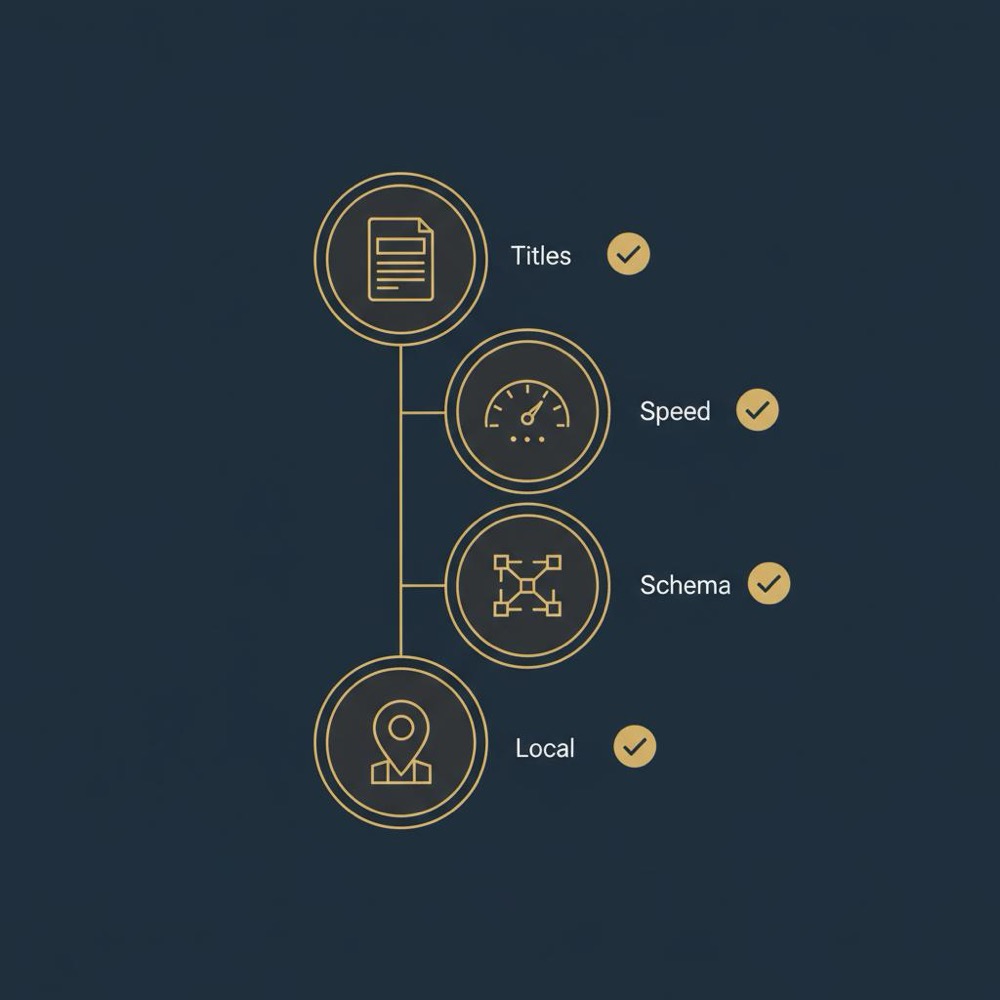
Use this checklist to prioritize work: (1) Fix crawl errors and canonical issues; (2) Improve titles/meta and H tags for intent; (3) Compress images and set sizes; (4) Build or refresh a pillar page with clusters; (5) Start one local review workflow; (6) Run one focused link outreach with a relevant story.
Why steady, human-centred work wins
SEO is a continuous conversation: it rewards steady improvements that help real people. The best SEO examples from this guide are small, measurable and grounded in actual user needs - not hacks. Over time, those small wins compound into sustainable traffic and revenue improvements.
One last thought
Start with what helps a real person today. Run a tiny experiment, measure honestly, and repeat. To learn more about the people behind these approaches, learn about our team.
Start small: rewrite title tags and meta descriptions for a high-traffic category to improve CTR; compress images on a subset of pages to improve Core Web Vitals; or add an FAQ and transcript to a pillar page and promote it. Each of these can be measured in a few weeks using CTR, LCP and organic sessions as KPIs.
Focus on a complete Google Business Profile, consistent NAP citations across directories, and a review management routine. Add local FAQ landing pages for common queries and use structured data for local businesses. Track calls and direction requests along with organic traffic to see the impact.
Yes - Orvus specializes in compact diagnostics and test-driven plans that match your constraints. They focus on architecture, measurement and small experiments that deliver measurable wins. If you want help designing and running a focused test plan, Orvus' services are a practical option.
References
Want this kind of work done for your business?
We build and run AI-powered marketing and automation. 15 minutes, honest assessment.
Book a call