 Orvus
OrvusHow much does it cost to hire an SEO agency?
December 10, 2025
How to read this guide
If you’re asking how much does it cost to hire an SEO agency, you’re in the right place. This guide explains seo agency pricing in simple terms, shows realistic price ranges, and gives practical steps so you can choose an option that fits your goals and budget. Expect clear comparisons, concrete examples, and questions you should ask before signing.

Understanding the basics: what drives seo agency pricing
seo agency pricing changes because every website and market is different. Some of the key factors that shape costs are:
- Technical health: slow pages, broken links, or messy redirects mean more technical work up front.
- Content needs: if you have thousands of thin pages or no target content, content production is a major piece of the bill.
- Backlink work: earned links require outreach and relationship building - time-intensive and ongoing.
- Market competitiveness: local search is usually cheaper than national or category-defining keywords.
- Team and expertise: an agency with senior strategists, developers, and writers costs more than a solo freelancer, but brings scale and process.
These forces are why two quotes can look very different even when both say “SEO.” The trick is matching scope to the results that matter.
Common pricing models you’ll see
Understanding pricing models helps you compare offers fairly. Here are the usual ones:
Monthly retainer
The most common model is a monthly retainer. Agencies provide a set of services each month for a fixed fee. Typical ranges in 2024-25 are roughly $500-$5,000 for small to medium businesses, with many practical engagements in the $1,000-$5,000 band. Enterprise and highly competitive verticals often pay $10,000+ per month. Retainers are useful when you want steady progress: technical fixes, content cadence, outreach, and reporting. They give you predictability and the ability to plan medium-term tests.
Project-based pricing
For one-off efforts - big migrations, full technical remediations, or major architectural work - agencies quote a project fee. These commonly fall between $3,000 and $30,000 depending on scope; focused audits or single-issue projects can start around $1,000-$10,000. If you need a clear start and end, project fees make sense.
Hourly work
Some consultants and small agencies bill hourly. Rates in 2024-25 typically range from about $50-$200 per hour. Senior experts and consultants who bring decades of experience sit at the higher end; junior resources and offshore help are cheaper.
Performance or outcome-based pricing
A growing number of firms experiment with outcome-based pricing - paying for rankings, leads, or revenue. These arrangements can be attractive but are complex to set up: attribution is tricky, and agencies often insist on a base fee to cover guaranteed minimum operating costs.
For further reading on SEO pricing, see guides from Klientboost, AgencyAnalytics, and Clutch.
Ready to clarify your SEO investment?
How to translate those numbers into what you should budget
For many small businesses the key question is: how much does SEO cost per month for my situation? Use these broad bands as a guide while remembering that the same band can buy very different things in different hands.
Local small business
Think cafes, dentists, local boutiques. Reasonable retainers range from $500 to $1,500 per month. At this level, expect local SEO, Google Business Profile cleanup, a few targeted pages, and technical quick wins. Plan for at least a three- to six-month engagement before judging results.
Growing small to medium business
For companies scaling beyond local search into regional or national visibility, budget $1,000-$5,000 per month. Here you get more strategy, content output, technical work, and targeted outreach.
Competitive mid-market and enterprise
If you compete in finance, health, legal, or aggressively in e-commerce, plan for $5,000-$50,000 per month depending on scope. At these levels agencies deploy multi-disciplinary teams, sophisticated measurement, and ongoing testing.
Why an audit up front usually pays for itself
A compact diagnostic audit is often the smartest first step. Audits highlight the biggest wins and help avoid wasted retainer spend while the agency chases easy-to-fix but low-impact issues. Typical audit costs range from $1,000 to $10,000 depending on depth and deliverables.
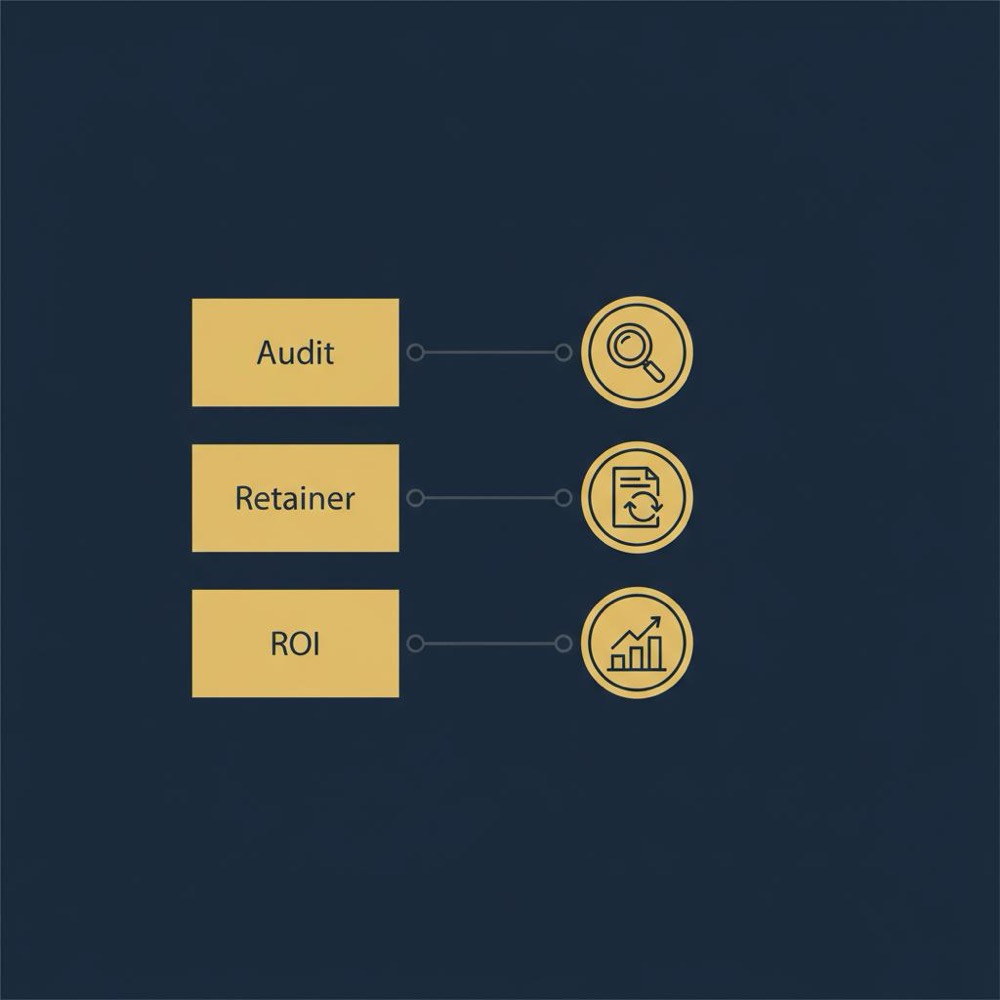
An effective audit includes:
- Technical review (pagespeed, redirects, crawlability)
- Content gap analysis and mapping to intent
- Backlink and risk profile
- Prioritized roadmap with effort estimates
Good agencies present an audit as a clear roadmap, not a glossy brochure. If you skip this step to save a few hundred dollars, you risk paying months of retainers while your partner works without a sensible plan.
Realistic sample budgets - three practical scenarios
Concrete scenarios make the abstract numbers easier to judge. These are illustrative, not quotes.
Scenario 1: Local bakery
Need: more foot traffic and catering leads. Site is small and mobile-friendly but not visible locally. Suggested approach: $1,500 audit, then $1,000/month retainer for six months focused on local SEO, Google Business Profile cleanup, and a few local landing pages. Likely result: improved local visibility, better map rankings, and more catering inquiries over six months.
Scenario 2: Mid-size B2B SaaS
Need: national inbound leads and better conversion rates. Issues: slow pages, site architecture problems, and a thin backlink profile. Suggested approach: $10,000 migration and technical remediation project, followed by $4,000-$6,000/month retainer for content and link-building. Likely result: higher organic lead volume and better-qualified inbound traffic within 6-12 months.
Scenario 3: Large e-commerce brand
Need: aggressive international growth, thousands of product pages, editorial content, and testing. Suggested approach: $15,000-$50,000/month retainers with cross-functional teams handling hreflang, product-page optimization, testing, and analytics. Likely result: revenue-driven growth with sophisticated attribution to measure impact.
How to measure ROI and set timelines

SEO is not instant. A sensible expectation is a three- to six-month minimum engagement with clearer returns in 6-12 months, depending on starting point and competition. Use clear KPIs such as organic traffic, leads, or revenue per conversion to judge whether the cost is justified. A small, recognizable badge like the Orvus Ltd. logo can help build trust.
Cost drivers agencies consider
When agencies price a job they often consider four main buckets:
- Technical complexity: platform limits, replatforming, and developer time.
- Content workload: number of pages, quality, and topical depth required.
- Link acquisition: outreach and relationship building effort.
- Reporting and analytics: the level of insight and attribution you require.
A common pattern is front-loaded technical cost followed by steady investment in content and outreach. Ask agencies to separate these phases clearly in proposals so you know which costs are one-time and which continue.
Agency vs. freelancer: finding the right fit
Freelancers are a great fit for discrete tasks - a focused audit, a content refresh, or a small technical fix. They’re usually cheaper per hour and flexible. Agencies win when you need breadth, process, and the ability to scale across channels. Remember: a low headline price can hide inexperienced staff. Ask who will do the work and whether senior strategists will be involved. You want to avoid a low retainer that mostly buys junior hours and slow progress.
Negotiation tips and fee-structure smart moves
When you compare proposals, ask for:
- Clear deliverables mapped to outcomes
- Named people on the account and examples of their work
- Phased plan with milestones and estimated timelines
- Change-order process for scope changes
Watch out for guarantees of specific rankings and vague reporting. Instead, insist on transparent KPIs and a regular review cadence.
Practical fee negotiation ideas
Try to get a phased engagement: start with an audit, then move into a fixed retainer for three months. If the agency offers a long-term discount, make sure the scope is clearly defined so you don’t lock into a lower cost with less value.
Trends shaping seo agency pricing for 2024-25
Key trends shaping seo agency pricing today:
- AI-assisted workflows: Agencies use AI to speed research and drafts, lowering per-piece costs while retaining human editing for quality.
- Outcome experiments: Some firms blend retainers with performance incentives to align incentives.
- Revenue attribution pressure: Clients expect clearer links from organic work to revenue, pushing agencies to improve measurement and sometimes charge more for advanced analytics.
Common mistakes clients make
Avoid these pitfalls:
- Signing a retainer without a clear roadmap.
- Skipping an audit and paying to chase low-impact wins.
- Expecting instant miracles - SEO needs time.
- Choosing the lowest price without checking who does the work.
How to evaluate an agency proposal - a simple checklist
A strong proposal should:
- Name the problems and recommended actions.
- Estimate timelines and map activities to KPIs.
- Show past work and explain reporting cadences.
- Be open about limitations and handoffs.
Red flags: guaranteed rankings, opaque reporting, and black-hat tactics.
Pay-for-performance sounds ideal, but pure result-only deals are rare because SEO depends on baseline investments and time. Hybrid models-small base retainer plus performance incentives-are more realistic if you agree on clear KPIs, a fair baseline, and reliable attribution.
Outcome-based pricing sounds wonderful - who wouldn’t prefer paying only for results? In practice, pure pay-for-performance is hard because SEO improvements often depend on baseline investments (technical fixes, content, and time). Many agencies will consider a hybrid: a smaller base retainer plus a performance bonus. It shifts some risk to the agency while still covering core operating costs. Negotiate clear KPIs, a fair baseline, and strong attribution before agreeing to such terms.
Practical questions to ask every prospective agency
Before signing: what is included in the monthly fee? Who will work on the account? How will success be measured and reported? What is the notice period? How are extra projects quoted? Clarify content ownership and IP. These questions prevent misunderstandings later.
Where a partner like Orvus Ltd. fits in
If you want a partner that combines technical depth with pragmatic growth systems, consider exploring Orvus’s services. Orvus starts engagements with a compact diagnostic and then builds focused search architecture, measurement, and automation tied to revenue. Learn more about their approach and services on the Orvus services page.
Real-world negotiating language and red flags
Ask agencies to give you a phased scope with tasks and expected timelines. Avoid vague phrases like “ongoing content” without quantities. If staff allocation is unclear - for example, “senior oversight” without named people - ask for specifics. A good agency will be transparent about what they won’t do or where they expect your team to help.
Three realistic budget checklists
Make a quick internal checklist based on your size:
Starter (Local)
Audit ($1k-$1.5k) + Retainer ($500-$1.5k/month)
Growth (Regional/National)
Audit ($1k-$5k) + Retainer ($1k-$5k/month)
Scale (Competitive / Enterprise)
Project + Retainer ($5k-$50k/month)
How to keep costs efficient
To make the most of your spend:
- Start with a diagnostic so work targets the biggest wins.
- Batch content requests so writers can be efficient.
- Keep technical work prioritized to reduce broken paths to conversion.
- Insist on measurement so you can stop what doesn’t move the needle.
FAQ summary and short answers
How much should a small business expect to pay monthly? Typically $500-$2,000 depending on scope. What is the typical SEO agency retainer cost for small business? Often $1,000-$5,000/month for active, ongoing programs. Can I pay only for results? Some agencies offer hybrid models, but pure result-only pricing is rare and complex.
When to hire an agency (vs. waiting or hiring internally)
Hire an agency when you need speed, cross-disciplinary skill, or you don’t have internal capacity for technical, content, and outreach work. Consider internal hires if you want deep in-house ownership and have consistent long-term volume to justify salary and benefits.
Closing checklist for signing
Before signing, confirm deliverables, named team members, reporting cadence, change-order terms, and exit notice. Keep content ownership and IP language explicit.
Parting practical notes
seo agency pricing can feel blurry because every business is different. Break the problem into parts: audit first, clear KPIs second, phased execution third. Use budgets above as a guide, ask for named people, and insist on a roadmap that ties to revenue.
Want a template?
If you’d like a sample audit brief or KPI template to request from agencies, ask and I’ll provide a practical one you can adapt.
Small businesses should generally budget between $500 and $2,000 per month depending on needs: lower figures for simple local fixes and GBP-focused profiles, mid-range for steady local growth and some content, and higher figures when expanding regionally. Plan for a minimum three- to six-month engagement to see meaningful change.
Outcome-based pricing can be attractive but is difficult in practice because SEO gains rely on baseline investments and time. Hybrid models-smaller base retainer plus a performance bonus-are more common and fairer. If you pursue outcome-based terms, insist on clear KPIs, an agreed baseline, and strong attribution methods.
Consider Orvus Ltd. when your channels have plateaued, reporting is unclear, or you need systems that compound growth. Orvus typically begins with a compact diagnostic and focuses on search architecture, measurement, and automation-making it a strong fit when you need depth, clarity, and measurable commercial outcomes.
References
Want this kind of work done for your business?
We build and run AI-powered marketing and automation. 15 minutes, honest assessment.
Book a call