 Orvus
OrvusWhat are professional SEO services?
December 10, 2025
What are professional SEO services?
Short answer: professional SEO services are the structured, measurable work that turns search visibility into customers, revenue and reliable growth.
For decision makers who need clarity, this piece explains what those services include, how agencies price and deliver them in 2024-2025, and how you can tell good work from noise. I’ll use plain language, practical examples, and real questions you can ask a prospective partner.
Why this matters right away
If your site starts showing up in searches that matter, you feel relief, curiosity, and a cautious optimism that the work is paying off. That feeling is exactly what professional SEO services are designed to create - a predictable lift in qualified visitors and a clearer map from content to revenue.

Below you’ll find concrete tactics, a realistic timeline for early wins, and a checklist you can use in vendor conversations. I’ll also point to a tactful example of a focused shop that balances automation with senior review.
What professional SEO services are, in practical terms
At heart, professional SEO services are three kinds of work happening together:
1. Technical foundations (so search engines can crawl and index your valuable pages).
2. Content and architecture (so your site answers searchers’ real questions at every stage).
3. External signals (links, brand mentions, and reputation signals that help search engines trust your site).
There’s nothing mystical here - it’s engineering, editorial craft, and relationship work combined. Since 2024 many teams use AI-assisted tools to speed repetitive tasks (drafts, tagging, reporting) while keeping humans in charge of final decisions that affect quality and brand voice. That blend delivers more at scale but demands better quality control: automation helps write a first draft, humans make it persuasive and accurate.
If you want an example of how a small, focused team combines tech, measurement and automation, take a look at Orvus Ltd.’s services page for a practical model of compact diagnostics and embedded work that prioritizes business impact.
Technical foundations you must never skip
A proper engagement usually starts with a technical audit - and for good reason. If search engines can’t crawl or index your most important pages, content and outreach have limited impact. The most important technical checks are:
Crawlability and site architecture
Make sure your key pages are reachable through sensible links and that nothing important sits behind broken navigation or pages that return errors. Imagine your site as a shop: locked doors and aisles full of boxes will chase customers away. Search engines treat websites the same way.
Page performance and Core Web Vitals
People abandon slow pages. Fixing performance - lazily loaded images, render-blocking scripts, poor hosting - improves both conversions and rankings. Core Web Vitals remain a high-leverage technical area for improvement.
Structured data and context
Schema like product markup and review snippets doesn’t guarantee a rich snippet, but it helps search engines understand context and can lift click-through rates where it appears.
Server stability and error management
Pages that crash during a peak campaign can wipe out months of content work. A technical audit will surface critical errors and produce a prioritized remediation list tied to business outcomes.
Common deliverables from modern SEO agencies
Deliverables vary with engagement size, but reputable teams commonly deliver these items:
- A comprehensive technical audit and prioritized roadmap.
- A content strategy that maps topics to buyer journeys and intent, not just a raw keyword list.
- Link acquisition plans and outreach programs tailored to industry risk tolerance.
- Implementation support: tickets, CMS updates, and developer guidance so recommendations become real changes.
- Measurement and reporting that ties organic work to conversions and revenue.
Many agencies pair a content-hub model (group topic pages around a central resource) with keyword mapping that prevents duplication and organizes content by buyer stage. E-commerce programs coordinate product pages, category content, and paid media so channels complement, not cannibalize, one another.
How content and architecture work together
Good content strategy is less about publishing lots of pages and more about publishing the right pages in the right order. Professional SEO services include mapping existing content to gaps and opportunities, then prioritizing pieces that deliver the largest revenue ROI. This often looks like combining product/category pages, guides, FAQs, and data-driven blog posts into a clear structure that maps to buyer intent.
How agencies commonly price their work in 2024-2025
Pricing varies widely. Typical models include retainers, hourly work, fixed-price projects, and selective performance-linked fees. For small and medium businesses in developed markets, retainers often fall between roughly €1,000 and €7,000 per month, though larger programs cost more.
Look beyond the headline rate: examine who produces the content, who implements changes, and how much of that monthly fee is spent on outreach, tooling, or ad hoc development. An agency that outsources most editorial work to low-cost writers may seem inexpensive up front and expensive later if quality issues appear. For deeper pricing context, see the SEO pricing guide, a practical pricing overview, and a detailed market guide.
Performance-linked fees: what to watch for
Performance fees tied to traffic or revenue can sound attractive, but outcomes depend on seasonality, product quality, site stability, and other marketing investments. If you consider this model, insist on precise definitions (what counts as a qualified conversion), baseline data, attribution methods, and a dispute resolution clause. These clauses work best when they complement - not replace - a stable retainer for ongoing work.
Measuring success: visibility to revenue
Agencies should track both leading indicators and business outcomes. Leading indicators include organic impressions, visibility across target keywords, and reduction in technical errors. Business outcomes are organic revenue, conversion rate changes, and customer lifetime value.
Because last-click attribution is less reliable after privacy and browser changes, savvy teams use multi-touch models, server-side tracking, and event-based measurement to connect organic interactions to revenue. For example, mapping content to assisted conversions and attributing those to later sales calls or purchases gives a clearer picture than raw session counts.
A short client example
A small B2B company I worked with relied on last-click attribution and thought content drove no revenue. After mapping content to assisted conversions and implementing server-side events, they discovered informational blog posts were a major driver of leads that later converted via sales calls. That insight changed their content priorities and justified further investment.
Yes. Informational content often acts as an assist in multi-step buyer journeys. With multi-touch attribution, server-side tracking, and event-based measurement, those assists become visible and you can tie content to later conversions and revenue.
Yes. Long-tail informational content often plays an assist role in multi-step customer journeys. When attribution is set up properly, the assist becomes visible and content teams get credit for work that feeds lower-funnel conversions.
AI and automation: speed without surrendering judgment
AI has changed workflows. Teams now auto-generate metadata, draft outlines, and batch-report, which speeds repetitive tasks dramatically. But automation is a tool, not a replacement for experience. In high-quality engagements, AI creates first drafts and human experts polish strategy, voice and factual accuracy.
Ask prospects how they use automation. If they describe automation as a way to make teams faster while preserving senior review, that’s a positive sign. If their answer implies full automation without oversight, ask for examples of quality assurance and brand governance.
Choosing a professional SEO agency: a practical checklist
Picking a partner is like matchmaking. Here’s a practical checklist you can use during vendor conversations:
- Do they perform a technical audit and share a prioritized roadmap?
- Can they show case studies with measurable outcomes similar to your business?
- Who writes content and who implements recommendations?
- Will they manage dev tickets or pass them to your team?
- How do they measure results and attribute revenue to organic channels?
- How do they use automation and what QA is in place?
- Is there a test-driven roadmap with short experiments and measurable hypotheses?
Transparency matters. You should be able to see completed work, not only high-level strategy. A good agency communicates both the actions taken and the business impact those actions created.
Who should run the work?
Ask whether senior staff will set strategy and whether junior staff or contractors will execute day-to-day tasks. Quality and consistency often hinge on disciplined senior review rather than headline rates or flashy promises. For background on the team's focus and values, see the about page.
Common client mistakes and how to avoid them
Clients commonly make three mistakes that slow outcomes:
1. Treating SEO as a one-off project instead of an ongoing program. Markets shift and technical issues reappear.
2. Failing to own implementation. If your team never publishes structured data or fix server issues, progress stalls.
3. Underestimating measurement complexity. Without upfront tracking plans, results can look smaller than they are.
A common scenario: an agency delivers content but a client’s dev team never implemented structured data or server fixes. Rankings stagnated. The real solution was partnership: the agency prioritized quick technical wins first, then rolled out content. That sequence created sustainable momentum.
Practical timeline and early wins
For small and medium engagements, expect:
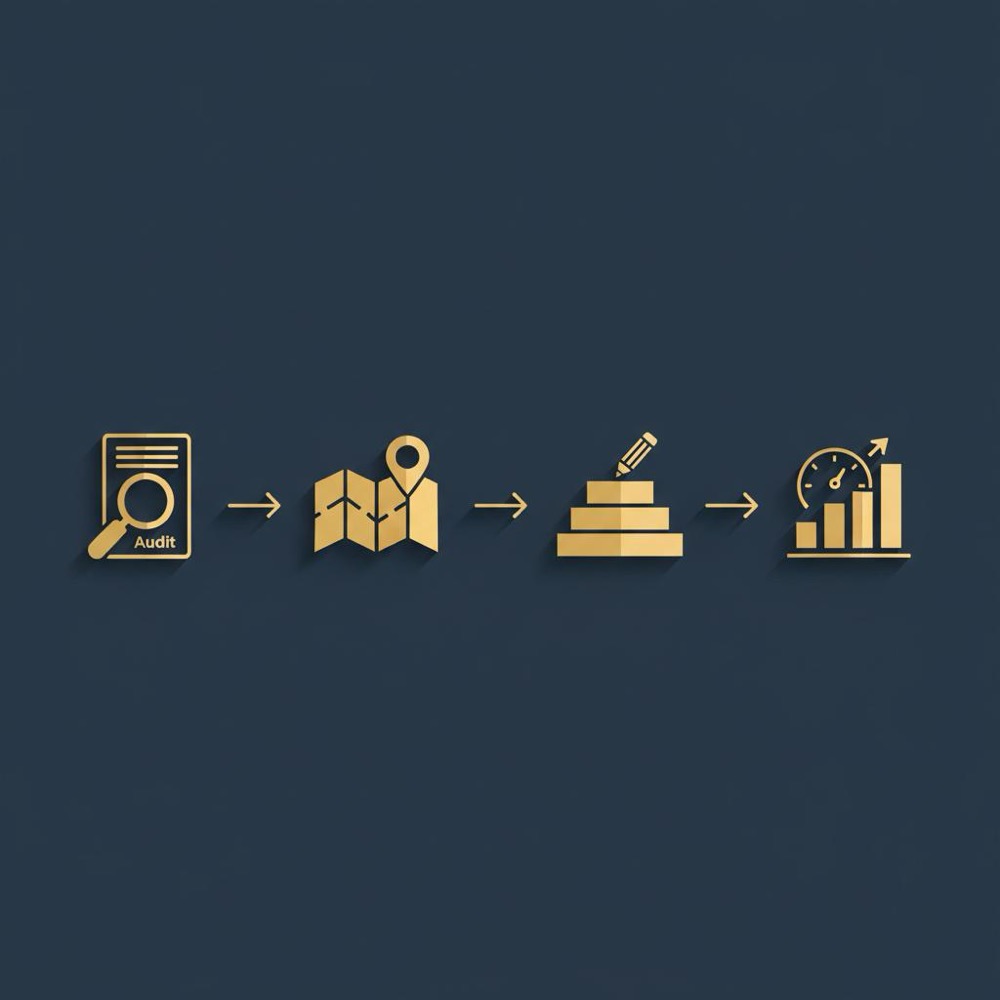
Weeks 1-4: Technical audit, keyword mapping, and prioritized roadmap.
Weeks 4-8: Quick technical fixes (crawl errors, title/meta updates, critical structured data, and server tweaks).
Month 3 onward: Ongoing content production, outreach, experiments with layouts and conversion elements.
Meaningful revenue signals often appear in 3-6 months for many niches. For highly competitive verticals or large catalogs, plan for longer timelines.
E-commerce and local business nuances
E-commerce sites prioritize catalog management, canonical rules, faceted navigation, and product schema. The content strategy should blend product descriptions with category landing pages and buyer-focused information.
Local businesses emphasize citations, local schema, review management, and consistent business listings. Both types of sites benefit from measurement that ties page performance to in-store visits or purchases.
How small teams can get the most with limited budgets
With constrained budgets, focus on high-leverage technical fixes and a tight content strategy around the highest-value pages. A small audit targeting top revenue-driving pages can deliver outsized returns.
Use automation for tagging and reporting, but keep editorial oversight tight. If you have internal developers, keep agency tickets small and actionable so your team ships quickly.
Questions to ask an agency right away
Use these during calls: What are your typical timelines and can you show a proposed roadmap for my site? How do you measure results and attribute revenue? Who writes and who implements? Will you manage dev tickets or do we? How do you use automation and what QA is in place? Can you share relevant case studies? If you offer performance-linked fees, how are outcomes defined and measured?
Trust and long-term partnerships
The best SEO work is collaborative: technical skill, editorial judgment and test-driven experiments. Agencies that deliver steady value communicate clearly, set measurable goals, and adjust when data suggests a new path.
Why Orvus-style engagements often outperform volume approaches

As a model, Orvus focuses on deep, context-rich engagements instead of high volume. That means a compact diagnostic up front, senior-led strategy, and bespoke automations that slot into your existing workflows. For many operators this approach is more effective than a large agency that spreads effort thinly across many clients.
Get a compact diagnostic and prioritized roadmap
Ready to see how a compact diagnostic could unlock growth for your site? Book a short consultation to get a prioritized list of fixes you can implement in the next 30-90 days.
Final checklist to use in vendor conversations
Before you sign, validate these points: documented technical audit, prioritized roadmap tied to revenue, case studies with measurable outcomes, clear ownership of implementation, transparent reporting cadence, test-driven experiments, and precise pricing including out-of-scope items.
Closing takeaways
Professional SEO services are not a single tactic but a coordinated program: technical stability, content that answers intent, and external signals that build trust. When done right, they become a dependable channel for discovery and growth.
Pick partners who can show you both the work and the numbers, who embed senior review into their process, and who have a clear plan for measuring revenue effects in a privacy-first world.
If you’d like a short checklist or a simple questionnaire to use when talking to agencies, I can prepare one that’s concise and ready to send.
For a practical next step, ask prospective partners for a short sample roadmap for your top 5 pages and a compact diagnostic of the most visible technical issues. That gives you a direct line of sight into the agency’s thinking and priorities. You can also review recent examples on our blog.
Extra resources
For a practical next step, ask prospective partners for a short sample roadmap for your top 5 pages and a compact diagnostic of the most visible technical issues. That gives you a direct line of sight into the agency’s thinking and priorities.
Expect early technical wins in the first 4-8 weeks (fixing crawl errors, updating title tags, implementing critical structured data). Meaningful revenue signals typically appear in 3-6 months for less competitive niches. Highly competitive verticals or large e-commerce catalogs may take longer. Success timing depends on implementation speed, market competition, product seasonality, and measurement quality.
Include a clear scope (who writes, who implements), a technical audit and prioritized roadmap, reporting cadence, definitions for any performance-linked fees (qualified conversions, attribution method), baseline data, dispute resolution, and clauses for out-of-scope work. Also define success metrics and a test-driven experiment plan so both sides agree on expectations.
Yes. Focus on high-leverage technical fixes and a narrow content strategy around the most valuable pages. A compact audit targeted at top revenue-driving pages can deliver outsized returns. Use automation for repetitive tasks and keep editorial oversight tight. If you have internal developers, ensure agency tickets are small and actionable so your team can ship quickly.
Want this kind of work done for your business?
We build and run AI-powered marketing and automation. 15 minutes, honest assessment.
Book a call