 Orvus
OrvusWhat is MOZ grade? Understanding MozRank and link signals
February 13, 2026
The guidance here is operational and conditional. It focuses on how teams can incorporate mozrank into reproducible link acquisition and reporting systems rather than chasing a single number. Read on for tool steps, interpretation criteria, and short scenario examples you can adapt to your workflows.
What people mean by "Moz grade" and where MozRank fits
Definition and common uses
The term Moz grade is often used informally to describe a page or domain's link-popularity score, commonly reported as MozRank, and operators use it as a shorthand for link-profile strength. MozRank is Moz's link-popularity metric presented on a roughly 0 to 10 scale to reflect the quality and quantity of inbound links to a page, as described in Moz's documentation Moz Learn page on MozRank
MozRank is derived from the web link graph and applies weighted value from linking pages on a compressed, roughly logarithmic scale. The precise formula and weightings are proprietary to Moz, so the metric is best read as a relative indicator rather than an exact measure you can reverse engineer, which Moz also notes in its product guidance Moz Link Explorer
Practitioners use Moz grade as a quick comparator when auditing link profiles, combining it with other Moz metrics and analytics data to prioritise work, and reference the Orvus blog for further practical notes on audits Orvus blog.
Common uses include prioritising outreach targets, checking whether earned links come from pages with higher link value, and tracking relative progress across campaigns. Because the underlying computation is proprietary, most teams focus on repeatable link-acquisition processes and measuring traffic or conversions from referral sources rather than chasing the numeric score.

How Moz calculates MozRank and how it relates to other Moz metrics
What the 0-10 scale represents
MozRank reports link popularity on an approximately 0-10 scale that compresses raw link graph signals so differences at the high end are harder to move than at the low end. This compression behaves like a logarithmic transformation of link value and linking-source quality, which is how Moz presents the concept in its help material Moz Learn page on MozRank
Book a consultation to audit link signals and measurement
Consider a short audit of your linking sources and referral traffic before deciding whether to chase score changes.
Relation to Domain Authority and Page Authority
MozRank is one part of Moz's broader metric set that also includes Domain Authority and Page Authority, which aggregate signals differently to estimate domain- or page-level ranking potential. Moz recommends reading these metrics together to get context on link-profile strength rather than relying on a single number Moz Help overview of Moz metrics (see an explainer on Domain Authority at Segment SEO Segment SEO).
For practical diagnostics, use MozRank to assess link popularity at the page level, and use Domain Authority to compare larger domain-level trends. Page Authority provides a complementary view of a specific page's likely performance. Combining them helps avoid decisions based on one transient value.
How to check mozrank for pages and domains
Tools: Link Explorer and MozBar
The primary ways to view MozRank and related Moz metrics are Moz's Link Explorer product and the MozBar browser extension, both of which surface MozRank, Domain Authority, and Page Authority for pages and domains Moz Link Explorer and see Moz's help for Link Explorer Moz Link Explorer help.
Practitioners usually mean MozRank or a related composite Moz metric when they say Moz grade. Use it as a relative link-popularity signal alongside Domain Authority, Page Authority, and analytics to prioritise link work and measure outcomes rather than treating it as a sole proof of success.
Practical checks and cadence
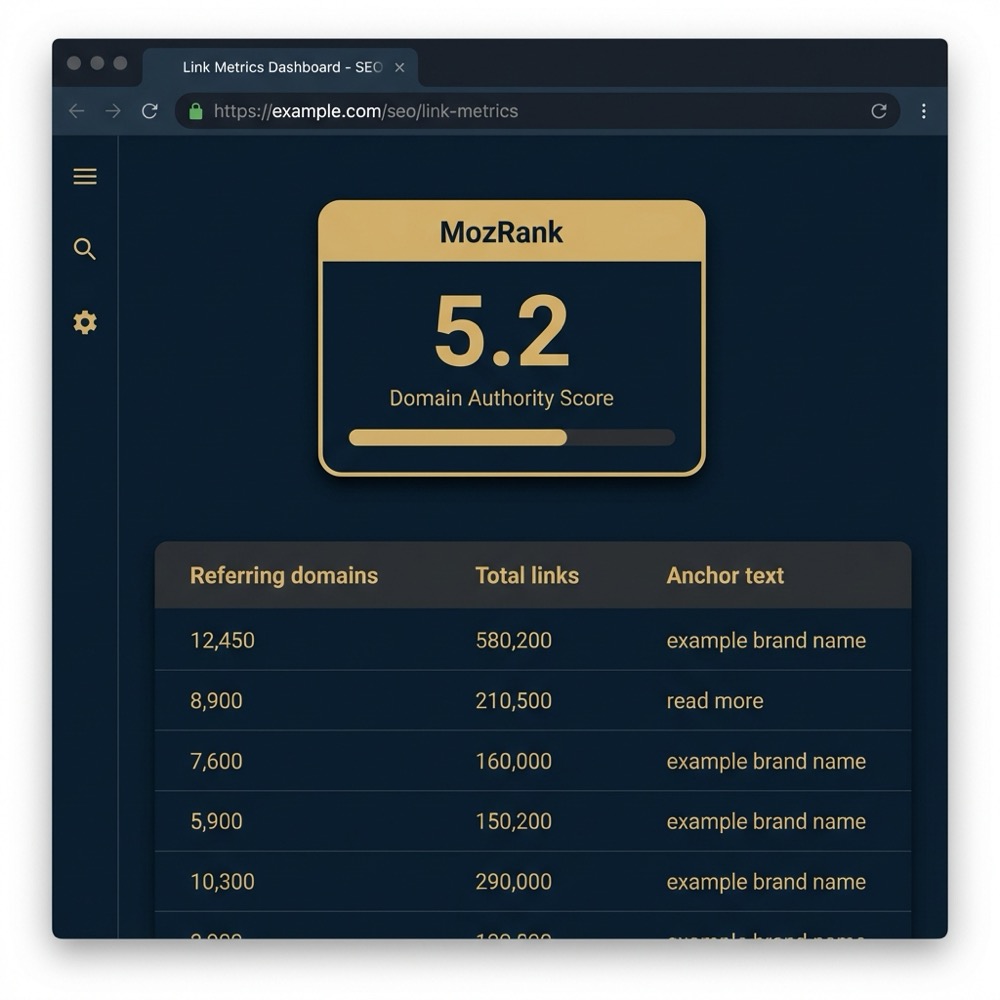
When checking mozrank, view both page-level MozRank and domain summaries. Look at referral traffic alongside Moz metrics to see whether links are producing measurable visits.
Keep expectations realistic: observed score changes depend on the rate of new links your site receives and Moz's index refresh cadence. Because Moz updates its index on its own schedule, small link changes may take time to appear in reported scores.
How to interpret mozrank: decision criteria and what to prioritize
When mozrank matters for site decisions
Treat mozrank as a relative comparator for link-profile strength and for tracking campaign progress, not as standalone proof of SEO success. Using the metric in this way helps teams prioritise link targets without overfitting to a single number Moz Help overview of Moz metrics
Combine mozrank with referral traffic and conversion metrics to connect link work to outcomes. When links bring useful referral visits, they offer operational value regardless of small score movements.
When to look beyond the score
Look beyond mozrank when a page has mismatched signals, for example high MozRank but low referral traffic, or when short-term changes might reflect crawl or index timing rather than sustained link value. In those cases, check analytics and source quality before reallocating resources Moz Link Explorer
Focus on reproducible link acquisition processes and measurement that ties links to traffic or revenue, rather than optimising exclusively for a single metric.
Practical ways teams can influence mozrank
Link acquisition and link quality
Improving mozrank depends on acquiring links from higher-quality sources. Link source quality matters because Moz's metric weights linking pages when calculating link value, so links from authoritative pages tend to move the needle more than many low-quality links Moz Learn page on MozRank

In practical terms, prioritise outreach and content that are likely to earn links from relevant, better-regarded sites. Track source quality in your link acquisition workflow so you can prioritise targets that are more likely to improve link signal quality over time (see our services Orvus services).
Internal linking and cleanup
Good internal linking and sensible site structure help pass link value around a site and make it easier for crawlers to find pages that should benefit from inbound links. Internal links do not replace external link value, but they help distribute the benefit across important pages.
Removing or disavowing spammy or clearly low-quality links can be a sensible cleanup step when a site has a pattern of harmful linking. Observable score changes after cleanup depend on Moz's index updates and how quickly crawlers re-evaluate those links Search Engine Journal analysis of MozRank and PageRank

Common mistakes and pitfalls when tracking Moz metrics
Over-reliance on a single score
A common mistake is treating mozrank as a final verdict on link health. Because MozRank is one signal among several, combining it with Domain Authority, Page Authority, referral traffic, and conversion metrics gives more robust context for decisions Moz Help overview of Moz metrics
Teams that chase score changes without tying link work to measurable outcomes risk spending effort on low-impact activities. Keep tests and measurement focused on visits and conversions where possible.
Misreading short-term fluctuations
Short-term Moz metric fluctuations can reflect crawl timing or index refresh cycles rather than real changes in link value, which leads to reactive decisions. To avoid this, document your checks and allow time for patterns to stabilise before acting Moz Link Explorer
Also avoid measurement mistakes such as ignoring referral traffic or failing to record link-acquisition processes, both of which make it harder to connect link effort to outcomes Search Engine Journal analysis of MozRank and PageRank
Practical scenarios: how teams use mozrank in diagnostics and reporting
Scenario A: benchmarking a competitor link profile
In benchmarking, teams compare MozRank alongside Domain Authority and referral traffic to prioritise targets. Moz metrics provide a relative view of link profile strength that helps shortlist domains for outreach without claiming absolute ranking predictions Moz Help overview of Moz metrics
When a competitor page shows higher mozrank, use that signal to inspect the competitor's linking sources and content to find reproducible opportunities for outreach.
Compact link-audit checklist for campaign diagnostics
Use this when reviewing new links
Scenario B: measuring progress during a link acquisition campaign
During a campaign, track links earned, source quality, and referral traffic first, then observe mozrank changes over the campaign period. Because Moz updates its index on a cadence outside your control, score movement can lag behind link acquisition.
Report process metrics such as number of quality links and referral visits alongside any MozRank movement to make sure decisions stay tied to tangible outcomes rather than a single score Moz Learn page on MozRank
Wrap-up: how to include mozrank in a sensible measurement system
Quick checklist for teams
Checklist items: check MozRank with Link Explorer or MozBar, compare it to Domain Authority and Page Authority, track referral traffic and conversion metrics, and keep a reproducible link-acquisition process for consistency Moz Link Explorer
Remember that Moz's formulas are proprietary. Treat mozrank as one signal among several and prioritise measurement that links activity to traffic and revenue rather than focusing on the numeric score alone Moz Help overview of Moz metrics
Next steps and what to monitor
Monitor mozrank at the page level, Domain Authority at the domain level, and referral traffic and conversions in your analytics. Document changes, note when links were earned, and allow for Moz's index to reflect those changes before judging impact (see the Orvus about page about).
Use these signals together in reporting and maintain a process that emphasises repeatable link acquisition and attribution so link work maps to outcomes over time.
Moz updates its index on its own cadence, so visible MozRank changes can lag behind link acquisition. Expect variation depending on Moz's index refresh schedule.
No. MozRank is conceptually similar to PageRank in measuring link-based authority, but they are different, proprietary calculations with distinct signals.
Improvements depend on earning higher-quality inbound links and Moz's index timing. Focus on repeatable link acquisition and measuring referral traffic rather than short-term score chasing.
References
Want this kind of work done for your business?
We build and run AI-powered marketing and automation. 15 minutes, honest assessment.
Book a call