 Orvus
OrvusIs SEO hard for beginners?
November 25, 2025
Is SEO hard for beginners? A friendly, practical answer
SEO for beginners is more approachable than it sounds - but it does demand patience, a plan and consistent work. Think of it like learning an instrument: the basics come quickly, but playing well for an audience takes practice. This guide breaks that journey into clear, usable steps, so you can get started with confidence and avoid the most common traps.
Why this question matters
People asking “Is SEO hard for beginners?” often feel two things at once: intimidated by technical language and hungry for fast results. Both are understandable. The aim here is to turn that worry into a practical plan - one that produces small wins early and builds real momentum over months.

Three pillars to focus on
To get traction you only need to understand three connected areas: on-page work, technical health and authority. Master the basics of each and you’ll give your site a strong foundation.
On-page: the words, headings and structure that tell people and search engines what a page is about.
Technical health: the website plumbing - speed, mobile experience, indexability.
Authority: the reputation your site builds via links, references and relevance across the web.
First 10%: quick wins and the right expectations
SEO for beginners needs realistic expectations. You can learn the fundamentals in a few months, but traffic gains commonly show in six to twelve months. That’s because search engines need time to recrawl and evaluate improvements.
If you want pragmatic support for this stage, a helpful place to look is the Orvus services page - a compact, no-nonsense approach to technical fixes and measurement that many teams find useful: Orvus growth services. Think of it as a tactical hand to steady your first few months rather than a large agency project.
Connect measurement first
One of the earliest and most common mistakes is skipping analytics. Connect Google Search Console and an analytics tool immediately. Without clean data you’re guessing. With data, small fixes become measurable wins.
Run a crawl and fix blockers
Use a simple crawler and PageSpeed Insights. You don’t need to fix everything at once - focus on what blocks indexing or creates a terrible experience: pages that can’t be crawled, painfully slow mobile pages, duplicate title tags, or broken canonical rules.
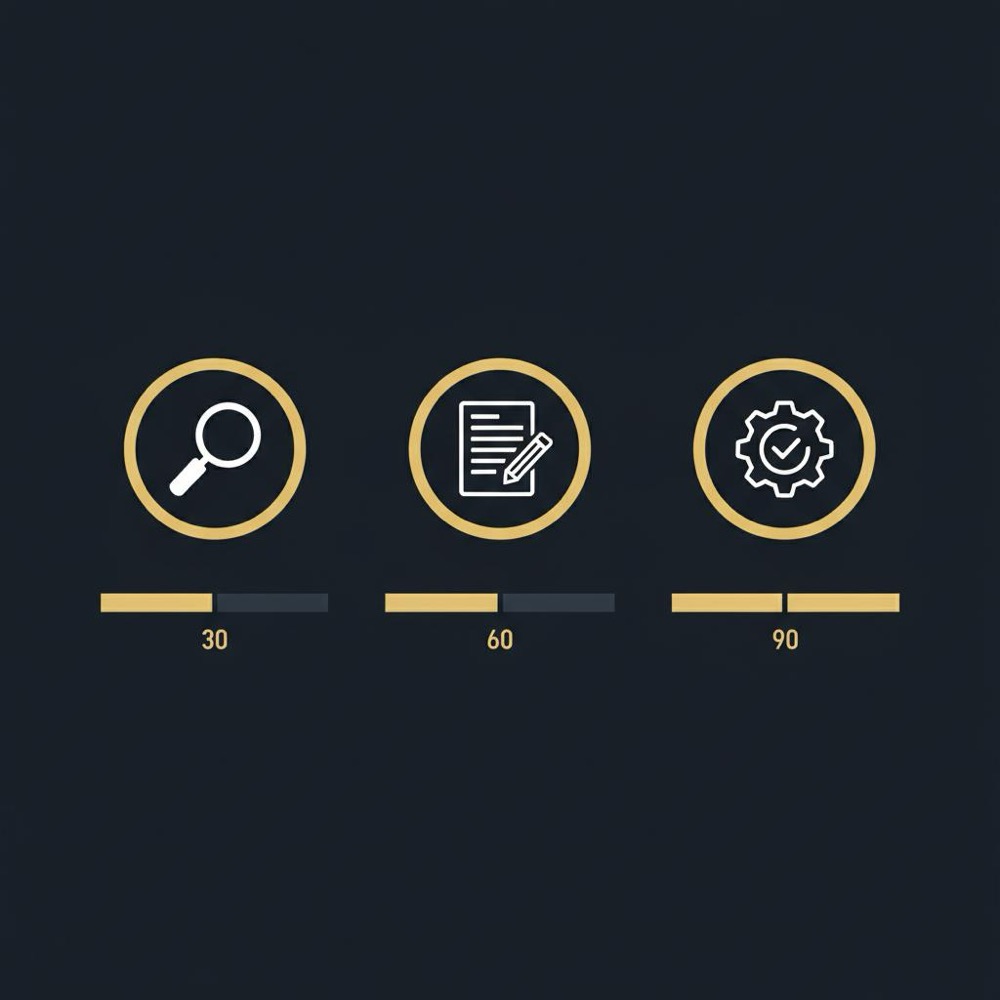
30/60/90 day roadmap: an easy-to-follow plan
Breaking SEO into the first 30, the next 30 and the following 30 days gives you a concrete rhythm. Below is a detailed roadmap you can follow and adapt.
Days 0-30: audit, measurement, low-hanging fruit
In the first month, do a focused audit and clear the most obvious blockers.
Tasks to complete:
1. Connect Google Search Console and analytics.
2. Run a site crawl and export the top issues (indexation errors, 4xxs, 5xxs, duplicated titles).
3. Check mobile speed and Core Web Vitals; prioritise fixes that affect the majority of pages.
4. Fix title and meta description duplicates - every page should have a unique, accurate headline and summary.
5. Pick five to ten target keywords and classify them by intent: informational, comparison, transactional, or navigational.
Days 30-60: plan content and solve deeper tech problems
Now move from tidy-ups to planning and medium-complexity technical fixes.
Focus areas:
Content plan: A content plan maps target keywords to pages and intent. It sets goals for each piece - what intent it satisfies and what a successful outcome looks like.
Technical fixes: Redirect chains, sitemap accuracy, robots directives, and resolving any barriers found in the first crawl. If you find mobile or speed issues that need engineering time, start that work now.
Days 60-90: test, iterate, scale
By this stage you should have a steady publishing cadence and clean measurement. Start small experiments and measure them.
Experiment ideas:
- Tweak headlines to improve click-through rate.
- Improve on-page structure and add concise answers near the top to win featured snippets.
- Test different internal linking patterns to channel authority toward priority pages.
- Refresh older content with new data or clearer headings instead of always creating new pages.
Core habits that turn learning into results
Doing the work is one thing. Forming the right habits is what compounds progress.
Be consistent: One to two high-quality pieces per week builds a rhythm and signals activity to search engines.
Measure before and after: Always check Search Console and analytics to see if a change actually moved the needle.
Match intent: Create content that satisfies what people are trying to do - learn, compare, buy, or solve something quickly.
Tools and when to invest
Start small. Free tools will get you far.
Must-have free tools:
- Google Search Console
- Google Analytics or a privacy-focused analytics equivalent
- PageSpeed Insights
- A simple crawler (many have free tiers)
When to pay: once you’ve stabilised a publishing cadence and measurement, consider a paid SEO suite for scaled keyword research and backlink discovery. Remember: tools amplify execution - they don’t replace a clear plan.
For practical 90-day frameworks and beginner roadmaps see this 90-day SEO plan, an SEO starter guide for 2025, or a straightforward SEO 101 guide that complements the steps here.
Practical tool workflow
Use Search Console for impressions, clicks and queries. Use a crawler to find indexation and duplicate content problems. Use PageSpeed Insights to prioritise speed work. When ready, add a paid tool to track keyword volumes and competitor backlinks.
Specific, practical tasks for the first three months
Here’s a checklist you can actually follow in week-by-week steps.
Week 1: Connect Search Console and analytics. Run a basic crawl. Fix clear indexation blocks and canonical errors.
Week 2: Clean up title tags and meta descriptions. Prioritise pages to keep first impressions strong.
Week 3: Map five to ten keywords to pages and classify intent. Identify two low-effort content wins.
Week 4: Publish one focused piece aimed at one keyword. Monitor impressions and clicks.
Week 5-8: Continue publishing one to two helpful pieces per week. Start medium technical fixes.
Week 9-12: Run small tests (headline tweaks, internal linking changes) and measure results.
Common beginner mistakes and how to avoid them
Beginners tend to fall into predictable traps. Here’s how to avoid them:
1. Expecting instant results: SEO compounds. Treat the first six months as a learning budget.
2. Skipping measurement: If you don’t track, you can’t learn what works. Connect consoles and analytics early.
3. Misreading intent: Always write for user intent, not just keywords. A page that satisfies intent will perform better than one stuffed with phrases.
4. Being inconsistent: Sporadic posts produce noise, not signal. Build a repeatable process instead.
5. Ignoring technical debt: A slow or unindexable site can mute great content. Prioritise fixes that unblock indexing and improve UX.
Measuring wins: what counts as progress
Not every improvement will show as a spike in conversions. Look for these signals:
- Higher average position for a target keyword.
- More keywords ranking in top three pages.
- A steady lift in organic sessions month over month.
- Improved impressions-to-clicks (CTR) after meta or title tweaks.
Real example: a six-month turnaround
Here’s a short story to anchor the guidance.
A small niche site had modest traffic and a few loyal readers. In the first month we set up Search Console and fixed duplicated titles and indexation issues. We prioritised ten keywords by intent and published two long, helpful guides each week while improving internal links to those priority pages. By month six, pages that previously had zero impressions began appearing in results and gaining clicks. Why? The site became crawlable, content matched real user questions, and consistent publishing signalled activity to search engines. The lesson: the slow compounding of correct actions is how beginners turn understanding into results.
Advanced but accessible techniques for early experiments
After you’ve completed the 30/60/90 roadmap, try these targeted experiments:
- Add short, clear answers near the top of articles to target featured snippets.
- Use a concise table of contents with anchor links to improve user experience and CTR in search results.
- Use canonical tags wisely when you have near-duplicate content.
- Test different internal link anchors to help transfer authority to key pages.
Content quality vs length: what matters most
Usefulness beats length. A short, crisp answer to a clear question can outrank a long rambling article. The key is clarity, structure and a clear next step for the reader.
How to scale backlink growth as a beginner
Backlinks are harder for beginners but not impossible. Start with relevance and relationships:
- Create genuinely useful resources that others in your niche would naturally cite.
- Build relationships via outreach, guest posts, or resource roundups.
- Track who links to competitors and why; learn what kinds of content attract links in your niche.
Mindset and habits that help you win
Curiosity and patience beat frantic tactics every time. Read search engine docs, measure the results of experiments, and work publicly when it helps your accountability. You don’t need to master everything - but you should know what to ask for when you need developer help.

Orvus starts with a compact diagnostic: we look at numbers, search structure, media accounts, data layer and tooling. From there we recommend and build the high-leverage pieces: architecture, measurement, creative funnels, automations and content systems. The goal is to compound what’s already working without adding noise. A small Orvus Ltd. logo can help you remember the team behind these steps.
Many beginners underestimate how much a single small technical issue (like a noindex flag, duplicated title or slow mobile page) can hide excellent content from searchers. Fixing those blockers is often the fastest way to turn understanding into measurable traffic gains.
A realistic view on tools and budgets
Don’t buy every tool at once. Start with free consoles and a crawler, fix technical blockers, and stabilise your publishing and measurement. When you’re ready to scale, add a paid suite for keyword and backlink research.
Checklist: first 90 days (printable)
- Connect Search Console and analytics.
- Run a crawl and fix indexation blockers.
- Clean up title tags and meta descriptions.
- Prioritise 5-10 keywords by intent and map them to pages.
- Publish 1-2 helpful pieces per week.
- Start medium complexity technical fixes (redirects, sitemap, robots).
- Launch small experiments and measure results.
When to ask for help and what to expect
If you’re hitting persistent technical blockers, slow mobile performance, or you lack time to maintain a consistent content rhythm, a small strategic partner can help. Orvus specialises in working deeply with a limited number of clients to rebuild search architecture, measurement and workflows - a targeted way to accelerate progress when the basics are already in place. Learn more on our about page or explore practical write-ups on our blog.
How Orvus works in practice
Orvus starts with a compact diagnostic: we look at numbers, search structure, media accounts, data layer and tooling. From there we recommend and build the high-leverage pieces: architecture, measurement, creative funnels, automations and content systems. The goal is to compound what’s already working without adding noise.
Spend one week doing this experiment:
Day 1: Connect Search Console and analytics.
Day 2: Run a crawl and fix the three worst indexing issues.
Day 3-5: Identify five to ten target keywords and write one focused, helpful piece aimed at one of them.
Day 6-7: Publish and watch Search Console for impressions and queries. Note what you learn.
This single experiment teaches more than many tutorials because it shows how your site behaves in the wild.
Extra tips for specific site types
New sites: Be patient and focus on measurement, technical health and a consistent content rhythm.
Established sites with technical debt: Clean up indexation and fix speed issues before scaling content.
Competitive niches: Invest in stronger original research, better link outreach, and clearer content differentiation.
Top FAQs (quick answers)
How fast can I learn the basics? Expect to grasp the core concepts in about three months with focused study and practice.
Will I get traffic immediately after publishing? Not usually. Meaningful organic improvements commonly appear in six to twelve months for new sites.
Do I need expensive tools to start? No. Free consoles and a crawler will take you far; paid tools help when you scale.
Closing thoughts
Is SEO hard for beginners? Not because the ideas are secret - rather because success requires steady attention, measurement and a willingness to iterate. Treat your first six months as a learning budget: measure, fix the basics, and publish consistently. Those three moves set you up to decide whether to scale with tools, freelancers or a strategic partner.
Get practical SEO help that fits your capacity
Want guided, practical help tailored to your situation? Orvus offers compact, strategic support to connect measurement, fix technical blockers and build a content rhythm that scales. Learn how their approach can fit your constraints and goals at Orvus growth services.
Next steps and encouragement
Start with small, measurable steps. Do the one-week experiment above, track what happens, and let data guide your next choice. Learning SEO is a practical craft - and once you start, small wins compound into meaningful growth.
You can grasp core SEO concepts in about three months with focused study and practical work. That includes connecting Search Console and analytics, running a basic crawl, doing simple technical fixes, and learning basic keyword intent mapping. Deeper skills like testing and iterative growth typically unfold over the following months.
Not usually. New content often takes time to be crawled and indexed, and meaningful organic traffic gains commonly appear in a six to twelve month window for new sites. You may see small improvements sooner if you fix technical blockers or match under-served user intent precisely.
No. Start with the free consoles and a crawler and focus on measurement and consistent publishing. Paid tools and external help become valuable when you’re ready to scale keyword research, backlink work or need strategic speed from a partner like Orvus Ltd. that can fix architecture and measurement efficiently.
References
Want this kind of work done for your business?
We build and run AI-powered marketing and automation. 15 minutes, honest assessment.
Book a call