 Orvus
OrvusIs buying backlinks illegal? Dangerous Truth Revealed
November 25, 2025
Understanding the question: why ask "is buying backlinks illegal"?
Is buying backlinks illegal is a simple, urgent query for many small business owners, founders and marketers who want faster visibility without big budgets. The short, direct truth is that is buying backlinks illegal rarely means criminal charges - but it often means regulatory risk, reputational trouble and search-engine penalties that can wipe out months of growth.
How this guide helps
This long-form guide walks through legal risks, search-engine consequences, detection methods, step-by-step recovery, and safer long-term link strategies. You’ll get practical checklists, realistic timelines, and templates you can use immediately.

Legal perspective: when buying links crosses a line
Legally, is buying backlinks illegal is not a one-word answer. In most jurisdictions the act of exchanging money for a hyperlink is not per se a criminal offense. But several legal layers can make buying backlinks risky:
- Advertising and disclosure laws: In the US the Federal Trade Commission requires clear disclosure when there is a material connection between an advertiser and an endorser. If a link is paid and functions as a promotion, the relationship should be visible to readers.
- Consumer-protection rules: Misleading claims tied to paid placements, or undisclosed paid endorsements, can trigger enforcement action.
- Contract and fraud risks: Poorly documented deals, fake invoices or false promises from vendors can create civil liability or fraud investigations in extreme cases.
So while the headline question - is buying backlinks illegal - often results in “not exactly,” the real answer is: disclosure, transparency and context determine legal exposure.
Search engines: why Google treats paid links harshly
Search engines like Google see paid links as a potential manipulation of their ranking systems. The guiding principle is editorial relevance and natural linking. When links are paid and pass ranking signals, they can be classed as a link scheme. The typical outcomes include:
- Algorithmic devaluation: The search engine ignores the paid link when calculating rankings. The immediate effect is a zero return on the purchase.
- Manual actions: A human reviewer may apply a penalty to pages or entire domains. This can mean reduced rankings or, in extreme cases, deindexing. See a practical guide to detecting and recovering from penalties: Google Penalty Guide.
- Reputational impact: Publishers, partners and customers can lose trust if paid placements are hidden or deceptive.
Put bluntly: answering "is buying backlinks illegal" with “rarely criminal” misses the practical danger - you may lose traffic and income even if you don’t lose a court case.
How search engines spot purchased links
Algorithms and human reviewers use a mix of signals to detect unnatural link patterns. Look for these red flags:
- Sudden spikes in referring domains, especially from low-quality sites.
- Repeated anchor text across many new links (exact-match anchors are suspicious).
- Low editorial value on linking pages: thin content, excessive ads, or pages created mainly to host links.
- Network patterns: Many domains on the same IP, similar WHOIS data, or consistent template layouts that indicate a link network. For background on evolving link-scheme detection and algorithm changes, see Google algorithm history.
- Placement and context: Links tucked in footers, sidebars or directories without editorial context are less likely to be legitimate.
Understanding these signals helps you answer "is buying backlinks illegal" from a practical standpoint: search engines don't chase criminality - they protect search quality.
Detecting purchased backlinks on your site: a practical workflow
Here’s a concise, repeatable audit process to see whether your site has risky incoming links.
- Export all inbound links from Google Search Console and at least one commercial link index (Majestic, Ahrefs, Moz or similar).
- Group by domain and look for clusters - many links from one host are often a signal.
- Sort by anchor text to find exact-match repetitions.
- Sample pages manually: open the linking pages and check placement, content relevance, and disclosure.
- Document everything: maintain a spreadsheet with URL, anchor, date discovered, and a manual risk rating.
Repeat: if you’re asking "is buying backlinks illegal" because you suspect trouble, start this audit this week. Early detection reduces recovery time and cost.
For teams that need a rapid, careful audit and human review, Orvus link‑audit services combines multiple indexes and manual checks to produce a clear remediation plan you can act on.
Need a defensible link-audit and recovery plan?
If you want hands-on help with the audit and removal process, consider Orvus' specialist services for remediation and reconsideration - see Orvus link-audit services for details.
What to do if you find purchased links
If your audit shows suspicious paid placements, use a phased approach focused on transparency and removal rather than quick technical tricks.
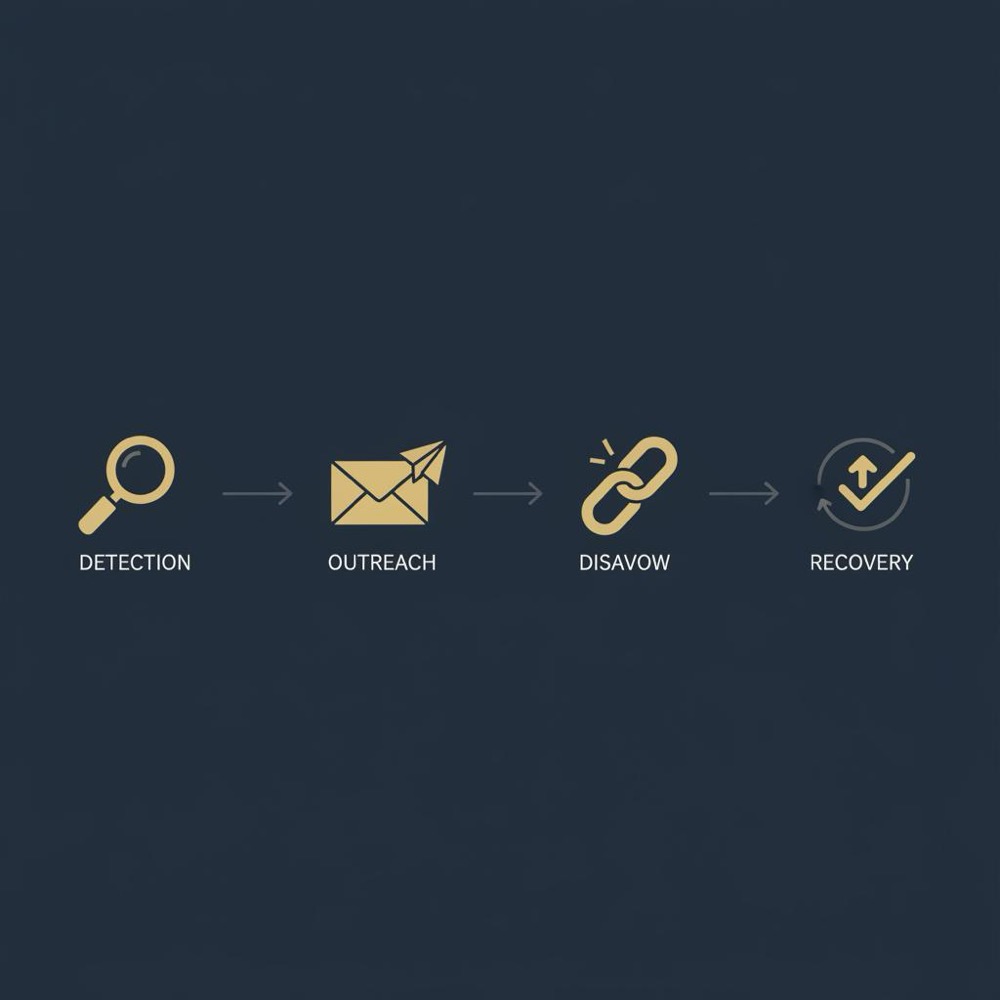
Step 1 - document the evidence
Export and timestamp everything. Record the linking page, the anchor text, apparent payment evidence, and the contact details for the publisher.
Step 2 - outreach and removal
Contact site owners with polite, factual removal requests. Keep records of sent emails, responses and screenshots. Many removals are granted if the owner understands the problem.
Step 3 - disavow as a last resort
Only use Google’s disavow tool after sincere removal attempts fail. Disavow tells Google to ignore links but doesn’t remove them from the web. It’s a blunt instrument and should be surgical.
Step 4 - file a reconsideration request if you have a manual action
If Google applied a manual action, prepare a clear timeline, include evidence of outreach, and explain the remediation steps you took. Honest documentation and a cultural shift toward compliance are more persuasive than clever wording. For practical context on algorithm updates and evasive link schemes, review this resource: Google algorithm updates and link scheme guidance.
Recovery timeline and expectations
Recovery varies by scale and responsiveness:
- Small problems: A handful of removable links - expect weeks for outreach and algorithmic rebalancing.
- Moderate problems: Hundreds of links or uncooperative publishers - expect months to rebuild rankings.
- Severe problems: Manual action across a domain - recovery can take many months and requires a solid reconsideration package.
Remember: answering "is buying backlinks illegal" matters less than how quickly and well you remediate when things go wrong.
When to involve legal or specialist help
Legal counsel is useful when disclosure laws may have been broken or when vendors behave fraudulently. SEO consultancies or remediation specialists are valuable for large profiles. Questions to ask prospective partners include:
- How do you combine data sources?
- What manual checks do you perform?
- How do you document outreach and removals?
- Do you provide a defensible reconsideration package if a manual action exists?

Orvus Ltd., for example, emphasizes a hybrid of automated feeds and human review - a method that’s especially effective for complex link profiles.
Safer alternatives to buying backlinks
Buying links can feel quick and measurable, but the safer, higher-return strategies are those that earn links over time:
- High-value content: Guides, tools and data that naturally attract links.
- Original research: Surveys and reports that niche journalists and industry sites cite.
- PR and outreach: Transparent partnerships with publishers and honest pitches that add value.
- Resource pages and partnerships: Create assets that others want to link to for the user benefit.
Each of these answers the deeper worry behind "is buying backlinks illegal": how do I grow visibility without risky shortcuts?
A single cheap backlink is unlikely to cause a ban on its own; more often it’s ignored. The real risk is when one paid link becomes part of a pattern of manipulative behavior. Focus on patterns, documentation and disclosure to reduce risk.
How to vet vendors before you pay
If you still consider paid placements, use strict vendor vetting to lower risk:
- Ask for documented editorial processes and proof of disclosure.
- Request sample placement URLs and contact details for references.
- Insist on rel="sponsored" or rel="nofollow" on paid links and a written clause in your contract.
- Keep invoices and communication records for audits or future remediation.
That checklist helps answer "is buying backlinks illegal" by focusing on risk management rather than blind shortcuts.
Common mistakes that turn a small problem into a big one
Poor documentation, invisible payments, and vendors who promise guaranteed rankings are classic culprits. Avoid these:
- Not saving invoices or contracts documenting the purchase.
- Buying bulk links with identical anchor text.
- Trusting vendors who won’t share placement URLs until you pay.
Those choices convert a transient boost into a sustained recovery project.
Measuring recovery success
Track these KPIs during remediation:
- Organic sessions and keyword ranking trends for affected pages.
- Number of removals confirmed versus number of disavowed links.
- Search Console manual action status and index coverage reports.
- Referral traffic from previously suspicious domains (to confirm removal or change).
Metrics tell you whether your work is restoring visibility or whether additional steps are needed.
Template: polite removal outreach (copy, paste, adapt)
Use a short, professional message when requesting link removal. Keep tone factual and non‑accusatory.
Subject: Request to remove a link to [your site]
Body: Hello [name], I hope you’re well. We’re auditing our link profile and found a link on [linking page URL] to our site, [your page]. Could you please remove or update this placement? I appreciate your help. Best, [your name]
Keep copies of every message and any replies - they matter for reconsideration requests.
Why not disavow everything?
Disavowing at scale can remove potentially valuable link diversity. Some low-quality links might have a small positive effect. A surgical, evidence-based disavow file is preferable to blanket lists. Use disavow only after manual review and unsuccessful removal attempts.
AI, automation and future trends
The rise of AI-generated content has blurred lines. Large volumes of low-quality, automated pages that host paid links are a growing enforcement challenge. Search engines aim to reward genuine editorial value - and AI or automation used transparently to assist creators can be fine. The key question remains: does the content exist to help readers or to pass ranking signals?
Case study: a common real-world recovery
A small e-commerce brand bought a package of cheap links and saw an immediate lift. Weeks later, traffic fell and a manual action appeared in Search Console. The brand had no invoices and the vendor vanished. Recovery involved an exhaustive audit, outreach attempts, a disavow file for stubborn links, and a thoughtful reconsideration request. It took months, cost more than the original purchase, and forced a change in strategy. The lesson: short-term boosts are often false economies.
Checklist: immediate steps to take this week
- Export links from Search Console and a commercial index.
- Identify the top 50 suspicious links and review them manually.
- Begin outreach to site owners for removal.
- Document responses and prepare a disavow file for stubborn cases.
- If you find a manual action, assemble evidence and prepare a reconsideration request.
Vendor relationships and contract language
Require transparent contract terms: placement URLs, disclosure obligations, and the use of rel="sponsored". Avoid vendors who use opaque networks or refuse to provide placement proof beforehand. That contract clarity helps answer the compliance part of "is buying backlinks illegal".
When paid placements can be acceptable
Paid placements aren’t always taboo. When they’re transparently disclosed, use rel attributes and do not pass ranking signals, many publishers and platforms allow sponsored content. Paid placement that is clearly advertising and does not manipulate rankings is a lower risk option.
Long-term link strategy that scales
Think systems, not isolated purchases. Orvus teaches an approach that blends content architecture, performance analysis and automation to produce repeatable link-attracting assets. Tactics include building cornerstone content, creating reproducible data assets, and leveraging client testimonials and partnerships.
Think systems, not isolated purchases. Orvus teaches an approach that blends content architecture, performance analysis and automation to produce repeatable link-attracting assets. Tactics include building cornerstone content, creating reproducible data assets, and leveraging client testimonials and partnerships.
Final practical advice
Ask three questions before any link spend: Is this placement transparent? Can I document the payment and placement? Will the publisher disclose the relationship and use rel="sponsored"? If you can’t answer yes to all three, don’t buy the link.
Parting thought
When you search for "is buying backlinks illegal" what you’re really asking is whether a shortcut is worth a long-term risk. In almost every case, the safer path is patience, transparency and creating work that earns links. That preserves traffic, reputation and peace of mind.
A single cheap backlink rarely causes an immediate penalty; search engines often ignore isolated paid links. However, patterns matter: repeated purchases, exact-match anchors, and placements that look editorially suspect increase the risk of algorithmic devaluation or manual action. Always document payments, vet vendors, and prefer disclosure (rel="sponsored") to reduce exposure.
Not immediately. The recommended order is: document the links, attempt removal via polite outreach, and use disavow only when removal attempts fail. Disavow is a blunt instrument and should be surgical - too many disavows can strip potentially useful link diversity. If a manual action exists, include outreach records and a disavow file where appropriate in your reconsideration request.
Yes. Orvus Ltd. offers a measured approach combining multiple link indexes, manual reviews, and documented outreach to build a defensible remediation plan. If you need help interpreting data or preparing a reconsideration package, Orvus’ services provide tailored support to restore organic visibility and prevent future problems.
References
Want this kind of work done for your business?
We build and run AI-powered marketing and automation. 15 minutes, honest assessment.
Book a call