 Orvus
OrvusHow to Vet a Marketing Agency: Red Flags Solo Founders Miss
June 6, 2026
The cost structure differs fundamentally. A three-month engagement with the wrong agency doesn't just waste $9,000 in fees for a bootstrapped founder, it consumes irreplaceable time in unproductive meetings and costs another $15,000 in lost revenue from campaigns that should have worked but didn't. Standard agency vetting advice focuses on portfolio review and strategic vision, which matters for enterprises. Solo founders need a different framework: accountability mechanisms, transparency tests, contract flexibility, and proof of execution in constrained-budget environments.
This guide provides that systematic framework, focusing on the specific red flags that seem minor during sales conversations but predict expensive failures once you're committed. The approach addresses the blind spots solo founders have when evaluating agencies, from transparency failures to misaligned communication cadences, helping you make informed decisions without burning time and budget learning lessons the hard way.
Why Solo Founders Get Agency Vetting Wrong
Solo founders and bootstrapped operators approach agency vetting with a fundamental handicap: expertise asymmetry. When you’re evaluating marketing specialists, you’re assessing capabilities you don’t fully possess. That’s the point of hiring them. But this creates a dangerous dynamic where confident agency language can mask incompetence, and your lack of domain knowledge prevents you from asking the questions that would expose it.
Corporate vetting processes don’t translate to solo operations. Enterprise buyers have procurement teams, legal review, pilot budgets, and the luxury of testing multiple agencies simultaneously. They can afford a six-month mistake. Solo founders can’t. When you’re the operator, a bad agency match doesn’t just waste budget, it consumes irreplaceable founder time in meetings, revisions, and damage control. Three months with the wrong agency might mean three months of zero revenue growth while you’re locked into contract minimums and trying to course-correct.

The cost structure differs fundamentally. A corporation spending $15,000 monthly on an underperforming agency loses money. A solo founder spending $3,000 monthly on the same loses money plus the opportunity cost of not executing the work themselves or finding a better match. For bootstrapped operations, agency spend often represents 10 to 20 percent of monthly revenue. That’s not experimental budget, that’s survival budget. A poor agency match for three months might cost $9,000 in fees plus another $15,000 in lost revenue from campaigns that should have worked but didn’t.
Standard agency vetting advice focuses on portfolio review, culture fit, and strategic vision. That’s fine for enterprises. Solo founders need a different lens: accountability mechanisms, reporting transparency, contract flexibility, and proof of execution in constrained-budget environments. The framework that follows addresses these operator-specific needs, focusing on red flags that seem minor during the sales process but predict expensive failures once you’re committed.
The Non-Negotiable Transparency Tests
Transparency separates professional agencies from expensive mistakes. The first test is case study verification. When an agency presents case studies, request the specific metrics, timeframes, and client context. A legitimate case study includes the starting position, the intervention, the timeline, and the measurable outcome. Vague language like “increased traffic significantly” or “improved conversion rates” without numbers indicates either poor tracking or fabricated results.
Ask these specific questions about every case study: What was the client’s monthly budget? What was the baseline metric before engagement? What was the metric after three months, six months, twelve months? What specific tactics drove the improvement? Can you connect me with this client directly? Agencies that hesitate or deflect on any of these questions are hiding something. Professional firms have this data ready because they track it for their own learning.
The reference check framework that actually works requires going beyond the curated list. When an agency provides references, ask for the contact information of their three most recent clients in your industry vertical, not their three best success stories. Then conduct independent verification. Search for the agency name plus “review” or “complaint” on multiple platforms. Check if the referenced clients actually exist and match the described business profile. A systematic verification protocol prevents you from being sold on cherry-picked success stories that don’t represent typical outcomes.
During reference calls, ask specific questions: How often did the agency provide performance reports? What format were they in? When you had concerns, how quickly did they respond? Did the agency meet its initial timeline estimates? Would you hire them again? What would you do differently if you were starting the engagement over? The answers reveal accountability patterns that the agency’s sales process won’t show you.
Reporting cadence reveals everything about accountability. Best-practice agencies provide weekly or bi-weekly performance dashboards with clear KPIs tied to your business goals. The reports should be accessible in real-time through a shared dashboard, not just emailed as PDFs once a month. Monthly reporting is a red flag for solo founders because it means you’re flying blind for 30 days at a time. When you’re spending a meaningful percentage of revenue on agency work, you need visibility into what’s happening and whether it’s working.
What the reports contain matters as much as their frequency. Look for specific metrics: traffic sources, conversion rates by channel, cost per acquisition, return on ad spend, ranking changes for target keywords, email open and click rates. Vague summaries about “progress” or “momentum” without numbers indicate an agency that either doesn’t track properly or doesn’t want you to see the actual results. Transparency in reporting structures serves as an early warning system for agencies that overpromise and underdeliver.
If you’re evaluating how to vet a marketing agency and the transparency tests reveal hesitation, vague answers, or resistance to providing detailed case studies and references, end the conversation. Transparency problems during the sales process only get worse once you’re under contract.
Vet Smarter, Not Harder
The difference between a productive agency relationship and an expensive mistake often comes down to the questions you ask before signing. A structured evaluation framework helps you systematically assess transparency, capability, and alignment so you're making decisions based on evidence rather than sales polish. The right preparation turns agency vetting from a gamble into a manageable risk.
Industry Experience vs. Generalist Promises
Vertical-specific experience matters exponentially more for solo operators than for enterprises. When you’re bootstrapped, you can’t afford the learning curve of an agency figuring out your market dynamics on your dime. A generalist agency might be competent at tactics, running Google Ads, building email sequences, but if they don’t understand your buyer’s decision process, your sales cycle length, or your industry’s content expectations, those tactics will miss the mark.
The difference shows up immediately in messaging and channel selection. An agency with deep SaaS experience knows that free trial conversion rates matter more than raw traffic. An agency with e-commerce experience knows that product page optimization and cart abandonment sequences drive more revenue than blog content. An agency without your vertical experience will default to generic best practices that sound good but don’t match how your customers actually buy.
Assessing genuine niche expertise requires specific questions that expose depth. Ask the agency: What are the typical customer acquisition costs in my industry? What’s the average sales cycle length? What content formats perform best for my buyer persona? Which channels typically deliver the highest ROI in my vertical? What are the common conversion rate benchmarks? An agency with real experience will answer these immediately with numbers and nuance. A generalist will give vague answers or pivot to talking about their process.
Request examples of work they’ve done in your specific industry, not adjacent ones. If you run a B2B service business, case studies from e-commerce clients don’t demonstrate relevant experience. If you operate in a regulated industry like finance or healthcare, you need an agency that understands compliance constraints. The tactics that work in consumer markets often fail in professional services, and vice versa. Industry-specific evaluation criteria help you separate genuine vertical expertise from surface-level familiarity.
There are scenarios where a generalist approach might work. If you’re in an emerging market where no agencies have deep experience yet, a strong generalist with a track record of entering new verticals can be acceptable. If your needs are purely tactical, like managing a specific ad platform, vertical experience matters less than platform expertise. If you’re willing to invest time educating the agency about your market and you have margin for a longer ramp-up period, a generalist with strong fundamentals might deliver.
But for most solo founders, those conditions don’t apply. You need results quickly, you don’t have time to train your agency, and you’re operating in established markets where vertical-specific knowledge exists. In those situations, choosing a generalist over a specialist is choosing to pay for their education instead of benefiting from their expertise.
Industry-specific experience combined with transparent reporting structures matters most for solo founders. An agency might be technically competent across multiple tactics, but if they don't understand your vertical's buyer behavior, sales cycle, and content expectations, their execution will miss the mark. Simultaneously, even vertical expertise is worthless if the agency won't provide weekly or bi-weekly performance dashboards with clear KPIs, because you'll have no visibility into whether their work is actually driving results. The combination of relevant experience and accountability mechanisms gives you both appropriate strategy and the ability to course-correct quickly when something isn't working. Agencies that have one without the other create different failure modes, but both lead to wasted time and budget for bootstrapped operators who can't afford extended learning curves or blind execution periods.
Evaluating the Agency’s Own Marketing
The self-marketing litmus test is simple: if an agency can’t market itself effectively, it probably can’t market you effectively either. This seems obvious, but founders overlook it constantly, swayed by smooth sales conversations and impressive client lists. The agency’s own marketing execution reveals their actual capabilities more reliably than any case study or testimonial.
Start with their website. Is it fast, well-structured, and easy to navigate? Does it clearly articulate what they do, who they serve, and what results they deliver? Is there proof of their claims in the form of case studies with real numbers? A marketing agency with a slow, confusing, or outdated website is telling you exactly how they’ll handle your marketing: poorly. Website quality assessment criteria should include load speed, mobile responsiveness, clear value proposition, and evidence of their own SEO competence.
Check if they rank for the services they’re selling. If an agency offers SEO services but doesn’t rank for relevant search terms in their own market, that’s a direct indicator of their SEO capability. If they claim to be content marketing experts but their blog is sparse, outdated, or low-quality, they’re not practicing what they preach. If they position themselves as social media specialists but their own social presence is inactive or engagement is minimal, the disconnect is obvious.
Content strategy reveals operational discipline. Look at their blog, newsletter, or resource library. Is content published consistently? Is it substantive and specific, or generic and thin? Does it demonstrate actual expertise, or does it read like keyword-stuffed filler? Agencies that produce high-quality content regularly are showing you they have systems, they understand content marketing, and they can execute consistently. Agencies with sporadic, low-effort content are showing you they’ll treat your marketing the same way.
Social proof signals require careful evaluation. Distinguish between meaningful social proof and manufactured credibility. Meaningful social proof includes: detailed case studies with named clients and specific results, video testimonials from recognizable people, independent reviews on third-party platforms, mentions or features in credible industry publications. Manufactured credibility includes: vague testimonials without names or companies, awards from pay-to-play organizations, self-published “best of” lists, inflated follower counts with minimal engagement.
Look at engagement rates, not just follower counts. An agency with 50,000 followers and 10 likes per post has a dead audience. An agency with 2,000 followers and 100 engaged comments per post has a real community. The latter tells you more about their ability to build meaningful audience relationships. Evaluating marketing consultants requires looking past vanity metrics to actual engagement and conversion indicators.
If the agency’s own marketing is mediocre, they’re either incapable of better work or they don’t prioritize their own growth. Either way, that’s not who you want managing your marketing budget.
Red Flags in Promises and Guarantees
Agencies that guarantee specific search rankings are either lying about their methods or using tactics that will damage your brand long-term. Search ranking guarantees indicate the agency plans to use manipulative link schemes, keyword stuffing, or other tactics that violate search engine guidelines. These methods might produce short-term ranking improvements, but they result in penalties that can take months or years to recover from.
Legitimate SEO agencies never guarantee rankings because they don’t control the search algorithms. What they can guarantee is process: keyword research, technical optimization, content creation, link outreach. They can commit to specific deliverables and activity levels. They can show you historical data about typical timeframes for ranking improvements in your industry. But they can’t promise you’ll rank number one for your target keyword by a specific date. Ranking guarantees indicate problematic tactics that put your long-term visibility at risk for short-term gains.
Viral result promises represent another fantasy metric category. Any agency promising to “make your content go viral” or “guarantee viral reach” is selling a fiction. Virality is not a reliable outcome. It’s the result of content that resonates unexpectedly with a large audience, often with elements of timing, luck, and cultural moment that can’t be engineered consistently. Agencies that promise viral results are either inexperienced or dishonest.
Watch for specific language patterns that signal unrealistic promises: “guaranteed first-page rankings,” “viral marketing campaigns,” “10x your traffic in 30 days,” “instant ROI,” “we’ll get you on the front page of Google.” These phrases indicate an agency that prioritizes closing the sale over setting realistic expectations. The promises sound appealing, especially to founders who need results quickly, but they’re red flags for eventual disappointment.
What legitimate agencies promise instead: a structured process, regular reporting, specific deliverables, and incremental improvement over defined timeframes. They talk about building sustainable systems, testing and optimization, and compounding results over months, not overnight transformations. They set expectations based on industry benchmarks and historical data, not on what sounds exciting in a sales call.

Process-focused agencies commit to things they control: conducting keyword research, publishing X pieces of content per month, running A/B tests on ad creative, optimizing landing pages, building email sequences, providing weekly performance reports. They frame success as incremental improvement: “We typically see a 15 to 25 percent increase in organic traffic over the first six months” rather than “We’ll triple your traffic in 60 days.” The former is a realistic commitment based on data. The latter is a sales pitch.
If an agency’s promises sound too good to be true, they are. End the conversation and find an agency that respects your intelligence enough to set realistic expectations.
Contract Structure and Flexibility Signals
Trial periods reveal agency confidence more than any sales pitch. An agency that offers a 30 or 60-day trial period, or month-to-month terms after a minimal initial commitment, is confident in their ability to deliver results that justify continued engagement. An agency that insists on six or twelve-month contracts upfront is either trying to lock in revenue regardless of performance or they know their results take too long to materialize.
For solo founders, contract flexibility is a risk reduction mechanism. You’re making a significant financial commitment to a service provider you haven’t worked with before. A trial period or short initial term lets you evaluate the working relationship, the quality of their work, and the actual results before committing to a longer engagement. Agencies that resist this structure are prioritizing their revenue security over your risk management, which tells you how the relationship will go.
Pricing model transparency serves as a trust indicator. Legitimate agencies provide clear breakdowns of what you’re paying for: strategy hours, execution hours, ad spend management fees, tool costs, reporting time. They explain their pricing structure and what’s included at each tier. They’re upfront about additional costs that might arise and under what conditions. Questions about pricing transparency should be answered directly and completely during the vetting process.

Opaque pricing is a red flag. If an agency won’t break down their monthly fee into component costs, they’re either hiding margin or they don’t have a structured service delivery model. If they’re vague about what’s included and what costs extra, you’ll face surprise charges later. If they resist discussing pricing until late in the sales process, they’re trying to build commitment before revealing the cost, which is a manipulative sales tactic.
Lock-in clauses and exit terms require careful negotiation. Read the contract for auto-renewal clauses, early termination penalties, and notice periods. A founder-favorable contract includes: a defined initial term with clear renewal terms, the ability to terminate with 30 days notice after the initial period, no penalties for early termination beyond paying for work already completed, and clear ownership of all work product and data.
Specific contract clauses to negotiate or avoid: automatic renewal without explicit opt-in, termination penalties that exceed one month’s fees, ownership claims on strategy documents or content created during the engagement, non-compete clauses that prevent you from working with other agencies in the future. Contract terms that protect founders shift risk away from you and onto the agency, which is appropriate given the expertise asymmetry.
Evaluate contract terms for founder-favorable risk allocation and exit flexibility
Green flags are trial periods, short notice, no penalties, and clear ownership transfer
If an agency pushes back hard on contract flexibility, ask yourself why. Confident agencies with strong track records don’t need to lock clients into long terms. They know their results will retain clients. Agencies that insist on rigid contracts are revealing their actual confidence level in their ability to deliver value worth continuing.
The Strategic Alignment Assessment
Communication cadence compatibility determines whether the day-to-day relationship works or becomes a source of friction. Some agencies operate on weekly check-ins with asynchronous updates in between. Others prefer bi-weekly strategy calls with minimal communication otherwise. Neither approach is wrong, but misalignment with your preferred working style creates frustration.
Ask specific questions about communication frequency and style during the vetting process: How often will we have scheduled calls? What’s the typical response time for email or Slack messages? Who will be my primary point of contact? Will I work with the person I’m talking to now, or will I be handed off to an account manager? What communication tools do you use? How do you handle urgent requests or time-sensitive issues?
Misaligned communication cadence shows up as a red flag in multiple ways. If you prefer frequent updates and quick iteration but the agency operates on monthly review cycles, you’ll feel ignored and out of control. If you prefer minimal meetings and asynchronous communication but the agency wants weekly hour-long calls, you’ll feel like your time is being wasted. Neither party is wrong, but the mismatch makes the relationship unsustainable.
Decision-making speed and founder autonomy matter especially for solo operators. You’re used to making decisions quickly and implementing immediately. Some agencies match that pace, presenting options and executing based on your rapid feedback. Other agencies have internal approval processes, creative review cycles, and implementation timelines that span weeks. Again, neither is wrong, but the mismatch creates friction.
Test decision-making alignment by asking: If I want to pause a campaign or shift budget between channels, how quickly can that happen? If I have feedback on ad creative or content, what’s the revision timeline? How much autonomy do I have to make tactical decisions versus needing to go through your team? Agencies that give you direct access to campaign dashboards and trust you to make real-time adjustments respect your operational speed. Agencies that gate all access through account managers and require approval for minor changes will slow you down.
Cultural fit indicators predict working relationship quality beyond tactical execution. Do they ask good questions about your business, or do they pitch their services immediately? Do they listen to your constraints and adapt their recommendations, or do they push a standard package? Do they acknowledge what they don’t know, or do they claim expertise in everything? Do they respect your time in meetings, or do they ramble and go over schedule?
Pay attention to how the agency treats you during the sales process. If they’re pushy, dismissive of your concerns, or disrespectful of your time before you’re a client, it will only get worse after you sign. If they’re responsive, thoughtful, and respectful during vetting, that’s likely how they’ll operate during the engagement. Cultural compatibility signals are soft factors, but they determine whether you’ll enjoy working together or dread every interaction.
The strategic alignment assessment is harder to quantify than transparency tests or contract terms, but it’s equally important. A technically competent agency that you can’t stand working with will produce mediocre results because the relationship friction prevents effective collaboration. Find an agency that matches your working style, communication preferences, and decision-making speed, not just your budget and tactical needs.
Building Your Agency Vetting Checklist
A structured vetting process starts with pre-call research. Before you schedule a conversation with any agency, complete these research requirements: review their website for service clarity and proof of expertise, read at least three case studies and note specific metrics, check their content quality and publication consistency, search for independent reviews on multiple platforms, verify their claimed expertise by checking if they rank for their own services, and identify at least two specific questions based on gaps or concerns from your research.
This research phase takes 30 to 45 minutes per agency and eliminates obvious mismatches before you invest time in conversations. If an agency fails the pre-call research, cross them off the list. Don’t schedule a call hoping they’ll somehow be better in person than their marketing suggests.
First conversation evaluation criteria should cover both capability and compatibility. Use this framework: Ask about their experience in your specific industry vertical and note the specificity of their answers. Request examples of similar clients and the results achieved. Discuss their reporting structure and ask to see a sample dashboard. Ask about their communication cadence and decision-making process. Inquire about contract terms, pricing structure, and flexibility options. Observe how they listen, whether they ask good questions about your business, and whether they adapt their pitch to your stated needs.
Take notes during the call using a consistent format across all agencies you’re evaluating. This makes comparison easier and prevents you from relying on impressions that fade over time. After the call, score each agency on the key criteria: industry experience, transparency, communication fit, contract flexibility, and overall confidence in their capability. Agencies that score poorly on any critical dimension should be eliminated immediately.
The proposal review framework ensures you’re comparing agencies on consistent criteria. When you receive proposals, evaluate them on: clarity of scope and deliverables, specificity of timeline and milestones, transparency of pricing and what’s included, realistic outcome expectations versus overpromises, evidence of customization to your business versus generic templates, and contract terms that protect your interests. A strong proposal demonstrates that the agency listened during your conversation and tailored their approach to your specific situation.
Generic proposals that could apply to any business indicate the agency isn’t investing in understanding your needs. They’re pitching a standard package and hoping you’ll buy it. Customized proposals that reference specific challenges you discussed, recommend channels based on your target audience, and acknowledge your budget constraints show an agency that’s thinking strategically about your success.
Decision timeline recommendations prevent both rushed decisions and analysis paralysis. A reasonable vetting timeline for solo founders: one week for initial research and outreach to 4 to 6 agencies, two weeks for first conversations and proposal requests with 2 to 3 finalists, one week for proposal review and reference checks, one week for final decision and contract negotiation. Total timeline: four to five weeks from starting research to signing a contract.
This timeline assumes you’re being deliberate but not overthinking it. Faster timelines risk missing red flags. Slower timelines often indicate you’re not ready to commit or you’re hoping a perfect agency will appear. Neither serves you well. Set a deadline for your decision and stick to it.
Your go/no-go criteria should be explicit before you start the process. Define your non-negotiables: minimum industry experience, required contract flexibility, maximum budget, communication style requirements, reporting frequency standards. Any agency that doesn’t meet these baseline criteria gets eliminated regardless of how good their sales pitch is. This prevents you from talking yourself into a bad fit because you’re tired of searching or you liked the salesperson.
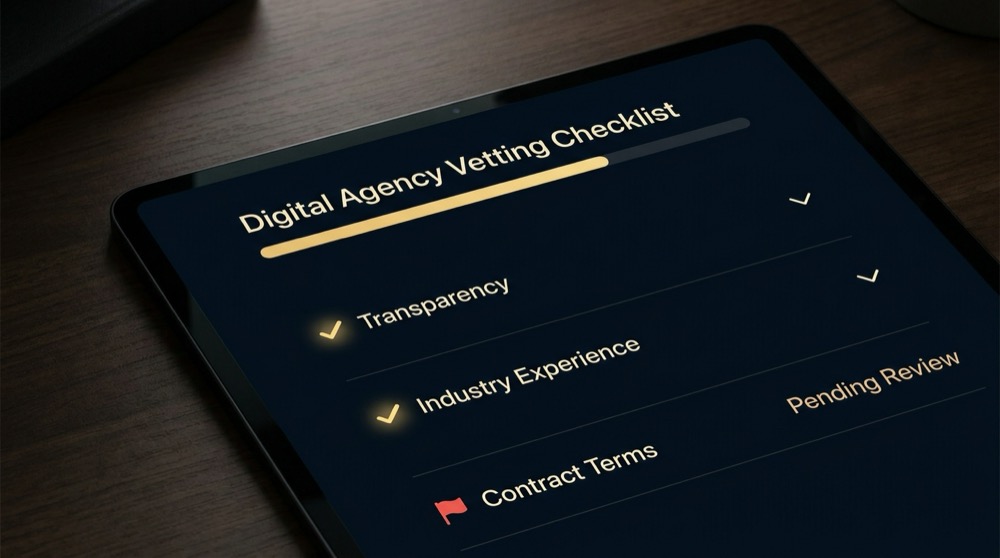
The final checklist synthesizing all vetting dimensions looks like this: Industry experience verified through case studies and specific knowledge. Transparency confirmed through detailed reporting samples and reference checks. Contract terms reviewed and negotiated to include trial period or short initial term. Pricing structure understood with clear breakdown of costs. Communication cadence and decision-making speed aligned with your preferences. Cultural fit assessed through sales process interactions. Red flags evaluated and either explained satisfactorily or used as elimination criteria. Proposal customized to your business with realistic expectations.
If an agency passes all these checkpoints, you’ve done the work to minimize risk. No vetting process is perfect, but a systematic approach to building marketing systems dramatically improves your odds of finding an agency partner that delivers results instead of excuses. The time you invest in thorough vetting pays back immediately by avoiding the much larger cost of a bad agency match.
A thorough vetting process for solo founders should take four to five weeks total. Spend one week on initial research and outreach to 4 to 6 agencies, two weeks on conversations and proposals with 2 to 3 finalists, one week on proposal review and reference checks, and one week for final decision and contract negotiation. This timeline balances deliberate evaluation with decisiveness. Faster timelines risk missing critical red flags like vague reporting structures or misaligned communication styles. Slower timelines often indicate hesitation or unrealistic expectations about finding a perfect agency. Set a clear deadline and stick to it, using explicit go/no-go criteria to eliminate agencies that don't meet your non-negotiables rather than endlessly comparing options.
End the conversation immediately. An agency that refuses to provide verifiable client references is hiding something, whether that's poor results, unhappy clients, or a lack of relevant experience. Transparency in past performance is foundational to trust, and professional agencies have satisfied clients who are willing to speak about their experience. If an agency claims confidentiality agreements prevent them from sharing any references, ask for anonymized case studies with detailed metrics instead, or request references from clients who have explicitly agreed to be contacted. If they resist both options, that's a definitive red flag. Your vetting process should eliminate agencies that won't demonstrate proof of their claimed capabilities through verifiable past work and client testimonials.
Hire an agency when your time is more valuable spent on product, sales, or operations than on executing marketing tactics, and when you have sufficient budget that agency fees represent a manageable percentage of revenue, typically 10 to 20 percent monthly. Do it yourself when you're in early validation stages, when your budget is extremely constrained, or when you need to deeply understand your marketing channels before delegating them. The decision depends on your specific constraints and opportunity costs. A good agency accelerates growth by executing tactics you don't have time to learn or implement yourself. A bad agency wastes money and founder time while delivering minimal results. The key is thorough vetting to ensure you're hiring an agency that understands your market, communicates transparently, and operates with contract terms that protect your interests. If you can't find an agency that meets those criteria within your budget, doing it yourself is often the better choice until you can afford a quality partner.
The time you invest in proper vetting, typically four to five weeks from research to signed contract, pays back immediately by avoiding the much larger cost of a bad agency match. Solo founders who skip vetting steps or ignore red flags because they're eager to start often spend six months and $20,000 learning that the warning signs were accurate. Operators who follow a disciplined process might spend an extra month in evaluation but find an agency partner that accelerates growth instead of consuming resources. The choice is between being deliberate now or being expensive later.
References
Want this kind of work done for your business?
We build and run AI-powered marketing and automation. 15 minutes, honest assessment.
Book a call