 Orvus
OrvusHow to Market a SaaS Product When You're Technical Not a Marketer
June 8, 2026
The bottleneck is not creativity or persuasion. It is distribution. You built something that solves a real problem. The challenge is getting it in front of people who need it. This guide shows you how to do that without hiring a marketing team, without a large budget, and without pretending to be someone you are not.
What follows is a systematic, execution-focused framework. It prioritizes channels that leverage your existing technical skills. It treats marketing as an engineering problem with measurable outcomes. It assumes you have limited time and no tolerance for guesswork. If that describes you, keep reading.
Why Technical Founders Struggle With SaaS Marketing (And Why That’s Fixable)
The common belief is that marketing requires creativity, persuasion skills, and an intuitive sense for what resonates with audiences. Technical founders look at marketing campaigns and see something that feels foreign, something that requires talents they do not possess. This is the wrong framing. Marketing is not magic. It is a system with inputs, outputs, and feedback loops. If you can debug code, you can debug a marketing channel.
The actual skill gap is not creativity. It is distribution. Most technical founders build products that solve real problems. They understand their domain, they ship working software, and they iterate based on feedback. What they lack is not product quality but reach. The bottleneck is getting the product in front of people who need it, not making the product better. This is a solvable problem.

Technical founders have advantages that traditional marketers do not. They understand data. They know how to instrument systems, measure outcomes, and iterate based on evidence. They are comfortable with experimentation and failure as part of the process. They can read analytics, write scripts to automate repetitive tasks, and build tools that make marketing more efficient. These are not minor advantages. They are structural ones.
The misconception that marketing requires innate creativity over systematic execution keeps many technical founders from starting. Marketing feels like a different discipline entirely, one that requires skills orthogonal to engineering. In reality, the best marketing for technical products comes from treating it as an engineering problem. You identify the constraint, you test hypotheses, you measure results, and you scale what works. This is not a metaphor. This is the actual process.
What stops most technical founders is not inability but unfamiliarity. Marketing has its own jargon, its own tools, its own conventions. Learning these takes time, but it does not require a personality transplant. You do not need to become a copywriter or a brand strategist. You need to understand which channels drive signups, how to measure what matters, and how to allocate limited time to activities with the highest return. This is tractable.
Start With the Foundation: Know Who You’re Building For
Before you write a single blog post or launch a single campaign, you need to know who you are marketing to. This is not about demographics or personas. It is about understanding the specific problems your product solves, for whom, and in what context. Most technical founders skip this step because they assume they already know. They built the product, after all. But building for yourself or a narrow set of early users is not the same as understanding the broader market.
Customer conversations are the starting point. Not surveys, not analytics dashboards, not assumptions. Actual conversations with people who use your product or who fit the profile of someone who should. You need to ask specific questions. What were they doing before they found your product? What problem were they trying to solve? What alternatives did they consider? Why did they choose your product, or why did they choose something else? What would make them recommend it to a colleague?
These questions reveal patterns. You will hear the same phrases repeated. You will notice common workflows, common pain points, common objections. This is the raw material for positioning, messaging, and channel selection. You cannot get this from analytics alone. Customer development is reconnaissance, and it must happen before you commit resources to any marketing channel.
Once you have conducted enough conversations, typically ten to twenty, you can start mining your existing user data for patterns. Look at your product analytics. Which features do your most engaged users rely on? How long does it take them to reach their first meaningful outcome? What actions correlate with retention? What actions correlate with churn? This is not about vanity metrics like page views or session duration. It is about identifying the behaviors that predict long-term value.
Segment your users by behavior, not demographics. Demographics tell you who someone is. Behavior tells you what they need. A user who logs in daily and uses three specific features is a different segment from a user who logs in once a week and only uses one feature, even if they work at similar companies or have similar titles. Behavioral segmentation lets you tailor your messaging and your product experience to what actually drives value.
Your ideal customer profile should be built from evidence, not assumptions. It should describe not just who your best customers are but what they do, what problems they face, and how they evaluate solutions. This profile becomes the filter for every marketing decision. Does this blog post speak to this profile? Does this partnership reach this profile? Does this feature appeal to this profile? Without this foundation, marketing becomes guesswork.
The goal of this research phase is clarity. You should be able to describe your ideal customer in a single paragraph, explain the specific problem your product solves for them, and articulate why your solution is better than the alternatives. If you cannot do this, you are not ready to market. You are still figuring out product-market fit.
Product-Led Growth: Let Your SaaS Sell Itself
Product-led growth is not a buzzword. It is a forcing function. It means your product must be good enough, clear enough, and valuable enough that users can evaluate it without talking to a salesperson. For technical founders, this is the ideal marketing strategy because it shifts the burden from persuasion to demonstration. You do not need to convince someone your product works. You let them see it work.
The decision between a free trial and a freemium model matters. A free trial gives full access for a limited time. A freemium model gives limited access indefinitely. Free trials work when your product delivers clear value quickly and when the full feature set is necessary to evaluate it. Freemium works when a subset of features provides standalone value and when you can convert users by adding capabilities, not by removing time limits. Most technical products fit one model better than the other. Choose based on your product’s time-to-value and feature architecture, not based on what competitors do.
Time-to-value is the critical metric. This is the time between signup and the moment a user experiences the core benefit of your product. If this takes days or weeks, you will lose most trial users before they see why your product matters. Your onboarding must compress this timeline. Remove friction, automate setup, provide sample data, guide users to the aha moment. This is not just user experience design. This is conversion optimization.
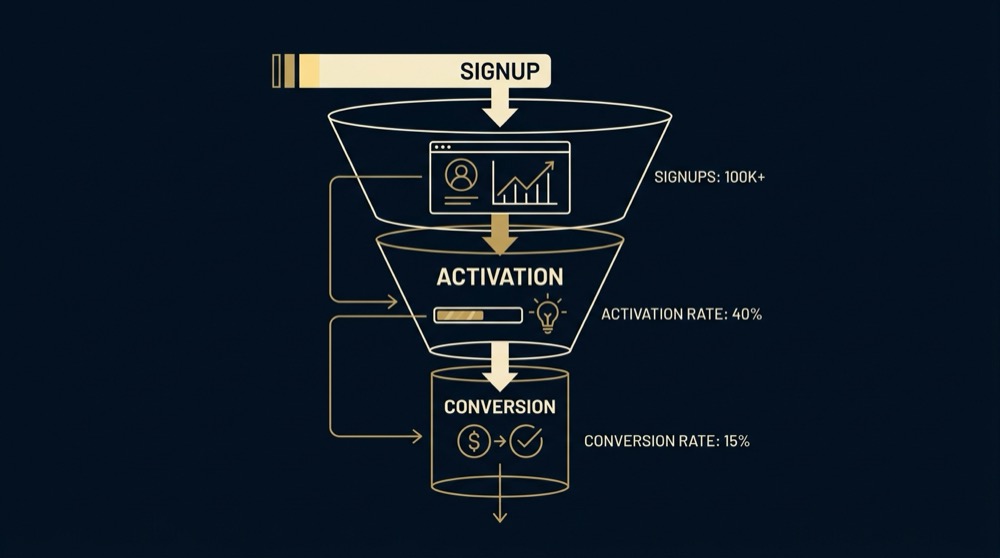
Activation rate is more important than signup rate. Activation means a user has completed the actions that correlate with retention. For a project management tool, activation might mean creating a project and inviting a team member. For an analytics platform, it might mean connecting a data source and viewing a report. Define activation based on your retention data, then measure what percentage of signups reach activation. This is the number that determines whether your product-led approach works.
Product-led growth requires instrumentation. You need to track every step of the user journey from signup to activation to conversion. You need to know where users drop off, which features drive retention, and which behaviors predict upgrades. This is not optional. Without this data, you cannot iterate. You are flying blind.
Systematic Marketing for Operators
Most technical founders underestimate how much onboarding determines conversion. A product that delivers value in five minutes will always outperform one that takes an hour, even if the latter is more powerful. The goal is not to showcase every feature. The goal is to get the user to their first success as quickly as possible. Every additional step, every additional form field, every additional decision point reduces activation. Strip it down. Make it obvious. Get them to value.
Freemium models require discipline. You need to draw a clear line between what is free and what is paid. The free tier must provide real value, or users will not stick around long enough to consider upgrading. But it must also have clear limitations that make the paid tier necessary for serious use. This is a product design problem, not a pricing problem. You are building two products: one that attracts users and one that retains paying customers.
Conversion from free to paid happens when a user hits a limit or needs a capability the free tier does not provide. Your job is to make this moment predictable. If you know that users who create more than ten projects typically upgrade, you set the free limit at ten projects. If you know that users who invite team members typically upgrade, you limit collaboration features in the free tier. This is not about tricking users. It is about aligning your product limits with natural usage patterns.
Content Marketing for People Who Hate Writing Marketing Copy
Content marketing for technical founders is not about writing persuasive copy. It is about solving problems in public. Every technical blog post, every tutorial, every architecture explanation is both documentation and distribution. You are not trying to convince anyone of anything. You are demonstrating expertise and providing value. The conversion happens as a side effect.
The content types that work for technical products are tutorials, comparison guides, architecture posts, and problem-solving walkthroughs. These are formats technical founders can produce without hiring a copywriter. A tutorial that shows how to solve a specific problem with your product is marketing. A comparison guide that explains when to use your approach versus alternatives is marketing. An architecture post that explains how you built a feature is marketing. None of these require persuasive writing. They require clarity and technical accuracy.
SEO basics are not complicated. Put your focus keyword in the title, in at least one H2, and in the first 100 words. Use it naturally throughout the post, but do not force it. Write for humans, not for algorithms. The goal is to rank for searches that indicate intent to solve the problem your product addresses. If your product helps developers monitor application performance, you want to rank for searches like “how to debug slow API responses” or “application performance monitoring setup.” These are not brand searches. They are problem searches.
Documentation can be repurposed into marketing content. If you have written clear setup guides, API references, or troubleshooting docs, these can be published as blog posts with minimal editing. The difference between documentation and content marketing is often just context. Add an introduction that explains the problem, add a conclusion that points to next steps, and you have a blog post. This is efficient. You are not creating new material. You are making existing material discoverable.
Use a prioritization matrix with two axes: search volume and product relevance. Search volume tells you how many people are looking for a solution. Product relevance tells you how directly the topic connects to your product's value proposition. High search volume with low relevance generates traffic that does not convert. Low search volume with high relevance generates a small number of highly qualified leads. The sweet spot is topics with moderate to high search volume that directly relate to problems your product solves. Use keyword research tools to estimate volume, then filter by asking whether someone searching for this topic would benefit from your product within the first three paragraphs of the post.
Technical content builds credibility over time. A single blog post will not drive significant traffic. Twenty posts might. Fifty posts will. This is not about going viral. It is about building a library of content that ranks for long-tail searches and demonstrates that you understand the problem space. Every post is a permanent asset. It continues to drive traffic and signups months or years after you publish it.
The blog post formula that works is problem, solution, implementation. Start with the problem your reader is trying to solve. Explain why it matters and why common approaches fail. Then present your solution, whether that is a technique, a tool, or a framework. Finally, show how to implement it with code samples, screenshots, or step-by-step instructions. This structure works because it mirrors how technical people think. They do not want theory. They want something they can use.
Avoid jargon, but do not dumb it down. Your audience is technical. They understand complexity. What they do not have is time. Write clearly, structure your posts with headings and lists, and get to the point. Long posts are fine if they are comprehensive. Short posts are fine if they are focused. What does not work is vague advice or surface-level overviews. Go deep or go narrow. Anything in between is forgettable.
Community and Platform Strategy: Where Technical Credibility Converts
Community engagement is not networking. It is not about collecting contacts or promoting your product. It is about establishing credibility by solving problems in public spaces where your potential customers already gather. For technical products, this means platforms like GitHub, Stack Overflow, niche Slack or Discord communities, and subreddit communities focused on your domain. The goal is to be helpful first and visible second.
Platform selection matters. If you are building developer tools, GitHub is non-negotiable. If you are building infrastructure software, Hacker News and relevant subreddits matter. If you are building tools for a specific industry, find the Slack or Discord communities where practitioners in that industry congregate. Do not spread yourself across every platform. Pick two or three where your ideal customers are active and focus there.
The 10:1 rule is simple. For every post or comment that mentions your product, you should have ten that do not. Answer questions, share insights, provide feedback, contribute to discussions. Build a reputation as someone who knows the domain and helps others. When you do mention your product, it should be in context, as a solution to a problem someone explicitly asked about. This is not self-promotion. This is relevance.
Building in public is a distribution strategy, not a transparency exercise. It means sharing your progress, your decisions, your challenges, and your learnings as you build your product. This works because it creates a narrative that people can follow. They see the product evolve, they see you solve problems, they see you respond to feedback. By the time you launch, you already have an audience that feels invested in your success.

Tracking community-driven signups is harder than tracking ad clicks, but it is possible. Use UTM parameters in any links you share. Ask new users how they found you during onboarding. Look for spikes in signups after you post in a community. Over time, you will see which platforms drive the most qualified leads. Double down on those. Deprioritize the rest.
Authentic participation means you care about the community, not just what you can extract from it. If you only show up to drop links, you will be ignored or banned. If you contribute value consistently, people will check out your profile, visit your website, and try your product without you asking. This is the compounding return. It takes months to build, but once established, it generates leads passively.
Integration Marketplaces and Strategic Partnerships
Integrations are not just features. They are distribution channels. When you integrate with a complementary tool, you gain access to that tool’s user base. When you get listed in an integration marketplace, you become discoverable to users who are already looking for solutions that work with their existing stack. This is leverage. You are borrowing distribution from platforms that already have it.
Prioritize integrations based on overlap with your ideal customer profile. If your customers use Slack, build a Slack integration. If they use Stripe, build a Stripe integration. If they use a specific CRM or project management tool, integrate with that. The goal is not to integrate with every platform. The goal is to integrate with the platforms your customers already rely on. This makes your product stickier and makes it easier for new users to adopt.

Marketplace listings require optimization. Most integration marketplaces have their own search algorithms and discovery mechanisms. Your listing needs a clear title, a concise description, relevant tags, and screenshots that show the integration in action. Treat this like SEO. Use keywords that potential users would search for. Explain the value, not just the functionality. Show the outcome, not just the features.
Co-marketing with integration partners is simpler than it sounds. Once you have built an integration, reach out to the partner’s marketing or partnerships team. Propose a joint blog post, a webinar, or a case study. Most companies are willing to promote integrations because it adds value to their platform. You do not need a formal partnership agreement. You just need a working integration and a clear value proposition.
Strategic partnerships work best when both parties have aligned incentives. You want to reach their customers. They want to provide more value to their users. If your product genuinely makes their platform more useful, the partnership is straightforward. If you are forcing it, it will not work. Look for natural fits, not aspirational ones.
Getting listed in marketplaces that matter takes time but not money. Most integration marketplaces are free to join. The barrier is technical, not financial. You need to build the integration, write the documentation, and submit the listing. This is work a technical founder can do without hiring anyone. The return is ongoing. Every user who discovers your product through a marketplace is a lead you did not have to pay for.
Metrics That Actually Matter When You’re Doing This Yourself
Vanity metrics are a trap. Pageviews, social media followers, email subscribers, these numbers feel good but they do not predict revenue. What matters is activation, retention, and conversion. If you are doing marketing yourself, you cannot afford to track everything. You need a minimal set of metrics that tell you whether your efforts are working.
Product qualified leads are more useful than marketing qualified leads for technical founders. A PQL is someone who has signed up, activated, and demonstrated intent to use the product seriously. This might mean they have completed onboarding, used a key feature multiple times, or invited team members. A PQL is not just interested. They are engaged. Your goal is to drive PQLs, not MQLs. MQLs are a construct from traditional B2B marketing that assumes a sales team will qualify leads. You do not have a sales team. You have a product that qualifies itself.
Activation rate is the percentage of signups who reach the activation milestone you defined earlier. This is the first critical metric. If your activation rate is low, nothing else matters. Users are signing up but not experiencing value. Fix onboarding before you drive more traffic. There is no point in pouring leads into a leaky funnel.
Time-to-value measures how long it takes a user to reach their first success with your product. This should be measured in minutes or hours, not days. If it takes a week for a user to see value, most will churn before they get there. Compress this timeline by simplifying onboarding, providing defaults, and guiding users to the aha moment as quickly as possible.
PQL-to-customer conversion rate tells you how well your product converts engaged users into paying customers. This is where pricing, packaging, and product limits matter. If your conversion rate is low, it means users see value but do not see enough value to pay. This is a product problem, not a marketing problem. You need to either increase the value of the paid tier or make the free tier more restrictive.
Calculate estimated monthly recurring revenue based on signup and conversion rates
Adjust rates based on your actual funnel metrics to forecast revenue impact of marketing efforts.
Building a dashboard you will actually use means keeping it simple. Pick three to five metrics that matter and track them weekly. Do not build a comprehensive analytics system with dozens of charts. You will not look at it. Use a spreadsheet, a simple BI tool, or your product analytics platform. The goal is visibility, not complexity. You need to know at a glance whether your marketing is working.
Avoid the temptation to track everything. More data does not mean better decisions. It means more noise. Focus on the metrics that directly correlate with revenue. Everything else is context. You can always drill down into secondary metrics when you need to debug a problem, but your primary dashboard should be ruthlessly focused.
Common Mistakes Technical Founders Make (And How to Avoid Them)
Stealth mode is expensive. Many technical founders build in stealth because they worry about competitors copying their idea or because they want the product to be perfect before they show it to anyone. This is a mistake. The risk of someone stealing your idea is far lower than the risk of building something nobody wants. Early feedback is more valuable than a polished launch. Ship early, talk to users, iterate in public.
The stealth mode trap is believing that the product will speak for itself once it is ready. It will not. Even great products need distribution. Even obvious solutions need explanation. The longer you wait to start marketing, the longer it takes to build momentum. Marketing is not something you do after launch. It is something you do in parallel with building.
Optimizing the product before validating the channel is another common mistake. Technical founders love to polish. They add features, refactor code, improve performance. This feels productive, but it does not drive growth. You need to validate that you can acquire customers before you invest heavily in product refinement. A mediocre product with a working distribution channel beats a perfect product with no distribution.
Channel validation means testing whether a marketing channel can drive signups at a cost and volume that makes sense for your business. This does not require a large budget. It requires small experiments. Write five blog posts and see if they rank. Post in three communities and see if you get signups. Build one integration and see if it drives traffic. If a channel shows promise, double down. If it does not, move on. Do not commit to a channel before you have evidence it works.
Treating marketing as a post-launch problem is the most expensive mistake. Many technical founders assume they will figure out marketing after the product is built. By then, they have spent months or years building in isolation. They have no audience, no distribution, no early adopters. They launch to silence. Marketing should start the day you start building. This does not mean running ads. It means talking to potential customers, sharing your progress, building an email list, writing about the problem you are solving. These activities compound over time. Starting them late means you lose months of momentum.
Your First 90 Days: A Practical Execution Plan
Week one through four is customer research and positioning. Your goal is to conduct at least ten customer conversations, analyze your existing user data if you have any, and write a one-page positioning document that defines your ideal customer, the problem you solve, and why your solution is better than alternatives. This is not aspirational. This is based on evidence from conversations and data.
Specific tasks for this phase: schedule and conduct customer interviews, review product analytics to identify activation and retention patterns, segment users by behavior, draft your ideal customer profile, write your positioning statement, and validate it with a handful of users or potential users. Time estimate is ten to fifteen hours per week. This is foundational work. Do not skip it.
Week five through eight is channel selection and first experiments. Based on your customer research, pick two marketing channels to test. For most technical founders, this will be content marketing and community engagement, but it could also include partnerships, product-led growth optimizations, or integration marketplace listings. The goal is not to scale. The goal is to validate that the channel can work.
Specific tasks for this phase: if you chose content, write and publish four blog posts targeting specific search queries. If you chose community, identify three communities and make at least twenty contributions. If you chose partnerships, reach out to five potential integration partners. If you chose product-led growth, instrument your onboarding funnel and run three A/B tests on activation steps. Time estimate is fifteen to twenty hours per week. You are running experiments, not building infrastructure.
Week nine through twelve is measurement, iteration, and scaling what works. By now, you have data. You know which blog posts drove traffic, which communities drove signups, which partnerships responded, which onboarding changes improved activation. Your goal is to double down on what worked and stop doing what did not. This is where the systematic approach pays off. You are not guessing. You are following the data.
Specific tasks for this phase: review metrics for each channel, calculate cost per signup and cost per activation, decide which channel to scale, create a repeatable process for the winning channel, and set weekly targets for output. If content worked, commit to publishing two posts per week. If community worked, commit to daily participation. If partnerships worked, commit to one new integration per month. Time estimate is twenty hours per week. You are transitioning from experimentation to execution.
Decision points for pivoting or doubling down: if a channel drove at least ten signups in the first month, it is worth scaling. If it drove fewer than five, it is worth trying a different approach or a different channel. If it drove zero, stop. Do not fall in love with a channel because it feels right. Follow the numbers. Your goal is not to do marketing. Your goal is to acquire customers.
What good looks like at each milestone: after thirty days, you should have clarity on who your ideal customer is and what problem you solve for them. After sixty days, you should have validated at least one marketing channel that drives signups. After ninety days, you should have a repeatable process for that channel and a clear plan for scaling it. This is not aspirational. This is the minimum viable outcome for a technical founder doing marketing for the first time.
Expect 60 to 90 days before you see meaningful traction from organic channels like content marketing or community engagement. Product-led growth optimizations can show results faster, often within 2 to 4 weeks, because you are improving conversion on existing traffic. Paid channels can generate signups immediately but require budget and ongoing optimization. The key is to start with small experiments, measure results weekly, and scale what works rather than waiting for perfect conditions.
Only after you have validated at least one marketing channel yourself. Hiring before you understand what works means you cannot evaluate whether the marketer or agency is effective. Most early-stage SaaS marketing is about experimentation and iteration, which requires tight feedback loops between product and marketing. A hire makes sense once you have a repeatable process that needs more execution capacity than you can provide, typically after your first 100 to 500 customers.
You can start with zero budget by focusing on organic channels: content marketing, community engagement, building in public, and product-led growth. If you allocate budget, start with $500 to $1,000 per month for tools (analytics, email, SEO research) and small paid experiments to accelerate learning. Avoid large ad spend until you have proven unit economics. Most bootstrapped SaaS companies get their first 1,000 customers through channels that cost time, not money.
The first 90 days will feel uncomfortable. You will write blog posts that get little traffic. You will participate in communities where nobody knows you. You will run experiments that fail. This is normal. Marketing is not a launch event. It is a compounding system. The work you do in month one pays off in month six. Start now.
References
Want this kind of work done for your business?
We build and run AI-powered marketing and automation. 15 minutes, honest assessment.
Book a call