 Orvus
OrvusHow do seos make money?
November 25, 2025
How do seos make money: a clear roadmap for 2024
how do seos make money is the question many professionals ask at three career moments: starting out, seeking stability, and scaling up. This guide walks through each revenue path with real numbers, practical examples, and step-by-step actions so you can pick the mix that fits your life and goals.

Why this matters
Money is more than a number - it shapes what projects you accept, how much risk you can tolerate, and whether you can invest in long-term products. The SEO market in 2024 offers several distinct ways to earn: salaried roles, hourly freelance work, monthly retainers, performance deals, productized services, and passive content-driven income. Each model has trade-offs in predictability, upside, and required infrastructure.
Salaries, freelance rates, and the middle ground
In-house roles give steady pay, benefits, and a predictable weekly routine. In the United States in 2024, many full-time SEO jobs range from around $70,000 to $95,000 annually, with senior or specialized roles pushing well above that. Companies that need deep technical SEO or enterprise-level strategy often pay higher.
Freelance rates vary widely. On marketplaces the median hourly figures often sit between $20 and $35, but experienced independent consultants commonly charge $75 to $250 per hour for technical migrations, architecture work, and high-stakes audits. Your placement in the talent stack and the platforms you use largely determine whether an hour is worth $30 or $300. For recent data and pricing breakdowns see Xamsor's cost overview, Backlinko's pricing guide and Neil Patel's SEO pricing guide.
Monthly retainers are a common bridge between hourly and salaried models. In 2024 typical retainer bands run from $1,000 to $5,000 per month depending on scope and expected outcomes. Small local businesses tend toward the lower end; national brands expect strategy, monitoring, and content programs that justify higher fees.
Make SEO a repeatable revenue engine
If you want a practical example of a services framework and repeatable systems, consider reviewing Orvus’ services for a concise example of how teams structure deliverables and measurement.
Real math: three profiles
Numbers feel abstract until you run the math. Consider three real profiles:
1) Junior full-time SEO: $75,000 salary with benefits, paid time off, and fixed hours. Predictable and secure.
2) Mid-career freelancer: $100/hour, 20 billable hours/week. After admin, taxes and costs, annual income falls between $80,000 and $110,000.
3) Senior consultant: A $3,000 monthly retainer for a handful of clients, productized audits at $1,500 each, and occasional revenue-share projects. This mix can push total income into the six-figure range.
How to price services: simple models and examples
Pricing is both arithmetic and psychology. Clients rarely buy hours; they buy solutions that reduce pain or increase revenue. Frame offers by what they achieve: for example, change “10 hours of content editing” to “a content-refresh package designed to lift organic conversions on high-value pages.”
When calculating rates, include non-billable time (business development, admin), taxes, software and hosting costs, and a margin for reinvestment. A useful rule of thumb for freelance SEOs is to estimate a utilization rate (the percentage of time you can realistically bill). Many independent consultants land between 30% and 60% utilization once non-billable work is counted.
Performance-based and revenue-share models: when they work
Performance pricing and revenue-share align incentives: both client and consultant win more when results improve. But these arrangements depend on clean measurement. Without stable conversion tracking and agreed-upon baselines, disputes are common.
Performance models work best when:
- Conversion tracking is accurate and stable.
- The site’s primary revenue flows are measurable (ecommerce, subscription sales).
- External variables (paid campaigns, seasonality, product launches) are accounted for in the contract.
When done well, revenue-share deals can produce outsized upside for SEOs and clients. When done poorly, they create disputes over attribution and timelines.
Practical safeguards for performance deals
Before accepting a performance or revenue-share engagement, make sure you and the client agree on:
- Baselines and windows for measurement (e.g., incremental revenue over the prior 12 weeks).
- Attribution model (first-touch, last-touch, or multi-touch) and how returns/refunds are handled.
- Rules for external changes during the measurement window (e.g., new paid campaigns).
If you can’t answer those cleanly, stick with retainers or fixed project fees until tracking improves.
Productized services and selling sites: turning time into scale
Productized services are fixed-price offers with a clearly defined scope. They’re ideal if you can document a repeatable delivery workflow with templates, checklists and automated reporting. Typical productized offerings in SEO include fixed-scope audits, two-week technical sprints, or a named content refresh package.
Selling built and ranked websites is another way to convert skills into capital. Buyers often pay multiples of a site’s annual revenue, but to fetch a fair price you must deliver strong documentation, transparent traffic records, and an honest projection of maintenance effort.
Content monetization, courses and coaching
Independent content income ranges widely: affiliate articles, display ads, subscriptions, paid courses, and coaching. Outcomes vary from a few hundred dollars a year to comfortable six-figure incomes for those who succeed. Important realities:
- Content compounds slowly - months or years to become reliable income.
- Consistent distribution and link-building are required for meaningful traffic.
- Courses and coaching often scale better once you have community and repeatable frameworks.
Combining models: a pragmatic mix
Most experienced SEOs use multiple income streams. A sensible, resilient approach looks like this:
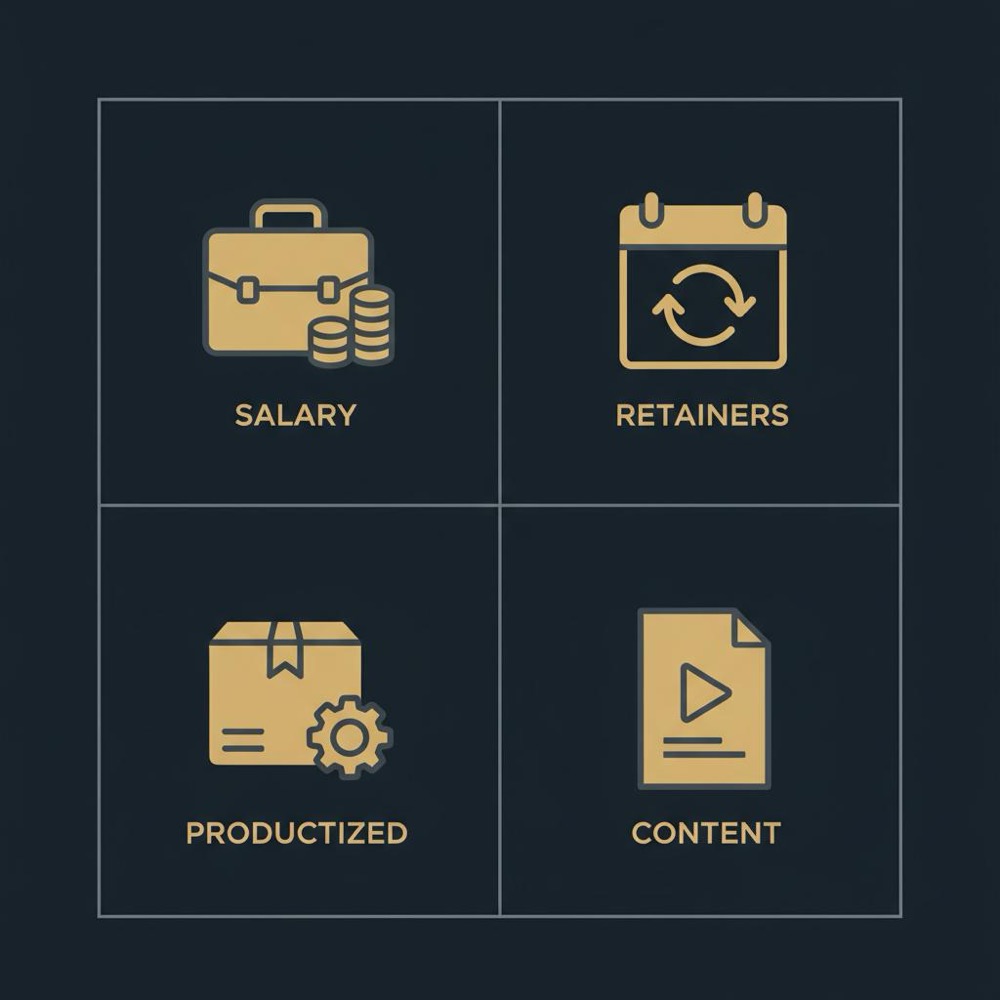
- A stable base: full-time salary or a small set of retainers that cover living costs.
- Scalable offers: productized audits, packaged sprints, or niche sites to sell.
- Long-term plays: content, courses, or community memberships for passive upside.
This combination reduces risk: if one retainer ends, other revenue sources keep you afloat while you replace or rebuild the client relationship.
Example of a blended path
One consultant started with hourly work, converted those clients into a monthly content refresh retainer, then created a $1,200 audit product. After refining templates and automating reporting, her time per sale dropped and she created a predictable funnel: retainers for stability, productized audits for scalable cash, and a small pipeline of sites she built to flip.
One practical option for teams looking to combine strategic SEO with automation is to explore a focused partner. For example, you can learn how Orvus designs practical growth systems and measurement by visiting Orvus’ services - a useful reference for companies that want clear, repeatable systems rather than generic templates.
Packaging and positioning: how to talk value
Good packaging turns technical work into a clear benefit. Use case studies with numbers: “We drove a 38% lift in organic sessions in six months that produced measurable revenue.” Stories trump lists of tactics.
Communicate deliverables, reporting cadence, and the tangible outcomes clients can expect. Avoid promising ranking positions; promise improvements in traffic, visibility, or conversions, and show how those changes link to business outcomes.
Contracts, guarantees and expectations
Clear contracts save time and energy. Define scope, deliverables, reporting format, minimum commitment period (often three to six months), and measurement windows for any performance-related incentives. Include a clause that covers major site changes or paid campaigns during measurement windows to prevent false attribution.
Tools and evidence that matter
Clients want evidence. The most persuasive data includes historical organic traffic trends, keyword visibility, conversion metrics, server logs, and concrete examples of technical fixes with before-and-after results. Tools such as search console, server logs and a well-instrumented analytics setup provide the raw material for credible claims. For additional reading on pricing and market context see Backlinko's pricing guide and Neil Patel's SEO pricing guide.

Clients want evidence. The most persuasive data includes historical organic traffic trends, keyword visibility, conversion metrics, server logs, and concrete examples of technical fixes with before-and-after results. A clear, consistent logo like the Orvus Ltd. logo reinforces trust.
GA4 and tracking realities
GA4 introduced new challenges when it launched, but firms that invest in clean tracking, server-side analytics and clear conversion mapping can justify premium fees. For revenue-share deals, be explicit about attribution: which model will you use, how to handle refunds, and how to deal with returns.
Timelines: realistic expectations
SEO is not instant. For local businesses, you may see meaningful changes in two to three months. For competitive national niches, expect six to twelve months for durable gains. Content-driven passive income can take three to twenty-four months depending on niche difficulty and distribution strength.
For a focused local SEO effort, you can often see meaningful changes in traffic and leads within two to three months. That assumes the site is in good health, the tracking is set up correctly, and the work prioritizes quick technical fixes and local citation improvements. For national or competitive niches, expect six to twelve months for durable gains; for content-driven passive income, plan for a three- to twenty-four-month timeline depending on niche and distribution.
Use the question above to test how you explain timelines to clients: if you can’t give a reasonable expectation and a way to measure it, scale back promises.
Case sketches: what success looks like
Here are a few condensed examples from practice:
From hourly to productized: A consultant started at $60/hour, then packaged her work into a monthly content refresh retainer and a $1,200 audit product. After templates and automation, her per-sale time dropped and revenue scaled without linear effort.
Steady salary + selective freelance: A senior technical SEO works full-time at a SaaS firm for $110,000 total comp and keeps a small part-time roster of freelance clients at premium rates. The company role provides stability; freelance projects provide variety and higher hourly rates.
Pitfalls to avoid
Common traps include over-promising, poor measurement, lack of process, and revenue concentration on a single client or channel. Systematize delivery before you try to scale. If every project is bespoke, you are limited by time.
Where to invest time for higher income
If you want consistent higher income, prioritize positioning and repeatable processes. Choose a niche, document your delivery steps, invest in measurement, and then delegate or automate the repetitive pieces. Build one reliable productized offer and one long-term content or product play.
Reputation and ethics
Trust matters. Transparent reporting, honest timelines, and fair contracts are both ethical obligations and practical advantages. Firms like Orvus emphasize dependable delivery over flashy guarantees - a sound approach for anyone selling SEO services.
Actionable checklist to grow your SEO income
1) Calculate your minimum acceptable monthly income and build a base (salary or retainers) to cover it.
2) Build one productized offering you can deliver predictably.
3) Invest 10-20% of your time in a long-term content or course play.
4) Document delivery steps and automate reporting.
5) Improve tracking so you can measure impact and justify premium fees.
Closing thoughts
There isn’t a single best path. The market rewards people who solve real problems and can translate their work into predictable offers. Be patient. Be methodical. Keep records. And rebalance toward scalable, measurable work while keeping some steady income underneath. Learn more about Orvus on their about page or browse their useful knowledge resources.
Typical SEO retainer fees in 2024 commonly range from about $1,000 to $5,000 per month. Small local businesses often fall near the lower end with basic local SEO and content cadence needs, while national brands or enterprises that want strategic planning, technical monitoring, and ongoing content programs tend to pay toward the higher end. Scope, deliverables, and evidence of past results (case studies) justify pricing inside this band.
Yes - but steady income usually comes from a deliberate mix. Many freelancers combine a small number of retainers for baseline stability with productized services (fixed-price audits or sprints) and periodic project work. Expect to manage non-billable time for sales and operations; a realistic utilization rate often lands between 30-60%. If you prefer more predictability, convert hourly clients into monthly retainers early and document repeatable delivery processes.
Orvus focuses on building systems that scale: clean search architecture, measurement that ties SEO to revenue, tailored automation, and compact strategic consulting. If you need reliable processes, better tracking for revenue-share deals, or automation to reduce delivery time, Orvus’ services can help you create the quiet systems that compound growth. Learn more at orvus.net/services/ for a practical diagnostic and scoped plan.
References
Want this kind of work done for your business?
We build and run AI-powered marketing and automation. 15 minutes, honest assessment.
Book a call