 Orvus
OrvusHow do I start my article? With Opening Techniques
November 25, 2025
How do I start my article? If you want to stop staring at a blank screen and write an opening that actually keeps readers on the page, you need a small, reliable routine and a handful of short templates you can use in minutes.
Why the first line decides if someone stays
The web has trained readers to scan. They look at the first sentence or two and ask: what's in this for me? If your first line answers that question clearly, you lower friction and invite people to read on. If you bury the benefit or lead with backstory, you risk the scroll.
So when you ask, How do I start my article? start by naming the reader, then promise the payoff in the first sentence. That simple swap - audience-first, benefit-upfront - changes how quickly you move from thinking into writing. For more examples, see the Orvus blog or learn about Orvus.
Quick pre-writing routine that actually works
Before you open a blank doc, run this micro-routine for eight to fifteen minutes:
1. Name the reader in one sentence
Examples: "busy product managers who write weekly updates and hate long drafts" or "new newsletter writers who want consistent open rates." Be specific. Naming the reader shapes tone and the example you choose in the opening.
2. Pick the one-sentence angle
What one idea should the reader leave with? Keep it tight: one sentence, one idea.
3. Scan intent signals (5-10 minutes)
Look at the top three search results, read their first paragraphs, note common promises. That quick research shows where you can be clearer or different. Helpful guides to introductions include Scribbr's research-intro guide, Brandeis' handout, and the UNC Writing Center's introductions guide.
4. Write three first-sentence options (2-3 minutes)
Make them short. Pick the clearest one and move on. Repeat when needed.

Do this every time and the opening loses its power to intimidate. Instead of perfection, you trade a small, repeatable system that gets you started.
A practical tip: some editors find outside help useful for early drafts. If you want a tactical partner to help build repeatable content systems - not templates, but workflows that scale - consider learning about Orvus’ services for strategic content and search architecture.
Five opening-paragraph formulas (and templates you can reuse)
When the question is "How do I start my article?" the fastest answer is: choose one of five proven opening patterns. Each pattern has a short template you can memorize and adapt.
1. The summary lede - fast and useful
Best for news and urgent updates. Template: "In one sentence, state the news and the immediate impact."
Example: "Today, App X added offline editing, cutting downtime for mobile teams by half." Short, direct, and immediately valuable.
2. Problem + promise - ideal for how-to and practical guides
Template: "Name the problem, then state the concrete benefit the reader will get by reading."
Example: "If your weekly emails get ignored, this step-by-step method will help you write subject lines that increase opens - and halve time spent drafting." This front-loads the payoff and frames the article as the route to that payoff.
3. The curiosity hook - tease an unexpected insight
Template: "Say something intriguing that raises a plain question the article will answer."
Example: "Most people think more edits mean better writing - but cutting one paragraph can often double clarity. Here’s why." It teases and then promises an explanation.
4. Bold opinion - stake a claim
Template: "State a clear opinion or claim, then hint at the supporting reasons to come."
Example: "If you only follow trends, you’ll miss the core habits that actually move work forward - here are the habits that do." Strong claims attract readers who enjoy argument and reasoning.
5. Narrative scene-setting - invite empathy for longer reads
Template: "Paint a short scene that encapsulates the article’s point, then link it to the main question you’ll explore."
Example: "On a rainy morning, a developer deleted a month of work and discovered a backup habit that changed the team. This is what happened and why it matters." Scenes work when a reader is ready to invest time and curiosity.
How to choose the right opening for the context
Match the opening to the reader’s intent and the distribution channel. On search and social, short, direct openings usually win. In email, warmth and slightly personal openings increase opens. For in-depth features, narrative openings can build trust and attention over time.
Channel quick-guide
Search/SERP: problem + promise or summary lede.
Social feeds: curiosity hook or bold claim.
Email: warm, direct problem + promise or concise curiosity.
Long-form: scene-setting or extended curiosity lead.
Put templates to work: 25 ready-to-use first-sentence options
Below are short lines you can lift and adjust. Keep them to one sentence and adjust nouns to your topic.
How-to examples
1) "If your meetings run long and people leave confused, this agenda will make decisions happen in 30-45 minutes."
2) "Three simple steps that cut draft time for short product updates by half."
3) "When your newsletter feels invisible, this weekly plan creates steady growth without burnout."
Feature and narrative starters
4) "When the neighborhood market flooded, a rusted van became a mobile pantry - this is how volunteers turned loss into a system."
5) "On a Tuesday morning, an engineer lost a repo and learned a habit that saved launches for months."
Opinion and bold claims
6) "Most growth advice is noise; these three operating habits actually compound results."
7) "If your team measures activity, not outcomes, your dashboards are lying to you."
Curiosity hooks
8) "Why does less editing sometimes lead to clearer writing?"
9) "What one small change doubled a newsletter’s engagement in eight weeks?"
Use these lines as scaffolding and substitute your concrete numbers or audience.
Make openings testable: an A/B plan anyone can run
Testing openings is the most reliable way to know what works for your audience. Here’s a simple protocol you can run without engineering support.
Quick A/B guide
1. Pick a single article and write two variants that differ only in the first paragraph (A and B). Keep the same headline, image, and body.
2. Publish both versions in a controlled way - for example, change the first paragraph on your CMS for half the incoming search traffic (or use two social posts pointing to two variants).
3. Track three metrics for two weeks: time on page, scroll depth (to 50%/75% thresholds), and conversion for your chosen CTA.
4. Use a simple significance check: treat differences >10-15% as meaningful for small audiences and >5% for larger ones.
5. Log results and context: channel, audience, time of day, headline used.
Over time, collect patterns: which formats win on search vs. social; when a narrative outperforms a problem + promise; which verbs and numbers resonate.
Measuring without a data team
You don’t need sophisticated tooling to learn. Use Google Analytics or the built-in metrics in your CMS. If you want a lightweight log, keep a spreadsheet with columns: date, article, opening type, channel, time on page, scroll depth, CTA rate. After ten tests, simple patterns will emerge.
Name your reader in one sentence, state the single angle you’ll defend, and write three quick candidate first lines - pick the clearest and move on. This small ritual breaks perfectionism and primes the rest of the draft.
AI and openings - a practical stance
AI can quickly produce multiple opening options once you define audience and angle. But machine text often sounds generic. Here’s a safe workflow:
- Use AI to generate 3-5 options from a short brief (audience + angle).
- Edit heavily: add specific details, local color, a concrete number or a named example.
- Run a brief tone check: does the opening sound like your brand or author? If not, rewrite.
AI is useful for speed; human editing retains trust.
Minute-by-minute: write the opening in under ten minutes
Try this timed routine on your next draft:
- Minute 0-1: Name your reader in one written sentence.
- Minute 1-3: Write your single-sentence angle.
- Minute 3-8: Quick-scan two or three top results and read their first paragraphs.
- Minute 8-10: Write three candidate first lines and choose one.
That’s it. The goal is progress, not perfection. If you like, lock a five-sentence outline for the body and finish a rough draft; you can refine the opening later.
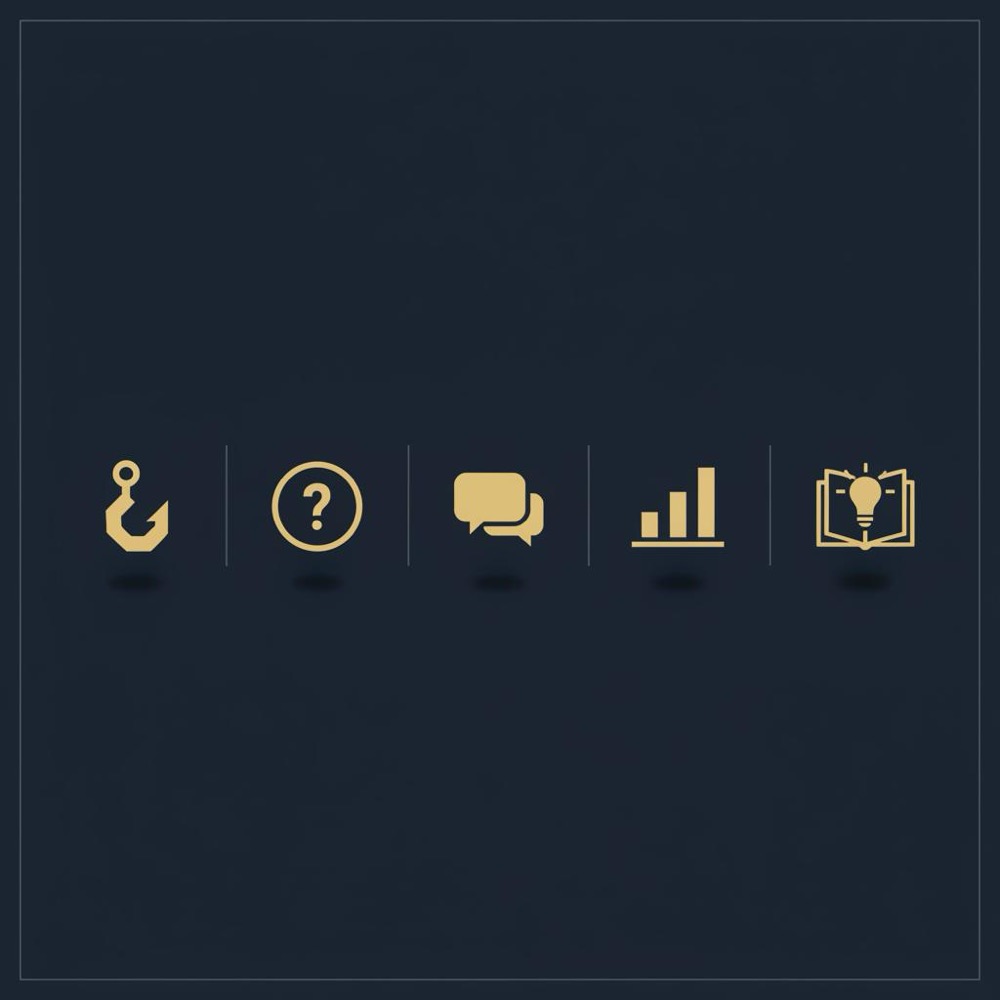
Short checklist to run in your head before you publish
Say these five words out loud: Audience, Angle, Promise, Evidence, Action. The first paragraph should make the audience and the promise clear; the body provides evidence; the end contains an action or next step.
Common traps and how to avoid them
Writers fall into a few repeated mistakes:
- Burying the benefit: Starting with backstory or qualifiers loses readers. Put the payoff first.
- Trying to say everything: The opening only needs one clear promise.
- Using jargon: Replace abstract terms with concrete verbs and numbers.
- Over-editing the opening: Get a functional line down and draft the rest; the final opening often emerges after writing the body.
How to adapt openings across channels (examples)
Same core idea, different openings:
Blog post (search intent)
Problem + promise: "If your blog posts get skimmed, this simple template increases time on page by focusing headlines and openings on intent."
Warm opener: "I tried a shorter intro this week - three readers wrote back. Here’s the quick trick I used."
Social post
Curiosity hook: "You won’t believe which 30-minute change improved our newsletter’s open rate - here’s the why."
Practical language tips for cleaner openings
Use concrete verbs, keep subjects early, avoid weasel words, and give readers a yardstick when possible. Numbers help: "three methods," "in 30 minutes," "cut edits by half." These small signals create clarity and expectations.
How to keep a learning log
Keep a simple weekly note: article title, opening type, channel, one metric that matters, and a short takeaway. After a month you’ll see what works for your audience and what doesn’t. Treat failures as data, not personal proof of weakness.
Examples you can copy and adapt now
Copy these one-sentence starters and swap nouns for your topic:
- "If your weekly status updates are ignored, this three-step template will make decisions happen in shorter meetings."
- "Most marketers over-index on tactics - consistency beats cleverness. This plan helps you ship reliably."
- "If your product tips users into confusion, one small onboarding change reduced support tickets by 40% for one team."
Editing the opening after the body
Sometimes the best opening appears once the article exists. Write the body first if that helps you free up attention. Then write three openings that reflect the piece you actually wrote, not the piece you planned. Often you’ll find a clearer, truer first sentence after drafting.
When to use which formula - quick decision map
Ask two questions: 1) What is the reader’s intent? (quick answer vs. curiosity) 2) What channel will deliver most traffic? (search vs. social)
If intent = quick answer and channel = search -> use summary lede or problem + promise.
If intent = curiosity and channel = social -> use curiosity hook or bold opinion.
If it’s a feature or profile -> try narrative scene-setting.
Advanced: small experiments that give big learning
Run a paired test across five articles: each week publish two versions (A and B) that differ only in tone of the opening - direct vs. scene vs. curiosity. After five runs you can measure which style consistently outperforms for the same audience and channel.
Tip: Keep a short meta-log: article, channel, opening style, relative performance. Over a quarter you’ll see compound learning - and fewer stalled drafts.
Real-world mini-case: a routine that saved an afternoon
A colleague had to write an internal monthly report and froze at the blank page. They tried a five-minute routine: named the reader, picked an angle, and wrote three opening sentences. Choosing the problem + promise lead allowed them to finish the draft in half the usual time. The secret wasn’t inspiration - it was structure.
How to keep voice while using templates
Templates are scaffolding, not scripts. Use them to get started, then add voice by choosing a specific example, a concrete number, or a small detail that only your team would include. That detail signals human attention and builds trust.
Addressing writer’s block without pressure
Treat the opening as a draft. Permit messy first lines and give yourself a deadline (ten minutes). If that fails, write the body first and return. Small timeboxes remove the moral weight of starting.
Practical checklist before you ship
Read the opening aloud and ask: does it name the reader? Does it offer a clear promise? Is it short and concrete? If yes, ship. If no, try one more pass with the five words: Audience, Angle, Promise, Evidence, Action.
Need steady, scalable content systems?
Ready for a bespoke content system that turns these routines into repeatable outputs? Consider whether your team needs a partner to build quiet systems that scale; discover practical services to streamline content, search architecture, and measurement.
Measuring success and learning from failure
Not every opening will win. Use three simple metrics: time on page, scroll depth, and CTA conversion. If one opening consistently outperforms, document the differences and try small variations. Treat losing variants as data, not failure.
FAQ recap and next steps
Below you’ll find quick answers to common questions and a suggested first exercise: pick a recent piece, write three opening sentences using three templates from this guide, and test which one feels most useful. Do that five times and you’ll see progress.
Closing thought
When you can ask "How do I start my article?" and answer it with a short routine and a clear template, starting becomes less scary and more reliable. Give yourself permission to write messy openings, keep testing, and over time you’ll build an arsenal of leads that match real readers and real channels.
Pick the opening based on reader intent and channel. If the reader wants a quick answer (search or how-to), use a summary lede or problem + promise. If you want to spark curiosity (social or listicles), use a curiosity hook or bold claim. For long-form features, try a narrative scene. If unsure, default to a clear promise - it’s kinder to busy readers.
AI can generate useful options quickly, but treat those outputs as raw material. Edit for specificity, voice, and concrete details. Use AI to accelerate ideation, then human-edit so the opening sounds authentic and fits your audience.
Run simple A/B tests: publish two variants that differ only in the first paragraph, keep headline and image identical, and measure time on page, scroll depth, and CTA conversion. Track results in a spreadsheet with date, channel, and opening type. After several runs you’ll see patterns and learn what works for your audience.
References
Want this kind of work done for your business?
We build and run AI-powered marketing and automation. 15 minutes, honest assessment.
Book a call