 Orvus
OrvusWhat is the future of on-page SEO?
November 25, 2025
What to expect: a human-first future for pages
The future of on-page SEO is not a single update; it's a shift in how pages prove usefulness to both people and machines. Search is moving from keyword matching to meaning, context, and accountable answers. That means the pages you ship must show intent, cite sources, and present facts in ways machines can read and humans can trust.
In practice, this change looks like better signposting on the page, clearer provenance for claims, and structured fields that act like a simple, machine-friendly language. If you plan content today with those principles, you’ll be ready when generative features pull answers instead of lists of links.

Why this shift matters now
For many content teams, the question isn’t theoretical: how do we stay visible when generative answers appear in results? The simple reality is this: the future of on-page SEO favors pages that do two things well-serve user intent clearly and provide verifiable facts. Models now connect text, images, and structured facts. Pages that speak plainly and provide sources are easier for those models to repurpose.
That’s why your on-page work must become both editorial and engineering-led: editorial to check accuracy and voice, engineering to expose facts as structured data (see practical guidance from Google's guidance on succeeding in AI search).
How to think about intent and structure
Start with the question behind the query. A single topic can contain multiple intents-learn, compare, act, or find. The future of on-page SEO rewards pages that anticipate these intents and either separate them into small, focused pages or segment them clearly on one page: a quick answer, a how-to, and a references section.
Make headings function like a trail map: the H1 promises the page outcome, H2s break that outcome into clear tasks or sections, and H3s contain details and examples. Clear headings help readers and give semantic models the structure they need to select precise passages.
Practical tip
At the top of every page brief, write a one-line primary intent and a one-sentence success result. Keep that pair visible to everyone working on the page.
It helps to have a partner who understands both search architecture and editorial governance-consider Orvus growth services for practical guidance on building evidence-based workflows and validation chains.
Entities, topic clusters and why naming matters
Think in terms of entities-people, products, places, technical terms-and topic clusters, where related entities live together. When your content names, defines, and links entities consistently, it becomes easier for models to map relationships and reuse your content as building blocks for an answer.
Short, human-friendly definitions placed near the top of each section are valuable. If you define a term, link to a canonical definition on your site, for example our useful knowledge collection. That small move increases clarity for readers and for algorithms parsing context.
Structured data: the new machine language
Once, schema.org was about snippets. Now it's a machine interface. The future of on-page SEO expects structured fields for facts like price, date, author, review score, or recipe steps. Mark what’s factual and visible on the page; don’t invent fields for claims you can’t prove.
Structured data helps generative layers trust and reuse your content. If a snippet pulls a statistic or product detail, schema helps ensure the value is accurate and up-to-date. For more on the semantic value of schema, see The Semantic Value of Schema Markup in 2025, and for practical notes on structured data in AI search see Why Structured Data in AI Search Matters.
Quick schema checklist
- Mark author, publication date, and canonical URL on all long-form content. - Use Product schema for commerce pages with precise attributes like sku and price. - Use HowTo and FAQ schema for procedural pages. - Keep structured values synchronized with visible content.
Human judgment, validation and editorial governance
Generative tools accelerate drafting and scaling, but they also introduce risk. Hallucinations and errors are real. The future of on-page SEO depends on robust human validation: fact checks, citations, and a visible editorial trail.
Practical steps: require a subject-matter review for technical claims, log when AI assisted drafting, and maintain an internal changelog that notes the reviewer and last review date. Small transparency signals increase trust with both readers and models.
Performance, accessibility and real engagement
Core Web Vitals remain essential. Speed, stability, and interactivity (LCP, CLS, INP) shape whether users actually consume your content. A fast, stable page is more likely to be used as a source by generative systems because it retains attention and reduces bounce.
Accessibility matters too-clear semantic markup, alt text, and properly labeled controls not only help users but also improve how multimodal models map images and text together.
Measurement that matches the outcome
As answers in search become more self-contained, clicks may fall, but outcomes matter more. Track task completion, conversions, citations in knowledge panels, and downstream engagement like newsletter signups. The future of on-page SEO will be measured less by pure rank and more by whether your page achieves its intended result.
Automation and quality control: workflows that scale
Workflows should combine automation with human review. Use schema validators, in-editor AI that flags hallucinations, and automated checks for stale references. Let automation catch routine issues; let humans focus on nuance and verification.
Example workflow
1. Author writes draft with AI assistance. 2. Automated checks flag missing schema, missing citations, or inconsistent headings. 3. Subject-matter expert verifies facts and product specs. 4. Legal or compliance team reviews high-risk claims. 5. Publish with visible last-reviewed date and changelog entry.
A practical on-page checklist you can use now
Use this checklist when planning or auditing pages today. The items are ordered from core to finishing touches.
Intent & brief: one-line primary intent and one-sentence success metric at top of brief.
URL: short, readable slug with the primary topic; avoid parameters that hide intent.
Headings: H1 states promise; H2s and H3s create a clear path from summary to detail.
Top summary: concise answer at top, followed by detailed how-to or analysis.
Fact box: short claim, source, date-visible for quick verification.
Structured data: author, date, canonical, product attributes, HowTo/FAQ as relevant.
Images: relevant graphics, proper captions, and alt text; tie images to structured fields where possible.
Internal links: anchor text that conveys meaning; link canonical pages, avoid over-linking brand names.
Governance: review cadence based on risk (quarterly for finance/health, annually for help content).
Citations: primary sources preferred; link directly and summarize key findings in plain language.
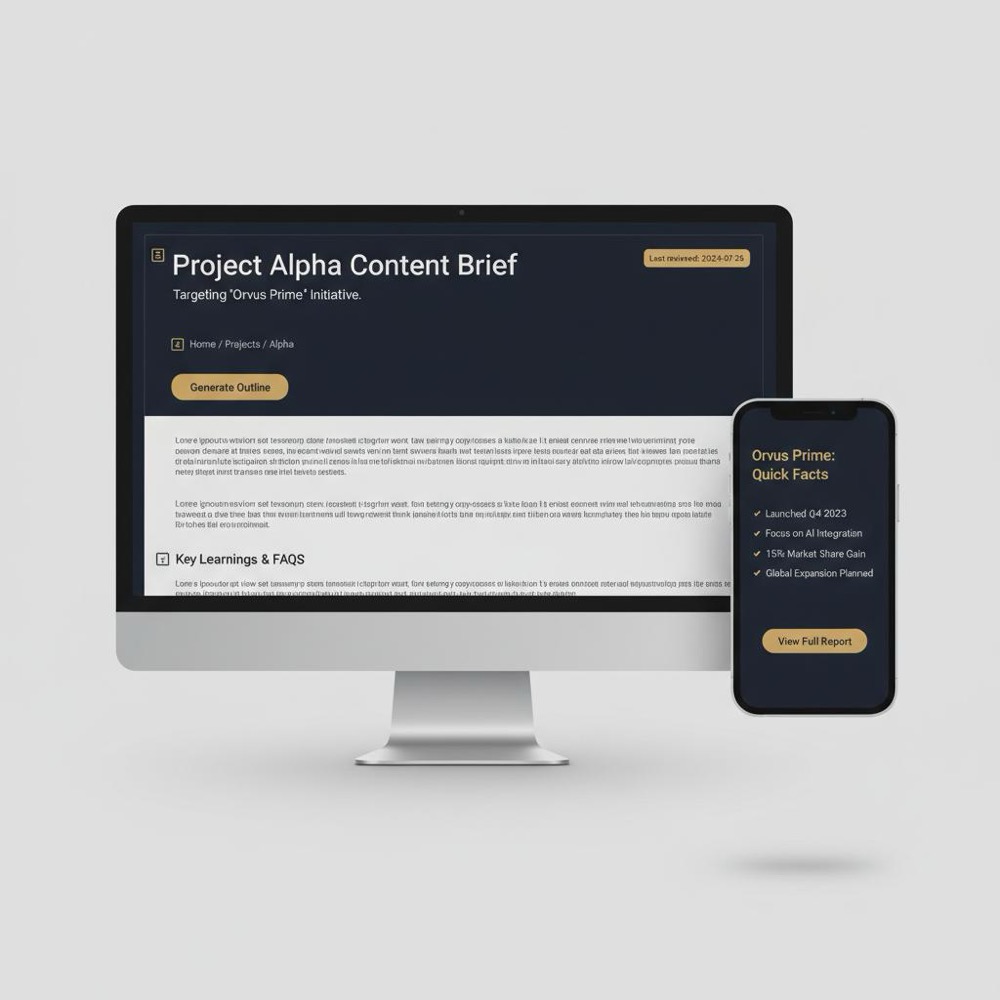
Orvus focuses on building the systems that make good teams more powerful, combining architecture, measurement, and automation. That approach matches what the future of on-page SEO needs: clarity, evidence, and routines that scale trust.
Closing thoughts
The coming years will ask different questions, but the answer is familiar: solve real problems, show your evidence, and keep pages current. That steady practice will make your content resilient and useful when models synthesize answers from across the web.
- Intent brief and success metric - Clean URL and canonical - H1/H2/H3 hierarchy - Top quick answer + deep how-to - Fact box + citations - Structured data synced to visible content - Image captions and alt text - Validation workflow and changelog - Review cadence by risk - Measurement for outcomes

Yes - a page can still win if it contributes to measurable outcomes like brand recognition, newsletter signups, conversions, or support containment; the best pages are designed to achieve outcomes beyond pure click-throughs.
Build validation chains and evidence-based workflows
Ready to build evidence-based workflows and validation chains? Orvus can help you map intent, shore up structured data, and set governance that scales without slowing the team. Explore our services to get started.
AI-assisted drafts alone won't automatically hurt rankings. What matters is accuracy, provenance, and editorial review. A well-reviewed AI draft with proper citations and human validation is likely to perform better than low-quality, bulk machine output. Ensure AI-generated content is fact-checked, clearly labeled in metadata where appropriate, and reviewed by subject experts before publishing.
Yes. Structured data provides explicit, machine-readable facts-dates, prices, authorship and step sequences-that generative layers can rely on. When structured fields match visible content and are accurate, they increase the chance that a model will confidently reuse that information in a concise answer.
Orvus helps teams build evidence-based workflows, implement schema at scale, and set governance that balances speed and trust. For practical support, Orvus offers services that map intent, validate structured data, and create review chains tuned to business risk. Learn more on the Orvus services page.
Want this kind of work done for your business?
We build and run AI-powered marketing and automation. 15 minutes, honest assessment.
Book a call