 Orvus
OrvusHow to Find Your First 10 Customers Without Paid Ads or Outbound
May 1, 2026
This guide presents a tactical framework for acquiring first customers through five proven organic channels: warm network introductions, strategic community participation, targeted direct outreach, problem-solving content, and product-led beta access. Each channel has distinct effort-to-conversion characteristics, timeline expectations, and execution requirements. The framework helps you choose which channels match your product type and founder strengths, then provides specific implementation steps for running multiple channels simultaneously without spreading effort too thin.
The approach assumes you have a working product or service, a clear understanding of who your ideal customer is, and the ability to commit consistent time to systematic outreach and follow-up. It does not assume you have an audience, a marketing budget, or prior sales experience. What it requires is discipline to execute proven methods thoroughly rather than jumping between tactics when results do not appear immediately.
Why Traditional Marketing Advice Fails First-Time Founders
Most marketing advice assumes you already have customers. The frameworks, tactics, and benchmarks that dominate business publications are built for companies with established distribution, existing audiences, and conversion funnels fed by consistent traffic. When you have zero customers, none of that applies. You are not optimizing a funnel. You are building one conversation at a time.
The paid ads trap burns early budgets because it treats customer acquisition as a math problem before you understand the customer. Running ads requires knowing your ideal customer profile, your conversion messaging, your offer structure, and your unit economics. At zero customers, you have educated guesses at best. Spending money to test those guesses rarely produces customers. It produces expensive lessons about what does not work.
What actually works at zero customers differs fundamentally from what works at 1,000 customers. At scale, you optimize for efficiency, conversion rate improvement, and cost per acquisition. At zero, you optimize for learning customer language, validating that anyone cares about your solution, and building the repetition that teaches you how to sell. The distinction between growth tactics and acquisition tactics matters here. Growth tactics amplify what already converts. Acquisition tactics create the first proof that conversion is possible.
Conversion rate matters more than reach at this stage because you need signal, not volume. A single conversation that results in a paying customer teaches you more than 10,000 impressions that produce nothing. You learn what objections surface, what language resonates, what alternatives customers consider, and what finally tips the decision. That intelligence compounds. Each conversation improves the next pitch, sharpens your positioning, and builds the messaging foundation that eventually scales.

The compounding advantage of learning customer language early cannot be overstated. Founders who treat their first 50 outreach attempts as customer research rather than sales activity build better products, sharper messaging, and more durable acquisition systems. They stop guessing what customers want and start speaking in the exact terms customers use to describe their problems.
The Five-Channel Framework for First Customer Acquisition
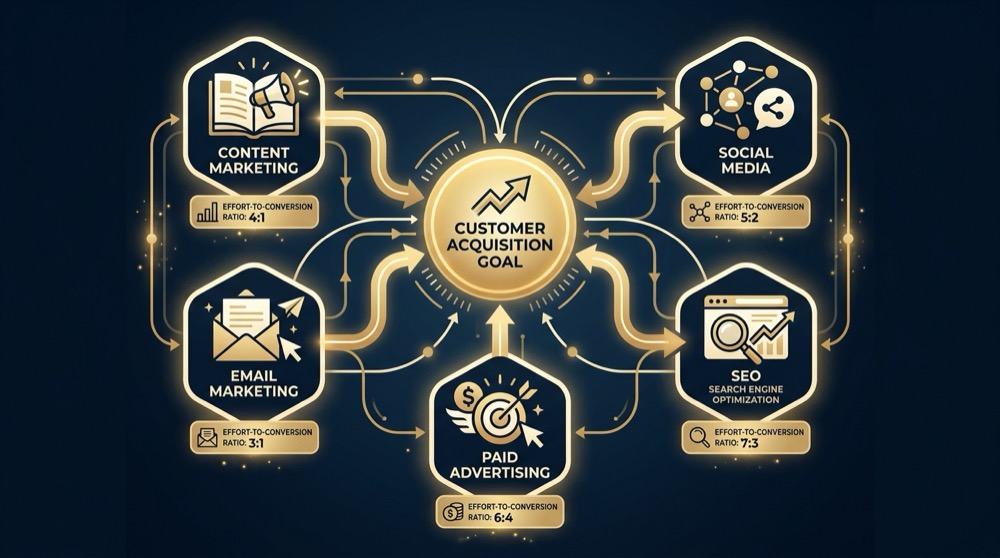
Finding your first customers requires running multiple organic channels simultaneously, each with different effort-to-conversion characteristics. The five channels that consistently produce early customers are warm network introductions, strategic community participation, targeted direct outreach, problem-solving content, and product-led beta access. Not every channel fits every product type or founder strength, but most early-stage operators can execute at least two of these effectively.
Evaluating which channels match your product type starts with understanding where your ideal customers already spend attention. B2B software products often convert best through warm introductions and targeted outreach because buying decisions involve research and risk assessment. Consumer products and services gain traction faster in communities where users actively discuss problems your product solves. Content works well for products that solve searchable, high-intent problems. Beta access works when your product creates immediate, demonstrable value that users want to share.
Effort-to-conversion ratios vary significantly across these organic methods. Warm introductions typically convert at 10-15%, but require existing network proximity to your ideal customer. Community participation converts at 2-5%, but demands weeks of value contribution before any promotional activity. Direct outreach converts at 3-8% when highly personalized and well-researched. Content converts at 1-3% but builds compounding visibility over time. Beta programs convert at 15-25% when structured as a genuine exchange of feedback for early access.
Running multiple channels simultaneously matters because early customer acquisition is a numbers game played at small scale. You need 50-100 total attempts across channels to generate 10 customers. Relying on a single channel creates binary risk: it either works or it does not, and you lose weeks finding out. Running two or three channels in parallel produces faster learning, reveals which methods match your natural communication style, and creates redundancy when one channel underperforms.
Expected timeline and effort investment vary by channel intensity. Network introductions can produce first customers within one to two weeks but exhaust quickly. Community participation requires four to eight weeks of consistent contribution before conversion opportunities emerge. Direct outreach generates responses within days but demands significant research time per prospect. Content takes four to twelve weeks to gain search visibility but continues working after publication. Beta programs can convert within one to three weeks if you already have a qualified waitlist.
Get the Channel Selection Framework
Choosing your first two channels depends on your product type, existing network strength, communication preferences, and time availability. A systematic decision process prevents the common mistake of choosing channels that sound appealing but do not match your actual situation or capabilities.
Channel One: Mining Your Existing Network for Warm Introductions
Your existing network contains more customer proximity than you realize. The mapping exercise starts by listing every person you know professionally or personally, then categorizing them by how closely they match your ideal customer profile or how likely they are to know someone who does. This is manual work. Open a spreadsheet and start writing names.
The first column lists the contact name. The second column rates their fit as a direct customer: high, medium, low, or none. The third column rates their likelihood of knowing ideal customers: high, medium, or low. The fourth column captures relevant context such as industry, role, shared history, or mutual connections. The fifth column tracks outreach status. Most founders discover 50-150 names through this exercise, with 10-20 high-potential direct fits and 30-50 strong referral sources.
The introduction request template that actually works balances clarity, specificity, and low friction. The structure is simple: remind them of your connection, explain what you are building in one sentence, describe your ideal customer in specific terms, and ask if they know 1-2 people who match that description. The request ends with an easy yes or no and offers to send more detail if helpful.
Here is the template: "Hi [Name], hope you are doing well. We worked together at [Context] and I have always valued your perspective on [Relevant Area]. I am launching [Product] which helps [Specific Customer Type] solve [Specific Problem] by [How It Works in 10 Words]. I am looking to connect with [Ideal Customer Description with 2-3 Concrete Attributes]. Do you know 1-2 people who might fit that profile? Happy to send more detail if useful, but no pressure either way."
Converting warm intros without burning relationships requires treating the introduction as the beginning of a conversation, not a sales pitch. When someone makes an introduction, your first message to the new contact should acknowledge the mutual connection, express genuine interest in learning about their situation, and offer a specific, low-commitment next step such as a 15-minute call. The goal is dialogue, not closing.
Common mistakes that damage relationships include pitching immediately after an introduction, failing to update the person who made the introduction on the outcome, asking for introductions to people far outside your stated ideal customer profile, and requesting introductions from people you have not spoken to in years without re-establishing the relationship first. Warm introductions work because they carry implicit social endorsement. Misusing that endorsement burns bridges quickly.
The first conversation after an intro should focus 80% on understanding their situation and 20% on explaining your solution. Ask about their current approach to the problem your product solves, what they have tried before, what works and what does not, and what would make a solution valuable enough to switch. Listen for language, priorities, objections, and alternatives. Only after understanding their context should you explain how your product addresses what they described.
Channel Two: Strategic Community Participation
Strategic community participation means identifying where your ideal customers congregate online, contributing genuine value consistently, and building enough trust that when you eventually mention your product, people listen instead of flagging you as spam. This channel requires patience and discipline, but it produces customers who already trust your expertise before any transaction occurs.
Identifying high-density communities where your customers congregate starts with reverse engineering where they go for answers. Search Reddit for keywords related to your product category and note which subreddits appear repeatedly. Join industry-specific Slack communities and Discord servers by searching directories or asking contacts for invitations. Look for niche forums that have survived the social media era because they serve specific professional or hobbyist communities. The goal is finding 3-5 active communities where your ideal customer asks questions, shares problems, and seeks recommendations weekly.
Platform evaluation focuses on three factors: activity level, relevance density, and moderation culture. Activity level means new posts and comments daily, not weekly. Relevance density means at least 30% of discussions relate to problems your product solves. Moderation culture determines whether helpful, non-promotional contributions from new members get welcomed or scrutinized. Spend a week reading before posting anything. Understand the norms, the tone, the recurring questions, and the community's tolerance for commercial activity.
The 10:1 value-to-promotion ratio is the discipline that separates community participation from spam. For every one mention of your product, you need ten contributions that provide value with zero self-interest. Answer questions thoroughly. Share relevant resources you did not create. Offer feedback on other people's projects. Contribute to discussions where your product is irrelevant. Build a posting history that demonstrates expertise and generosity before you ever mention what you are building.
Start by directly asking the first 5-10 prospects or customers you speak with: where do you go online to ask questions about your work, learn new approaches, or discuss challenges with peers? Document the specific platforms, subreddits, Slack groups, Discord servers, or forums they mention. Cross-reference those answers by searching for your product category keywords on Reddit, checking LinkedIn for active groups in your target industry, and exploring community directories like Slack list or Discord server lists. The pattern that emerges from actual customer behavior is more reliable than assumptions about where they should congregate. If five people independently mention the same subreddit or Slack community, that is a high-density target worth your participation effort.
What genuine contribution looks like versus self-promotion comes down to intent and framing. Genuine contribution solves the immediate problem the person asked about, offers multiple approaches including ones that do not involve your product, and focuses on teaching rather than selling. Self-promotion jumps straight to your solution, ignores alternative approaches, and includes product links in every response. The community can tell the difference immediately.
Timeline expectations for trust-building in communities typically span four to eight weeks of consistent participation before promotional mentions feel earned rather than spammy. You need 15-25 helpful contributions, visible engagement with other members' content, and recognition from moderators or active community members. Rushing this process by promoting early destroys credibility and often results in bans that block future access.
Successful community engagement follows a pattern. A founder joins a subreddit for SaaS founders, spends three weeks answering questions about pricing strategy, customer onboarding, and churn reduction. After building comment history and earning upvotes, they post a detailed breakdown of their own pricing experiment with real numbers and lessons learned. At the end, they mention they built a tool to test pricing variations and offer it free to anyone who wants to try the approach. The post gets 40 upvotes, 12 people try the tool, and 3 become paying customers after the trial. The key: value first, product mention last, and only when directly relevant.
Channel Three: Targeted Direct Outreach That Converts
Targeted direct outreach works when you treat it as high-quality, low-volume research rather than a numbers game. The goal is not sending 1,000 emails and hoping for 10 responses. The goal is identifying 50-100 people who perfectly match your ideal customer profile, researching each one individually, and crafting personalized messages that demonstrate you understand their specific situation.
Building a list of 50-100 ideal prospects starts with defining your ideal customer profile in concrete, observable terms. Not "marketing managers" but "marketing managers at B2B SaaS companies with 10-50 employees who recently raised Series A funding." Not "fitness enthusiasts" but "runners training for their first marathon in the next six months who live in urban areas." Specificity enables research. Vagueness produces generic outreach that gets ignored.
Once you have a clear profile, identify prospects through LinkedIn search, industry directories, conference attendee lists, podcast guest appearances, bylines in trade publications, or active participants in relevant online communities. Export names and basic contact information into a spreadsheet. The research phase begins before you write a single message.

Message structure for cold outreach follows a tight format: personalized opening that references specific research, one-sentence explanation of what you built, clear statement of the problem it solves, and a single, low-friction ask. The message should be 75-125 words maximum. Longer messages do not get read. The opening line must prove you researched them specifically, not that you plugged their name into a template.
Here is an example: "Hi [Name], saw your post in [Community] about struggling with [Specific Problem]. I built [Product Name], a [10-word description] that helps [Customer Type] solve exactly that issue by [Key Differentiator]. Would you be open to a 15-minute call to walk through how it works? No sales pitch, just want to show you the approach and get your feedback." The specificity in the opening and the feedback angle in the close significantly improve response rates.
Follow-up cadence matters because most people do not respond to the first message, but persistence without annoyance requires discipline. The three-touch sequence works well: initial message, follow-up after four days if no response, final follow-up after another week. The first follow-up adds new information or a different angle. The second follow-up acknowledges you are following up and offers an easy out. After three attempts with no response, move on. Conversion benchmarks to expect from well-executed direct outreach range from 3-8% response rate and 30-50% conversion from response to customer, meaning 50-100 outreach attempts should yield 2-4 paying customers.
Channel Four: Problem-Solving Content as Customer Magnet
Problem-solving content attracts customers by answering the exact questions they search for when experiencing the problem your product solves. This is not thought leadership or brand building. This is creating utility that ranks in search results, gets shared in communities, and positions you as someone who understands the problem deeply enough to teach others how to solve it.
Identifying the three problems your first customers are actively searching for requires customer research, not guessing. If you have spoken to 10-20 prospects or early users, review your notes for recurring questions, complaints about current solutions, and phrases they use to describe their pain points. If you have not spoken to anyone yet, search Reddit, Quora, and niche forums for discussions about your product category and note which questions appear repeatedly. Look for problems with high search volume but unsatisfying existing answers.
The problems worth creating content around share three characteristics: they are specific enough to have clear solutions, common enough that many people search for answers, and directly related to the value your product provides. Avoid broad, conceptual topics. Focus on tactical, how-to problems that someone actively experiencing the issue would search for right now.
Content formats that convert searchers to customers include step-by-step guides, comparison articles that evaluate different solution approaches, troubleshooting tutorials, and framework breakdowns that teach a repeatable process. The format matters less than depth and completeness. Your content should be the definitive answer to the question, not a shallow overview that forces readers to search elsewhere for actual solutions.
Each piece of content should include a natural transition to your product without hard selling. After explaining how to solve the problem manually or with existing tools, mention that your product automates or simplifies the process you just described. Offer it as one option among several, not the only solution. The goal is awareness and credibility, not immediate conversion. Readers who find your content valuable will remember your product when they are ready to invest in a solution.
Track which content topics generate customer conversations and conversions to identify highest-value subjects
Manual tracking focuses attention on content ROI without requiring analytics tools
Distribution tactics when you have no audience require manual promotion in places where your target customers already gather. Post your content in relevant subreddit threads where people ask the exact question your article answers. Share it in Slack or Discord communities when the topic comes up naturally in discussion. Send it directly to prospects during outreach as a value-add before any product pitch. Submit it to niche newsletters or aggregators that curate resources for your target audience. The distribution effort often exceeds the creation effort at this stage, and that is normal.
Success in content-driven acquisition comes from publishing 3-5 truly comprehensive pieces that each target a high-intent problem, then distributing those pieces consistently for 8-12 weeks. One excellent guide that ranks and gets shared produces more customers than ten mediocre posts that disappear. Depth and distribution beat volume. For founders looking to build systematic content approaches, exploring content marketing systems can provide frameworks for creating repeatable processes that generate consistent customer conversations.
Channel Five: Product-Led Acquisition Through Beta and Early Access
Product-led acquisition turns your product itself into the primary acquisition channel by letting potential customers experience value before committing to payment. Beta programs and early access offers work when your product delivers immediate, demonstrable value that users want to share with others facing the same problem.
Structuring beta programs that attract quality early customers starts with defining what you offer and what you ask for in return. The offer is early access to your product, often at a discounted rate or free for a limited period. What you ask for is detailed feedback, regular communication about their experience, willingness to iterate with you as you improve the product, and ideally, public testimonials or case studies if the product delivers value.
The feedback-for-access exchange must be explicit and structured. Do not just give away free access and hope people provide feedback. Set clear expectations: weekly check-ins, responses to specific questions about features and usability, and participation in short surveys or calls. The best beta users are those who actively experience the problem your product solves and have strong opinions about how solutions should work. They become development partners, not just free users.
Recruiting beta users happens through the same channels covered earlier: warm introductions to people who fit your ideal customer profile, direct outreach to prospects with a beta offer instead of a sales pitch, posts in relevant communities offering limited beta spots in exchange for feedback, and content that ends with an invitation to join the beta program. Positioning beta access as exclusive and limited increases perceived value and attracts more engaged participants.
Converting beta users to paying customers requires demonstrating clear value during the beta period and making the transition feel natural rather than transactional. Toward the end of the beta period, share specific improvements made based on their feedback, show metrics or outcomes they achieved using the product, and present pricing as the next step in a relationship that has already proven valuable. Offer early-bird pricing or extended discounts to beta participants as recognition of their contribution.
Beta users become referral sources and brand advocates when they feel ownership in the product's development and success. They told you what to build, you built it, and now they have a vested interest in seeing it succeed. Encourage them to share their experience in communities, write reviews, or introduce you to others facing similar problems. The most effective early customer acquisition loops start with beta users who become active promoters because they genuinely believe in what you built together.
Early-bird pricing strategies for transitioning beta users to paid customers should offer meaningful discounts (30-50% off standard pricing) locked in for 6-12 months in exchange for committing before the official launch. This creates urgency, rewards early participation, and generates initial revenue that validates your pricing assumptions. The discount is not charity. It is compensation for the risk and effort of being an early customer.
Common Mistakes That Kill Early Customer Acquisition
Spreading too thin across channels before validating one is the most common execution error in early customer acquisition. Founders try to run all five channels simultaneously, execute each one poorly, and conclude that organic acquisition does not work. The correct approach is choosing two channels that match your strengths and situation, running them with full effort for four weeks, and measuring results before adding or switching channels.
The premature scaling trap appears when founders see early traction from manual, founder-led efforts and immediately try to systematize, automate, or hire someone to scale the channel. At 10 customers, you do not have a system worth scaling. You have anecdotes. Scaling before proving the model wastes resources and often kills the channel entirely because the personal touch that made it work disappears.
Pitching before establishing any credibility or value is the fastest way to burn channels, especially communities and content. Founders join a community and immediately post about their product, or publish content that is thinly veiled product promotion. The audience sees through it instantly, and the founder loses access to a channel that could have worked with proper execution. Value first, promotion later is not optional. It is the price of entry.
The importance of channel focus cannot be overstated at the early stage. Each channel requires different skills, different time investments, and different timelines to results. Executing two channels well produces more customers than executing five channels poorly. Focus also enables learning. When you run one channel for a month, you understand what works and what does not. When you run five channels for a week each, you learn nothing useful.
Recognizing when a channel is not working requires setting clear expectations and measuring against them. If direct outreach produces zero responses after 30 attempts with strong personalization, the channel may not fit your product or your ideal customer profile needs refinement. If community participation generates no meaningful conversations after six weeks of consistent contribution, you may be in the wrong communities. The signal is not immediate success but directional progress. Some positive responses, some conversations, some interest. If you see none of that after reasonable effort, pivot.
Measuring What Matters in Your First 10 Customer Conversations
Measuring early customer acquisition requires different metrics than scaled marketing because sample sizes are small and qualitative signals matter more than statistical significance. The three metrics that predict channel viability are response rate, conversation-to-customer conversion rate, and time-to-close. These metrics tell you whether a channel is worth continued investment.
Response rate measures how many people engage with your initial outreach. For direct outreach, this is email responses or accepted meeting requests. For community participation, this is replies to your posts or direct messages from members. For content, this is comments, shares, or inbound inquiries. A viable channel produces response rates above 5% for outreach, above 2% for community posts, and above 1% for content. Below those thresholds, something is wrong with targeting, messaging, or value proposition.
Conversation-to-customer conversion rate measures how many people who engage with you eventually become paying customers. At the early stage, this should be 20-40% for warm introductions, 10-25% for beta programs, 5-15% for direct outreach, and 3-10% for community and content channels. These are rough benchmarks, not universal standards, but they provide reference points for evaluating performance.
Time-to-close tracks how long the journey from first contact to paying customer takes for each channel. Warm introductions often close within one to three weeks. Direct outreach takes two to five weeks. Community participation can take four to ten weeks because trust-building precedes any transaction. Content-driven acquisition varies widely, from one week for high-intent searchers to three months for researchers in early problem exploration. Understanding time-to-close helps you set realistic expectations and manage pipeline.
Qualitative signals that matter more than numbers include the language customers use to describe their problems, the objections they raise, the alternatives they consider, and the specific features or benefits that tip their decision. Document these signals in a simple spreadsheet or note file after every customer conversation. Patterns emerge quickly. If five prospects mention the same objection, your messaging needs to address it upfront. If three customers chose you over the same competitor, you have a differentiation angle worth emphasizing.
Sample sizes needed before making channel decisions are smaller than you think. Ten outreach attempts is not enough to judge a channel. Fifty attempts with consistent execution provides signal. If you have reached out to 50 well-researched prospects with personalized messages and received zero responses, the channel likely does not fit. If you have published three comprehensive guides, promoted them consistently for eight weeks, and seen zero inbound interest, content may not be your fastest path to first customers.
Documenting and analyzing early customer conversations systematically prevents the common mistake of relying on memory or gut feel. After each conversation, spend five minutes writing down what you learned: their current solution, their main pain point, their budget range, their decision timeline, their objections, and the language they used to describe everything. Review these notes weekly to identify patterns, refine messaging, and adjust your approach based on real customer input rather than assumptions.
Your First-Week Action Plan
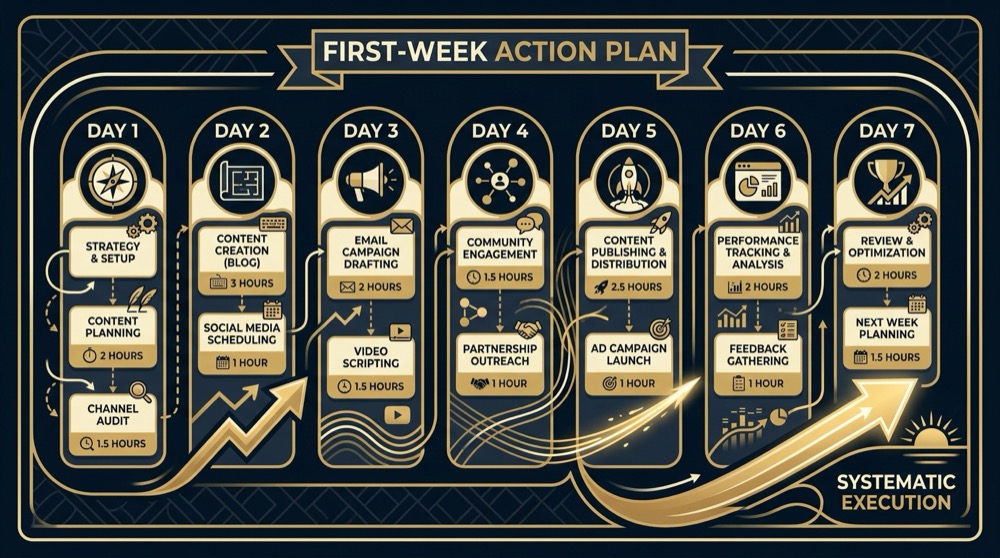
Implementation starts with choosing two channels that match your product type and personal strengths. If you have a strong existing network and your ideal customers are within two degrees of separation, start with warm introductions and direct outreach. If your customers congregate in active online communities and you communicate well in writing, start with community participation and content. If your product delivers immediate value and you can structure a compelling beta offer, start with beta access and warm introductions. The combination matters less than committing fully to two channels.
Day one focuses on setup and research. For warm introductions, complete the network mapping exercise and identify your top 20 contacts. For direct outreach, define your ideal customer profile in specific terms and build a list of 30 prospects. For community participation, join 3-5 communities and spend two hours reading to understand norms and recurring topics. For content, identify three high-intent problems and outline your first guide. For beta access, draft your beta program structure and the feedback expectations. Time investment: three to four hours.
Day two is execution day for first outreach. Send introduction requests to your top 10 network contacts. Send personalized messages to your first 10 prospects. Make your first 3-5 contributions in communities, answering questions or adding value to discussions with zero self-promotion. Begin writing your first content piece or setting up your beta landing page. Time investment: three to four hours.
Days three and four focus on follow-up and continued outreach. Respond to any replies from day two. Send 10 more direct outreach messages. Make 5 more community contributions. Continue content creation. Send introduction requests to the next 10 network contacts. The goal is maintaining momentum and building volume across your chosen channels. Time investment per day: two to three hours.
Day five is review and adjustment. Analyze response rates from your outreach. Evaluate which community contributions generated engagement. Assess whether your messaging is landing or needs refinement. Make small adjustments based on early feedback, but do not overreact to limited data. Time investment: one to two hours, plus continued execution of outreach and content work.
Days six and seven continue execution with adjustments incorporated. The goal for week one is not closing customers. The goal is starting conversations, building pipeline, and learning whether your chosen channels show any positive signal. Success in week one looks like 3-5 responses to outreach, 2-3 meaningful community interactions, or 1-2 people signing up for beta access. These are leading indicators that the channels can work with continued effort.
Week four expectations differ significantly from week one. By week four, you should have 15-25 active conversations across your channels, 3-5 prospects in serious consideration, and 1-3 closed customers. If you have none of that after four weeks of consistent execution, reassess your channel selection, your ideal customer profile definition, or your core value proposition. The channels work, but they require the right fit between what you offer and who you target.
Time allocation across research, outreach, and follow-up should be roughly 30% research and preparation, 50% outreach and execution, and 20% follow-up and conversation management. Founders often under-invest in research, which leads to generic outreach that fails. The research phase is not wasted time. It is the foundation that makes outreach convert. For solopreneurs managing multiple acquisition channels without team support, implementing a systematic marketing approach helps maintain consistency across channels while preventing burnout from scattered efforts.
Clear next steps after first 10 customers involve doubling down on whichever channel produced the most customers with the least effort, documenting the exact process that worked, and beginning to build repeatability. At 10 customers, you have enough data to know which channel fits your product and your skills. The next goal is reaching 50 customers through systematic execution of that proven channel before exploring new acquisition methods.
Timeline varies by channel and execution quality, but realistic expectations are four to eight weeks for first 10 customers when running two channels simultaneously with consistent effort. Warm introductions can produce customers within one to two weeks but exhaust quickly. Direct outreach and beta programs typically convert within two to four weeks. Community participation and content require four to eight weeks of trust-building before conversion opportunities emerge. The key variable is execution consistency, not channel selection. Founders who commit three to four hours daily to systematic outreach, research, and follow-up reach 10 customers faster than those who work sporadically regardless of channel choice.
Focus on two channels simultaneously, not one and not five. Running a single channel creates binary risk where success or failure depends entirely on that method working for your specific product and audience. Running five channels spreads effort too thin and prevents learning what actually works. Two channels provide redundancy, faster learning through comparison, and enough volume to reach 10 customers within reasonable timeframe. Choose channels that complement each other in timeline and effort profile, such as warm introductions (fast results, limited scale) paired with community participation (slower results, sustainable scale), or direct outreach (immediate control) paired with content (compounding visibility). After reaching 10 customers, double down on whichever channel produced better results.
Niche products still have customers who congregate somewhere, just not in obvious places. The research process changes, not the viability of community-based acquisition. Start by identifying where your ideal customers go for adjacent topics rather than your exact product category. A highly specialized B2B tool might not have a dedicated community, but the professionals who would use it participate in industry associations, LinkedIn groups, or Slack channels for their role or sector. Interview your first 3-5 prospects and explicitly ask where they go online to learn, ask questions, or discuss work challenges. For extremely niche products, direct outreach and warm introductions often outperform community participation because you can target the small population precisely rather than waiting for them to surface in public forums.
The framework presented here works because it matches the reality of early-stage operations. You have more time than money, more flexibility than process, and more ability to do things manually than any funded competitor. Those constraints become advantages when you treat first customer acquisition as research that happens to generate revenue rather than sales that happens to generate insights. Start with two channels, execute them systematically for four weeks, measure what matters, and adjust based on real customer feedback rather than assumptions about what should work.
References
Want this kind of work done for your business?
We build and run AI-powered marketing and automation. 15 minutes, honest assessment.
Book a call