 Orvus
OrvusHow to Build a Content Workflow That Actually Ships (Solo Operator Guide)
May 10, 2026
The solo operator needs a different approach. Not a simplified version of team workflows, but a system designed from the ground up for one-person execution. A system that enables consistent output without process bloat, maintains quality without endless revision cycles, and ships content without requiring daily heroics.
This guide builds that system. It presents a four-stage framework specifically designed for solo operators who need to produce consistently while running the rest of their business. The approach focuses on stage separation, time-blocking, and batching mechanics that reduce context-switching and leverage momentum. No team required.
Why Standard Content Workflows Fail Solo Operators
Standard content workflows are designed for teams. They assume someone handles ideation while another person writes, a third edits, and a fourth manages distribution. For the solo operator running a business alone, these multi-person systems create overhead that kills momentum rather than supporting it.
The Team-Workflow Trap
The typical content workflow includes approval stages, stakeholder reviews, editorial calendars with multiple contributors, and handoffs between specialized roles. When a solo operator tries to implement this structure, they end up playing every role in sequence, which means constant context-switching between strategist, writer, editor, and distributor. Each switch costs time and mental energy.
Tool sprawl compounds the problem. A team might justify separate platforms for planning, writing, editing, SEO optimization, and scheduling because different people use different tools. A solo operator using the same stack spends more time managing systems than creating content. The result is a workflow that looks professional on paper but produces nothing because the operator drowns in their own process.
Approval bottlenecks that make sense for teams become absurd for solo work. When you are both the writer and the approver, a formal review stage is just procrastination with extra steps. Over-planning follows the same pattern. Detailed content briefs, competitor analysis documents, and multi-week editorial calendars serve teams coordinating across people. For one person, they often become displacement activity that delays actual production.
Where Solo Operators Actually Get Stuck
Solo operators fail at content consistency for specific, predictable reasons. First, they try to do everything daily. They wake up intending to ideate, write, edit, and publish all in one session. This daily multi-tasking approach guarantees shallow work across all stages and produces mediocre output when it produces anything at all.
Second, they confuse perfection with shipping. Without a team to enforce deadlines, solo operators often get stuck in endless revision cycles. The draft that could ship today gets held for another week of polish that adds minimal value. Consistency matters more than perfection for solo operators because publishing regularly builds audience trust and compounds visibility over time. A good article published beats a perfect article perpetually refined.
Third, context-switching destroys productivity in ways solo operators underestimate. Research on solo content creators shows that switching between workflow stages multiple times per day reduces effective output by approximately 40% compared to dedicated stage-blocking. Every time you shift from writing mode to editing mode to distribution planning, you pay a cognitive switching cost. For team members with defined roles, this cost is minimal because they stay in their lane. For solo operators attempting all roles, the cost accumulates across every transition.
The real cost shows up in what does not get published. Solo operators often have dozens of half-finished drafts, abandoned outlines, and ideas that never moved past capture. The workflow intended to help them ship actually prevents shipping because it was designed for coordination across people, not execution by one person.
The Four-Stage Solo Content Workflow Framework
A functional content workflow for solo operators separates work into four distinct stages: Capture, Production, Refinement, and Distribution. Each stage has clear boundaries, specific activities, and dedicated time blocks. The separation is not bureaucratic overhead. It is the structural foundation that enables consistent output without team resources.
Stage 1: Capture (Idea Intake Without Disruption)
Capture is the ongoing collection of content ideas, observations, questions, and angles without interrupting other work. This stage runs continuously in the background. When an idea surfaces during a client call, a book you are reading, or a question someone asks, you capture it immediately in a simple system and return to what you were doing.
The key principle is frictionless intake. If capturing an idea requires opening multiple apps, filling out forms, or making decisions about priority and timeline, you will not do it consistently. Successful solo operators use single-input capture systems like a dedicated note in their phone, a voice recorder, or a simple text file. The goal is to get the idea out of your head and into the pipeline in under 30 seconds.
Capture does not include evaluation, outlining, or research. Those activities belong in Production. Mixing capture with development kills the speed that makes capture work. You want ideas flowing into the system without friction, which means accepting rough, incomplete, and sometimes unusable inputs. Filtering happens later.
Stage 2: Production (Batched Creation Sessions)
Production is where ideas become drafts. This stage includes research, outlining, writing, and initial formatting. For solo operators, production works best in dedicated batches where you produce multiple pieces in a single focused session rather than attempting one piece at a time across multiple days.
A typical production session starts with selecting 3-5 ideas from your capture backlog, doing any necessary research upfront, then writing all pieces in sequence. The batch approach leverages momentum. Once you are in writing mode, staying there for multiple pieces is more efficient than ramping up and down repeatedly. Studies on solo content production show that batching can reduce total production time by 30-50% compared to single-piece workflows.
Time allocation for production should represent 40-50% of your total content time. If you dedicate 8 hours per week to content, 3-4 hours should go to production. This stage is where the actual content gets made, so it deserves the largest time block. Protecting this time from distribution tasks, email, and other business activities is critical. Production requires deep focus that shallow, interrupted work cannot provide.
Stage 3: Refinement (Editing as Separate Activity)
Refinement is editing, fact-checking, SEO optimization, and final formatting performed as a distinct activity separate from production. Solo operators often skip this stage entirely, publishing first drafts because they conflate writing with editing. This approach produces lower-quality content and misses the efficiency that comes from editing multiple pieces in one session.
Editing in batches works for the same reason writing in batches works. You develop momentum and consistency. When you edit three articles back-to-back, you catch patterns in your writing, apply fixes systematically, and maintain quality standards more effectively than editing one piece weeks after writing it.

Refinement should take 20-25% of total content time. For an 8-hour weekly content block, that is roughly 90 minutes to 2 hours. This is enough time to edit 3-5 pieces if production delivered clean first drafts. The key is treating refinement as a separate calendar block, ideally on a different day than production, so you approach your own work with fresh perspective.
Stage 4: Distribution (Publishing and Promotion)
Distribution covers publishing, scheduling, social promotion, email sends, and any cross-posting or repurposing activities. This stage is often treated as an afterthought by solo operators, but it deserves dedicated time and systematic execution. Content that is not distributed does not exist.
Distribution should take 25-30% of total content time. This might seem high, but effective distribution includes more than hitting publish. It includes writing social posts that drive traffic, sending email announcements, updating internal links, and monitoring initial performance. These activities require focused attention, not the scattered 5-minute blocks most solo operators give them.
The four-stage framework works because it eliminates the constant role-switching that kills solo productivity. Instead of trying to be strategist, writer, editor, and promoter in the same hour, you dedicate specific time blocks to specific stages. Research on solo content workflows indicates that operators using defined stages achieve 3-4x higher publishing consistency than those working ad-hoc. The improvement comes from reducing cognitive load and making each stage a distinct, completable task rather than an ongoing, never-finished responsibility.
Get the Complete Implementation Guide
The four-stage framework gives you structure, but implementation requires translating stages into actual calendar blocks and daily decisions. Most solo operators know they need a system but struggle with the practical details of making it stick in a real business schedule where content competes with client work, product development, and everything else that keeps the business running.
Time-Blocking Strategy: When to Do What
Knowing the four workflow stages matters less than knowing when to execute each one. Time-blocking turns the framework into a functioning system by assigning specific days or half-days to specific stages. This approach eliminates the daily decision fatigue of figuring out what content work to do and prevents the multi-tasking trap that destroys solo productivity.
The Full-Day Block Approach
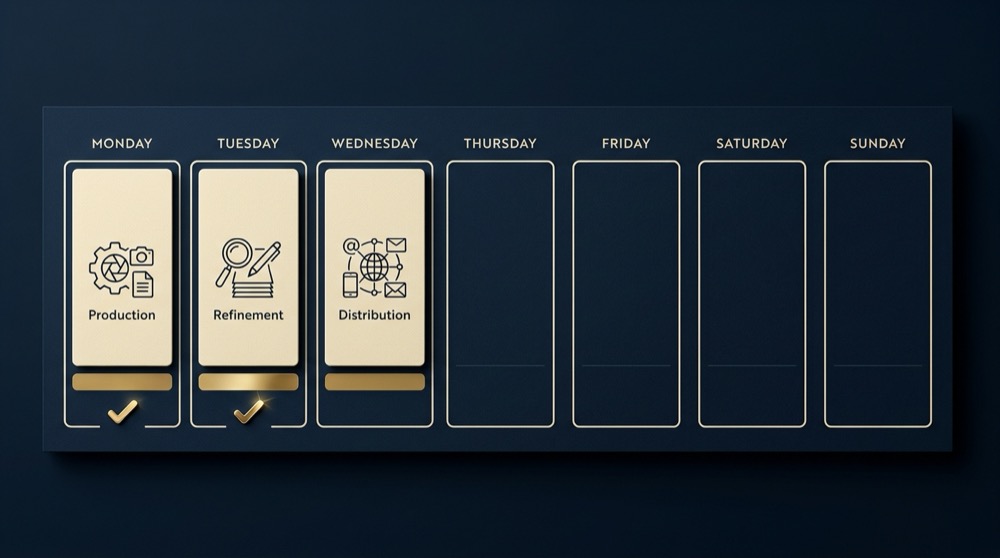
The most effective time-blocking strategy for solo content operators is the full-day block. Instead of splitting each day between multiple workflow stages, you dedicate entire days to single stages. Monday becomes Production Day. Tuesday becomes Refinement Day. Wednesday handles Distribution. This approach may feel extreme, but it produces dramatically better results than trying to write, edit, and publish every day.
Full-day blocks work because they eliminate context-switching between fundamentally different types of work. Writing requires generative thinking, open exploration, and tolerance for messy first attempts. Editing requires critical evaluation, attention to detail, and systematic improvement. Trying to do both in the same session means neither gets the mental mode it needs. Separating them by full days lets you enter the appropriate headspace and stay there.
For solo operators who cannot dedicate full days due to client work or other business demands, half-day blocks provide a workable alternative. The critical point is maintaining separation. A morning spent writing followed by an afternoon spent editing is better than hourly switches between the two. Research on time-blocking for independent content producers shows that stage-blocking reduces context-switching overhead by approximately 40% compared to daily multi-tasking approaches, which translates directly into higher output and better quality.
Sample Weekly Schedule for Solo Content Operators
A practical weekly schedule for a solo operator publishing 2-3 substantial pieces per week might look like this. Monday: Production (4-5 hours writing 3 articles from researched outlines). Tuesday: Refinement (2 hours editing Monday's drafts, plus SEO optimization and formatting). Wednesday: Distribution (2 hours publishing, scheduling social posts, sending email, updating archives). Thursday: Capture review and planning (1 hour reviewing captured ideas, selecting next batch, doing any needed research). Friday: Overflow and adjustment (available for catch-up or getting ahead).
This schedule assumes 10-12 hours per week dedicated to content, which is realistic for a solo operator running a business where content supports but does not constitute the entire business model. The distribution is roughly 40% production, 20% refinement, 20% distribution, 10% planning, and 10% buffer. These ratios matter more than the specific days. Adjust day assignments to fit your business calendar, but maintain the stage separation.
The schedule also builds in pipeline visibility. By Thursday, you know what you will write the following Monday because you have reviewed your capture backlog and selected the next batch. This advance planning prevents the Sunday night panic of realizing you have nothing queued for the week ahead.
Most solo operators discover they spend time inconsistently across workflow stages, often doing all stages in compressed sessions or skipping editing and distribution entirely. Tracking actual time allocation for one week reveals patterns that explain why consistency suffers. The four-stage framework works because it assigns specific time blocks to specific stages, preventing the ad-hoc approach that leads to incomplete execution and missed deadlines.
Why Daily Multi-Tasking Kills Output
The alternative to stage-blocking is the daily multi-tasking approach where you try to capture ideas, write, edit, and publish something every day. This method feels productive because you are always doing content work, but it produces less actual output because of constant context-switching and shallow engagement with each stage.
When you write for 30 minutes, then edit for 30 minutes, then spend 20 minutes on social promotion, you never reach the depth required for quality work in any stage. Writing needs sustained focus to develop ideas fully. Editing needs distance from the writing process to see problems clearly. Distribution needs enough volume to justify the setup overhead of opening tools, writing promotional copy, and scheduling posts.
Daily multi-tasking also creates the illusion of progress without actual shipping. You can spend an hour on content every day and still publish nothing because you are spreading effort across stages without completing any single piece. Stage-blocking forces completion. When Wednesday is Distribution Day, you must have finished pieces ready to publish, which means Production and Refinement had to deliver. The deadline is structural, not aspirational.
Minimum viable time blocks vary by stage but follow consistent principles. Production needs at least 2 hours to be effective because the first 30-45 minutes go to ramping up and getting into flow. Refinement can work in 90-minute blocks if you are editing pre-written drafts. Distribution needs at least 60-90 minutes to handle publishing plus promotion without rushing. Capture runs continuously but benefits from a weekly 30-60 minute review session to process the backlog and plan upcoming production.
Template Systems That Actually Save Time
Templates reduce the decisions required to start and complete content pieces. For solo operators, this reduction in decision fatigue translates directly into faster production and more consistent output. The key is understanding what to template and what to leave flexible.
What to Template (and What Not To)
Template the structure, not the content. A good template defines the sections, flow, and format of a piece without dictating what you say in each section. For example, a how-to article template might specify an introduction, 3-5 main sections with subheadings, a common mistakes section, and a conclusion. It does not specify the topic, the specific steps, or the examples. Those come from the individual piece.
Template recurring content types where you publish multiple instances of the same format. If you write weekly how-to guides, create a how-to template. If you publish case studies, create a case study template. If you send a weekly newsletter, create a newsletter template. Do not create templates for one-off pieces or experimental formats. The value of templates comes from reuse, and reuse requires repetition.
Do not template voice, tone, or perspective. Templates should be structural scaffolding, not fill-in-the-blank Mad Libs. If your template is so detailed that you are just swapping out nouns and verbs, you are not writing, you are assembling, and readers notice. The goal is to reduce structural decisions so you can focus creative energy on ideas, arguments, and expression.

Research on content templates for solopreneurs shows that template-based systems reduce production time by 30-50% while maintaining quality and brand consistency. The time savings come from eliminating the blank-page problem and the structural decisions that slow down drafting. When you know the piece needs an introduction, three main sections, and a conclusion, you start writing the introduction instead of debating whether to start with a story, a statistic, or a question.
Building Your Core Content Templates
Start with your three most common content types. For many solo operators, this is how-to articles, opinion pieces, and case studies or examples. Build a simple structural template for each. The template should fit on one page and include section headings, rough word counts per section, and any standard elements like introductions or conclusions.
A practical how-to template might include: Introduction (100-150 words, state the problem and preview the solution), Main Steps (3-5 sections, 200-300 words each, one clear action per section), Common Mistakes (150-200 words, 3-4 specific errors to avoid), and Conclusion (100-150 words, summarize and provide next step). This structure works for most instructional content and gives you a clear path from outline to draft.
An opinion piece template might include: Hook (50-100 words, specific observation or claim), Context (150-200 words, why this matters now), Argument (3-4 sections, 200-250 words each, one supporting point per section), Counterargument (100-150 words, acknowledge the opposing view), and Conclusion (100-150 words, restate position and implications). This structure ensures your opinion pieces make clear arguments instead of wandering observations.

For email newsletters, a simple template might include: Opening (2-3 sentences, direct address to reader), Main Content (1-3 short sections, 100-200 words each, focused on one idea or update), and Call-to-Action (1-2 sentences, clear next step). Email templates benefit from brevity and directness because readers scan newsletters quickly.
Template Maintenance and Evolution
Templates should evolve as your content improves and your understanding of what works deepens. Review your templates quarterly. Look at your published content from the past three months and identify patterns in what performed well and what fell flat. Adjust templates to reinforce successful patterns and eliminate structural elements that consistently underdeliver.
Common template adjustments include changing section order, adding or removing standard sections, and adjusting word count targets. If you notice that your how-to articles perform better when you add a tools or resources section, add that section to the template. If your opinion pieces drag when you include lengthy context sections, reduce the target word count for context or eliminate it as a required section.
Know when to break template rules. Templates provide structure, not laws. If a specific piece needs a different approach, use a different approach. The goal is to make 80% of your content easier to produce, not to force every piece into the same mold. Breaking the template occasionally keeps your content fresh and prevents the robotic feel that comes from over-templating.
Batching Mechanics: How to Produce Multiple Pieces in One Session
Batching is the practice of producing multiple content pieces in a single focused session rather than spreading production across multiple days. For solo operators, batching leverages momentum, reduces startup friction, and produces more output in less total time than single-piece workflows.
Setting Up Effective Batch Sessions
A successful batch session requires upfront preparation. You cannot sit down to write three articles if you have not selected topics, done research, or created outlines. Preparation happens in a separate session, ideally the day before your batch production session. This separation ensures that production time goes to actual writing, not to the planning and research that should have happened earlier.
Start by selecting your batch topics from your capture backlog. Choose 3-5 ideas that fit the same content type and require similar research or expertise. Writing three how-to articles about related topics in one session works better than writing a how-to, an opinion piece, and a case study because you stay in the same mental mode and can reuse research across pieces.
Do all research before the batch session starts. Open the relevant sources, take notes, bookmark references, and gather any data or examples you will need. The goal is to eliminate research interruptions during writing. When you stop mid-draft to look something up, you lose momentum and add friction that slows the entire session. Research upfront, write in batch.
Create rough outlines for each piece. The outline does not need to be detailed, but it should include the main sections and 1-2 sentence descriptions of what each section will cover. Outlines prevent mid-draft structural decisions that break flow. When you know the next section before you finish the current one, you maintain momentum.
Batch Size and Diminishing Returns
Optimal batch size depends on content length and complexity, but most solo operators find that 3-5 pieces per session works well. Smaller batches do not justify the setup overhead. Larger batches lead to fatigue and quality degradation in later pieces. Research on batch production for solo creators shows that quality remains consistent through the first 3-4 pieces in a session, then drops noticeably as mental fatigue accumulates.
For short-form content like social posts or email newsletters, batch sizes can go higher. Writing 10-15 social posts in one session is reasonable because each piece is brief and follows a simple structure. For long-form articles, 3-4 pieces per session is a practical ceiling. Anything beyond that pushes into diminishing returns where the time spent writing piece five would be better spent on other business activities.
Track your own performance to find your optimal batch size. If you consistently produce strong work on pieces one through three but notice quality drops on piece four, your optimal batch is three pieces. If you feel energized and maintain quality through five pieces, batch five. The goal is maximum output at acceptable quality, not maximum output regardless of quality.
Maintaining Quality Across Batches
Quality maintenance in batch production comes from preparation, pacing, and separation of writing from editing. The preparation work mentioned earlier handles the first element. Pacing means taking short breaks between pieces to reset mentally. After finishing piece two, stand up, walk around, get water, then return to start piece three. The break does not need to be long, but it needs to exist.
Separation of writing from editing is critical. Do not edit during batch production. Write the drafts, accept that they are rough, and move to the next piece. Editing during production breaks momentum and activates the wrong mental mode. Writing is generative and exploratory. Editing is critical and restrictive. Switching between them in the same session guarantees neither gets done well.
Save all editing for your dedicated refinement session. When you return to the batch-produced drafts a day or two later, you will see them with fresh eyes and catch problems you would have missed immediately after writing. This temporal separation improves editing effectiveness and prevents the over-attachment to recent work that causes solo operators to skip necessary cuts and revisions.
Idea Capture and Pipeline Management
Consistent content output requires consistent idea flow. Solo operators who wait until they need an idea to find an idea end up publishing sporadically or not at all. A systematic capture system and pipeline management process ensures you always have 2-3 months of content visibility and never face the blank page without options.
Building a Frictionless Capture System
The best capture system is the one you actually use. For most solo operators, this means a single, always-available input method that requires minimal steps and no complex decisions. Common effective systems include a dedicated note in a phone notes app, a voice recorder for verbal capture, or a simple text file synced across devices.
The capture entry should include just enough information to reconstruct the idea later. This typically means a working title or topic phrase, 1-2 sentences describing the angle or key point, and optionally a tag or category. Do not write full outlines during capture. Do not evaluate whether the idea is good. Do not decide when you will write it. Just capture and move on.
Review your capture backlog weekly during your planning session. This review is where evaluation happens. Look at the ideas captured over the past week, eliminate the ones that no longer seem relevant or interesting, and flag the ones that fit your upcoming production schedule. Some ideas will sit in the backlog for months before the right moment to develop them. Others will move to production immediately. The weekly review keeps the backlog current and prevents it from becoming a graveyard of forgotten ideas.
From Ideas to Scheduled Content
Moving ideas from capture to production requires a lightweight prioritization process. During your weekly planning session, select the 3-5 ideas you will develop in your next production batch. Selection criteria should include relevance to your audience, fit with your current business priorities, availability of research or examples, and your own interest in the topic.
Once selected, move these ideas into a production queue separate from your general capture backlog. This queue represents committed work, not possibilities. For each queued idea, do the research and outlining work needed to make it ready for batch production. This preparation happens during your planning session or in dedicated research time, not during production time.
Maintain a simple content calendar that shows what you plan to publish over the next 2-3 months. The calendar does not need to be detailed or rigid, but it should provide visibility into your pipeline and help you identify gaps before they become problems. Research on editorial planning for solo creators shows that operators who maintain 2-3 months of pipeline visibility experience significantly less last-minute stress and produce higher-quality content because they are not rushing to fill unexpected gaps.
Maintaining 2-3 Month Pipeline Visibility
Pipeline visibility means knowing what content you plan to publish 8-12 weeks out. This does not mean every piece is written or even outlined, but it means you have identified topics, confirmed they fit your strategy, and scheduled approximate publication dates. This advance visibility serves multiple purposes.
First, it prevents the panic of realizing on Sunday that you have nothing to publish Monday. When you can see eight weeks ahead, you know whether your capture and production rates are keeping pace with your publishing schedule. If you see gaps forming six weeks out, you have time to adjust before they become urgent problems.
Second, it allows for strategic sequencing. Some topics build on others. Some are timely and need to publish at specific moments. Some require more research or production time. When you can see the full pipeline, you can sequence pieces logically and allocate production time appropriately.
Third, it reduces decision fatigue. When production day arrives, you do not spend mental energy deciding what to write. You look at the pipeline, see what is queued, and start writing. The decision was made during planning, which is the right time for strategic thinking about content direction.
Update your pipeline weekly during your planning session. Add new ideas that have moved from capture to committed production. Adjust dates based on actual production progress. Remove pieces that no longer fit. The pipeline is a working document, not a contract, but it should always show a clear path forward for the next 2-3 months.
Tool Stack for Solo Content Workflows
The right tools reduce friction and manual work. The wrong tools create overhead and distraction. For solo operators, tool selection should prioritize workflow integration, ease of use, and genuine time savings over feature lists and marketing promises.
Core Tools vs. Nice-to-Haves
Core tools are the minimum viable stack needed to execute your content workflow. For most solo operators, this includes a writing environment, a content management system for publishing, and a distribution tool for social scheduling or email. Everything else is a nice-to-have that should be added only if it solves a specific, measurable problem.
A writing environment can be as simple as a text editor or as complex as a dedicated writing app with outlining and research features. The key requirement is that it supports focused writing without distractions. Many solo operators use plain text editors or minimal writing apps specifically to avoid the feature bloat and notifications that come with heavier tools.
A content management system handles publishing, formatting, and basic SEO. Modern CMS platforms offer solo-optimized features that reduce the traditional dependency on technical help or design resources. Look for systems with intuitive editors, built-in SEO guidance, and simple publishing workflows. The best CMS for a solo operator is the one that lets you go from draft to published in under 10 minutes without technical friction.
Distribution tools vary by channel but should minimize manual work. If you publish to social media, a scheduling tool that lets you queue a week of posts in one session saves significant time compared to posting manually each day. If you send email newsletters, your email platform should integrate with your CMS or at least make it easy to pull content from published articles.
Pre-publication checklist to ensure content meets quality and SEO standards before going live
Run this checklist during your Distribution stage to catch common oversights before publishing
AI-Assisted Features Worth Using
AI tools in 2025 offer genuine productivity improvements for solo operators, but not all AI features deliver equal value. The most useful AI-assisted features for content workflows are grammar and style checking, SEO optimization suggestions, and image generation for visual content.
Grammar and style tools catch errors and inconsistencies that solo operators miss when editing their own work. These tools do not replace human editing, but they reduce the time spent on mechanical fixes and let you focus editing time on structural and strategic improvements. Research on AI tools for solo content workflows shows that AI-assisted grammar checking reduces editing time by 20-30% while improving published quality.
SEO optimization features analyze your content against target keywords and suggest improvements for search visibility. For solo operators without dedicated SEO expertise, these tools provide actionable guidance that improves discoverability without requiring deep technical knowledge. Look for tools that integrate into your writing or CMS environment rather than standalone platforms that require exporting and importing content.
Image generation tools let solo operators create custom visuals without design skills or stock photo subscriptions. AI image generators work well for blog headers, social media graphics, and illustration of abstract concepts. They work less well for realistic photography or highly specific visual requirements. Use them where they fit, skip them where they do not.
Avoid AI features that promise to write entire articles for you. These tools produce generic content that lacks the perspective and specificity that makes content valuable. They can help with outlining or generating ideas, but the actual writing should remain human work. Readers can tell the difference, and search engines increasingly penalize purely AI-generated content.
Avoiding Tool Sprawl
Tool sprawl happens when you add new tools without removing old ones, gradually building a stack that requires more time to manage than it saves. Solo operators are particularly vulnerable because every new tool promises to solve a problem they actually have, and without team coordination requirements, there is no natural brake on accumulation.
Prevent tool sprawl by enforcing a one-in-one-out rule. When you add a new tool, remove an old one. This forces evaluation of whether the new tool genuinely improves your workflow or just adds features you will not use. Most solo operators can execute a complete content workflow with 4-6 tools. If your stack exceeds 10 tools, you almost certainly have redundancy and overhead.
Evaluate tools annually. Go through your entire stack and ask whether each tool is still serving its purpose. Tools that seemed essential six months ago may now be redundant because your workflow changed or because another tool absorbed their functionality. Cancel subscriptions for tools you have not used in 60 days unless there is a specific seasonal or project-based reason for the gap.
Prioritize integrated tools over point solutions. A CMS with built-in SEO features is better than a CMS plus a separate SEO tool. An email platform that pulls content from your CMS is better than manually copying content between systems. Integration reduces context-switching and eliminates the manual work of moving content between tools.
Common Workflow Mistakes Solo Operators Make
Even with a clear framework, solo operators fall into predictable traps that undermine consistency and quality. Recognizing these patterns helps you avoid them or correct course quickly when you notice them developing.
Over-Engineering the Process
The most common mistake is building a workflow more complex than the output justifies. Solo operators read about content operations at large companies and try to implement the same systems for a one-person operation publishing 2-3 pieces per week. The result is a process with more overhead than output.
Over-engineering shows up as excessive documentation, too many workflow stages, detailed tracking that never gets reviewed, and tool stacks with redundant capabilities. If you spend more time managing your content system than creating content, you have over-engineered. The fix is aggressive simplification. Cut any process step that does not directly contribute to getting content published.
A related mistake is perfectionism disguised as process. Solo operators create elaborate review checklists, multi-pass editing protocols, and detailed quality standards that ensure nothing ever ships because nothing ever meets the standard. Perfectionism kills shipping. The goal is consistent publication of good content, not occasional publication of perfect content. Good content published beats perfect content perpetually refined.
Skipping the Editing Stage
The opposite mistake is skipping editing entirely and publishing first drafts. This happens when solo operators conflate speed with efficiency or when they are so far behind schedule that editing feels like a luxury they cannot afford. Publishing unedited work damages credibility and wastes the effort invested in creation.
First drafts contain structural problems, unclear explanations, factual errors, and mechanical mistakes that readers notice and that undermine your authority. Editing does not need to be extensive, but it needs to happen. A focused 20-30 minute editing pass catches most problems and significantly improves published quality.
The solution is making editing a non-negotiable stage with dedicated time. If you batch-produce three articles on Monday, you batch-edit them on Tuesday. The editing happens, or the articles do not publish. This structural requirement prevents the rationalization that leads to skipping editing when you are busy or behind schedule.
Publishing Without Distribution Planning
Creating content without planning how to distribute it is like cooking a meal and leaving it in the kitchen instead of serving it. Solo operators often treat distribution as an afterthought, publishing an article and then scrambling to figure out how to promote it. This approach guarantees weak initial performance because distribution is reactive rather than strategic.
Distribution should be planned during or immediately after production. When you write an article, you should also draft the social posts, email copy, and any other promotional materials needed to drive traffic. This planning happens in the same session because the content is fresh in your mind and you can create more effective promotional copy.
Effective distribution also requires understanding where your audience actually consumes content. If your readers do not use Twitter, posting there is wasted effort regardless of how clever your tweets are. Focus distribution effort on the 1-2 channels that actually drive traffic and engagement for your specific audience. Spreading effort across six channels guarantees shallow presence everywhere and strong presence nowhere.
Making Your Workflow Actually Stick
Reading about workflow systems is easy. Implementing them is harder. Making them stick long enough to become habit is hardest. Most solo operators try a new system, see initial results, then gradually drift back to ad-hoc approaches as other business pressures accumulate. Preventing this drift requires deliberate implementation and ongoing maintenance.
The First 30 Days of Implementation
The first month determines whether a new workflow becomes permanent or gets abandoned. During this period, focus on execution consistency over optimization. Run the system as designed even if it feels inefficient or awkward. Early optimization usually means reverting to old habits disguised as improvements.
Week one should focus on setting up the basic infrastructure. Create your capture system, set up your content calendar, build your core templates, and block time on your actual calendar for each workflow stage. Do not start producing content in week one. Get the system ready first.
Week two is your first full execution cycle. Run a complete cycle from capture review through production, refinement, and distribution. Expect this first cycle to feel slow and mechanical. You are learning the system, which always takes longer than executing a familiar process. Do not judge the workflow based on week two performance.
Weeks three and four are about building rhythm. Run two more complete cycles, maintaining the same stage separation and time-blocking discipline. By week four, the workflow should start feeling more natural, and you should see improvements in both speed and output quality. If you are not seeing improvement by week four, the workflow may not fit your specific situation and needs adjustment.
Workflow Audits and Iteration
Quarterly workflow audits keep your system aligned with your actual needs and prevent drift toward either over-engineering or abandonment. A workflow audit is a structured review of what is working, what is not, and what needs adjustment.
Start by reviewing output metrics. How many pieces did you publish in the past quarter? How does that compare to your target? If you are consistently missing targets, the workflow has a problem. If you are exceeding targets, you may have room to increase ambition or reduce time investment.
Next, review time allocation. Track where your content time actually goes for one week, then compare it to your intended allocation. If you planned 40% production time but actually spent 60%, something is wrong with either your plan or your execution. Adjust time blocks to match reality or adjust execution to match the plan.
Finally, review quality and engagement. Are published pieces meeting your standards? Are readers engaging? If quality is slipping, you may need more refinement time or better editing discipline. If engagement is dropping, you may need to revisit topic selection or distribution strategy.
When to Simplify vs. When to Add Structure
Knowing when to simplify your workflow and when to add structure is a judgment call based on specific symptoms. Simplify when you are spending more time on process than production, when you have tools or stages you consistently skip, or when the workflow feels like a burden rather than a support system.
Add structure when you are missing deadlines despite having time available, when quality is inconsistent across pieces, or when you are constantly making the same mistakes. These symptoms indicate that your workflow lacks the constraints needed to ensure consistent execution.
The goal is the minimum viable structure that produces consistent, quality output. More structure than that is overhead. Less structure than that is chaos. The right amount of structure feels almost invisible when the workflow is running well but provides clear guidance when you are tired, distracted, or behind schedule.
Most solo operators need less structure than they think when starting out and more structure than they think after six months of operation. Start simple, add structure only when specific problems emerge, and remove structure that stops serving a purpose. Your workflow should evolve with your content operation, not remain static based on initial design.
Initial setup takes about one week. Week one focuses on infrastructure: creating your capture system, setting up templates, building your content calendar, and blocking time on your actual calendar for each workflow stage. You should not start producing content during setup week. Weeks two through four are execution cycles where the workflow starts feeling natural and you see improvements in speed and quality. By the end of 30 days, the workflow should be functioning consistently.
Yes, the four-stage framework works at any publishing frequency. For once-per-week publishing, you might dedicate one half-day to production, one morning to refinement, and one afternoon to distribution each week. The key principles remain the same: separate workflow stages, batch similar activities, and maintain 2-3 months of pipeline visibility. Lower publishing frequency actually makes stage separation easier because you need less total time and can fit workflow stages into smaller calendar blocks.
The minimum viable stack includes three tools: a writing environment (text editor or writing app), a content management system for publishing, and a distribution tool for scheduling social posts or email. Most solo operators can execute a complete workflow with 4-6 total tools. If your stack exceeds 10 tools, you likely have redundancy and overhead. Prioritize integrated tools over point solutions to reduce context-switching and manual work moving content between systems.
The system works if you run it consistently for 30 days. Most solo operators see measurable improvements in output and quality within the first month. The workflow becomes habit within 90 days. After that, it runs in the background, supporting your content operation without requiring constant attention or adjustment. Build the system, run the system, ship the content.
References
Want this kind of work done for your business?
We build and run AI-powered marketing and automation. 15 minutes, honest assessment.
Book a call