 Orvus
OrvusShould You Automate Your Sales Outreach? A Decision Framework
May 23, 2026
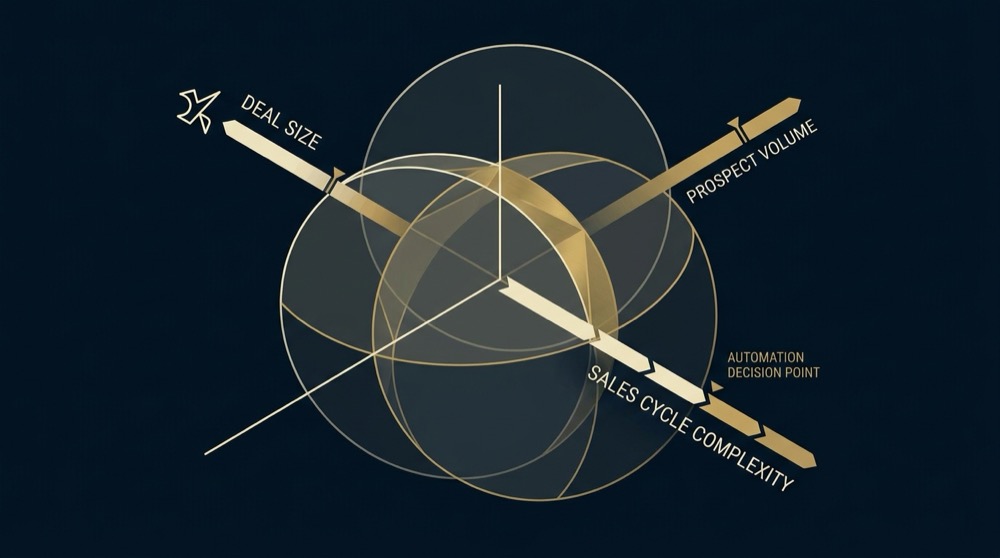
The question is not whether automation is good or bad. The question is whether it makes sense for your specific situation right now. That answer depends on three measurable variables: the size of your typical deal, the number of prospects you contact monthly, and the complexity of your sales cycle. These factors interact to determine whether automation will save you time and improve results, or waste money and tank your conversion rates.
This framework cuts through the positioning to show exactly when automation pays off and when it does not. It is built on 2024-2025 performance data, operator experience across different deal sizes and sales cycles, and the math that actually determines ROI. By the end, you will know whether to automate, what to automate if you do, and what to keep manual regardless of volume.
What Sales Outreach Automation Actually Means
Sales outreach automation refers to using software to handle repetitive prospecting tasks that would otherwise require manual effort. This includes sending initial emails, scheduling follow-ups, logging interactions, and moving prospects through predefined sequences based on their behavior or lack of response.
The confusion starts because automation exists on a spectrum. At one end, you have email templates and mail merge, which save typing but still require manual triggering. In the middle, you have cold email sequences that send a series of messages based on time delays or engagement triggers. At the far end, you have full-stack systems that integrate CRM automation, dynamic personalization, multi-channel coordination, and AI-assisted content generation.
Most operators considering whether to automate sales outreach are actually deciding between three levels. First, manual outreach with templates, where you write each message individually but use saved snippets. Second, sequence-based automation, where you load prospects into a tool that sends a predetermined series of emails over days or weeks. Third, AI-assisted or full automation, where software generates personalized content, adjusts messaging based on engagement data, and handles most touchpoints without human input.
The Spectrum from Templates to Full Automation
Templates represent the baseline. You save common email structures and personalize key details manually before sending. This works when you have under 50 prospects monthly and high deal values that justify individual attention. The time investment is substantial but conversion rates stay high because each message feels genuinely personal.

Sequence automation sits in the middle. You write a series of three to seven emails, define the timing between them, and the system sends them automatically based on whether the prospect opens, clicks, or replies. This level handles the repetitive follow-up work that kills productivity in manual outreach. Most operators who decide to automate sales outreach start here.
Full automation includes dynamic content generation, multi-channel coordination across email, LinkedIn, and phone, automatic lead scoring, and integration with your CRM to trigger actions based on website behavior or other signals. This level requires significant setup time, ongoing optimization, and usually makes sense only at high prospect volumes or when you have dedicated operations support.
What Gets Automated and What Should Not
Effective automation handles high-volume, low-variance tasks. Initial cold emails to prospects who match a clear profile. Follow-up sequences when someone does not respond. Reminder emails before scheduled calls. Meeting confirmation and preparation messages. These touchpoints follow predictable patterns and do not require real-time context or complex judgment.
What should stay manual: discovery calls, objection handling, negotiation, executive outreach to named decision-makers, and any interaction where the prospect has already engaged. Once someone replies to your automated sequence, a human needs to take over. Trying to automate these moments destroys credibility and tanks conversion rates.
The line between what to automate and what to keep manual depends on your specific situation, which is why you need a decision framework rather than blanket advice. That framework starts with three variables that determine whether automation will help or hurt your business.
The Three Variables That Determine Your Answer
Three factors determine whether automation makes sense for your sales outreach: the size of your typical deal, the number of prospects you contact monthly, and the complexity of your sales cycle. These variables interact, but each has clear thresholds where automation shifts from waste to necessity.
Deal Size and Contract Value Thresholds
Deal size creates the clearest breakpoint. If your average contract value sits below $5,000, automation typically delivers positive ROI within 90 days. The math is straightforward: lower-value deals require higher volume to hit revenue targets, which means more outreach than one person can handle manually while maintaining quality and speed.
Between $5,000 and $25,000, the answer depends on the other two variables. You might automate initial outreach but keep follow-up and closing conversations manual. Or you might use AI-assisted personalization to scale without losing the custom feel that higher-value prospects expect.
Above $25,000, research shows that manual personalization significantly outperforms automation in conversion rates. These deals usually involve multiple stakeholders, longer consideration periods, and complex evaluation criteria. Generic or templated outreach signals that you do not understand their specific situation, which kills trust before the relationship starts.
Prospect Volume and Pipeline Capacity
Volume creates the second threshold. If you contact fewer than 50 prospects monthly, manual outreach with templates usually works fine. You can maintain quality, remember context, and adjust your approach based on what you learn from each conversation.
Between 50 and 100 monthly prospects, you hit the sustainability limit for purely manual outreach. The time required to research, personalize, send, track, and follow up starts consuming your entire workday. Quality begins to slip because you rush. Follow-up falls through cracks because you lose track. This is where most solo operators start seriously considering whether to automate sales outreach.
Above 100 monthly prospects, automation becomes necessary unless you hire dedicated sales staff. The math does not work otherwise. Even with templates and efficient processes, manually managing that volume while doing everything else required to run a business is not sustainable.
Sales Cycle Complexity and Stakeholder Count
Complexity matters as much as volume. A simple sale to a single decision-maker who can say yes immediately works well with automation. Think SaaS trials, productized services, or straightforward B2C offers. The prospect evaluates your solution, makes a decision, and buys, usually within days or weeks.
Complex B2B sales cycles with multiple stakeholders resist automation. When your prospect needs to convince their boss, get budget approval, coordinate with other departments, or navigate internal politics, your outreach needs to address different concerns for different people. Automated sequences cannot adapt to this complexity without becoming so complicated that they break.
The interaction between these three variables determines your answer. High volume plus low complexity plus sub-$5,000 deals means automation probably makes sense. Low volume plus high complexity plus deals above $25,000 means stay manual. Everything in between requires the hybrid approach covered later in this article.
Decide Before You Automate
Most operators struggle to score their own situation objectively because they focus on what they want to be true rather than what the numbers actually show. A simple calculator that takes your deal size, monthly prospect volume, and sales cycle length can give you a clear yes, no, or hybrid answer in under two minutes. The framework removes the guesswork and shows you exactly where you fall on the automation spectrum.
When Automation Works: The High-Volume, Low-Complexity Case
Automation delivers clear wins in specific scenarios. When you have high prospect volume, relatively low deal values, and straightforward sales cycles, the time savings and efficiency gains justify the investment quickly. The data from 2024 shows what good performance actually looks like.
Time Savings and Efficiency Gains
Businesses that implement structured outreach automation report 30-50% time savings on repetitive prospecting tasks. This is not vendor marketing, it is measured time that used to go into writing individual emails, tracking who got what message, remembering to follow up, and logging everything in a CRM.
For a solo operator spending 15 hours weekly on outreach, automation can recover 5 to 7 hours. That time shifts to higher-value activities: actual sales conversations, product development, customer success work, or strategic planning. The efficiency gain compounds because you are not just saving time, you are redirecting it to work that actually grows the business.
The time savings show up in three areas. First, initial message creation drops from 10 minutes per prospect to essentially zero once you build your sequence. Second, follow-up happens automatically instead of requiring calendar reminders and manual sends. Third, tracking and reporting become automatic instead of requiring spreadsheet updates or CRM data entry.
ROI Timeline and Breakeven Analysis
For deals under $5,000, ROI typically appears within 90 days if you implement automation correctly. The breakeven calculation is simple: tool cost plus setup time versus time saved multiplied by your effective hourly rate, plus any conversion rate improvement from consistent follow-up.
Most automation tools for solo operators cost $50 to $200 monthly. Setup takes 10 to 20 hours to build sequences, integrate with your CRM, and test deliverability. If automation saves you 6 hours weekly, you recover the setup time in under a month. After that, you are ahead by 24 hours monthly, worth $1,200 to $3,000 depending on how you value your time.
The conversion rate impact matters more than the time savings for many operators. Automated follow-up ensures no prospect falls through cracks. Consistent timing keeps you top of mind. Systematic tracking shows what messaging works. These factors often improve close rates by 10-20% compared to inconsistent manual outreach, which accelerates payback significantly.
Most solo operators discover their manual process is unsustainable only after they have already started losing deals to poor follow-up. The warning signs appear around 75-100 monthly prospects: follow-up emails you meant to send but forgot, prospects who went cold because you did not reach out at the right time, and the constant feeling of being behind on outreach while other business priorities suffer. If you are spending more than 20 hours weekly on pure outreach activity, or if your prospect-to-meeting conversion rate has dropped as volume increased, your manual process has likely already broken down. The solution is not working harder or getting more organized. It is implementing systematic automation for the repetitive touchpoints while preserving manual attention for the moments that actually determine whether you win or lose deals. The hybrid model lets you scale volume without sacrificing the relationship quality that drives conversion.
Ideal Automation Scenarios
SaaS businesses with free trials or low-cost entry tiers represent the ideal automation case. Prospects can evaluate the product without sales involvement, the decision-maker is usually the end user, and deal values typically sit between $500 and $5,000 annually. Automated sequences that educate, nurture, and prompt action work well because the sale is straightforward.
Productized services with clear scopes and fixed pricing also benefit from automation. When you offer website audits, content packages, or design services with defined deliverables and transparent pricing, prospects know what they are buying. Your outreach just needs to establish credibility, demonstrate value, and prompt a decision. Automation handles this efficiently.
High-volume B2C offers where individual deal values are low but lifetime value justifies acquisition cost also fit the automation model. Think online courses, membership programs, or digital products. You need to reach hundreds or thousands of prospects to hit revenue goals, which makes manual outreach impossible. Automation becomes the only viable path to scale.
Lead nurturing for longer sales cycles also works well with automation, even if the final sale requires manual involvement. Automated sequences can educate prospects, share case studies, provide resources, and maintain engagement over weeks or months until they are ready for a sales conversation. This keeps your pipeline warm without constant manual effort.
When Automation Fails: Enterprise Sales and Complex Deals
Automation actively hurts conversion in specific situations. When deal values climb above $25,000, when multiple stakeholders need to align, or when the sales process requires deep customization, automated outreach signals that you do not understand the prospect’s situation. The damage to credibility outweighs any efficiency gain.
Why High-Value Deals Resist Automation
High-value contracts require high-touch sales processes because the risk and complexity demand it. A company considering a $50,000 purchase wants to know that you understand their specific challenges, have relevant experience with similar situations, and can deliver results that justify the investment. Generic outreach suggests you are fishing rather than targeting.
The threshold sits around $25,000 based on 2024 sales data. Below that number, prospects tolerate some automation if the value proposition is clear and the initial outreach shows basic relevance. Above it, decision-makers expect personalized communication that demonstrates you have done your homework on their business.
Time investment scales with deal size for good reason. A $100,000 contract might take 40 hours of research, customization, and relationship building to close. That is 0.04% of the contract value spent on sales effort. Trying to save 10 hours through automation while risking the entire deal makes no economic sense.
The Personalization Gap in Complex Sales
Multi-stakeholder sales create complexity that automation cannot handle well. Your champion needs different information than the CFO. The technical evaluator cares about different features than the end users. The executive sponsor wants strategic alignment while the procurement team focuses on terms and pricing.
Automated sequences cannot adapt messaging to these different audiences without becoming so branched and conditional that they require more maintenance than manual outreach. Even AI-assisted personalization struggles here because the context shifts based on internal dynamics you cannot observe from outside the organization.

Enterprise sales also involve timing sensitivity that automation misses. A prospect might be ready to move forward but needs a specific piece of information to bring to their next internal meeting. An automated sequence that sends generic content on a predetermined schedule misses the opportunity. Manual outreach lets you respond to the actual situation in real time.
Warning Signs You Are Automating the Wrong Thing
Several failure patterns show up repeatedly when operators try to automate complex sales. Automating discovery calls or needs analysis conversations destroys trust because prospects can tell you are not actually listening. Sending generic executive outreach to C-level contacts signals that you do not value their time. Automating objection handling with canned responses makes prospects feel like they are arguing with a chatbot.
Another common mistake is continuing automated sequences after a prospect has engaged. Once someone replies to your initial outreach, they expect a human to respond. Sending them the next message in your predetermined sequence instead of addressing their actual question or concern kills the relationship immediately.
Ignoring engagement signals represents a third failure mode. If a prospect visits your pricing page three times, downloads a case study, and forwards your email to a colleague, they are showing buying intent. An automated sequence that ignores these signals and keeps sending educational content misses the opportunity to accelerate the sale.
The cost of these mistakes is not just lost deals. It is damaged reputation, burned prospects who will not give you a second chance, and wasted time that could have gone into manual outreach to better-fit opportunities. When automation fails in complex sales, it fails expensively.
The Hybrid Model: Automation Plus Human Triggers
The practical middle path combines automated initial outreach with manual intervention at key decision points. This approach scales better than pure manual while preserving the relationship quality that pure automation sacrifices. For most operators, hybrid is the right answer.
How Engagement-Based Escalation Works
Hybrid approaches use automation for initial touchpoints and systematic follow-up, but escalate to human involvement when prospects show engagement. The system watches for specific signals: email replies, link clicks, meeting requests, website visits, or content downloads. When these triggers fire, a human takes over.
Research from 2024 shows that hybrid strategies outperform fully automated or fully manual approaches by 40-60% in response rates. The automated portion ensures consistent outreach and captures prospects who need multiple touchpoints before engaging. The manual portion provides the personalized attention that converts engaged prospects into customers.
The key is defining clear escalation rules. A simple framework: automate the first three emails in a sequence, but if someone replies, clicks a key link, or visits your pricing page, pause automation and notify the operator. This prevents the common failure mode where automated follow-up continues after someone has shown interest.
Setting Up Manual Intervention Points
Effective hybrid systems define specific moments where humans must take over. Email replies always trigger manual intervention. The prospect is engaging, which means they have questions, objections, or interest that requires real conversation. Automated responses to replies destroy credibility instantly.
Meeting requests also require immediate human involvement. If someone clicks your calendar link or asks about scheduling a call, that is a buying signal. Automated confirmation emails are fine, but the actual meeting preparation and follow-up need personal attention.
Objections and questions represent another critical intervention point. If a prospect replies asking about pricing, implementation time, or specific features, they are evaluating whether to buy. These moments determine whether you win or lose the deal. Automation cannot handle the nuance required to address concerns effectively.
High-value actions like downloading detailed case studies, visiting multiple product pages, or spending significant time on your site also warrant manual follow-up. These behaviors indicate serious interest. A personalized email that acknowledges what they have reviewed and offers to answer specific questions converts better than the next automated message in your sequence.

Performance Data on Hybrid Approaches
The 40-60% response rate improvement from hybrid approaches comes from combining the best aspects of both methods. Automation ensures you follow up consistently, which matters because most deals require five to eight touchpoints before prospects respond. Manual intervention provides the personalization and context sensitivity that converts interest into action.
Conversion rates also improve with hybrid models. While automated sequences might convert 2-3% of cold prospects into meetings, adding manual intervention at engagement triggers pushes that number to 4-6%. The improvement comes from catching prospects at the right moment with the right message, which pure automation misses.
Time efficiency stays strong with hybrid approaches because automation still handles 70-80% of outreach volume. You only shift to manual for the 20-30% of prospects who show engagement signals. This means you get most of the time savings from automation while preserving the relationship quality that drives conversions.
AI-Assisted Personalization: The 2025 Middle Ground
AI personalization tools have matured significantly in 2024-2025, creating a new option between generic templates and fully manual customization. These tools analyze prospect data and generate personalized content at scale, narrowing the performance gap between automated and manual outreach.
What AI Personalization Actually Delivers
Current AI tools can pull information from LinkedIn profiles, company websites, news articles, and other public sources to customize email content. They might reference a recent funding round, mention a specific pain point common in the prospect’s industry, or note a relevant case study from a similar company. This creates the appearance of research without the manual time investment.
The quality varies significantly. Basic AI personalization might just insert the company name and industry into a template. More sophisticated tools generate unique opening paragraphs that reference specific details about the prospect’s situation. The best systems combine data analysis with natural language generation to produce messages that feel individually written.
What AI personalization does not do well yet: understand complex context, adapt to subtle signals about prospect readiness, or handle the kind of deep customization required for high-value enterprise deals. The technology works best for mid-volume outreach where some personalization improves results but full manual customization is not economically justified.
Open Rate and Response Rate Improvements
AI-powered personalization tools enable automated outreach to achieve 15-25% higher open rates compared to generic templates. This improvement comes from subject lines and preview text that feel more relevant, which increases the chance that prospects actually read your message.
Response rates improve by roughly 10-15% with AI personalization versus generic automation. The gap between AI-assisted and fully manual personalization still exists, but it is narrower than the gap between generic templates and AI. For many operators, that middle ground offers the best balance of efficiency and effectiveness.
The performance gain depends heavily on data quality. If the AI has access to rich, current information about your prospects, it can generate genuinely relevant personalization. If it is working from minimal or outdated data, the personalization feels forced and actually hurts credibility.
When AI Personalization Is Worth the Cost
AI personalization makes economic sense when you are between the pure automation and pure manual thresholds. If you have 100-300 monthly prospects, deal values between $5,000 and $25,000, and sales cycles that benefit from some customization but do not require deep manual work, AI tools can improve results without destroying efficiency.
The cost consideration matters. AI personalization tools typically add $100-$300 monthly to your automation stack. That investment pays off if it improves conversion rates enough to generate one or two additional deals monthly. For a $10,000 average deal value, even a 1% conversion improvement justifies the cost.
When AI personalization is not worth it: very low deal values where generic automation works fine, or very high deal values where only deep manual personalization converts. The sweet spot is the middle market where prospects expect some personalization but you cannot afford to spend hours researching each one.
Estimate monthly time savings and ROI from adding AI personalization to your outreach
Assumes AI saves 40% of manual personalization time and improves conversion by 1%
The Solo Operator Threshold: When Manual Breaks Down
Solo operators and small teams face a specific breakpoint where manual outreach becomes unsustainable. Understanding this threshold helps you decide when to invest in automation versus when to keep things simple.
The 100-Prospect Monthly Sustainability Limit
The math on manual outreach is straightforward. Each prospect requires research, initial email composition, follow-up tracking, and response handling. Even with templates and efficient processes, this averages 15-20 minutes per prospect across the full outreach cycle.
At 50 prospects monthly, that is 12-16 hours of outreach work. Manageable for most operators. At 100 prospects monthly, you are looking at 25-33 hours, which starts consuming most of a full work week. At 150 prospects, manual outreach becomes your full-time job, leaving no time for actual sales conversations, product work, or business operations.
This threshold appears consistently in research on small team sales. Around 100 monthly prospects, operators report that manual processes start breaking down. Follow-up falls through cracks. Quality declines because of time pressure. Conversion rates drop because you rush through research and personalization.
Time Math on Manual Outreach
Breaking down the time investment makes the threshold clear. Initial research takes 3-5 minutes per prospect if you are efficient. Writing a personalized email takes another 5-7 minutes. Tracking who got what message and when to follow up adds 2-3 minutes. Handling replies and scheduling meetings takes 5-10 minutes for prospects who engage.
For 100 prospects monthly with a 10% engagement rate, you are looking at roughly 25 hours of pure outreach work. This does not include the actual sales conversations, proposal writing, contract negotiation, or any other business activities. It is just the outreach itself.
The time constraint forces a decision. Either accept lower prospect volume and slower growth, hire someone to handle outreach, or implement automation. For most solo operators, automation becomes the only economically viable path to scale past this threshold.
Scaling Without Sacrificing Quality
The challenge is scaling outreach volume without destroying the quality that drives conversion. This is where the hybrid model becomes essential. Pure automation at high volume maintains efficiency but tanks conversion rates. Pure manual at high volume maintains quality but becomes unsustainable.
The solution is automating the high-volume, low-variance touchpoints while keeping quality-critical moments manual. Initial cold outreach gets automated because you are sending similar messages to similar prospects. Follow-up for non-responders gets automated because it is repetitive. But replies, objections, and closing conversations stay manual because they require judgment and adaptation.
Practical implementation means building your sequences carefully, defining clear escalation triggers, and accepting that some prospects will slip through. You cannot maintain 100% perfect personalization at scale. The goal is maintaining enough quality to keep conversion rates acceptable while handling the volume required to hit your growth targets.
Common Automation Mistakes That Kill Conversion
Specific failure patterns show up repeatedly when operators implement sales automation poorly. Avoiding these mistakes prevents expensive lessons and protects your conversion rates.
Over-Automating High-Touch Moments
The most damaging mistake is automating interactions that require human judgment. Discovery calls cannot be automated. The entire point is learning about the prospect’s specific situation, which requires active listening and adaptive questioning. Trying to automate this with forms or chatbots signals that you do not actually care about their needs.
Objection handling also fails when automated. Prospects raise objections because they have specific concerns about your solution. Canned responses to common objections might address the surface issue but miss the underlying worry. This is where deals die, and automation cannot save them.
Executive outreach represents another high-touch moment that resists automation. Reaching out to a CEO or VP with a generic message that clearly came from a sequence destroys credibility. These contacts receive dozens of automated pitches daily. Standing out requires genuine personalization that shows you understand their business and have a specific reason for reaching out.
Generic Templates That Signal Mass Outreach
Even when you automate appropriately, generic templates kill conversion by signaling that you are fishing rather than targeting. Prospects can spot mass outreach instantly. Phrases like “I came across your company” or “I thought you might be interested” scream automation.
The damage goes beyond just low response rates. Generic outreach harms your sender reputation, which affects email deliverability. If enough recipients mark your messages as spam or delete them without opening, email providers start filtering your messages to spam folders automatically. This creates a downward spiral where your outreach becomes less and less effective.
Better templates include specific details that require at least minimal research: the prospect’s industry, a recent company milestone, a relevant pain point, or a concrete reason why your solution fits their situation. This does not require hours of research per prospect, but it does require more than just mail merge with company name.
Ignoring Engagement Signals and Context
Continuing automated sequences after prospects have shown engagement represents another common failure. Someone visits your pricing page, downloads a case study, and clicks through to your product demo, but your automation keeps sending educational content about the problem you solve. This mismatch between their buying stage and your messaging kills momentum.
Missing reply opportunities also damages conversion. If a prospect replies to your second email asking a question, but your automation sends the third email in the sequence before you respond to their question, you have just told them that you care more about your process than their needs.
Context blindness shows up in timing mistakes too. Sending a follow-up email 30 minutes after the previous one because your sequence triggered incorrectly. Reaching out during obvious blackout periods like December holidays or industry conference weeks. Continuing outreach after someone has explicitly asked to be removed from your list. These mistakes are automation failures that hurt your reputation.
Your Decision Framework: A Practical Checklist
The decision to automate sales outreach comes down to scoring your situation against clear criteria. This checklist gives you a structured way to evaluate whether automation makes sense for your business right now.
Scoring Your Automation Fit
Start with deal size. If your average contract value is under $5,000, score 2 points. Between $5,000 and $25,000, score 1 point. Above $25,000, score 0 points. Lower deal values favor automation because you need volume to hit revenue targets.
Next, prospect volume. If you contact 100 or more prospects monthly, score 2 points. Between 50 and 100, score 1 point. Under 50, score 0 points. Higher volume makes automation necessary because manual processes break down.
Third, sales cycle complexity. If your sale involves a single decision-maker who can say yes immediately, score 2 points. If it involves 2-3 stakeholders or a short evaluation period, score 1 point. If it requires multiple stakeholders, long evaluation, or complex customization, score 0 points. Simple sales work better with automation.
Add your scores. 5-6 points means automation probably makes sense. 3-4 points means hybrid is your best path. 0-2 points means stay manual for now and revisit when your situation changes.
Implementation Priorities If You Automate
If your score says automate, start with initial cold outreach. Build a 3-5 email sequence that introduces your solution, demonstrates value, and prompts a response. Test this sequence manually first with 20-30 prospects to validate messaging before automating.
Second, automate follow-up for non-responders. If someone does not reply to your initial outreach, a systematic follow-up sequence keeps you top of mind without manual effort. Space these messages 3-7 days apart and stop after 3-4 attempts if there is no engagement.
Third, set up engagement triggers that pause automation and alert you when prospects show interest. This prevents the common mistake of continuing automated outreach after someone has engaged. The triggers should catch replies, link clicks, website visits, and meeting requests.
Fourth, integrate with your CRM so all outreach activity logs automatically. This eliminates manual data entry and ensures you have complete records of every interaction. The integration also enables more sophisticated automation based on prospect behavior across channels.
What to keep manual: all replies and conversations, objection handling, closing discussions, and any outreach to named executives or high-value targets. These moments determine whether you win or lose deals, and automation hurts more than it helps.
What to Do If Automation Is Not Right Yet
If your score says stay manual, focus on making your manual process as efficient as possible. Build a library of email templates for common scenarios. Create a simple tracking system so follow-up does not fall through cracks. Develop a research checklist that speeds up prospect qualification without sacrificing quality.
Set a calendar reminder to revisit the automation decision in 90 days. Your situation will change as you grow. When you cross the 100-prospect monthly threshold, or when deal values drop as you move down-market, or when your sales cycle simplifies, automation might make sense even if it does not today.
Use the time you save from not implementing automation to improve your core sales process. Better qualification, stronger value propositions, more effective discovery questions, and tighter closing techniques all improve conversion rates. These fundamentals matter more than automation, and they work regardless of whether you eventually automate or not. For solopreneurs building sustainable systems without teams, understanding when to implement marketing systems follows similar decision frameworks. The same principles apply whether you are automating outreach or building broader content marketing and SEO systems that support your sales efforts.
For solo operators, basic sales automation tools typically cost $50-$200 monthly, with most effective solutions in the $100-$150 range. This covers email sequencing, basic CRM integration, and engagement tracking. AI-assisted personalization adds another $100-$300 monthly if you need it. Setup time represents the larger investment: expect 10-20 hours to build sequences, test deliverability, integrate with your existing tools, and optimize messaging. Total first-year cost including setup time usually runs $1,500-$3,500 depending on tool choice and complexity. The investment pays back within 90 days for operators handling 100+ monthly prospects with deal values under $5,000, but rarely makes sense for lower volumes or higher-touch sales.
Yes, but only if you follow strict deliverability practices. Use a dedicated sending domain separate from your main business email. Warm up new domains gradually by starting with low volume and increasing slowly over 4-6 weeks. Keep daily send volume under 200 emails for new domains, under 500 for established ones. Maintain list quality by removing hard bounces immediately and monitoring engagement rates. Personalize at least the subject line and opening sentence to avoid spam filter triggers. Most importantly, stop sending to prospects who never engage after 3-4 attempts. The operators who damage their sender reputation are the ones who blast high volumes of generic messages to purchased lists. Targeted, personalized automation to qualified prospects maintains good deliverability if you respect volume limits and engagement signals.
Automation typically pays off starting around 100 monthly prospects for solo operators, though the exact threshold depends on your deal size and available time. Below 50 monthly prospects, manual outreach with templates usually works better because setup time and tool costs outweigh the time savings. Between 50 and 100 prospects, you hit the gray zone where automation might make sense if your deal values are low or your sales cycle is simple. Above 100 monthly prospects, automation becomes necessary for most operators because manual outreach consumes 25-30 hours weekly, leaving no time for actual sales conversations or other business activities. The math is straightforward: if automation saves you 6+ hours weekly and you value your time at $50+ per hour, the investment pays back within 60-90 days once you cross the 100-prospect threshold.
Most operators who struggle with this decision are trying to find a universal answer that does not exist. Your situation determines the right path. Use the framework, score your variables honestly, and implement based on where you actually are rather than where you want to be. The operators who succeed are the ones who make decisions based on their numbers rather than their preferences.
References
Want this kind of work done for your business?
We build and run AI-powered marketing and automation. 15 minutes, honest assessment.
Book a call