 Orvus
OrvusWhat is the 80/20 rule in copywriting?
November 25, 2025
What is the 80/20 rule in copywriting? - Powerful Clarity
The 80/20 rule copywriting view is simple: a small fraction of your words create most of the effect. Think of a gallery where one painting pulls everyone to the room - that’s the headline or the main CTA on your page. If you accept that idea, your whole craft becomes a prioritization problem instead of a busywork problem.
This article walks through how to spot the high-leverage lines, test them, and turn small edits into measurable growth - with practical templates and examples you can use today.
If you prefer expert help to set up a regular testing cadence and align measurement, consider Orvus' services - they work with small teams to build quiet, repeatable systems so high-leverage copy changes actually compound across channels.
Start with a reality check: in most pages the headline, hero subhead, the first paragraph or benefit bullets above the fold, the primary call-to-action, and a couple of trust signals do the heavy lifting. In short, the 80/20 rule copywriting mindset asks you to map those few touchpoints and give them most of your creative time.
No. The 80/20 rule copywriting means prioritize the small set of lines that move outcomes first; it doesn’t mean the rest of the copy is useless. Secondary sections still matter, especially for deeper evaluation and long-term trust, but they usually deserve less of your immediate creative time until the top touchpoints are proven.
Why the 80/20 rule copywriting matters right now
Attention is scarce and visitor patience is short. Channels are noisy and budgets are tight. The 80/20 rule copywriting puts your time where it returns fastest: headlines that promise a real benefit, subheads that remove doubt, and CTAs that make the next step obvious and low-friction. These edits are not marketing theatre; they directly reduce friction and increase measurable outcomes.
Quick anatomy: the high-leverage touchpoints
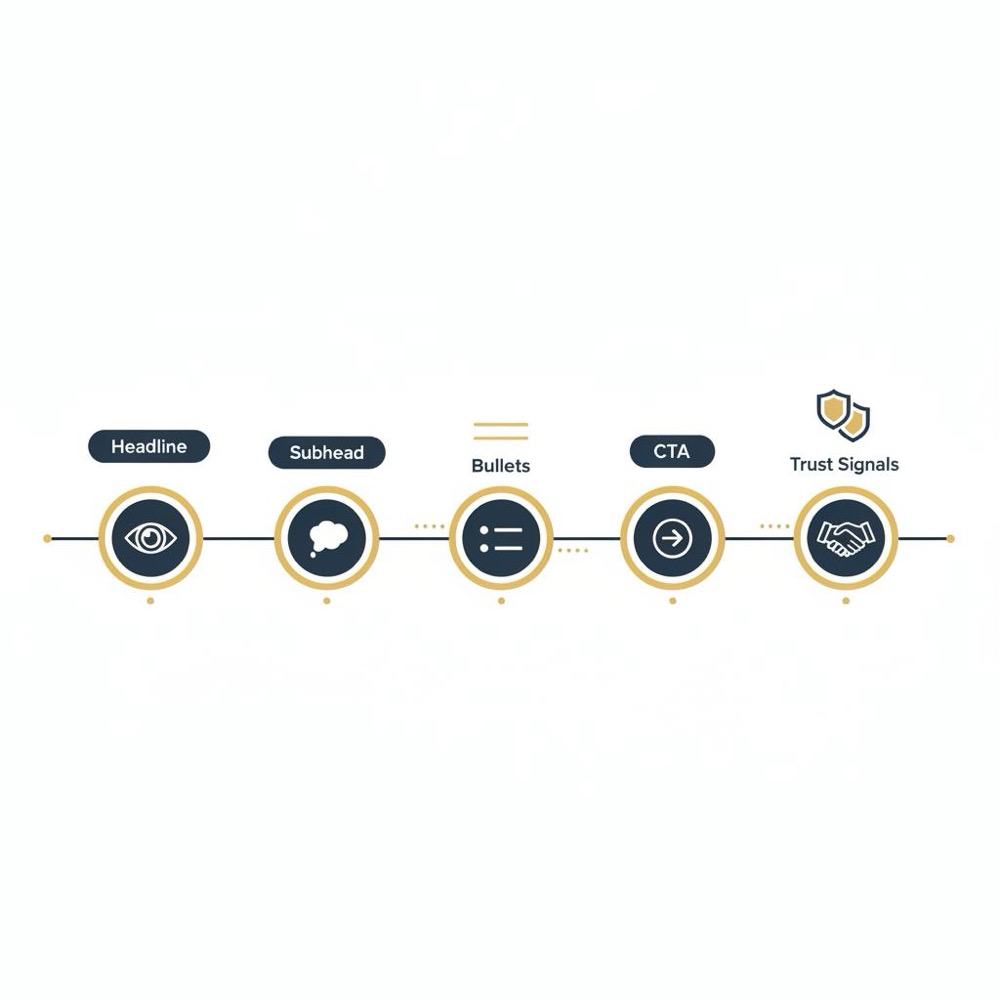
When you audit a page through the 80/20 rule copywriting lens, focus on five elements:

When you audit a page through the 80/20 rule copywriting lens, focus on five elements: a headline, a supportive subhead, a scannable above-the-fold opening, a primary CTA, and a few trust signals. A clear, consistent logo can act as a subtle trust cue.
1. Headline - first promise, first impression.
2. Hero subhead / primary value proposition - the short line that supports the headline.
3. Above-the-fold opening (first para or bullets) - what readers actually scan.
4. Primary CTA - the action you ask for and the reward you promise.
5. Trust signals - short proof that removes doubt (stats, logos, a tight quote).
How to rank those touchpoints
Rank each item by exposure (how many visitors see it) and expected impact (how likely a change is to move a metric). The 80/20 rule copywriting method says: work top-down on that ranked list. A headline every visitor sees usually beats polishing a testimonial three pages down.
Headlines: the highest-return copy
The headline is where the 80/20 rule copywriting returns quickest. A clear, specific benefit converts better than cleverness. Here’s the difference in practice.
Weak: “Comprehensive Accounting Tools for Your Business.”
Better: “Close Your Books Two Days Faster.”
Better still: “Close Your Books Two Days Faster - No Spreadsheets Required.”
Why the second and third are stronger: they answer the reader’s implicit question - what will I get? - and they make the benefit tangible. Use numbers and timeframe when possible; those details make the claim easy to evaluate.
Headline checklist (80/20 rule copywriting)
- State one clear benefit.
- Use a tangible metric or timeframe if you can.
- Avoid jargon and abstractions.
- Promise what you can prove with supporting copy or proof.
Subheads and above-the-fold: support the promise
Once your headline hooks attention, the subhead should land the claim. The 80/20 rule copywriting approach asks you to make that supporting sentence remove the biggest doubt. Keep it short and specific.
Example:
Headline: “Avoid Payroll Mistakes with One Click.”
Subhead: “Automated checks catch common errors and file corrected reports in minutes, not hours.”
The subhead answers: how does the product deliver, and why should I trust the headline? If the subhead raises new questions, rewrite it until it reduces doubt.

Calls-to-action: swap vagueness for intention
Vague CTAs are a common leak under the 80/20 rule copywriting microscope. Replace generic language with a promise that sets expectations and lowers anxiety.
Weak CTA: “Get Started.”
Better CTA: “Try a 14-Day Free Trial - No Card.”
Contextual CTA: “See Pricing for Teams of 5-50.”
Each better CTA says what happens next and what the visitor gets. It removes guesswork.
Examples and templates
Use these as starting points and then test. Templates speed ideation, but must be truthful. For more templates and swipe files see OptinMonster's list of 41 copywriting templates.
- “Try [Timeframe] Free - No Card.”
- “Get [Benefit] in [Time Period].”
- “See Plans for [Audience Size].”
- “Schedule a [Length]-Minute Walkthrough.”
Testing that follows the 80/20 rule copywriting
Testing should be simple and hypothesis-driven. The core rules:
- Change one element at a time.
- Keep metrics aligned to the touchpoint (CTR and bounce for headlines; CTA clicks and next-step conversion for CTAs; revenue per visitor for the business lens).
- Run tests long enough to cover natural traffic cycles (weekday/weekend) and reach credible thresholds for your traffic size.
Small tests are fast and clear. When teams focus on top-ranked items from their audits - headline, hero subhead, CTA - the largest measurable gains tend to appear. For frameworks and structure behind testing and copy, the copywriting frameworks guide is a helpful read.
Example A/B test
Original headline: “Join Our Community.”
Variation: “Get Practical Marketing Templates That Save 4 Hours a Week.”
Result: Signups rose in a week because the variation removed ambiguity and made the benefit explicit. That kind of test exemplifies the 80/20 rule copywriting payoff: clarity beats cleverness.
How to generate quick wins (step-by-step)
When time is short, follow this practical mini-process derived from the 80/20 rule copywriting mindset:
Step 1 - Pick one page. Choose the page with enough traffic to measure impact.
Step 2 - List top three touchpoints. Headline, subhead, CTA.
Step 3 - Write three variations for each touchpoint. Keep changes focused and testable.
Step 4 - Run isolated A/B tests for each touchpoint. One element at a time.
Step 5 - Promote winners and document learnings. Build a playbook of headline frames and CTA templates.
30-day cadence example
Week 1 - Audit and ideate. Create three headline variations, three subhead variations, and three CTA variations.
Week 2 - Launch A/B tests, one element at a time.
Week 3 - Analyze results; run a secondary round on winners.
Week 4 - Document and roll winners into other channels.
Channel differences - adapt the 80/20 rule copywriting
Context matters. The 80/20 rule copywriting is a lens, not a formula. Different channels reward different brevity and tone.
Paid search: Ultra-clear, tight match to query. Use short timeframe or metric when possible.
Email: Subject lines that promise a specific payoff and preview text that supports it.
Long-form landing pages: Headline still matters, but you can use narrative and layered proof below the fold.
Product pages: Tight headline + quick benefits, then detailed features for those who want depth.
Audience segments
Segment-level testing is high-value. First-time visitors, returning users, mobile visitors and paid-search visitors often respond differently. The 80/20 rule copywriting approach recommends tailored headlines and CTAs by segment - not a single universal line for everyone.
Built-in examples and concrete rewrites
Here are more real-world conversions of bland lines into high-leverage candidates that fit the 80/20 rule copywriting approach:
Blah: “We offer integrated team tools.”
80/20 rewrite: “Cut your team’s project handoffs in half.”
Blah: “Sign up for updates.”
80/20 rewrite: “Get 5 proven email templates for onboarding in your inbox now.”
Blah: “Contact sales.”
80/20 rewrite: “Schedule a 20-minute demo - we’ll show a real use case.”
Measurement tips and pitfalls
Measure both relative lift and absolute impact. A 10% lift on a low-traffic page may move fewer customers than a 2% lift on a high-traffic page. Align experiments with business outcomes like revenue per visitor as your metric when possible.
Avoid these traps:
- Changing too many variables at once.
- Chasing statistically insignificant lifts on tiny samples.
- Copying a winning line from a different channel without adaptation.
When tests are flat
Flat tests are useful. They show you where attention is wasted. If headline or CTA edits produce little change, either the page’s fundamental value proposition is weak or your audience needs a different message. Use qualitative feedback, session recordings, or quick user interviews to find the blockers.
Organizing wins so they compound
When a headline frame or CTA template proves effective, capture it in a simple repository. The 80/20 rule copywriting benefits multiply when you reuse and adapt winning frames across channels and pages. Build short playbooks: headline formulas, CTA templates, and the evidence behind them.
Example playbook entry:
Frame: “Save [Time] on [Task].”
Use cases: Accounting close, onboarding sequence, weekly reporting.
Evidence: +12% CTR on organic landing, +8% conversion in paid ads (tested Q1).
Operational rules to avoid over-polishing
Teams often polish low-leverage sections endlessly. Set rules: limit editing time on secondary sections to a fixed percentage, or use a 30-day cadence that prioritizes high-leverage touchpoints first. Treat long-form narrative as a later step after headline/subhead/CTA experiments are complete.
Practical copy templates and CTAs you can use
These short templates follow the 80/20 rule copywriting logic: clear benefit + timeframe or audience + low friction.
- “Start a 7-day free trial - import your first project today.”
- “See plans for small teams (1-10 people).”
- “Download the 5-step checklist to cut onboarding time.”
- “Try our demo: 20 minutes, real data.”
Real anecdote that proves the point
I once worked with a team where a single headline swap increased registrations significantly. Original: “Join Our Community.” Variation: “Get Practical Marketing Templates That Save 4 Hours a Week.” The page was unchanged otherwise and the test produced noticeable gains within seven days. That’s the 80/20 rule copywriting in action: a focused, specific promise beats a vague invitation.
Scaling the approach across an organization
To scale, centralize results and encourage reuse. Create short, shared documents where teams record headline frames, CTA language, audience notes, and channel-specific adjustments. Encourage hypotheses that are grounded in user questions and measurable outcomes.
Tools and process
Use any experiment tracker and a simple spreadsheet to record tests, results, and variations. Tag wins with channel and audience. Over time, the collection becomes a growth library and saves hours on creative ideation. For structured curriculum and templates you can adapt, consider Copywriting for Creatives.
Checklist for your next hour
If you have sixty minutes, apply the 80/20 rule copywriting method like this:
0-15 min: Pick a page and list the top three touchpoints.
15-40 min: Draft three headline options and two CTA alternatives.
40-60 min: Publish a test (or prepare test variations) and schedule a check in one week.
Common questions teams ask
Most teams worry about traffic, test length, and how many variations to try. The 80/20 rule copywriting strategy handles these by focusing on big-impact items, running minimal variations, and using qualitative feedback for low-traffic pages.
How to decide when to rewrite the whole page
If you’ve exhausted top-touchpoint experiments and see only marginal improvements, a deeper rewrite may be warranted. But the rewrite should start with the same principle: clarify the single, most compelling benefit and make the primary action explicit.
Final tips: language, proof, and honesty
Always use the language your audience uses. Be specific with proof. And be honest - promising something you can’t support kills long-term trust. The 80/20 rule copywriting is about focus, not magic.
Templates to steal (and adapt)
- “Get [Benefit] in [Timeframe] - [Low-friction qualifier].”
- “See pricing for [Audience segment].”
- “Start a [Timeframe] free trial - cancel any time.”
Bring the work together
Map your top pages, audit the high-exposure lines, run small, clean tests, and document winners. Over weeks and months those small edits compound into measurable business improvement. That’s the quiet power of the 80/20 rule copywriting approach.
Build a 30-Day Testing Cadence with Expert Support
Ready to build a repeatable testing cadence? Work with a team that helps you identify the high-leverage lines and systematize experiments - Explore Orvus services to set up a 30-day cadence and begin compounding small wins today.
Parting thought: spend your craft time on the few lines that truly matter, and let small edits do the heavy lifting.
You can often see measurable gains within days or weeks for high-traffic pages. Headline and CTA changes are the fastest wins. For low-traffic pages, combine small tests with qualitative feedback; the pattern is the same but the timeline can stretch longer.
Start with the headline, primary value subhead, and the main CTA - the three touchpoints that most visitors see first. Run isolated A/B tests for each element so you know which change produced the lift.
Yes. Orvus Ltd. can help set up a disciplined testing cadence, centralize experiments across channels, and document playbooks so winning headlines and CTAs compound. Their service focuses on architecture, measurement, and practical execution.
References
Want this kind of work done for your business?
We build and run AI-powered marketing and automation. 15 minutes, honest assessment.
Book a call