 Orvus
OrvusIs AI copywriting legal?
November 25, 2025
Is AI copywriting legal? A concise guide to risk, rules and practical controls
The question "Is AI copywriting legal?" sits at the intersection of technology, law and plain common sense. As you read this article you'll get a clear picture of the current legal landscape, practical steps marketing teams use today, how regulators are approaching AI-generated text, and easy-to-follow disclosure language you can start using immediately. The term AI copyright law appears throughout because it is the central issue companies must manage when deploying generative tools.
Generative models can speed ideation, but they also raise questions about ownership, training data and misleading claims. Below you'll find concrete controls, checklists and examples designed for marketers, counsel and content teams who want to move fast without creating legal exposure.
If you want tactical help putting these ideas into a reliable workflow - from vendor contracts to a documented editorial process - consider working with the team at Orvus services, who specialise in practical systems for growth and compliance.
Throughout this piece you'll see straightforward recommendations you can adopt in the next week, plus the longer-term signals from courts and regulators that will shape the next 12-24 months.

No - not every draft needs a label. Mark content when AI materially shaped the information that matters for a consumer decision (product claims, analysis, personalised recommendations). For internal ideation and heavily edited drafts the requirement is lower. When in doubt, short, honest disclosures reduce risk and build trust.
Why the answer isn't a simple yes or no
At first glance, the legal question seems simple: who owns the words a model produces? But the law is still updating and courts have started testing the boundaries. Two overlapping concerns make the issue complicated: first, whether training a model on copyrighted works violates copyright law; second, whether how you present AI-generated text to consumers risks being misleading under advertising and consumer-protection rules. Both are core parts of modern AI copyright law.
That uncertainty doesn't mean inaction. It means sensible controls: record-keeping, clear vendor contracts, human editorial input and honest disclosure. These reduce risk, protect reputation, and make it easier to respond if a dispute arises.
A shifting legal landscape
Across jurisdictions we see similar themes: courts and agencies are focused on provenance, human authorship, and transparency. In the United States, the Copyright Office guidance has been explicit: registrations for works that lack demonstrable human authorship will be rejected. The agency - and some early court decisions - make plain that a simple prompt is not the same as meaningful human creative input. In short, if your final text can be shown to reflect human choices, edits and expression, that strengthens claims of authorship and registrability.
At the same time, high-profile lawsuits allege that some large-language models were trained on copyrighted texts without permission. Those suits test whether large-scale ingestion for training is itself infringing, even when outputs are newly generated rather than copied verbatim. The outcomes of these cases will matter for vendors and customers alike, and they will shape commercial contracts and model choices (see the Copyright Office's Part 3 report).
Regulatory pressure: advertising rules and disclosure
Regulators are already acting where consumer protection is at stake. The Federal Trade Commission in the U.S. and the Advertising Standards Authority in the U.K. have signalled they will enforce against misleading claims that rely on AI inappropriately. The EU’s AI Act introduces transparency duties for certain generative outputs and requires providers to be more open about capabilities and limitations. Those rules do not criminalise routine use of generative copy, but they do require clarity about the role of AI in content that influences consumer decisions.
Practical controls teams use now
Most organisations have moved from a debate about whether to use generative models to a conversation about how to use them responsibly. Here are the operational steps that reduce legal exposure and help teams scale safely.
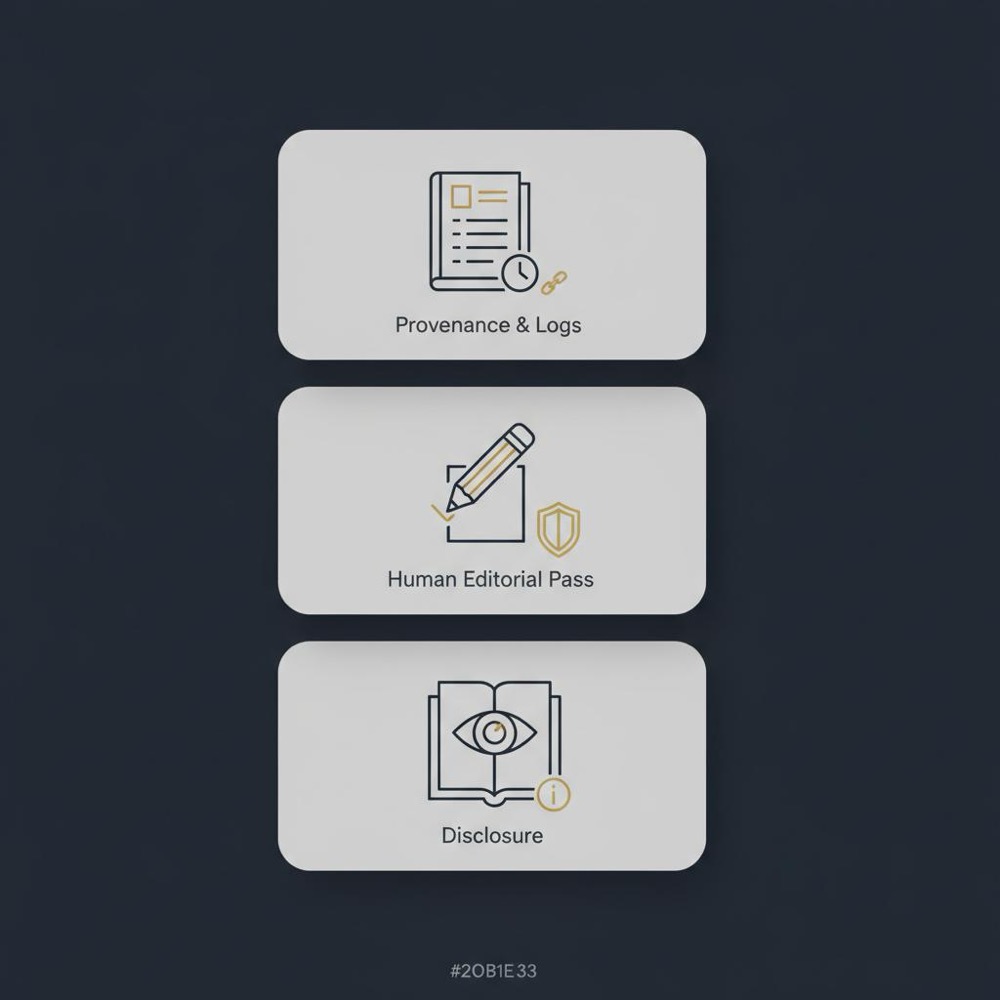
1. Keep detailed logs and provenance records
Document the prompt, model version, timestamp and any inputs or files used. These logs serve two purposes: they create an audit trail that can help defend a company if an allegation arises, and they let teams reproduce the path from idea to publication. In AI copyright law disputes, provenance evidence matters.
2. Contractual protections with vendors
Ask for clear representations about training data, the right to audit if feasible, and indemnities or limitations of liability that reflect real-world bargaining power. Not every vendor will offer a full indemnity - and indemnities are only as good as the vendor's resources - but contractual clarity shifts expectations and helps you manage risk.
3. Human editorial oversight
Human edits change the legal posture of a piece of copy. Editors and subject-matter experts should review outputs for style, tone and substance. The Copyright Office uses the concept of "meaningful human creative input"; a documented edit that reshapes expression is the clearest way to show such input existed.
4. Similarity, privacy and bias checks
Run outputs through similarity-detection tools against reference libraries to flag passages that are suspiciously close to known copyrighted texts. Screen for personal data or potentially defamatory statements. Include bias checks in your editorial workflow to catch stereotypes or unfair language patterns. These operational checks reduce litigation risk and protect brand trust.
5. Treat AI drafts as drafts
Many teams adopt a rule that AI outputs are "first drafts only". They require a named human reviewer who documents changes, signs off, and stores an edited copy linked to the original draft. This process provides a clear record of how human creativity shaped the final text and helps with both copyright registration questions and internal compliance.
How courts are framing the disputes
The central legal questions being litigated include whether training a model on copyrighted works is a stand-alone infringement, how close an output must be to an original work to be infringing, and how doctrines like fair use apply to the training process. Judges are wrestling with the fact that copyright law was designed for human authors, so they must translate doctrines like copying and transformation into a world where patterns are absorbed statistically rather than memorised as passages.
The metaphor many lawyers use is instructive: training a model is like giving a writer access to a vast library. But the model does not "remember" books the way a person does; it abstracts patterns. Courts will decide which legal rules apply to that abstraction. Until those decisions land, businesses must manage risk on the facts and through operational controls.
European nuance: the AI Act
The EU AI Act emphasises transparency and risk classification. It may not directly decide copyright disputes, but by requiring disclosures from providers and limiting certain risky systems, it changes market dynamics. Providers who can clearly show licensed provenance or mitigation steps will be more attractive to risk-averse customers.
A practical decision framework for marketing teams
When deciding whether and how to use generative text, follow a short, repeatable framework: risk, provenance, review, document. Below is a step-by-step guide you can use in a sign-off meeting.
Step 1: Assess the risk
Ask: what will the content claim? Who will see it? What harm could follow if it were wrong or unlawfully derived? High-risk content includes health or financial advice, high-profile campaign claims, or personalised guidance. Low-risk content includes early ideation and heavily edited product descriptions.
Step 2: Check provenance
Where did the model come from? Do you have contractual assurances about training data? Is the vendor transparent about provenance? If not, treat the output more cautiously and escalate review for sensitive use cases.
Step 3: Review and document edits
Create a requirement that each externally published piece contains a documented human edit. Save both the AI draft and the edited final with notes on what changed and why. This is practical evidence of human creative contribution under current AI copyright law guidance.
Step 4: Run content checks
Similarity scans, fact-checking, privacy reviews and bias checks should be standard for external communications. For high-impact material, involve legal or subject-matter experts.
Step 5: Decide on disclosure
If AI materially shaped content in a way that would matter to a consumer, disclose it. A short, honest note - for example, "Draft assisted by AI and reviewed by our editor" - is sufficient for many contexts and aligns with regulatory expectations.
How and when to disclose AI usage
Disclosure is about truthfulness and context. Where regulators require transparency, follow the rules. Where they don't, use common sense: if the AI input affects a consumer decision or sits behind a claim, disclose it. Below are example phrases you can adapt.
Short disclosure (social post)
"Draft assisted by AI and edited by our team." This is simple, transparent, and works for many social and promotional contexts.
Moderate disclosure (product claim)
"This description was generated with AI assistance and reviewed by an editor to ensure accuracy and compliance." Use this when the content supports purchase decisions or asserts product features.
Full disclosure (analysis or personalised content)
"This report was produced using a generative model trained on licensed and public datasets; it was reviewed and validated by our analysts. For questions, contact our team." This level is appropriate when consumers rely on the output for important choices.
Handling third-party materials and training data
Training provenance is the most technically and legally complicated issue. If a model's training set is opaque, treat outputs as potentially risky for reproducing or echoing copyrighted content. Prefer vendors that can document licensed data or use curated corpora. When contracting, ask for representations about training material and, where possible, a right to audit or inspect provenance statements.
Contract sample language (illustrative)
Below are examples teams often adapt - speak with counsel before using them in live contracts.
Representation: "Vendor represents that, to the best of its knowledge, the model was not trained on datasets that include infringing third-party copyrighted works, and Vendor has obtained all necessary licences for material used to train the model."
Right to audit: "Customer may request a written summary of the training data categories and, subject to confidentiality, may audit Vendor's provenance statements for the model used to deliver services."
Indemnity (limited): "Vendor agrees to defend and indemnify Customer for third-party claims that Customer's use of the supplied model, as authorised by the agreement, directly infringes the claimant's copyright, subject to Vendor's liability caps."
Defamation, privacy and bias - not just copyright
Legal risk extends beyond copyright. Models can invent quotes, repeat falsehoods, or surface personal data. Editorial workflows must include:
Fact-checking of any assertions or quotes.
Privacy screening to ensure no personal data is exposed.
Bias review to catch stereotyped or harmful language.
These controls protect both consumers and brand reputation. They are also often cheaper and faster than legal remediation later.
When to pause and when to proceed
Pause or use greater caution for:
Medical, legal or financial advice.
High-profile marketing claims and campaigns.
Personalised content that uses private or sensitive data.
Proceed more freely for internal ideation, neutral product copy that will be edited heavily, and iterative drafting where human authorship is obvious.
Real-world process example: the "two-pass" rule
One agency workflow that works well in practice is the "two-pass" rule: first, a creative pass by a writer who reshapes tone and structure; second, a legal/quality pass that checks for copyright, defamation and privacy. The agency keeps logs of both passes and links the final copy to the initial AI draft. This simple procedural choice both reduces risk and keeps the creative speed benefits of models.
How Orvus and similar firms implement safeguards

Organisations like Orvus tend to favour pragmatic, systems-focused solutions: documented vendor agreements, named editors who sign off, and clear rules for which content classes may use opaque models versus curated ones. These small design choices make compliance manageable without blocking innovation. A clear visual identity, such as the Orvus Ltd. Logo, can help with internal adoption.
What courts will decide next
Key unresolved questions include how courts treat large-scale ingestion of copyrighted works for training and whether outputs that resemble originals are infringing when they are newly generated. Judges will also decide the scope of fair use (or equivalent doctrines elsewhere) for model training. These decisions will affect model licensing, vendor liability and the attractiveness of different providers to commercial customers.
Market implications
If courts or regulators demand provenance and transparency, vendors that can show licensed datasets or provide strong indemnities will become more commercially valuable. That dynamic will encourage a market shift toward licensed-model offerings and away from opaque scraping-based models.
Sample in-house checklist for an AI-assisted campaign
Use this checklist before publishing any AI-assisted marketing copy:
Document model name, version and timestamp.
Save the original AI draft and every edited version.
Run similarity checks against a reference corpus.
Fact-check claims and verify quotes.
Screen for personal data and privacy concerns.
Have a named editor and, for high-risk items, a legal sign-off.
Add a concise disclosure statement where material.
Disclosure language: quick examples you can borrow
Keep disclosure short and honest. Here are three variants you can adapt:
Social post: "Draft assisted by AI and edited by our team."
Product page: "This description was generated with AI assistance and reviewed by our editor to ensure accuracy."
Analysis/report: "Generated with a model trained on licensed and public data; reviewed by our analyst team."
Vendor negotiation tips
When negotiating with vendors, prioritise these items: clarity on training data, a written provenance statement, contractual representations, and a realistic indemnity if possible. Also consider operational controls such as an agreed-upon model version freeze or a notification if the vendor changes training procedures.
Stories from the field
Practical experience matters. One small creative agency used AI for rapid ideation but enforced a strict two-pass rule. An AI line echoing a lyric slipped past the first pass and the legal reviewer recommended a rewrite. The rewrite avoided a potential takedown and kept the campaign on schedule. Simple, repeatable rules like that save time and trouble.
What we still don’t know - and how to plan for it
There are open questions with meaningful uncertainty: how courts will interpret training ingestion, whether cross-border publication will trigger different disclosure duties, and whether legislatures will create specific licensing regimes for training data. Plan for flexibility: document processes now so you can adapt quickly as rules change.
Common misconceptions
Misconception: A short prompt makes the content "ours."
Reality: A prompt alone rarely creates enough human creative input to secure authorship. Editorial changes that shape tone, structure and expression are what matter.
Misconception: An indemnity from the vendor eliminates risk.
Reality: Indemnities help but depend on vendor solvency and specific contract terms. They don't remove the need for internal controls.
Final pragmatic advice
Use models where they add value, keep records, design a human-in-the-loop editorial process, and be honest with consumers. These steps let you capture the benefits of generative text while keeping legal exposure manageable.
Main question many teams ask - and a friendly answer
The most common practical question is whether a team must label every piece of copy that touches a model. The short answer: label when the AI materially shaped content in a way that matters to decisions. For low-impact drafts and early brainstorming this is unnecessary; for product claims or analytical output, a clear note about AI assistance is wise.
Next steps you can take this week
Start small. Identify your three most sensitive content streams, document who signs off on final copy, and create a log policy for model versions and prompts. Those three moves will dramatically reduce your immediate risk. See practical guides on our blog for templates and examples.
Build safe, fast AI writing systems with Orvus
Need help turning these practices into a repeatable system? Orvus builds quiet, reliable workflows that fit your team's constraints. Explore Orvus services for help with vendor contracts, editorial flows and automation that keep creative velocity without adding risk.
Closing notes
AI-generated text does not have to be a legal minefield. With clear provenance, documented human edits and honest disclosure, teams can use these tools responsibly. Keep the controls proportionate to the risk and update processes as court rulings and regulation clarify the law.
In many jurisdictions, pure machine-generated works without demonstrable human authorship are not eligible for copyright registration. Where humans make meaningful creative contributions-editing, rearranging structure, choosing expression-registration may be available. The key is to document those human choices, keep draft records, and save the editor's notes so you can show meaningful human input if needed.
Not always. Disclosure is most important when AI materially shaped content that influences consumer decisions-product claims, analysis, personalised recommendations, or any high-impact messaging. For casual ideation or heavily edited drafts the need is lower. When in doubt, short, honest disclosures such as "Draft assisted by AI and edited by our team" reduce reputational and regulatory risk.
A vendor indemnity can shift financial risk for third-party claims back to the vendor, but it is not a complete solution. Indemnities depend on the vendor’s solvency and the contract's specific limits and exclusions. They don’t replace operational controls like provenance logs, human editorial review, and similarity checking. Use indemnities as one layer in a multi-layered risk-management approach.
References
Want this kind of work done for your business?
We build and run AI-powered marketing and automation. 15 minutes, honest assessment.
Book a call