 Orvus
OrvusWhat are the 3 C's of SEO?
November 25, 2025
What are the 3 C's of SEO? If you want a straightforward, practical framework that fits everything that matters for search visibility, you’ll appreciate the clear trio: Content, Code, and Credibility. The phrase 3 C's of SEO helps teams remember what to check: the words and usefulness on the page, the technical foundation that makes pages findable, and the signals that prove your site matters.
The 3 C's of SEO: a short orientation
In everyday terms, the 3 C's of SEO are a simple map. Content answers user intent and demonstrates experience and expertise. Code makes sure search engines can find, render, and evaluate that content. Credibility is the external proof-links, citations and brand presence-that tells the web your content is worth attention. Keep these three lenses visible whenever you plan work, and you’ll avoid the classic silo mistakes.
Why the 3 C's of SEO still matter in 2024-2025
Search engines keep changing, but they still reward pages that are useful, accessible, and trustworthy. The 3 C's of SEO combine those ideas into an action plan you can use every week: create helpful content, keep the technical base solid, and earn credible mentions. This article walks through practical checks, KPIs, tooling, and a repeatable workflow so you can act without chasing every shiny tactic.
How to read this guide
Each section below pairs a principle with quick audits and small templates you can copy into editorial or engineering tasks. Expect examples, short experiments, and clear next steps rather than abstract theory.

If you want a compact, practical diagnostic and tactical plan, consider exploring Orvus services. For a focused systems approach that ties search work directly to growth outcomes, check out Orvus’ compact consulting and implementation offerings at Orvus services. That link leads to a clear description of how Orvus partners with teams to turn audits into steady gains without unnecessary noise.
Content: what good content looks like now
Content remains the foundation of organic performance. When you think about the 3 C's of SEO, start here: useful, original content is the floor, not the ceiling. But useful has layers. At a minimum, content must satisfy intent-answer the real user question early and clearly. It should also show E‑E‑A‑T: Experience, Expertise, Authoritativeness, and Trustworthiness. First-person accounts, clear author bylines, citations, and concrete examples boost real-world credibility.
Practical checks for content:
- Intent match: Does the page give the primary answer within the first 1-2 paragraphs?
- Originality: Does the page add a unique example, data point, or angle?
- Depth: Is the coverage appropriate for the query-overview for beginners, deep-dive for advanced queries?
- Trust signals: Author bio, update date, citations, and clear editorial notes.
Small content templates you can use
Title template: [Target query] - [Benefit or outcome] | [Brand]
Meta template: One-sentence answer + one-sentence unique value + call to action.
Code: the technical layer that controls access and experience
Technical SEO is the plumbing that lets content do its job. When you audit the 3 C's of SEO, check whether crawlability, rendering, indexing, and page experience are intact. Mobile-first indexing means the mobile version is primary, so prioritize mobile rendering, Core Web Vitals, and structured data that reflects the visible content.
Technical checklist
- Robots and indexing: ensure important pages are crawlable and not blocked by robots.txt or noindex.
- Canonical rules: remove contradictory canonical tags that create duplicate content signals.
- Crawl budget: avoid wasting a crawl on thousands of low-value parameter or filter pages.
- Structured data: add schema where it clarifies content type (articles, products, events) and matches visible content.
- Core Web Vitals: measure LCP, INP (or FID where relevant), and CLS and prioritize the biggest wins.
Tools and how to use them
Start with Search Console for impressions, clicks, and coverage issues. Use a site crawler to find redirect chains, orphan pages, and duplicate titles. For performance, combine field (RUM) data with lab tools to reproduce slow scenarios and test fixes quickly. Logs and analytics reveal crawl behavior and unexpected robot traffic. For practical, prescriptive checklists and deeper reads see the 18-step SEO audit checklist, an SEO optimization checklist, and a technical SEO audit checklist.
Yes-treated as three ongoing lenses (not a one-off checklist), the 3 C's of SEO guide teams to focus on content that satisfies intent, technical foundations that allow discovery and good experience, and credibility that earns attention. They simplify prioritization and keep cross-functional teams aligned.
Credibility: links, mentions, and signals that matter
Credibility is the third leg of the 3 C's of SEO. Link profiles remain important, but quality matters much more than raw quantity. Editorially earned links from topically relevant domains signal trust and topical authority. Look for natural mentions in niche publications, industry directories, and professional communities.
What to measure for credibility
- Referring domains (quality, topical relevance, diversity).
- Anchor text diversity and natural patterns.
- Rate of acquisition-sudden, inorganic spikes can trigger scrutiny.
- Brand mentions and citations in places that matter: industry press, authoritative directories, and local listings.
KPI set that connects the 3 pillars
Measure signals that connect to real user intent and business outcomes rather than vanity counts. Useful KPIs include organic impressions, clicks, CTR for target queries, rankings for priority terms, Core Web Vitals for page experience, crawl and index coverage for technical health, and referring-domain quality for credibility. Finally, tie page-level revenue or conversion to organic visits so you can see impact.
How to prioritize metrics
Sort issues by expected impact and effort. A page with high impressions and low CTR often needs a headline/meta refresh. A high-value page with poor Core Web Vitals needs engineering effort. Credibility gaps are usually mid- to long-term investments in outreach or content formats that attract links.
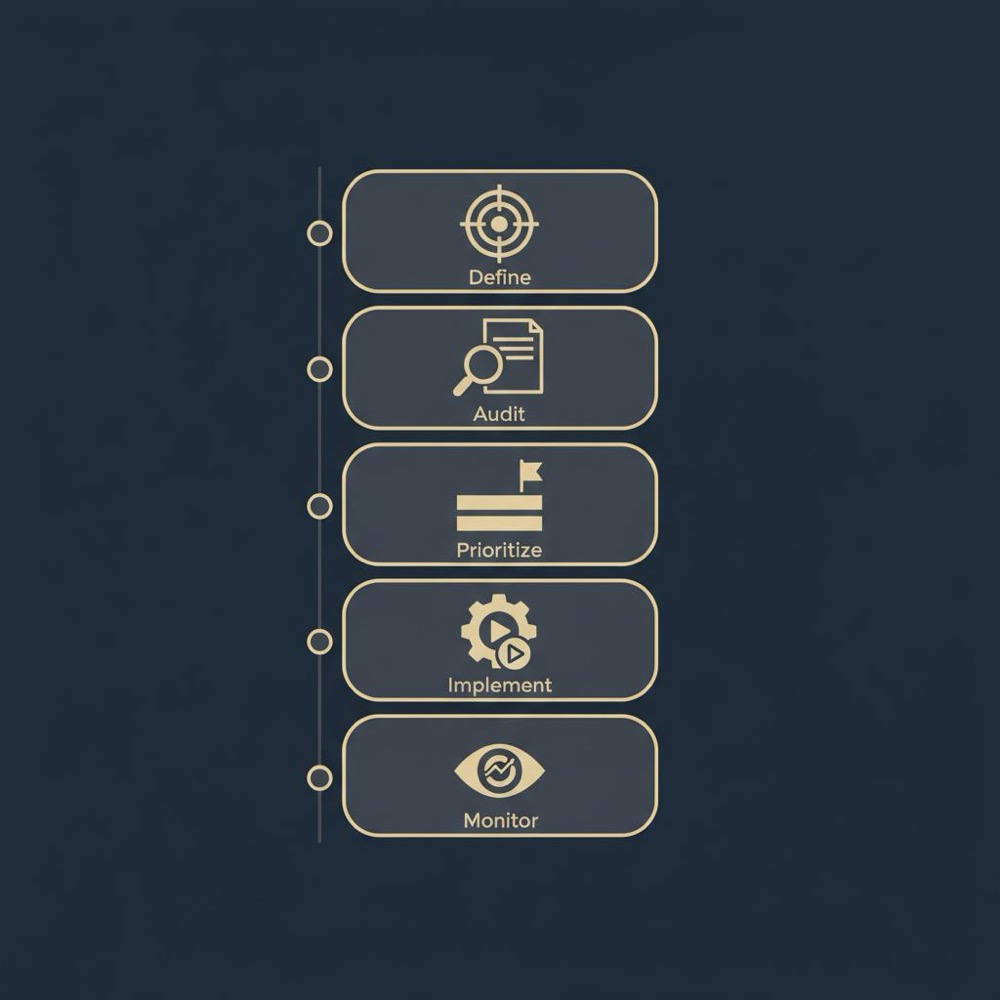
A compact 5-7 step workflow
To avoid endless to-dos, use a repeatable workflow. Here is a concise pattern that teams can run weekly or monthly for a set of pages:
- Define target queries and outcomes: what business metric will these pages support?
- Combined audit: content review + technical check + credibility snapshot.
- Prioritize: impact vs effort-what moves the needle fastest?
- Implement: assign owners, set timelines, and make changes.
- Monitor: watch KPIs and give a clean window for changes to settle.
Optional: test changes on a sample before full rollout and run targeted link-earning for pages already showing traction.
Common failure modes to watch for
The fastest way to find value is to know the usual errors: thin or templated content, indexing mistakes, broken structured data, slow mobile pages, spammy inbound links, or poor internal linking. Group these into quick wins, medium fixes, and strategic investments and run a focused sprint.
Practical examples and templates
Headline experiment: pick a page ranking in the low top-ten. Rewrite the headline to answer the user’s question (not to sell) and track impressions and CTR for four weeks. Meta description: one sentence that answers + one sentence that communicates unique value (study, tool, or step-by-step guide) + a soft CTA. Internal linking: add context-rich links from authoritative pages to new content using descriptive anchor text.
Trends you should plan for in 2024-2025
Three notable trends shape how you apply the 3 C's of SEO:
- AI-generated content scrutiny: Use generative models as drafting tools, then add human experience, verification, and transparency.
- Page experience matters: Core Web Vitals influence engagement and indirectly affect visibility.
- Quality link earning: Data reports, useful tools, and partnerships beat mass outreach.
Open questions practitioners are watching
How will automated content signals be weighted in future updates? Will privacy changes reduce visibility into referral sources and push teams toward stronger first-party analytics? These are live debates, and the best defense is a robust process that balances human experience, solid technical foundations, and genuine outreach.

How Orvus Ltd. uses the framework Orvus adopts the 3 C's of SEO as a planning shorthand because it maps to real work: content alignment, crawlable architecture, and earned credibility. When teams are constrained, Orvus helps pick the highest-leverage fixes so the compound effects actually show up in traffic and revenue.
Final tactics you can apply this week
1) Pick a high-impression page and rewrite the headline and meta; 2) Run a quick mobile render check and fix blocking resources; 3) Identify one authoritative site you can reasonably approach for a contextual mention or citation.
A short case reflection I worked with a small publisher using syndicated content and broad tag pages. We rebuilt core pages to match intent, added author bios, fixed indexing, and earned a handful of thoughtful mentions. The result was gradual but steady: better impressions, higher CTRs, and more recurring readers. When the 3 C's of SEO were aligned, the site’s performance became more predictable.
How to run a quick triage audit now
Spend an hour on a single URL set and ask three questions: Does the content satisfy intent? Can search engines access and render the page? Does the page have credible external signals? For each failure, pick one immediate fix and one medium-term project.
Sample triage checklist
- Content: answer visibility, evidence of experience, author signal.
- Code: indexing, canonical tags, mobile rendering, Core Web Vitals.
- Credibility: referring domains, anchor text, brand mentions.
Practical pitfalls and how to avoid them
Avoid buying shortcuts: purchased links, mass content that repeats the same thin ideas, and organizational silos. Instead, create a shared checklist, schedule regular cross-functional reviews, and build small automations that keep the work visible without adding friction.
Further reading and templates
If you want a single-sheet checklist or a template pack for audits, reach out or adapt the simple templates in this article for your editorial and engineering processes. These small tools keep the human element visible while you scale. See the Orvus blog for more practical posts and templates.
Turn your SEO audit into steady growth
Ready to turn audits into steady growth? If you want a short diagnostic and a clear plan for moving forward, Orvus helps teams find the highest-leverage moves and make them stick. Learn more about hands-on services and compact growth systems at Orvus services.
Closing thought
The 3 C's of SEO are not a one-time checklist but a set of lenses you return to. Keep content useful, code reliable, and credibility earned-and you’ll see real, sustainable results.
The 3 C's of SEO are Content, Code, and Credibility. Content addresses user intent and demonstrates experience and expertise; Code ensures pages are crawlable, indexable, and fast; Credibility signals-like high-quality backlinks and brand mentions-show search engines that your pages deserve attention. Together they form a balanced approach that prevents siloed work and produces steady, sustainable organic growth.
Start with a quick triage: (1) Content-does the page answer the primary query early and show author or experience signals? (2) Code-can search engines crawl and render the page; are Core Web Vitals acceptable? (3) Credibility-does the page have quality referring domains or brand mentions? For each failure, assign one immediate fix (headline, noindex removal, or outreach) and one medium-term project (content refresh, front-end performance work, or a link-earning campaign).
Yes. Orvus works with a small number of brands to design compact, measurable growth systems that align content, technical architecture, and credibility-building. If you'd like a focused diagnostic and tactical roadmap, Orvus’ services are described at orvus.net/services/ and can be tailored to your goals.
References
Want this kind of work done for your business?
We build and run AI-powered marketing and automation. 15 minutes, honest assessment.
Book a call