 Orvus
OrvusWhat is website optimization? A systems approach
January 30, 2026
This article explains how to map your site to a three-pillar framework, run practical diagnostics, and build a 30 to 90 day roadmap. It also covers decision criteria for when to hire specialised services and common pitfalls to avoid.
What website optimization covers, definition and context (website optimization services)
Website optimization services refer to a systems-level programme that combines three distinct but related disciplines: technical performance, on-page SEO or search architecture, and UX-driven conversion rate optimisation. Framing optimisation this way helps teams measure and prioritise work against business outcomes instead of chasing isolated metrics, which aligns with broader industry measurement projects that map common web patterns.
Each discipline requires its own diagnostics and success metrics. Technical performance is measured with user-centred metrics, content work is prioritised by intent and revenue potential, and UX work is evaluated by funnel outcomes and conversion signals. When these strands are coordinated, the output is a single, prioritised optimisation roadmap that links site changes to business goals Web Almanac 2024.
Check for gaps in end-to-end measurement, persistent page speed issues, or recurring user friction in key funnels; these are common indicators that a structured optimisation programme can help.
Is my site a candidate for optimisation work? Use a quick self-assessment: do you have incomplete end-to-end measurement, persistent page speed problems, or recurring user friction in key flows? If yes, the site will likely benefit from a structured optimisation programme that separates quick wins from platform work.
The three-pillar framework for website optimization
Practitioners commonly use a three-pillar framework to map tasks and responsibilities. The pillars are technical performance, search and content architecture, and UX and conversion optimisation. Keeping these areas distinct makes it easier to set appropriate metrics and ownership.

Technical performance focuses on how fast and stable pages load for real users. Search and content architecture focuses on intent alignment, templates, and structured data. UX and conversion optimisation focuses on reducing friction in funnels and improving task completion rates. This separation supports repeatable 30 to 90 day prioritisation plans and clearer workflows for teams and vendors Core Web Vitals.
Tools and responsibilities also differ. Engineering or platform teams usually lead technical changes, content teams or SEO owners lead content architecture, and product or UX teams lead conversion work. A coherent plan makes the handoffs explicit and limits work overlap.
Technical performance deep dive: diagnostics and common fixes
Core Web Vitals provide a shared diagnostic language for perceived performance, covering metrics such as Largest Contentful Paint, Cumulative Layout Shift, and interaction latency. Understanding these metrics helps teams prioritise what to fix first and why it matters for users and funnels Core Web Vitals.
Automated tools are the starting point for audits. Audits and tools like Lighthouse and PageSpeed Insights produce repeatable scans and suggested improvements. Teams often use these tools to create an initial findings list and to track progress across releases PageSpeed Insights and Lighthouse Documentation.
compact performance audit checklist for first pass
Use as initial diagnostic only
Quick wins frequently include image optimisation, proper caching, and fixing form errors that block user tasks. These fixes are often schedulable within a few sprints. By contrast, systemic issues such as inefficient rendering paths, legacy front-end frameworks, or fragmented build pipelines are platform-level work and count as technical debt.
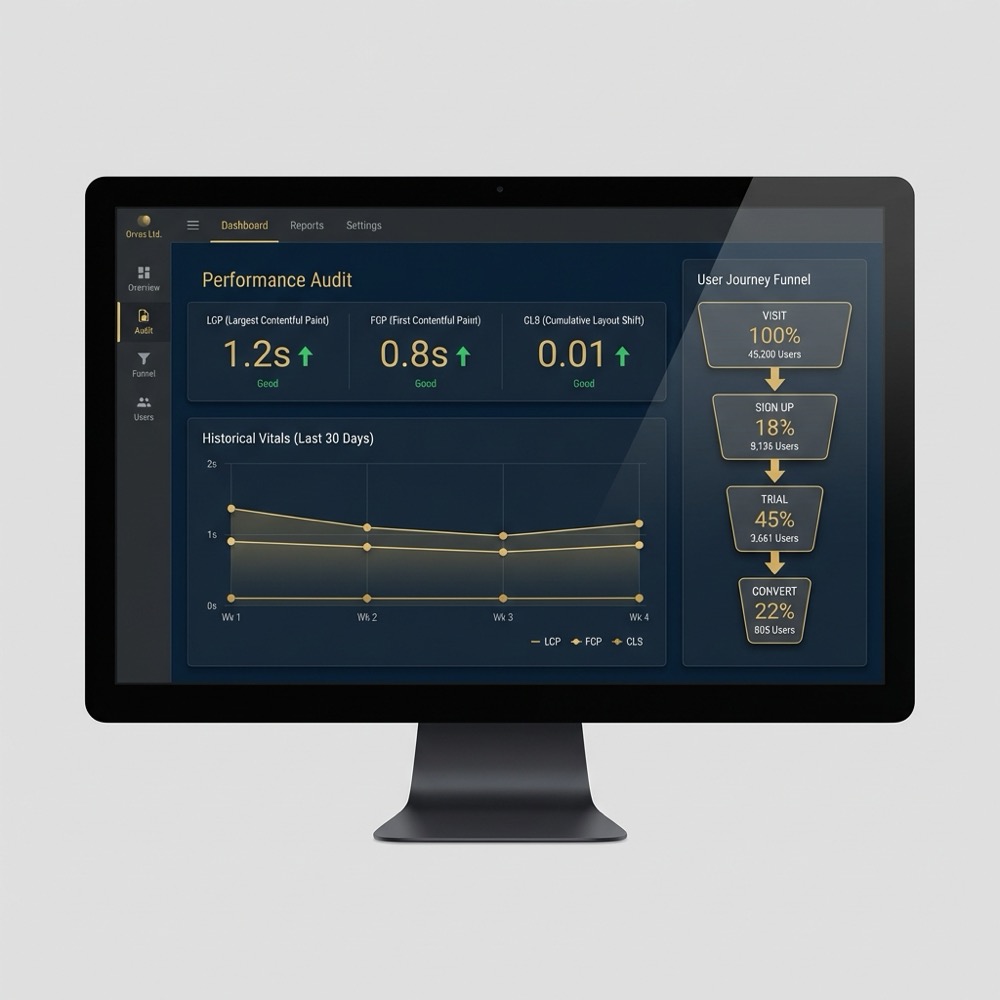
When planning fixes, separate items by effort and risk. Aim to deliver measurable wins early, then schedule higher-effort platform work into a 30 to 90 day roadmap that aligns with release cycles and resource constraints.
Search architecture and on-page SEO: intent, templates, and measurement
Search architecture treats on-page SEO as intentional design. It uses intent-driven content templates, structured data, and clear content models to ensure pages match user queries and funnel intent. Good search architecture reduces duplicated effort and makes scaling content more predictable Web Almanac 2024.
Prioritisation for content work should consider intent, traffic potential, and revenue attribution. Not every page needs the same level of effort. Focus first on templates that serve high-intent cohorts or pages that sit near conversion funnels.
Structured data can surface content to downstream systems and support measurement that ties organic sessions to commercial events. The real aim is to link search signals to revenue outcomes, not to optimise solely for position metrics.
UX and conversion rate optimisation: research, funnels, and reliable fixes
Usability research shows that reducing friction often produces reliable conversion improvements. Common friction points include checkout errors, confusing form flows, and unclear calls to action. Addressing these issues usually improves task completion and conversion metrics in predictable ways Nielsen Norman Group overview.
Funnel-based hypotheses are practical for small teams. Define the key task, identify where users drop off, and test a single hypothesis at a time. Simple A/B tests or session recordings can validate whether a change meaningfully affects the funnel.

When usability fixes are straightforward and tied to funnel bottlenecks, they often take priority over content experiments. This is especially true when conversion gains are directly linked to measurable revenue events.
Practical audits and a 30-90 day optimisation roadmap

The audit sequence commonly looks like this: run automated scans to collect repeatable data, perform walkthroughs of key funnels to find friction, and map findings to business metrics. The output is a ranked list of quick wins and platform work with estimated effort and impact.
Quick wins, such as image compression, improved caching headers, and fixing blocking form errors, are often scheduled in the first 30 days. Platform work, including refactors or build pipeline changes, typically falls into the 30 to 90 day window when teams align releases and allocate engineering time.
Start a compact diagnostic or request consultation on the services page
Run a compact diagnostic or download a one-page audit template to clarify the highest priority fixes your team can deliver in the next 30 days.
When presenting a roadmap, show effort versus impact and be explicit about data gaps. If revenue attribution is incomplete, note the assumptions and propose small instrumentation changes to improve future decisions.
Decision criteria: when to hire specialised website optimisation services
Certain signals point to a need for external specialists. Common signals include extensive technical debt, fragmented or missing end-to-end measurement, and the need to build repeatable systems for search architecture and automation. These indicators often suggest the work goes beyond single-ticket fixes Make the Web Faster guidance.
Specialised services typically help design systems, not just deliver one-off fixes. They can produce compact diagnostics, set up repeatable reporting, and help translate technical work into prioritised business outcomes. For teams with internal capacity, short diagnostics can be used to build internal workflows and dashboards instead.
When scoping external help, favour fixed-scope diagnostics or 30 to 90 day engagements that produce a clear, prioritised plan. This keeps work focused and reduces open-ended resource commitments.
Common mistakes and troubleshooting in optimisation projects
One frequent error is over-focusing on single metrics, such as chasing ranking positions or only targeting synthetic speed numbers, without linking changes back to revenue or task completion. This narrows decision making and can waste resources Web Almanac 2024.
Another common problem is treating content and technical work as one-off tasks. Without repeatable templates and ownership, improvements degrade over time. Establishing content templates and handoff processes reduces this risk.
Fragmented reporting hides issues. If analytics, server logs, and search consoles are not stitched together, teams will miss attribution gaps. Practical troubleshooting includes validating event instrumentation, reconciling data sources, and running small calibration tests to confirm measurement quality.
Practical examples and scenarios (non-identifying, illustrative)
Example 1, ecommerce: a store had slow product pages and high dropouts on mobile. The audit combined Lighthouse scans with transaction-level data and found large images and an unoptimised render path. The 30 day plan focused on image optimisation and caching. The 30 to 90 day plan scheduled a front-end refactor aligned to release cycles.
Example 2, service site: a professional services site had unclear content templates and inconsistent internal linking. A content architecture review produced intent-driven templates and a reworked taxonomy, prioritised by pages closest to contact conversions.
Example 3, small team: a two-person marketing and engineering team built a repeatable audit dashboard that combined automated Lighthouse runs with a spreadsheet that mapped issues to revenue signals. They used the dashboard to track quick wins and to justify platform refactor time during planning.
Wrap-up: realistic next steps and how to use optimisation work as a system
First 30 day checklist: run automated performance scans, fix clear form and image issues, validate key conversion events, and document high-cost platform items. This creates momentum and clarifies what requires larger investment.
Optimisation compounds when teams build repeatable workflows: consistent scans, content templates, and dashboards make it easier to prioritise new work and to measure impact over time. Revisit priorities when funnel changes, data quality issues, or strategic shifts occur.
Remember that next steps depend on your funnel, data quality, and team constraints. Use the framework here to turn ad hoc fixes into a systems-level programme that supports measurement and compound improvement.
They are structured programmes that combine technical performance, on-page search architecture, and UX-focused conversion improvements into measurable workflows.
Teams commonly use a 30 to 90 day roadmap to deliver quick wins and schedule platform work, with ongoing cycles for measurement and iteration.
Consider specialised help if you have extensive technical debt, fragmented measurement, or need repeatable systems for search architecture and automation.
The best next steps depend on your funnel, data quality, and team constraints, so use the framework here to prioritise what matters most.
References
- https://almanac.httparchive.org/en/2024/
- https://developers.google.com/speed/pagespeed/insights/
- https://web.dev/fast/
- our services
- our knowledge base
- about Orvus
- https://web.dev/case-studies/vitals-business-impact
- https://searchengineland.com/guide/core-web-vitals
- https://developers.google.com/search/docs/appearance/core-web-vitals
Want this kind of work done for your business?
We build and run AI-powered marketing and automation. 15 minutes, honest assessment.
Book a call